• About Us
    • What Is Street Harassment?
    • Why Stopping Street Harassment Matters
    • Meet the Team
      • Board of Directors
      • Past Board Members
    • In The Media
  • Our Work
    • National Street Harassment Hotline
    • International Anti-Street Harassment Week
    • Blog Correspondents
      • Past SSH Correspondents
    • Safe Public Spaces Mentoring Program
    • Publications
    • National Studies
    • Campaigns against Companies
    • Washington, D.C. Activism
  • Our Books
  • Donate
  • Store

Stop Street Harassment

Making Public Spaces Safe and Welcoming

  • Facebook
  • Instagram
  • Pinterest
  • Tumblr
  • Twitter
  • YouTube
  • Home
  • Blog
    • Harassment Stories
    • Blog Correspondents
    • Street Respect Stories
  • Help & Advice
    • National Street Harassment Hotline
    • Dealing With Harassers
      • Assertive Responses
      • Reporting Harassers
      • Bystander Responses
      • Creative Responses
    • What to Do Before or After Harassment
    • Street Harassment and the Law
  • Resources
    • Definitions
    • Statistics
    • Articles & Books
    • Anti-Harassment Groups & Campaigns
    • Male Allies
      • Educating Boys & Men
      • How to Talk to Women
      • Bystander Tips
    • Video Clips
    • Images & Flyers
  • Take Community Action
  • Contact

Archives for October 2011

Snapshot of street harassment stories, news & tweets: October 16, 2011

October 17, 2011 By HKearl

(Better a day late than not at all, right? 🙂

Read stories, news articles, blog posts, and tweets about street harassment from the past week and find relevant announcements and upcoming street harassment events.

** Sign up to receive a monthly e-newsletter from Stop Street Harassment ***

Street Harassment Stories:

Share your story! You can read new street harassment stories on the Web from the past week at:

Stop Street Harassment Blog | “Street Respect” stories

HarassMap

Hollaback

Hollaback Berlin

Hollaback Birmingham

Hollaback Chandigarh

Holla Back DC!

Hollaback Israel

Hollaback NYC

Hollaback Philly

Hollaback West Yorkshire

From XO Jane

In the News, on the Blogs:

* Spartan Daily, “Catcalling should not be acceptable in our society“

* Coffee Talk, “Police advise girls not to wear school uniform skirts on public transit“

* xo Jane, “It Happened to Me: I Was Groped“

* ABC 7, “Victor McEachin charged with stabbing Metro bus driver“

* The Guardian, “Guatemalan women hail single-sex buses“

* Al Arabiya News, “Moroccan activists launch campaign against sexual harassment“

* The Times of India, “Bikers slash girl for protesting eve-teasing“

* Ses Turkiye, “Turkish women organise against harassment“

* The Financial Express, “Unbearable rise in ‘Eve teasing’“

* Reuters, “”Fight Back” phone app to protect women in India“

* The Good Men Project, “Men May Never Truly Understand a Day in the Life of Women. But Shouldn’t We Try“

* Jezebel, “Girls Told To Stop Wearing School Uniform Skirts To Ward Off Perv“

Announcements:

New:

* Donate to Students Active for Ending Rape so they can mentor and teach students to advocate for safer campuses!

* If you’re in London, help a Ph.D. student out with her dissertation research by meeting to share your street harassment stories.

Reminders:

* Two weeks ago Stop Street Harassment launched a new weekly “Street Respect” series highlighting the type of stories we want to see instead of street harassment stories!

* Call for men to share views/stories about street harassment

* Sign Mend the Gap’s petition to address subway harassment in Delhi, India

* Are you in Egypt? Use HarassMap to report your street harassers

* Have an iPhone? Download the Hollaback iPhone app that lets you report street harassers

10 Tweets from the Week:

1. k_mukai Too many gals (me included) ignore street harassment. Kinda proud I just heard a lady say, “im not interested. go away or I will mace you”

2. nelldrik Nothing starts the day off right like a double dose of street harassment! #ohwait

3. UrbanBedu does co-ed education help men develop emotional maturity and in effect help reduce sexual harassment on the street?

4. 01_gav In other news, today my friend & I got some low-level homophobic street harassment. Slightly baffled: I don’t think we looked like a couple.

5. AlizaySteinberg One of the reasons I take cabs is so I can avoid street harassment when walking home at night. Sucks that instead, I get cabbie harassment.

6. EndStHarassment Burlington, VT – Guy wolfwhistled at me from his truck on my walk to work. Left me raw and feeling unsafe all day. #EndStreetHarassment

7. thetrudz Sometimes when ppl are really rude to me I am really polite. Like call a street harassment dude “Sir” and watch his puzzlement.

8. rosefox @divakarssathya The day women engage in street harassment is the day I stop generalizing about men being harassers.

9. beenasarwar Unacceptable. RT @nongenderous: RT @coracalliope: I hate it when people dismiss #streetharassment by saying “boys will be boys.” #sheparty

10. HannahHaniya Later I was catcalled by a middle-aged white man in a newish sedan. Easy to forget street harassment is not restricted to developing world.

Share

Filed Under: News stories, Stories, street harassment, weekly round up

“Anita Hill stood up in 1991 and we can all stand up in 2011.”

October 16, 2011 By HKearl

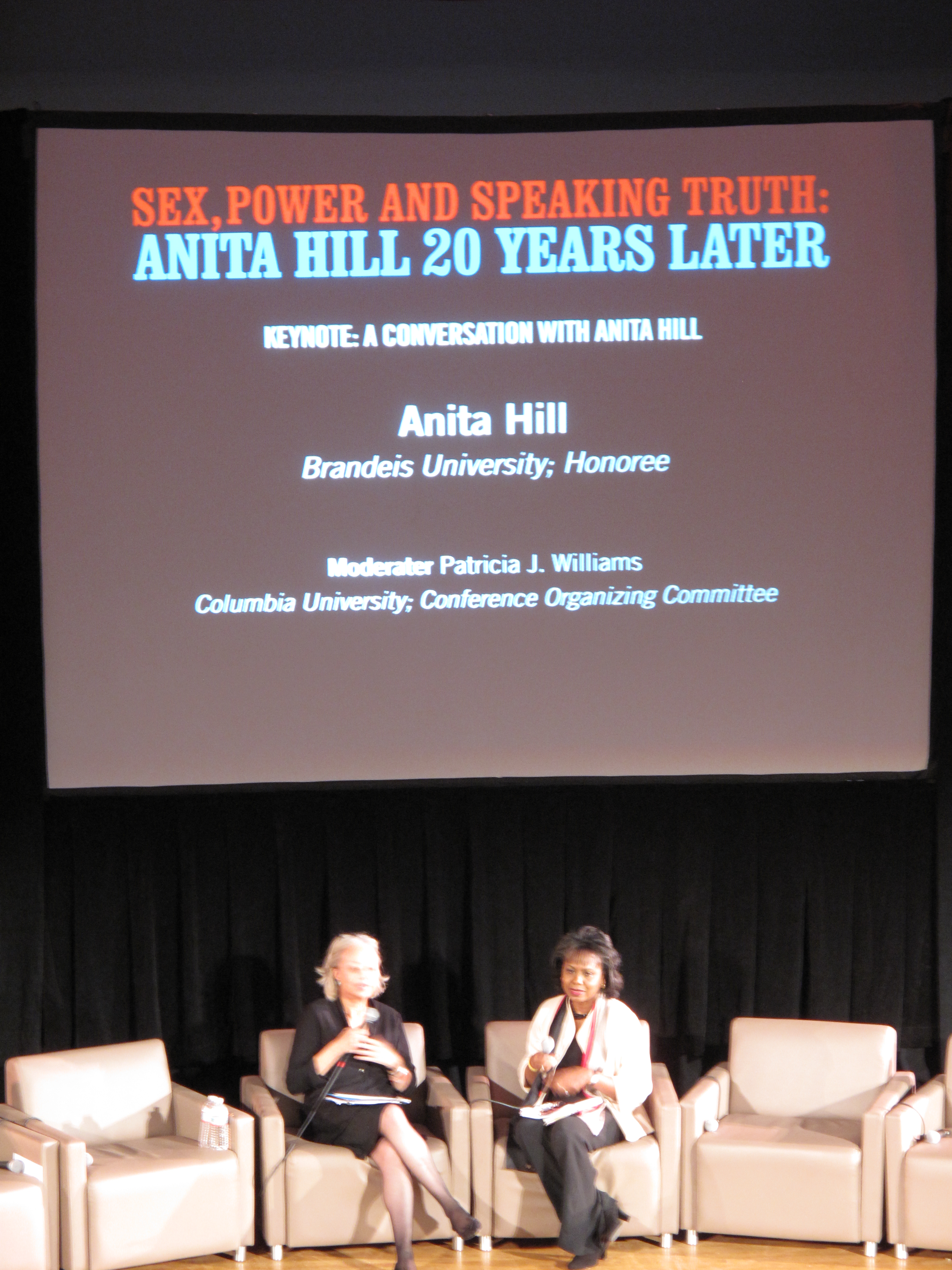
Charles Ogletree, a professor at Harvard Law School and the lead counsel for Anita Hill in 1991 spoke those words yesterday at the moving conference Sex, Power and Speaking Truth: Anita Hill 20 Years Later at Hunter College in New York City.

I agree. We all can stand up today as she did then. But, as I discuss in the latter part of the post, the knowing how to stand up in a way that will be effective and have a lasting-impact is often challenging.

The Conference

Throughout the conference, renowned lawyers, academics, and activists offered history lessons focused on what happened 20 years ago, commentary about the impact it had on current events and organizing efforts, and ideas for addressing sexual harassment in the future (though I thought the latter was a bit light on realistic ideas.)

We watched a compelling clip from Sex & Justice showing what happened 20 years ago and participated in lunchtime discussions on sexual harassment sub-topics.

If you missed it, you can watch most the conference online at C-Span.org.

To give you a taste of the day, here are some of my notes from two of the three panels and from Hill’s keynote address:

1. Charles Ogletree, Harvard Law School spoke first. He represented Anita Hill in 1991.

“What she stood for in 1991 still resonates with us…she’s in a class with Susan B. Anthony, Rosa Parks, Eleanor Roosevelt, Fanny Lou Hamer…”

Despite all of the backlash he and Hill faced, his then 12-year-old daughter told him on the phone, “I believe Anita.”

2. Lani Guinier, Harvard Law School

She talked about how Anita Hill made people “deal with the ambivalence and ignorance of the question: ‘Are you black or are you a woman?'”

“Many of us realized that not all women are white, not all blacks are men, and some of us, like Anita Hill, are very brave.”

3. Judith Resnik, Yale Law School

She examined the context of the hearing…how the male Senators on the hearing committee didn’t want to let Hill speak and then cut her defense short. While Thomas should have been on trial, they made it so Hill was.

It’s with the work of Hill and others who stood up for her and spoke out against sexual harassment that “things that are seen as ‘the way things are’ become intolerable”

4. Catharine A. MacKinnon, University of Michigan Law School

She’d been speaking out against sexual harassment since the 1970s and wrote the first book on it in 1979. During the hearing, she gave commentary on NBC.

The hearing was a “massive consciousness raising session” on an issue she’d been trying to raise awareness about for years..the hearing “made sexual harassment real to people” in a way her 1979 book did not, the EEOC guidelines did not, etc…only Anita Hill did.

“Women identified with Anita Hill…they believed her with ferocity and more said so as time and heat passed. They realized what happened to them was often as bad as what happened to her and if she could do it, they could do it too.”

“Sometimes it’s important to stand up and do the right thing, even if you lose,” she said about the DSK-Diallo sexual assault case.

5. Jamia Wilson, Women’s Media Center

“I am not Anita Hill but I could have been and that scares the crap out of me.”

Thelma & Louise + Anita Hill introduced her to victim-blaming and rape shaming. She witnessed the hearings become “a modern day witch hunt rather than the high tech lynching, as Thomas said.”

She feared she could be marked a traitor [against her race] for one day speaking out. The hearing was “intersectionality 101” for her.

6. The keynote address was a conversation between Patricia J. Williams and Hill. Here are a few notes from it:

Anita Hill spoke about the death threats, bomb threats, sh*t people mailed her and how she had to go to the grocery store knowing 7 in 10 people thought she had perjured herself…and how her family and friends helped her through it.

She talked about wanting to get her life back and resented that things didn’t go back to normal after the hearing ended. She said once she let go of that (about 6 months later) and realized she had a different life and she had to decide what shape that life would take, then she was able to move forward and also recognize that while it was an important event that shaped her life, it was just an event.

In her new book Reimagining Equality: Stories of Gender, Race, and Finding Home she writes about home and also the housing crisis in the USA.

Some of the last things she said related to her work on sexual harassment as she “helps people find their voice, talk about the issues that keep people from living full lives of equality…we should imagine a future where sexual harassment no longer exists”

7. Kimberlé Crenshaw, The African American Policy Network (You can read her speech in the current issue of The Nation).

She spoke a lot to the issue of intersectionality of race and gender.  She said the message still is “just get over it” re: sexual harassment, but “until we say it’s over, it’s not over.”

8. Virginia Valian, Hunter College

She shared stats on sexual harassment in the workplace…they’re the same today as they were 20 years ago.

She said there are several calls to action, including: 1) be smarter about how we influence people in power and how we get them into power. educate judiciary, lawyers, lawmakers, and be more systematic in our efforts 2) Form rapid response teams so we can influence the media and get the correct facts out. Giving good info to the people in power immediately.

9. Gloria Steinem

She talked about the DSK case and how the work of Hill and others allowed Nafissatou Diallo to come forward to report him. Both lost in the courts but they won in public opinion…Most importantly, this is the legacy of Anita Hill: “Thomas is on the Supreme Court but DSK will never be president of France!”

“We have the strength to go forward”

10. Devon Carbado, UCLA School of Law

“What have we learned from the Thomas-Hill hearings? That our anti-racism needs to be tied to a robust feminism and our feminist interventions must be infused with anti-racism.”

11. Julie Zeilinger, FBomb

“Gender conditioning and gender stereotyping allow sexual harassment to continue.”

“Our work isn’t yet done, plenty of us are willing to continue the fight and take Anita Hill’s legacy and run with it.”

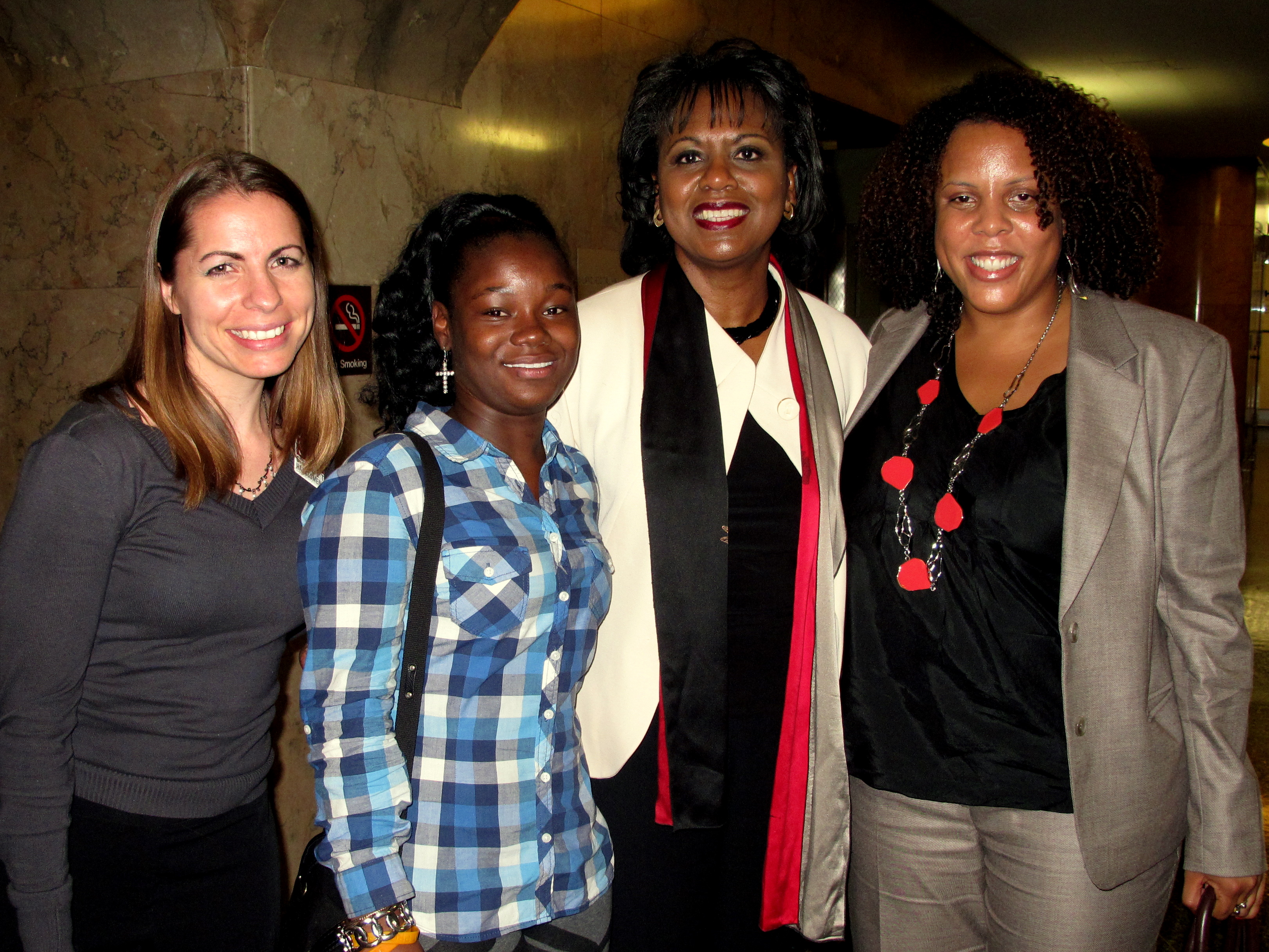
It was a day I will never forget. Especially after I had the huge honor of meeting both Steinem and Hill at an evening reception. I got to meet Hill with Joanne Smith, founder and ED of Girls for Gender Equity and one of her organizers Jodyann. Jodyann was determined to get to meet Hill and was overcome with emotion when she did. It was moving.

I’m still feeling the adrenaline and awe f meeting two feminist icons in one evening on top of meeting and reconnecting with amazing current activist/future feminist icons.

L to R: Holly Kearl, Jodyann of Girls for Gender Equity (GGE), Anita Hill, Joanne Smith the ED of GGE

What to Take Away

The conference is over. What now?

Let’s look back to Ogletree’s quote. “Anita Hill stood up in 1991 and we can all stand up in 2011.”

If you’re reading this blog, you probably want to (and do) stand up against sexual harassment—especially the kind that happens in public places—and ideally, you’d like to do so to the same extent that Anita Hill stood up against workplace sexual harassment.

But, if you’re like me, you may find that figuring out what actions will work, what efforts will be effective, and what kind of collective organizing will create long-term change is challenging. It’s especially challenging since “street harassment” is not a universal term and it’s not seen as a legitimate problem by most people. We’re still at the consciousness-raising and education stage.

To help with that stage, sites like HarassMap, Hollaback and mine collect individuals’ stories of resistance to street harassment, people write articles, tweet, and post stories on Tumblr, and numerous groups and people organize community anti-street harassment efforts. But I just don’t think they are enough to really turn street harassment into an immediately-recognized issue that is treated as seriously as workplace sexual harassment, or at least not any time soon.  There must be more we can collectively do about street harassment that is inclusive, appropriate, and effective; or one major action we can rally behind to raise awareness as people rallied behind Anita Hill. But what  is it?

Something I’m taking away from the conference is a better understanding of the workplace anti-sexual harassment movement and I hope that as I reflect on all that I’ve learned, I may come across ideas for effective, inclusive ways we can stand up against street harassment.

A related conference take away for me is a desire to learn even more about the general anti-sexual harassment movement and see what messaging, campaigns, and laws work. I know a lot of people still treat sexual harassment as a joke and it’s still a big problem at work and schools, but at least you don’t get blank stares from decision makers, academics and regular people when you bring it up (as happens with street harassment).

While learning about the anti-sexual harassment movement is not new to me, I’ve never delved very far into it. As my first step, I’m half-way through Carrie Baker’s fascinating and well-documented book, The Women’s Movement Against Sexual Harassment. Attending the Anita Hill conference was another step and now, for my next step, I plan to connect with scholars and activists I heard and met there.

Questions for You

If you attended the conference, what are your takeaways?

And, a question for anyone, do you have thoughts about what we in the anti-street harassment “movement” can learn from Anita Hill and related efforts to end workplace sexual harassment?

Share

Filed Under: Events Tagged With: 20 years later, anita hill, clarence thomas, girls for gender equity, gloria steinem, hunter college, joanne smith, sexual harassment, street harassment

Watch the Anita Hill Summit Live October 15

October 15, 2011 By HKearl

Cross-posted from what I wrote for AAUW’s blog:

Twenty years ago this week, Professor Anita Hill testified about sexual harassment before the Senate Judiciary Committee during the confirmation hearings for then-Supreme Court justice nominee Clarence Thomas. Hill used to work for Thomas and felt it was her duty to share her experiences of sexual harassment in her workplace. In the end, Thomas was still appointed as a justice, and he continues to be one today.

Two decades later, it is clear that the hearings were a pivotal moment in our nation’s history.

Working women across the nation identified with what Hill said, and her testimony opened up the floodgates. In record numbers, women shared their sexual harassment stories, and in just a few years, the number of sexual harassment complaints filed with the Equal Employment Opportunity Commission doubled.

Hill’s testimony ultimately changed how we think about sexual harassment. Before, it was seen as a personal problem and something women should handle with a sense of humor or thick skin. Hill’s testimony helped people understand that sexual harassment is discrimination and a tactic that both men and women use to oust others from a workplace.

The disbelieving, hostile way the all-male Senate Judiciary Committee treated Hill and the subsequent confirmation of Thomas to the Supreme Court led to several women being elected to the Senate the following election year in what was dubbed the “Year of the Woman.”

Tomorrow, Saturday, October 15, Hunter College in New York City is hosting a daylong summit on workplace sexual harassment, and Hill is the keynote speaker. Panelists will host sessions such as What Happened, What Does Anita Hill Mean to You, and What Have We Learned in 20 Years and What Comes Next?

Stop Street Harassment is one of the many conference co-sponsors, and we will host one of the lunchtime discussions. Ours will focus on the sexual harassment of teenagers in schools and on the streets.

For the majority of you who cannot be there, you can watch via live streaming on the conference website. If you’re on Twitter, follow @anitahill20 and view live updates by following the hashtag #AnitaHill.

Share

Filed Under: Events Tagged With: anita hill, hunter college, sexual harassment

“I had put up with stares and harrassment all my life in my own neighborhood”

October 15, 2011 By Contributor

I am 20 years old. I was waiting for the train on 59th street in NYC and rubbing my eye because it was dry, when a middle aged man approached me and leered at me. He said, “Don’t cry baby,” flirtatiously, moving close. I gave him a dirty look and raised my voice, declaring, “Nobody’s crying. And don’t call me baby, I am NOT your baby.”

I moved away from him and everyone was staring at him (and at me). But at that point, I didn’t care. I had put up with stares and harrassment all my life in my own neighborhood and couldn’t even commute without the daily dose of harrassing behavior, including from a guy who sat next to me in an empty train car and told me to take my headphones off because it was “against the law” according to him, since he wished to speak to me.

I am sick of that sense of entitlement that some harrassers have towards women. I DON’T owe you anything, and you need to st op invading my space.

– SA

Location: 59th street & Lexington train station, NYC

Share

Filed Under: Stories, street harassment

“I want it to stop for all women”

October 14, 2011 By Contributor

Yes, indeed, I have a vagina, but I do not need to be constantly reminded of it.

I am a woman. I have been living in Barcelona for 10 years and nearly every day I am harassed by men. Nearly every day, as I go about my daily business, I endure leering, cat calls, whistles, honking, kisses, lewd slurping noises and sexually explicit gestures with the fingers, tongues, hands. This is all unpleasant enough if it weren’t often accompanied by sexual remarks about my body, breasts, and genitalia, offers of sex and other sexual acts, or lascivious details about what the sexual encounter would entail. Sometimes there is unsolicited physical contact, other times the harasser exposes himself or masturbates. The harassment occurs nearly anywhere and at any time of the day. The harassers are of all ages (pubescent boys to aged men) and races (white Catalan/Spanish, South American, Middle Eastern, but interestingly NEVER black). The harassers are ALWAYS male.

I am a woman and I am harassed by men on a daily basis. It never happens when I am accompanied by another male. But it does happen when I am accompanied by my young daughter.

I am a woman and I am harassed. I want it to stop. I want it to stop for me and I want it to stop for my daughter and I want it to stop for all women. We women deserve to be free to live our lives in peace.

I am a woman. I am harassed. I am tired of living a life being harassed by men.

– Anonymous

Location: Barcelona, Spain

Share

Filed Under: Stories, street harassment

« Previous Page
Next Page »

Share Your Story

Share your street harassment story for the blog. Donate Now

From the Blog

  • #MeToo 2024 Study Released Today
  • Join International Anti-Street Harassment Week 2022
  • Giving Tuesday – Fund the Hotline
  • Thank You – International Anti-Street Harassment Week 2021
  • Share Your Story – Safecity and Catcalls Collaboration

Buy the Book

  • Contact
  • Events
  • Join Us
  • Donate
  • Facebook
  • Instagram
  • Pinterest
  • Tumblr
  • Twitter
  • YouTube

Copyright © 2026 Stop Street Harassment · Website Design by Sarah Marie Lacy