• About Us
    • What Is Street Harassment?
    • Why Stopping Street Harassment Matters
    • Meet the Team
      • Board of Directors
      • Past Board Members
    • In The Media
  • Our Work
    • National Street Harassment Hotline
    • International Anti-Street Harassment Week
    • Blog Correspondents
      • Past SSH Correspondents
    • Safe Public Spaces Mentoring Program
    • Publications
    • National Studies
    • Campaigns against Companies
    • Washington, D.C. Activism
  • Our Books
  • Donate
  • Store

Stop Street Harassment

Making Public Spaces Safe and Welcoming

  • Facebook
  • Instagram
  • Pinterest
  • Tumblr
  • Twitter
  • YouTube
  • Home
  • Blog
    • Harassment Stories
    • Blog Correspondents
    • Street Respect Stories
  • Help & Advice
    • National Street Harassment Hotline
    • Dealing With Harassers
      • Assertive Responses
      • Reporting Harassers
      • Bystander Responses
      • Creative Responses
    • What to Do Before or After Harassment
    • Street Harassment and the Law
  • Resources
    • Definitions
    • Statistics
    • Articles & Books
    • Anti-Harassment Groups & Campaigns
    • Male Allies
      • Educating Boys & Men
      • How to Talk to Women
      • Bystander Tips
    • Video Clips
    • Images & Flyers
  • Take Community Action
  • Contact

Archives for April 2012

“Not only was I disgusted at his behavior, but I FELT disgusting.”

April 4, 2012 By Contributor

On a Wednesday morning, about 10 a.m. I was waiting at crowded a bus station for the next bus due to arrive in the next five minutes or so. An older man came up to me to ask me what time the bus was going to be there, I answered, and then he struck up conversation with me about who had just won the lottery.

I was trying to be polite so I politely responded in conversation as necessary. After a minute or two he turns to me and says, as the bus pulls up, “Oh, I forgot a bus transfer,” and I reply, “You might make it if you run inside quickly.”

He says, “Thanks” followed by…”Bye, Pussy.” And he sticks his tongue out and waves it provocatively in the air at me before running off.

I was too surprised to respond before he ran off…

Not only was I disgusted at his behavior, but I FELT disgusting.

– JaguarGrin

Location: Kennedy Station, Toronto, Ontario, Canada

Share your street harassment story today and help raise awareness about the problem.
Find suggestions
for what YOU can do about this human rights issue.

Share

Filed Under: Stories, street harassment

International Day Against Victim-Blaming

April 3, 2012 By HKearl

Study after study shows that over 80 percent of women and girls have experienced street harassment, including 99 percent of women in Yemen, where women are usually covered in public places. Girls and women face street harassment while wearing all kinds of clothes: from school uniforms to business suits, from exercise clothes to winter coats, from swimming suits to party clothes.

It is clear that street harassment is not about what women/girls wear or where they go. Instead, street harassment is about disrespect, power and control, and bad manners.

Blaming people – asking what they were wearing or saying it’s because they’re “pretty” or “provocative” takes attention away from what’s really going on. It gives harassers a free pass.

Street harassment will never end until the victim-blaming ends. I am against victim-blaming.

Share

Filed Under: street harassment Tagged With: slutwalk, street harassment, victim blaming

“It made me feel slightly better, but still really humiliated.”

April 3, 2012 By Contributor

I was filling up my car at a petrol station, which have been very busy lately (due to the proposed strikes).

I was minding my own business when a young guy in a car full of people shouted out, “Fatty!”

I’ve been harassed about my weight all my life, but this is the first time in the last couple of months. I felt really hurt. I put my middle finger in the air, but didn’t look back so I don’t know if he saw it. It made me feel slightly better, but still really humiliated.

– Anonymous

Location: Petrol Station

Share your street harassment story today and help raise awareness about the problem.
Find suggestions
for what YOU can do about this human rights issue.

Share

Filed Under: Stories, street harassment

Thanks, WMATA for the new campaign against sexual harassment on the Metro!

April 2, 2012 By HKearl

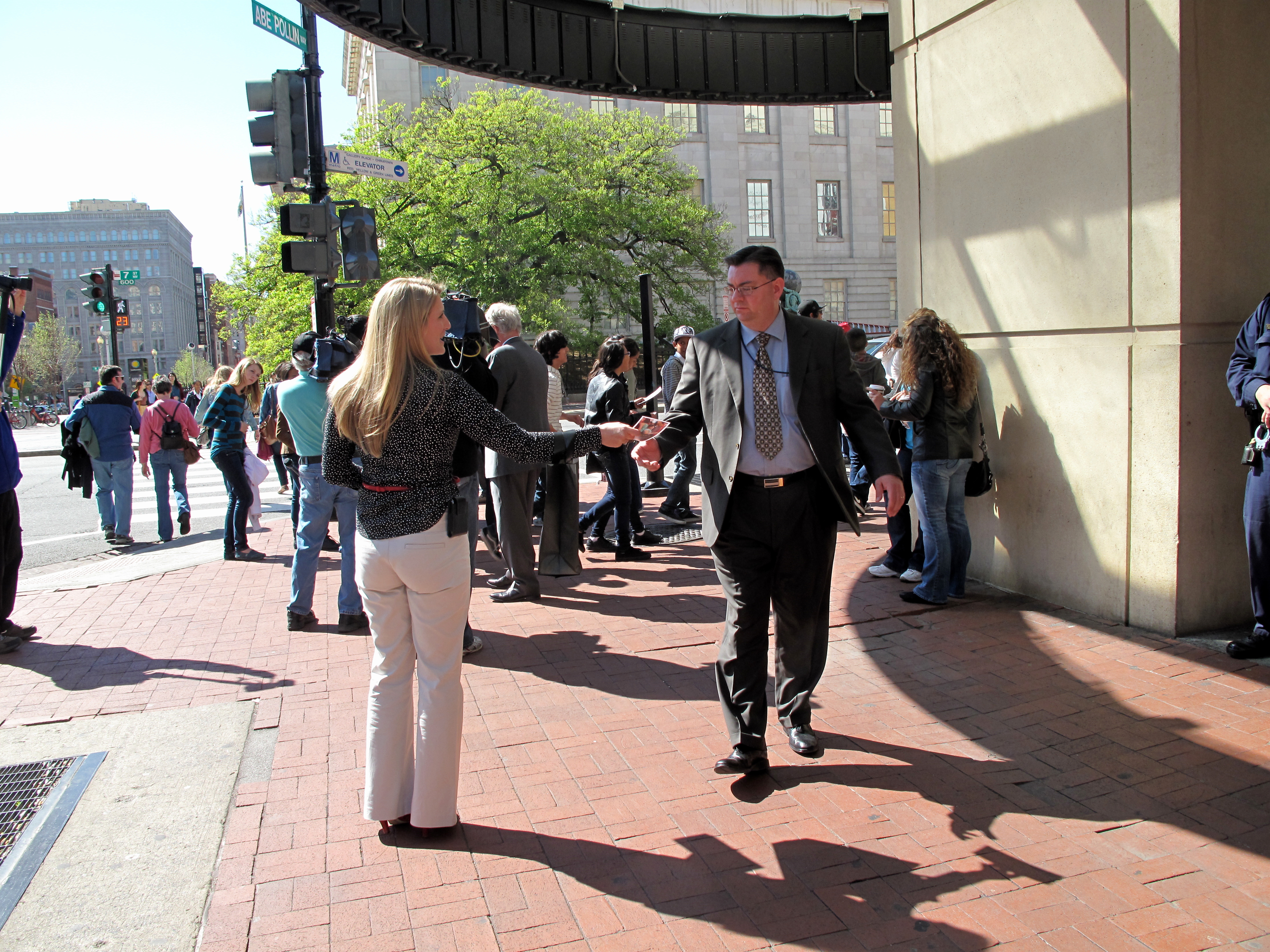
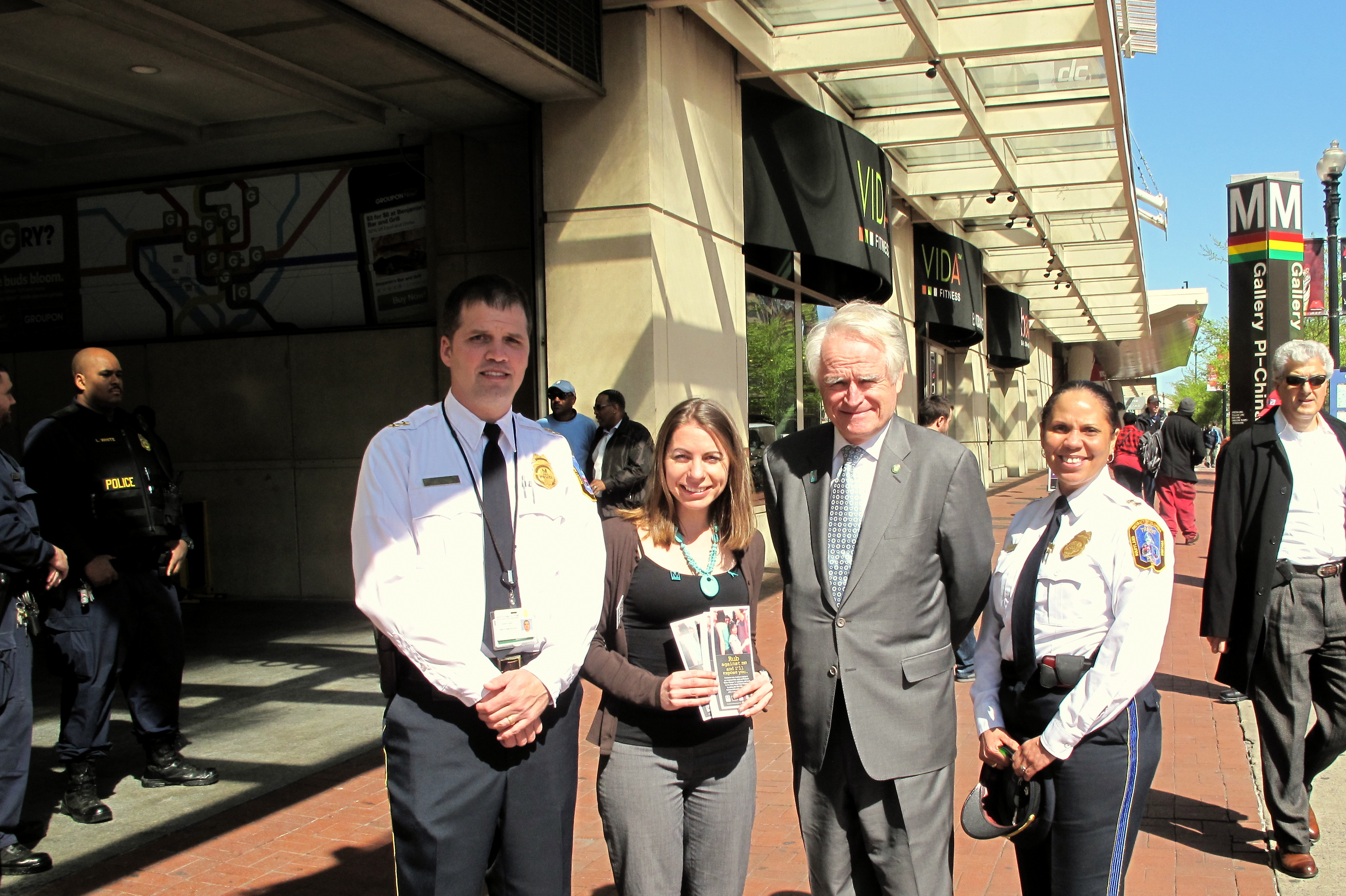
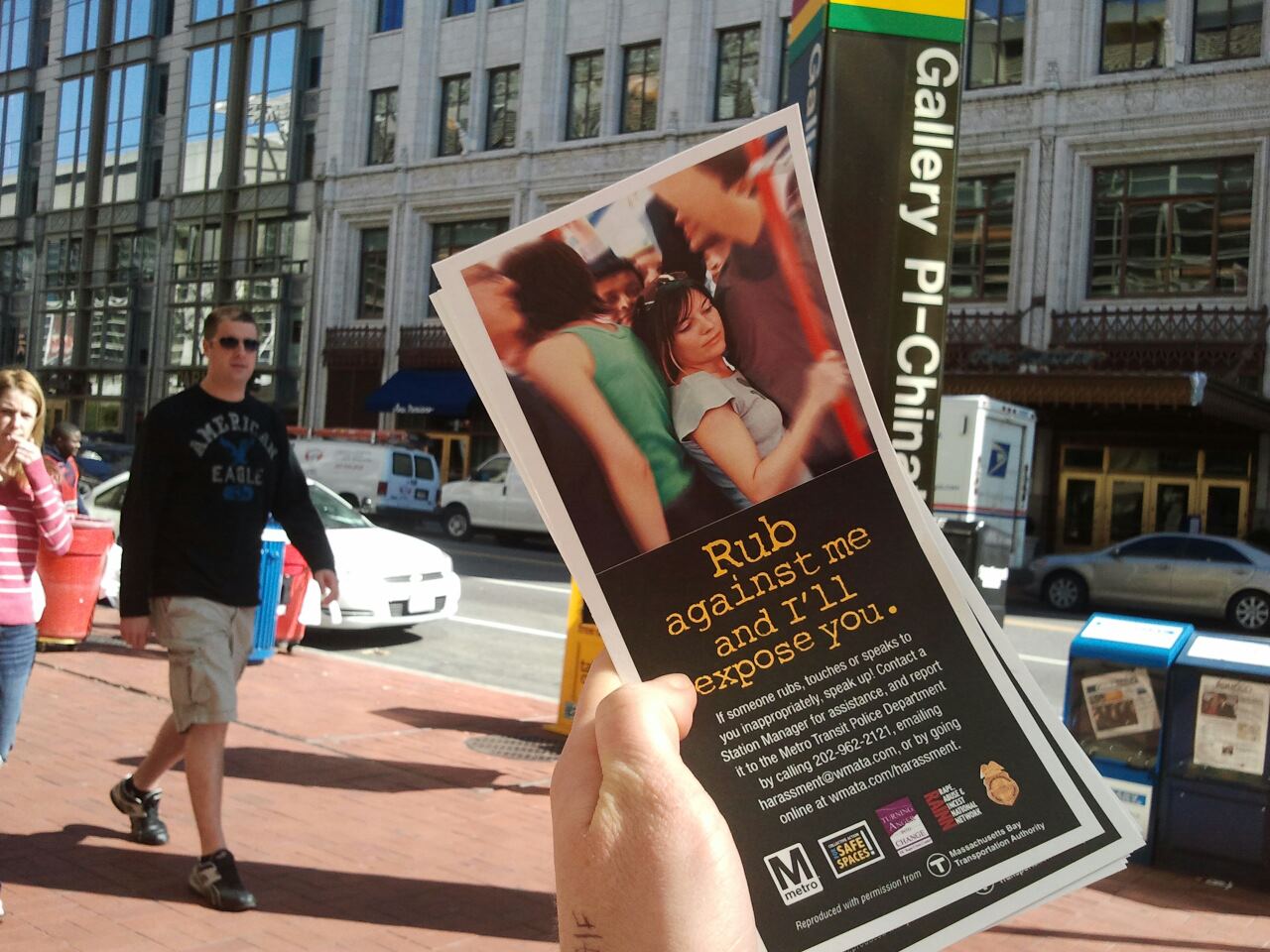
This afternoon outside the Gallery Place/Chinatown metro station entrance in Washington, DC, wearing teal “M” pins for Sexual Assault Awareness Month, Washington Metropolitan Area Transit Authority (WMATA) staff (including the General Manager and several transit police officers) joined volunteers from Collective Action for Safe Spaces (CASS), the Rape, Abuse & Incest National Network, and the DC Rape Crisis Center. We all handed out brand new fliers to passersby as part of the official launch of WMATA’s anti-sexual harassment campaign (the flier was the image on the right).

There were about ten of us who passed out the fliers for an hour to regular commuters and tourists alike. Some women eagerly grabbed the fliers when they heard about the campaign. Many men took fliers too and one man told me it was a disgrace that harassment happened. I overhead one young woman who’d picked up a flier from someone else but was passing by me say to her friend, “Oh my gosh! Finally someone is doing something about this. I deal with this all the time.” And of course, many people refused fliers before we could even tell them what it was about, but thankfully, no one was rude or harassed us.

Every major local tv station was there. While most stations only interviewed the General Manager, Fox 5 interviewed CASS board member Ben Merrion and me for their news clip.

I have to say, I am floored. I tracked the launches of the anti-sexual harassment campaigns in Boston, New York City and Chicago on my blog, and WMATA’s efforts stand out for their fast pace and thoroughness.

It was fewer than six weeks ago that six members of the public and board members of CASS testified before the DC City Council about sexual harassment on the DC-area transit system. We were nervous and felt we had to be on the defensive and explain why this issue matters, especially after we heard some of the soundbites WMATA gave the media which made it sound like they didn’t care about the issue. We didn’t have much hope that anything would come out of our testimonies, not even when WMATA said they would do something immediately. We feared that was just lip service. But then they invited us to a meeting at their offices two weeks later.

On March 7, three CASS board members met with WMATA and they gave us an overview of their campaign plans and we were blown away how responsive they were, how comprehensive their plans were, and how it had only been two weeks since we’d given testimony!

In March they quietly released a new webpage and email address (harassment@wmata.com) where people can report sexual harassment – including, for the first time, verbal harassment. The fliers we handed out today inform people about the new ways to report harassment. Additionally, a PSA ad campaign will roll out soon and WMATA is finalizing a new training video for their employees. To make the issue more accessible, the training video includes the harassment stories of several members of the public who agreed to be filmed during The REAL Metro Forum, held during International Anti-Street Harassment Week.

The WMATA task force for this issue has been great to work with, especially the project lead Caroline Lukas. They’ve treated the issue with the gravity it deserves and have asked for input throughout the process. They have obviously made the issue a top priority if they were able to launch their campaign so soon after we brought the issue to their attention. It’s also refreshing to hear them acknowledge that it will take time to get the word out and then even more time to track the effectiveness of the campaign. Caroline has assured us WMATA is in this for the long haul.

If you’re in the DC-area or know anyone who is, spread the word about the new campaign and encourage them to report anything they experience or see. Help WMATA track the problem so that they can then more effectively address it. Social change doesn’t happen overnight, but it certainly has a chance of happening faster with the help of a major institution like WMATA. Thanks, WMATA.

WMATA Media Relations Manager Caroline Lukas hands out fliers

Holly Kearl with WMATA staff, including the General Manager

Handing out fliers

Teal pin
Share

Filed Under: News stories Tagged With: PSA campaign, sexual harassment, WMATA

SAAM 2012: “Violence against women is as American as apple pie”

April 2, 2012 By HKearl

Rep. Gwen Moore (D-Wis.) recently gave an eloquent speech advocating for the re-authorization of the Violence Against Women Act (VAWA). In addition to sharing her own stories of sexual abuse she said, “Violence against women is as American as apple pie.”

And she’s right. A December 2011 study by the Center for Disease Control and Prevention found that as many as many as 1 in 3 women have experienced rape, physical violence or stalking by an intimate partner in their lifetimes. And as more and more men come forward with their sexual abuse stories, it’s clear that sexual abuse in general is an epidemic problem.

This is an outrage. Everyone should have the right to lives free from sexual violence. This should not be an American tradition. April is Sexual Assault Awareness Month, and there are a lot of ways you can be involved in speaking out and creating change. Here are 10 ideas for 2012.

1. Believe/help survivors. Believe survivors when they confide in you. Visit the website of the Rape, Abuse & Incest National Network to find information to help you help the survivor. And to find information to help yourself.

2. Find help. If you are a survivor who isn’t sure where to turn to or how to get help, I highly recommend visiting the RAINN website. I volunteered with them for 2.5 years and applaud their work. You can find information about a phone or online hotline and information about recovery.

* Are you male? Visit the website 1 in 6 for resources specifically for you.

* Are you in the military? RAINN has a helpline called Safe Helpline specifically for survivors in the military.

3. No victim-blaming. Don’t engage in victim-blaming. For example, don’t ask about or comment on what a survivor was wearing or  ask if they were drunk or if they were out late at night. On April 3 (tomorrow), Slutwalk Toronto is hosting a day of action for the first-ever International Day Against Victim-Blaming. They say to participate, “start conversations, take a stand, and take up space on April 3rd to fight for our right to live free of violence and victim-blaming. Join us in our mission to spread the word that those who experience sexual violence are never the ones at fault.” Use the twitter hashtag #EndVictimBlaming.

4. Write your Senators. Send a quick e-mail or make a quick phone call to your Senators asking them to re-authorize the Violence Against Women Act.

5. #TweetAboutIt. The National Sexual Violence Resource Center provides a variety of resources each year for Sexual Assault Awareness & Prevention Month, including free reports and manuals and campaign materials. This year, they’re hosting a Tweet About It Tuesday every Tuesday at 2 p.m. EST throughout the month. Various people will lead the tweet-chat on a different topic each week, using the hashtag #TweetAboutIt. Read more and join in.

6. Wear jeans. Make a social statement by wearing jeans on April 25 as part of Denim Day in LA & USA. The day is a visible way to protest against misconceptions that surround sexual assault. Order their Denim Day Action Kit and raise awareness at your workplace, neighborhood, or community. Encourage each person who participates to donate one dollar to Denim Day to fund prevention programming. (I just ordered my kit.)

7. Work to prevent sexual abuse of Native Americans. Native American women face the highest rates of rape of any demographic: 1 in 3 will be raped in their lifetime.

* Learn more and read about the maze of injustice that keeps survivors from finding justice.

* Donate to Project Respect, an organization that works to combat sexual and gender based violence amongst South Dakota’s Native American youth. The funds will go toward creating a youth shelter/programming area and a summer mentoring program that pairs Native American teens with adolescents entering middle school.

8. Advocate against military sexual assault. Sexual assault in the military is a well documented problem, yet the military does very little to truly address or prevent it.

* Sign a petition addressed to the U.S. Senate asking them to support H.R. 3435, The STOP Act, and H.R. 1517, The Holley Lynn James Act, legislation that would require the military to do more.

* Watch the trailer for a Sundance Film Festival Award-Winning documentary called The Invisible War about military sexual assault. It will be released on June 15, 2012.

* Donate to AAUW, an organization where I work in my day job, which provides financial support to two sets of plaintiffs who are former service members who were raped or sexually assaulted by their co-workers and are bravely suing the Department of Defense.


9. Use the arts or march
.
Take part or organize arts-based initiatives or a march to raise awareness about sexual assault. Examples of initiatives include:

* The Clothesline Project, an initiative to bear witness to violence against women. Women affected by violence decorate a shirt and hang the shirt on a clothesline to be viewed by others as testimony to the problem of men’s violence against women.

* V-Day event offers several performance and film screening options for groups to implement in their community in February, March, and April. The purpose of these events is to raise awareness about violence against women and girls as well as raise money for local beneficiaries that are working to end violence. There is no theater or producing experience necessary. Visit the V-Day website to learn how to organize a V-Day event.

* Story of a Rape Survivor (SOARS) is an award winning multimedia performance you can bring to your community that entertains as well as educates the audience about sexual assault prevention. Featuring the music of Nina Simone, Maxwell, and Sade, SOARS tells one woman’s story about how she reclaimed her body, sexuality, and self-esteem after being sexually assaulted in college. SOARS is a cutting-edge theatrical experience that stars a diverse cast of women, combining photographs, dance, spoken-word poetry and music as a way to educate about healing from sexual violence.

* By wearing a white ribbon, White Ribbon Campaign members make a personal pledge to “never commit, condone or remain silent about violence against women and girls.” You can order materials to help challenge the community to speak out on the issue, learn about sexual violence, and raise public awareness.

* Organize or participate in a Take Back the Night March in your community or on campus and make a statement that women have the right to be in public and to go about their lives without the risk of sexual violence. Order a kit with resources for the event.

10. Support consent. One fun way to work to prevent sexual assault is to talk about and emphasize consent in all sexual activities. Here are two amazing initiatives you can bring to your campus or community to do that:

* The Consensual Project is an interactive, sex-positive, fun workshop during which participants can learn why consensual hooking up is hotter hooking up. College students are an ideal audience for this workshop.

* The Line is a film that explores the intersection of sexual identity, power, and violence. How do we negotiate our boundaries as sexually liberated women? How much are we desensitized to sexual violence? Through conversations with football players, educators, survivors of violence, prostitutes, and attorneys, this personal film explores the “grey area” and the elusive line of consent.

(And if you’re unsure about the connection between street harassment and sexual assault, listen to a CALCASA Prevention podcast where I talk about the connections. Briefly, some of the connections are that both behaviors fall on the same spectrum of gender violence; street harassment sometimes escalates into sexual violence; and street harassment can be re-triggering for survivors of sexual abuse.)

Share

Filed Under: Resources, street harassment Tagged With: a long walk home, april, CDC, clothesline project, denim day, gwen moore, native american youth, project respect, rape, sexual abuse of boys, sexual assault, Sexual Assault Awareness Month, slutwalk toronto, take back the night, the invisible war, V-Day

« Previous Page
Next Page »

Share Your Story

Share your street harassment story for the blog. Donate Now

From the Blog

  • #MeToo 2024 Study Released Today
  • Join International Anti-Street Harassment Week 2022
  • Giving Tuesday – Fund the Hotline
  • Thank You – International Anti-Street Harassment Week 2021
  • Share Your Story – Safecity and Catcalls Collaboration

Buy the Book

  • Contact
  • Events
  • Join Us
  • Donate
  • Facebook
  • Instagram
  • Pinterest
  • Tumblr
  • Twitter
  • YouTube

Copyright © 2026 Stop Street Harassment · Website Design by Sarah Marie Lacy