• About Us
    • What Is Street Harassment?
    • Why Stopping Street Harassment Matters
    • Meet the Team
      • Board of Directors
      • Past Board Members
    • In The Media
  • Our Work
    • National Street Harassment Hotline
    • International Anti-Street Harassment Week
    • Blog Correspondents
      • Past SSH Correspondents
    • Safe Public Spaces Mentoring Program
    • Publications
    • National Studies
    • Campaigns against Companies
    • Washington, D.C. Activism
  • Our Books
  • Donate
  • Store

Stop Street Harassment

Making Public Spaces Safe and Welcoming

  • Facebook
  • Instagram
  • Pinterest
  • Tumblr
  • Twitter
  • YouTube
  • Home
  • Blog
    • Harassment Stories
    • Blog Correspondents
    • Street Respect Stories
  • Help & Advice
    • National Street Harassment Hotline
    • Dealing With Harassers
      • Assertive Responses
      • Reporting Harassers
      • Bystander Responses
      • Creative Responses
    • What to Do Before or After Harassment
    • Street Harassment and the Law
  • Resources
    • Definitions
    • Statistics
    • Articles & Books
    • Anti-Harassment Groups & Campaigns
    • Male Allies
      • Educating Boys & Men
      • How to Talk to Women
      • Bystander Tips
    • Video Clips
    • Images & Flyers
  • Take Community Action
  • Contact

Archives for May 2013

“Who are you, f***ing Wonder Woman?”

May 20, 2013 By Contributor

You walked up to me as I was waiting at the bus stop and pointed at my groceries and asked, “Can I use some lotion?”

I said “No,” then, “Please give me some space” and held my hand up when you got too close.

You stepped 5 or 6 feet back, and then spent the next 10 minutes threatening to break my neck if I ever went downtown (you wouldn’t do it here), telling me that I was a bitch, that I needed to get raped. I stood and stared straight ahead until you got on your bus. “Bye Bitch!” you yelled.

But you didn’t get within 5 feet of me. As for your question, “Who are you, f***ing Wonder Woman?”, I can only answer “Yes.”

– Anonymous

Location: Harbor East, Baltimore, MD

Share

Filed Under: Stories, street harassment

Digest of Street Harassment News: May 19, 2013

May 19, 2013 By HKearl

** Sign up to receive a monthly e-newsletter from Stop Street Harassment ***

Street Harassment Stories:

Share your story! You can read street harassment stories on the Web at:

Stop Street Harassment Blog

Collective Action for Safe Spaces

HarassMap in Egypt

Bijoya in Bangladesh

Resist Harassment in Lebanon

Ramallah Street Watch in Palestine

Name and Shame in Pakistan

Safe City India

Safe Streets in Yemen

Street Harassment in South Africa

Many of the Hollaback sites

Everyday Sexism

Street Harassment In the News, on the Blogs:

* FRA, “LGBT persons’ experiences of discrimination and hate crime in the EU and Croatia“

* Left Standing Up, “Harassed at the Corner Store: the Men and the Milk“

* HuffPost Live, “I was groped on the subway“

* Ms. Blog, “The Next Step In Fighting Street Harassment? A Comic Book.”

* Gender Focus, “New Apps Tackle Dating Violence, Street Harassment”

* Care2, “Nearly 100% of Women in Egypt Face Sexual Harassment“

* Slog, “It’s Spring! Who’s Ready for Street Harassment?“

* Blisstree.com, “Would You Like Some Perversion With That? My Worst Street Harassment Experience Yet“

* Ravere EduBlogs, “Street Harassment and Catcalling“

Announcements:

New:

* SSH is hiring our first summer intern! Info.

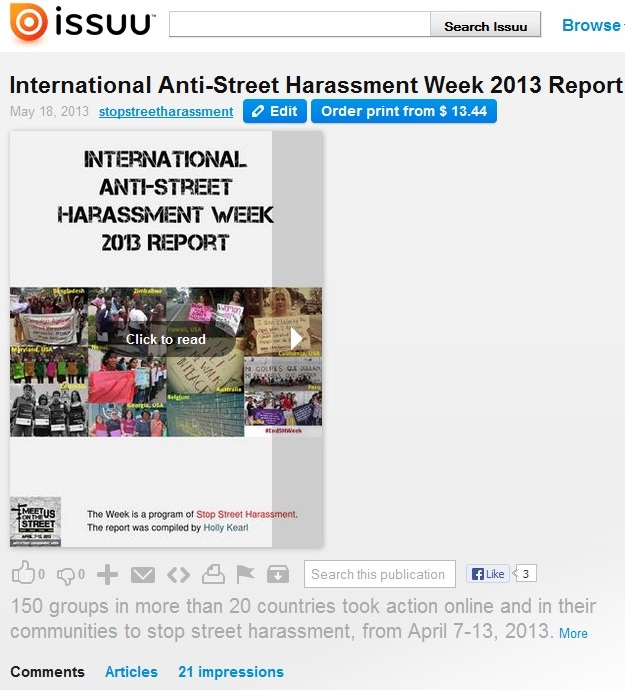
* Read the report about the activities that took place for International Anti-Street Harassment Week 2013!

* If you live/work/place in Washington, D.C., take this survey for Collective Action for Safe Spaces.

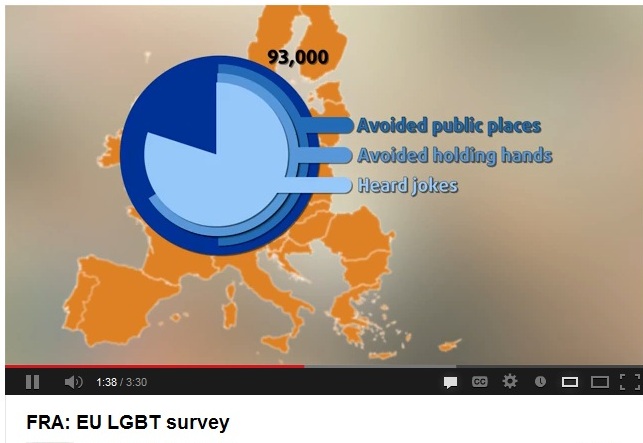
* A new study of 93,000 LGBQT individuals in the European Union countries reveals that street harassment is a pervasive problem for them.

Reminders:

* If you’re in the Washington, DC-area, come to the five-year anniversary Stop Street Harassment Happy Hour on June 5, 5-9 p.m. Info.

* “Cat calls” aren’t benign. Words can lead to violence. Support the documentary that tells that story: http://kck.st/XUZPmq

20 Tweets from the Week:

1. @Dara_212 “Sometimes I forget that, by virtue of being a woman, my body is constantly up for appraisal by strangers” time to end #streetharassment.

2. @charitydash Nothing makes me prouder to be a woman than enduring street harassment on my way to work!

3. @msjoyluckclub old man on the street just leeringly said “konichiwa” to me as i walked past him to catch my train // #gross #stopSH #streetharassment

4. @SaraLang Hard to listen to the two women on this train talking about street harassment they’ve experienced this week – it’s just so pervasive.

5. @thetrudz @one_wyz_womn No point. I deal with street harassment and racial microaggressions ALL DAY. Why go home to “comedy” that’s all insults?

6. @MissBethMyer The next guy to give me street harassment will take the fall for all the ones who came before him. Hope it’ll be worth it, buddy.

7. @MiaLWS @EverydaySexism Today, while walking home some dude honked, whistled, & shouted “Imma dick you down and wife you up!” #StreetHarassment

8. @DreuxD @WrittenbyBene Street harassment pisses me off to no end… Like I should be happy to be told go smile. Fuck off.

9. @WrittenbyBene I don’t have time to go on a #StreetHarassment rant, but it’s real. And guys need to cut it out. Seriously.

10. @AquafarE @and1grad @Aftashok We live in the same society where parents panic when daughters grow breasts because of street harassment.

11. @brittanclaire I just had a dream in which my response to street harassment was to push off the ground and fly, soaring over the trees/interstates/haters.

12. @juneylynne @BestPatricEgan Of course. I’m making a list this summer of each incident of street harassment I encounter. I anticipate it to be lengthy.

13. @iasshole “Hey despite 100s of people in this thread telling me street harassment is real and bad I still think you should be flattered.” #headdesk

14. @tessaquarium I miss my home in SF but I do not miss the crazy amount of street harassment i get.

15. @MarieSwartz My first experiences being ‘perceived’ as a woman were all street harassment in high school

16. @KaylinSnailin Socialization is fucked up. I experienced #streetharassment twice in 2 minutes and -I- feel guilty because I was riding my bike in a dress.

17. @stitchesofspace going outside means an 80% chance of being made uncomfortable. fuck street harassment.

18. @SuzanEraslan I am so fucking sick of street harassment I could tear someone’s eyes out.

19. @etoilee8 Nothing like a little bit of #streetharassment to make me want to punch a grown man. Lemme ask you something. Has it ever worked?

20. @SaraLang  Yesterday while walking down U street, I averaged one incident of street harassment per block. #hollaback

Share

Filed Under: News stories, Resources, weekly round up

#EndSHWeek 2013 Report of Activities!

May 18, 2013 By HKearl

Check out the report detailing the activities that took place during International Anti-Street Harassment Week 2013 in April! Thank you to everyone who spoke out and participated that week. You’re amazing!

Share

Filed Under: anti-street harassment week, Resources

Half of LGBT Members in the EU Avoid Public Places Because of Harassment

May 17, 2013 By Contributor

A new study by the European Union Agency for Fundamental Rights (FRA) sheds light on the levels of discrimination faced by LGBT members of the EU community, with important findings related to how this demographic experiences street harassment.

According to the FRA’s website, the results of the online survey of more than 93,000 LGBT individuals “provide valuable evidence of how LGBT persons in the EU and Croatia experience bias-motivated discrimination, violence and harassment in different areas of life, including employment, education, healthcare, housing and other services.”

A video on the FRA YouTube page illustrates that one-half of all respondents avoid public places, two-thirds avoid holding hands when in public, and four-fifths frequently overhear jokes being made at the expense of LGBT individuals.
In all countries, when asked “Where do you avoid being open about yourself as L, G, B or T for fear of being assaulted, threatened or harassed by others?” respondents reported the highest levels of fear in public spaces (restaurants, public transportation, streets, parking lots, parks, and other public premises) and lower (though still significant) levels at home, work, and school. Similarly, respondents overwhelmingly identified the “street, square, car parking lot / public place” when asked where their most recent incident of physical/sexual attack or threat of violence occurred.
The most serious incidences of harassment occur, in all countries, when there is more than one perpetrator, and these perpetrators tend to be male and often strangers to the harassed individuals (an indicator that many of these “most serious” incidences probably happen in public). A notable portion of this harassment (second only to ‘someone else you didn’t know’) was perpetrated by teenagers or groups of teenagers, a reminder that, while we tend to think of younger individuals as more accepting of non-normative identities, there is still a culture of intolerance that circulates globally.
This study underscores the importance of Stop Street Harassment’s and other organizations’ goal of educating the public about how critical this issue is to the lives of so many women and LGBT individuals (and women who identify as LGBT). While folks across all identity categories experience street harassment in unique ways, we are united in our goal of research, education, and mobilization so that surveys like these are no longer needed.

This is a guest post by Patrick McNeil. Patrick is finishing his master’s thesis at The George Washington University in Washington, D.C., where he is pursuing his Master’s in Women’s Studies. His work focuses on whether and how gay and bisexual men experience street harassment and how this form of harassment intersects with and diverges from the gender-based street harassment of women. Follow him on Twitter at @patrickryne.

Share

Filed Under: LGBTQ, Resources

Colombia: Confronting Harassers

May 17, 2013 By Contributor

By: Adriana Pérez-Rodríguez, SSH Correspondent

When I talk to female friends about street harassment I can tell most of them feel something is wrong with it, they realise that we should not put up with such behaviour. Yet, when it comes to reacting and confronting harassers, many of them don’t know where to start from. That’s why I want to tell my personal experiences to hopefully help clarify any doubts. I believe that, although, conscientiously acknowledging the problem is highly important, it isn’t sufficient as we do also need to take action on the matter.

However, one thing I want to clarify first is that I do understand we all feel scared when confronting harassers. For that reason I do not advice that we should always confront them directly, sometimes collective action or other sorts of actions are much better. I advise we measure the risks and dangers we can get into, always considering our safety first, especially if we’re on our own.

One reason that’s always listed when rejecting the idea of confronting street harassers is the fear factor: we, in the end, don’t know how they will react, especially if we’re on our own. Nevertheless, it’s also important to realise that in some cases we’re not necessarily concerned about our safety per se, but more about the sole fact of speaking up. If we’re systematically brought up to believe women should not speak up, open resistance becomes quite a challenge, as we first have to overcome strong cultural barriers imposed upon us since our first stages of socialisation. If we’re brought up to believe we should cope with how we are treated, especially if those who are harming us are men, then it’s normal we sense fear at the thought of openly reacting. Speaking up, in the end, can be seen as an act of political resistance, but as we’re told we should always cope, this act can also be quite overwhelming at first thought. My personal experience has been marked by that, as it took me quite a while to overcome fear for both, my safety, and more importantly, for overcoming cultural barriers.

So, the first time I confronted my harasser, I was walking down a very lovely but quiet road. In fact, it was just me on that road when I heard something along the lines of “hey beautiful”. I tried not to pay attention and kept walking when I heard again something like “you’re so beautiful, what are you doing walking on your own?” In that moment something snapped in my head, I had enough. I was so angry at the fact I knew this guy was blatantly talking advantage that it was just him and I on that road that I couldn’t cope any longer, so I stood in front of him and with a sharp tone I said “what did you just say?!”. He didn’t know what to say, he looked so puzzled, almost embarrassed and that’s when I left.

I think that’s important, as many of us may think that in order to confront we need to give speeches on how they’re reproducing patriarchal ideas of women in public spaces. However, a sharp and affirmative answer will do most of the times. In fact, sometimes they will be willing to engage in conversations where you’ll be able to fully explain what’s wrong with it. That happened once when I was walking with a friend and an older man started verbally harassing us, I couldn’t take it so after I answered back and he looked puzzled (how typical!) my friend replied “you know? We don’t like it”. He then explained why he did it and after we explained what’s so wrong with it he apologised.

Finally, in some cases collective action can be a better answer because it has a bigger impact and it does keep us safe. My experience with collective action was this: there’s a construction site in front of my place, I was tired of putting up with the builders harassing me and every woman every time we walked passed it, but I knew that I could get into a lot of risk if I confronted them on my own. So I collected signatures from everyone in the building and sent a petition letter with all the signatures to the project engineer explaining him how uncomfortable people from this building were at the behaviour of the builders. Seems to be it has worked since harassment has pretty much disappeared. However, that will be an experience I’ll write properly about the next time.

One thing you’ll realise once you start confronting them is how good it feels after, not only you confronted a wrongdoer but also you’re overcoming, resisting and reacting against cultural barriers that dictate that we, for the sole fact of being women, should keep quiet. We’re putting a message across for everyone to see that we’re not conforming to patriarchal ideas of women as submissive. We’re saying “we’re here, we’ll stay here and we don’t need your approval.”

Adriana is a Colombian national who’s passionate about all topics concerning social justice, especially gender-based justice.

____________________________________________

Enfrentando a un acosador:

Cuando hablo con amigas sobre el acoso sexual callejero puedo darme cuenta que la mayoría de ellas sienten que sí hay algo malo con eso y se han dado cuenta que no deben aguantar ese comportamiento. Aun así, cuando se trata de reaccionar y afrontar los acosadores, muchas no saben por dónde empezar, por eso me gustaría comentar mis experiencias personales para lograr aclarar dudas con respecto a este tema. Yo creo que, aunque tomar conciencia del problema es de gran importancia, no es suficiente puesto que también debemos actuar.

Una cosa que primero me gustaría aclarar es entiendo que todas sintamos temor al enfrentar a acosadores, por lo que enfrentarlos directamente no sea necesariamente la mejor solución, a veces acciones colectivas tienen un mejor efecto. Por lo tanto, yo aconsejo ponderar los riesgos y peligros, considerando nuestra seguridad primero, en especial si estamos caminando solas.

Una razón que siempre es nombrada cuando se rechaza enfrentar a nuestro acosador es el miedo: al fin y al cabo no sabemos cómo va a reaccionar nuestro agresor, especialmente si estanos solas. Sin embargo, también es importante darse cuenta que en algunos casos no estamos preocupadas por nuestra seguridad como tal, sino por el hecho de hablar. Si somos criadas sistemáticamente para creer que las mujeres no debemos manifestar nuestra oposición, la resistencia se vuelve todo un desafío ya que primero debemos vencer barreras culturales que fueron impuestas sobre nosotras desde las primeras etapas de socialización. Si fuimos criadas con la creencia de que debemos aguantar la manera en que somos tratadas, más aún si los que nos hacen daño son los hombres, se vuelve normal sentir miedo a la idea de hacer pública nuestra resistencia; manifestar abiertamente nuestra oposición puede considerarse como un acto de resistencia política pero, como siempre nos enseñaron a aguantar, esta idea puede ser inicialmente arrolladora. Así, mi experiencia personal ha estado marcada por estos hechos ya que me ha tomado tiempo superar estos miedos, tanto por mi seguridad personal, como por vencer estas barreras culturales.

La primera vez que enfrenté a un acosador fue mientras estaba caminando por una vía muy linda pero sola, en realidad era solo yo cuando oí algo como “oye hermosa”. Traté de no prestarle atención y seguir caminando hasta que oí algo como “qué hermosa eres, ¿por qué estás caminando sola?”, en ese momento sentí que ya no pude aguantar, estaba tan molesta del hecho que sabía que él se estaba aprovechando de que estaba caminando en una vía sola que le dije tajantemente “¡¿Qué me acabó de decir?!”. Él no supo qué decirme, me estaba viendo con una cara de confundido, así que me fui.

Creo que entender eso es importante ya que muchas creemos que a la hora de enfrentar a nuestro acosador debemos dar todo un discurso de cómo están reproduciendo lógicas patriarcales de la mujer en el espacio público, pero muchas veces una respuesta tajante es la mejor solución. Es más, en ciertos casos se podrá entablar una conversación con el agresor en donde se le expliqué por qué está mal, como me pasó una vez que fuimos acosadas por un hombre más mayor mi amiga y yo. Después de responderle a su agresión y de que el agresor me viera con cara de confuso (¡qué típico!), mi amiga le dijo “¿Sabe? Eso no nos gusta”, él nos explicó por qué lo hizo y nosotras lo que está mal con ese comportamiento, por lo que él se disculpó.

Finalmente, en varios casos acciones colectivas pueden ser la mejor respuesta debido al mayor impacto que tiene y a que protege nuestra seguridad. Mi experiencia con acciones colectivas fue la siguiente: hay un edificio en construcción enfrente de mi casa y cada vez que yo u otras mujeres pasaban en frente, teníamos que aguantar el acoso verbal de los obreros, empero yo sabía que corría riesgos altos si me enfrentaba directamente con ellos. Por lo que recogí firmas de todas las personas que viven en mi edificio y firmamos una carta de petición que fue enviada al ingeniero residente de la obra explicándole lo incómodos e incómodas que nos sentíamos los y las habitantes de este edificio con el comportamiento de los obreros, y al parecer ha funcionado ya que el acoso de los obreros ha prácticamente desaparecido desde entonces. Sin embargo, esa será una experiencia que relataré con más profundidad en mi próximo artículo.

Una cosa que uno se da cuenta cuando empieza a enfrentar estos actos es lo bien que se siente después, no sólo confrontamos algo que está mal hecho sino que también empezamos a luchar y derrumbar barreras culturales que nos dictan que por el hecho de ser mujeres debemos mantenernos en silencio. Estamos transmitiendo el mensaje, para que todos y todas lo vean, de que no vamos a aguantar ideas patriarcales que nos definen como sumisas, estamos diciendo “aquí estamos y aquí nos quedamos, y no necesitamos su aprobación”.

Soy una colombiana apasionada por todos asuntos relacionados con la justicia social, especialmente justicia de género.

Share

Filed Under: correspondents, street harassment

« Previous Page
Next Page »

Share Your Story

Share your street harassment story for the blog. Donate Now

From the Blog

  • #MeToo 2024 Study Released Today
  • Join International Anti-Street Harassment Week 2022
  • Giving Tuesday – Fund the Hotline
  • Thank You – International Anti-Street Harassment Week 2021
  • Share Your Story – Safecity and Catcalls Collaboration

Buy the Book

  • Contact
  • Events
  • Join Us
  • Donate
  • Facebook
  • Instagram
  • Pinterest
  • Tumblr
  • Twitter
  • YouTube

Copyright © 2026 Stop Street Harassment · Website Design by Sarah Marie Lacy