• About Us
    • What Is Street Harassment?
    • Why Stopping Street Harassment Matters
    • Meet the Team
      • Board of Directors
      • Past Board Members
    • In The Media
  • Our Work
    • National Street Harassment Hotline
    • International Anti-Street Harassment Week
    • Blog Correspondents
      • Past SSH Correspondents
    • Safe Public Spaces Mentoring Program
    • Publications
    • National Studies
    • Campaigns against Companies
    • Washington, D.C. Activism
  • Our Books
  • Donate
  • Store

Stop Street Harassment

Making Public Spaces Safe and Welcoming

  • Facebook
  • Instagram
  • Pinterest
  • Tumblr
  • Twitter
  • YouTube
  • Home
  • Blog
    • Harassment Stories
    • Blog Correspondents
    • Street Respect Stories
  • Help & Advice
    • National Street Harassment Hotline
    • Dealing With Harassers
      • Assertive Responses
      • Reporting Harassers
      • Bystander Responses
      • Creative Responses
    • What to Do Before or After Harassment
    • Street Harassment and the Law
  • Resources
    • Definitions
    • Statistics
    • Articles & Books
    • Anti-Harassment Groups & Campaigns
    • Male Allies
      • Educating Boys & Men
      • How to Talk to Women
      • Bystander Tips
    • Video Clips
    • Images & Flyers
  • Take Community Action
  • Contact

Archives for September 2013

Cameroon & Chicago Activists Address Street Harassment

September 26, 2013 By HKearl

We’re in the final month of the Safe Public Spaces Mentoring Program Pilot, and the three projects are wrapping up nicely!

Last week, I posted a report about the group in Kabul who did workshops in high schools on street harassment.

Here are brief updates on the groups in Buea, Cameroon, and Chicago, USA:

Cameroon
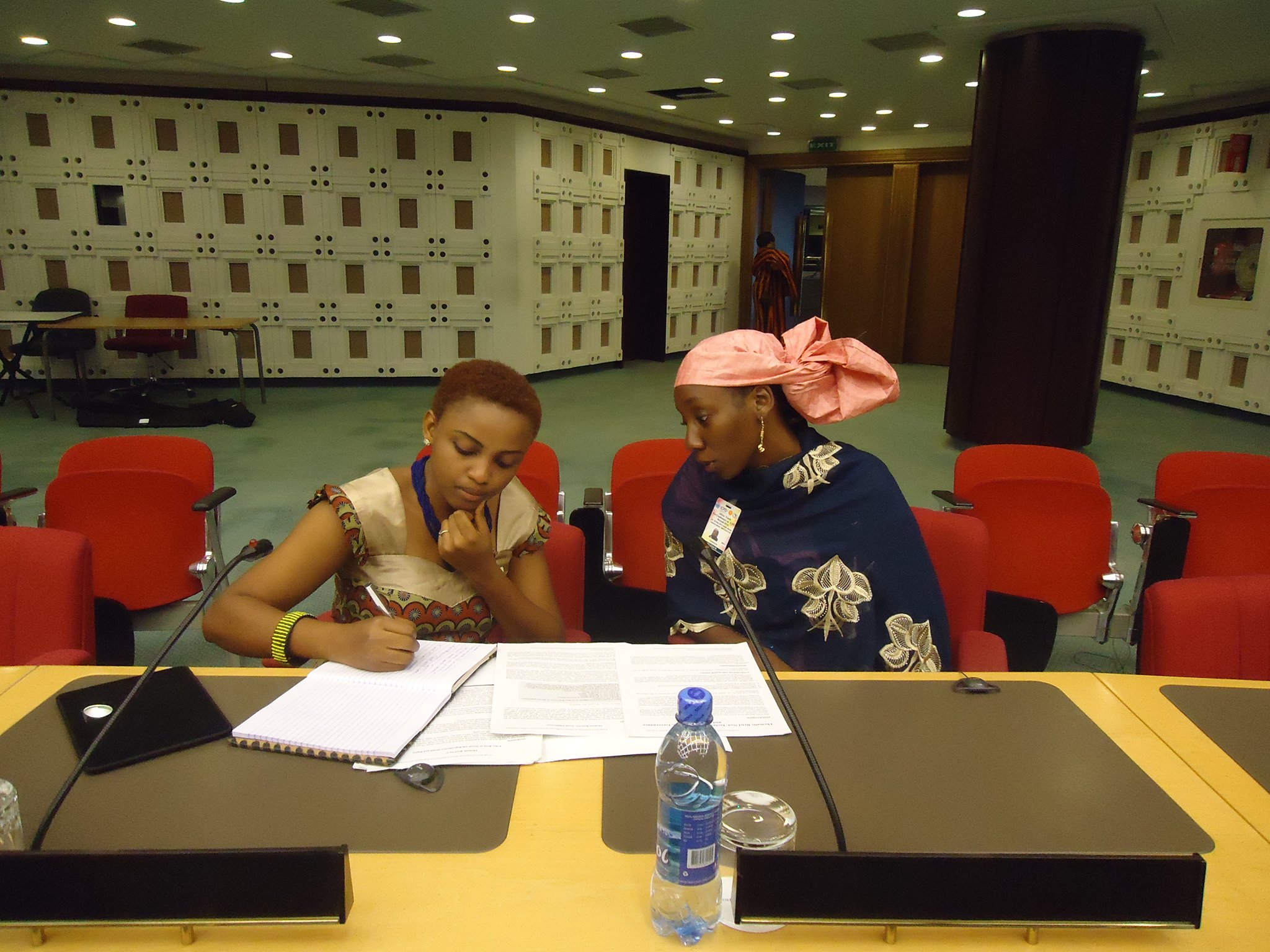
Zoneziwoh at the ICPD YOUTH AFRICA gathering.

Group leader Zoneziwoh has been talking about the issue with various groups of people throughout her community. For example, she talked with women street vendors and found: 1)  Women are harassed by unknown men walking by. 2) Women like the restaurant/ bar attendants, the one selling banana on roadside, maize etc been harass by clients. They fear to speak out against it for fear of losing their clients. Many people talked about reporting as being time consuming.

She also held a focus group with 10 participants who participated in activities to explain what street harassment means to them and several conducted an audit about places where they feel safe/unsafe. She aims to hold a community event by mid-October to further bring attention to the issue of street harassment.

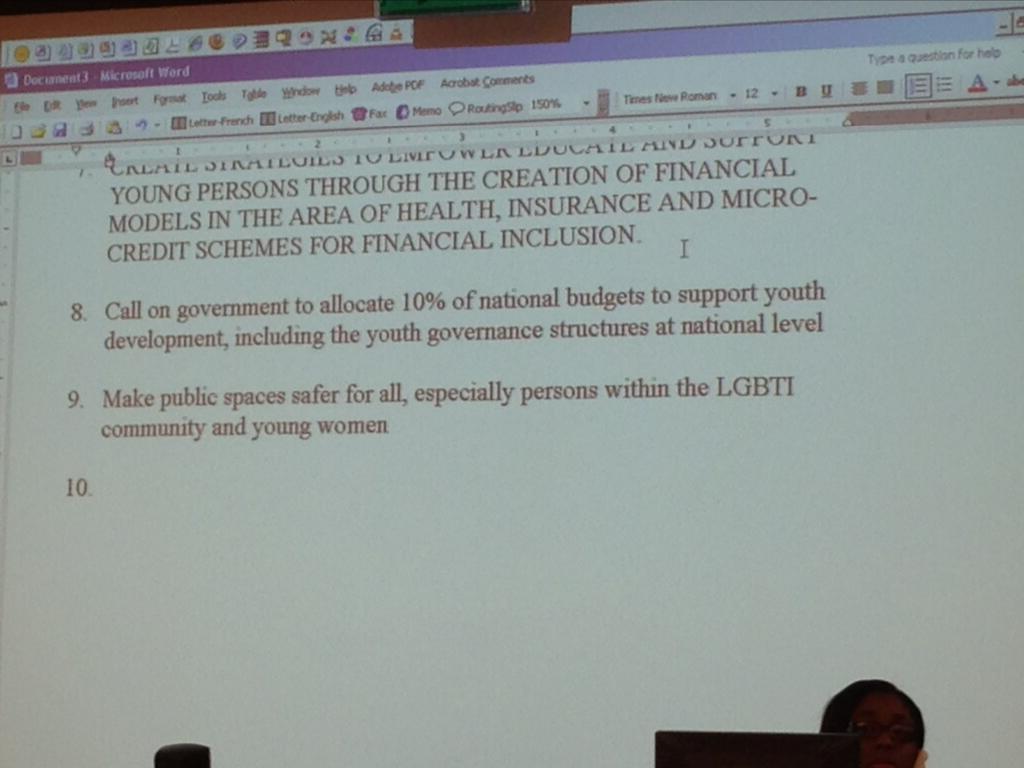
Additionally, this week, Zoneziwoh attended the Youth Forum preceding the African Regional Conference on Population and Development and she was able to speak about the need for policies that address sexual harassment in public space harassment.  Her recommendation was adopted and is currently included in the draft for the International Conference on Population and Development as the need to “Make public spaces safer for all, especially persons within the LGBTI community and young women.”

She believes this the first time that such a recommendation has been made about street harassment!
Chicago, Stop Calling Me Baby: Film Screening and Spoken Word

Group leader Phaydra: We have held a few meetings to work out the proposed film ideas. One meeting was composed of feminist activists and another with comedy writers. After receiving input and feedback we decided to concentrate on making one good film to satirize street harassment. We are working on a parody of dating commercials where the couples met via street harassment. We know this is a ridiculous scenario and hope it will emphasize how ridiculous it is to street harass. We will screen the film along with showcasing stand up comedy about street harassment and other common issues women encounter daily on October 13 in Chicago. It is free and open to members of the public! Info & RSVP.

 This pilot program is funded through the generous donation of Carlynne McDonnell. 

Help us expand this program in 2014 to work with 10 groups/sites with a tax-deductible donation to Stop Street Harassment. All donations made right now will be matched by a generous donor.

Share

Filed Under: SSH programs, street harassment

UK: Street Harassment, the Initiation into Adulthood

September 26, 2013 By Correspondent

By: Tilly Grove, London, UK, SSH Correspondent

In Chicago, teenagers with the Rogers Park Young Women’s Action Team spoke out against the street harassment they faced.

I remember being jealous of my friend who confessed to being wolf-whistled by the waste collectors she passed on her way to school, regardless of the fact that it clearly distressed her and she was lodging a complaint with the council.

We were fourteen or fifteen years old then. I had already swallowed whole the idea that street harassment wasn’t just something that we had to accept, but it was something that we should appreciate, something that we should want, something that we should envy other victims for. At the same time, these men were harassing a girl in her school uniform. Whether they were behaving in the way they did because they found her sexually attractive, because they wished to intimidate her, or both, they could be fairly safe in the assumption that they were dealing with a child. Clearly, it didn’t stop them. Maybe it encouraged them.

As women, we are acutely aware that street harassment is an accepted part of our lives. In many ways, though, it is more than that; it is the rite of passage we must undertake to be considered women. The moment a girl receives her first catcall, her first wolf-whistle or her first grope, she can consider herself well on the way to adulthood – no matter how unwanted the action was, and no matter how uncomfortable it made her. Such is the brainwashing of our society, she feels that she should be grateful, because it’s a compliment.

If she dares to pluck up the courage and tell someone – a parent, guardian, or teacher, perhaps – she may find her concerns brushed off on the basis that, “It’s just something women have to put up with,” so she needs to get used to it. If she tells her friends, she might find her complaints rejected because, “You love it really!” They’ve been taught to view it as a compliment, too.

The entitlement that men perceive themselves to have over women, their bodies and their lives knows no boundaries, age-related or otherwise. When I tweeted out a request for girls and women to share their earliest memories of street harassment, the majority recalled that it started before they were even teenagers. The eleven-year-old catcalled by builders on her way to get ice-cream, the thirteen-year-old beeped and hollered at by men in cars for wearing shorts, and the sixteen year old who can’t leave the house for even five minutes in a skirt without a man passing comment, all learned that the hard way.

Men began to intimidate them and reduce them to sex objects the moment they hit puberty. That’s the initiation into adulthood.

One thing above all else sticks out as being universal in the stories I heard, though: from the moment these women had their first experience of childhood street harassment, that harassment immediately became a constant part of their lives, and remains so to this day. They graduated into womanhood.

Tilly is studying for a BA in War Studies at King’s College London, where she is writing her dissertation on the effect that perceptions of gender have on the roles which women adopt in conflict. You can follow her on Tumblr and Twitter, @tillyjean_.

Share

Filed Under: correspondents, Stories, street harassment

USA: How to Better Respond to Street Harassment?

September 25, 2013 By Correspondent

By: Taylor Kuether, Minnesota, USA, SSH Blog Correspondent

Last night I was walking to a friend’s house for her housewarming party. It was a Saturday night and I was dressed to go out – not that that should be relevant. I had done my hair and put on makeup, and I thought I looked pretty good.

I was walking alone, which in my mid-sized college town of about 65,000 people, I’ve always felt safe and comfortable doing. I was walking down the sidewalk on a well-trafficked street full of popular bars. Two men walked around the corner, turning onto the street I was walking along. Instinctively, I quickened my pace and averted my eyes as I walked past them, as I do when I pass anyone on a narrow sidewalk and I’m walking alone.

As I passed them, one of the men said (and these really are his exact words), “Well aren’t you just the prettiest little lady in the whole wide world.”

I had not expected that. I don’t know why I was so caught off guard – maybe because I’d been lost in thought as I walked to my friend’s house, maybe because I’d walked far enough down the street that I was no longer in the heavily-trafficked area and I hadn’t expected to run into anyone, maybe because his words were something straight out of a movie. I mean, who says that?

Taken aback, I laughed. I actually laughed! And it gets worse – I laughed and said “thank you.” What?! Why did I do that? I write for a blog that aims to combat street harassment (thanks for reading, by the way!), and I THANKED a harasser for his comment.

That’s why I’m writing about this. How does one respond to street harassment? What should I have said? I know I handled it all wrong, and I’ve been kicking myself for responding with a laugh and a smile instead of a terse retort in – probably vain – effort to quell his future comments. But I didn’t. I’d been so caught off guard and so surprised by actually hearing such a cliché catcall in real life that my first natural reaction was to laugh.

So, readers, what should I have done? Tweet me @taylorkuether with your thoughts!

[Editor’s Note: There is no “right” or perfect response to street harassment! It’s okay if we don’t always speak out against it, there may be a million reasons why. At SSH we hope people know there are a range of responses to try out and that ultimately the choice is YOURS.]

Taylor Kuether is a senior journalism student at University of Wisconsin-Eau Claire in northwestern Wisconsin. She has previously written for The Washington Post and Minneapolis’ Star Tribune, worked as a reporter at her city’s daily newspaper, The Leader-Telegram, and its arts and culture publication, VolumeOne, hosted a local-music centered radio show on Wisconsin Public Radio, and worked as Editor-in-Chief at her student newspaper, where she enjoyed writing biting, slightly rant-y columns about feminist issues.

Share

Filed Under: correspondents, Stories, street harassment

“I didn’t ask you to look at me. In fact, I wish you wouldn’t”

September 24, 2013 By Contributor

I had dressed up for an interview and was wearing a bight colored dress. I walked past these two men on the street and one said, “Wow, you are really beautiful.” The other one followed it up with a whistle.

I wasn’t in the mood to talk or argue, so I smiled and continued to walk by. It was only a few steps after that I heard one of them yell, “What, you can’t say thank you?”

That’s when it dawned on me. Why was I obligated to say thank you? He had payed me a compliment, but had I asked him to look me up and down a evaluate me?

For a moment I felt almost naked and a little awkward. Then I felt angry that a man expected me to be grateful that I passed his expectations of what is beautiful.

I turned to him and asked, ‘Why do I need to thank you? Did you do me a favor? Did you help me?”

He looked a little surprised. “You don’t have to be so uptight,” he said.

“I didn’t ask you to look at me. In fact, I wish you wouldn’t.” I then quickly turned around and quickly walked in to the nearest apartment building entrance I could find, scared and hoping they wouldn’t follow. Thank goodness they didn’t.

I’m a happy, confident woman and I consider myself to be pretty. Sometimes I like to wear nice clothes and dress up. But sometimes I feel like I can’t because some one is going to assume I’m doing it to get attention. That I ‘want it’ be it a compliment or sex. I think that’s incredibly assumptive.

Has it ever dawned on these harassers that maybe a person likes to dress up for themselves? That it makes them feel good to look nice. That they could have other things on their mind than ‘getting some’, when they dress up?

It feels like a lose/lose. I’m either pretty and ‘wanting it’, or I’m a stuck up B because I ‘can’t take a compliment’.

Do you have any suggestions for dealing with harassers and/or ending street harassment in general?

Educate your male friends. Yes I know women do it too, but I have to say that from my point of view it comes from men more.

Give them examples of ‘harmless’ comments and explain to them why a women might feel uncomfortable with it. It’s all subjective after all.

– Frustrated Fem

Location: Downtown Hamilton

Share your street harassment story for the blog.

Share

Filed Under: Stories, street harassment

Book Release!

September 23, 2013 By HKearl

The new book 50 Stories about Stopping Street Harassers is officially out! Thank you so much to everyone who shared a story or a photo for inclusion in the book.

It’s available: In paperback for $10, Kindle for $6.99.

Proceeds: 50% of the book profits will fund SSH’s work.

Tweet chat: Join the book launch Tweet Chat tomorrow, Sept. 24, 1 p.m. ET, #50Stories, with @StopStHarassmnt and @FAANmail

Excerpt: Check out an excerpt of the book featuring seven stories on Bitch Magazine’s blog!

Share

Filed Under: Stories, street harassment

« Previous Page
Next Page »

Share Your Story

Share your street harassment story for the blog. Donate Now

From the Blog

  • #MeToo 2024 Study Released Today
  • Join International Anti-Street Harassment Week 2022
  • Giving Tuesday – Fund the Hotline
  • Thank You – International Anti-Street Harassment Week 2021
  • Share Your Story – Safecity and Catcalls Collaboration

Buy the Book

  • Contact
  • Events
  • Join Us
  • Donate
  • Facebook
  • Instagram
  • Pinterest
  • Tumblr
  • Twitter
  • YouTube

Copyright © 2026 Stop Street Harassment · Website Design by Sarah Marie Lacy