• About Us
    • What Is Street Harassment?
    • Why Stopping Street Harassment Matters
    • Meet the Team
      • Board of Directors
      • Past Board Members
    • In The Media
  • Our Work
    • National Street Harassment Hotline
    • International Anti-Street Harassment Week
    • Blog Correspondents
      • Past SSH Correspondents
    • Safe Public Spaces Mentoring Program
    • Publications
    • National Studies
    • Campaigns against Companies
    • Washington, D.C. Activism
  • Our Books
  • Donate
  • Store

Stop Street Harassment

Making Public Spaces Safe and Welcoming

  • Facebook
  • Instagram
  • Pinterest
  • Tumblr
  • Twitter
  • YouTube
  • Home
  • Blog
    • Harassment Stories
    • Blog Correspondents
    • Street Respect Stories
  • Help & Advice
    • National Street Harassment Hotline
    • Dealing With Harassers
      • Assertive Responses
      • Reporting Harassers
      • Bystander Responses
      • Creative Responses
    • What to Do Before or After Harassment
    • Street Harassment and the Law
  • Resources
    • Definitions
    • Statistics
    • Articles & Books
    • Anti-Harassment Groups & Campaigns
    • Male Allies
      • Educating Boys & Men
      • How to Talk to Women
      • Bystander Tips
    • Video Clips
    • Images & Flyers
  • Take Community Action
  • Contact

Archives for December 2013

#DelhiGangRape One Year Later

December 16, 2013 By HKearl

2012 vigil, via www.IN.com

One year ago today, a 23-year-old college student was brutally gang raped on a bus in India, on her way home from the movies. Her male friend was beaten by the rapists as he tried to protect her. Her injuries from the rapes eventually led to her death. During the following weeks, massive protests took place all over India and the world.

So where are we one year later?

PBS reports:

* India’s parliament passed anti-rape legislation earlier this year that would criminalize offenses like stalking.

* Organizations launched campaigns, in an effort to bring awareness to the prevalence of violence against women and offer suggestions for ways to stop it. This in-depth PBS NewsHour report from April details the some of those efforts.

* Earlier this year, in New Delhi, a help line was set up to encourage women to speak up and report crimes when they happen.

* And police in Delhi say that they conduct “surprise raids” on public transportation routes in which large numbers of women travel to monitor the incidents of harassment

According to the Wall Street Journal, more women in India are coming forward – reporting rapes and harassment. ” In Delhi, for example, 1,493 rapes were reported to police in the first 11 months of this year, more than double the number reported in the same period of 2012.”

It’s an encouraging indicator, but experts caution that there is much work to be done.

Ranjana Kumari who heads the Delhi-based Centre for Social Research, told the AFP: “The society is indeed becoming more sensitive to rape victims now, but there is still a long way to go. You cannot deny there is a rape epidemic in the country.”

Share

Filed Under: News stories

USA: Strong Women and Harassment

December 16, 2013 By Correspondent

By Sara Schwartzkopf, Colorado, USA, SSH Correspondent

As cold weather draws ever more present, I’m relieved. I’m relieved for the reprieve from shaving my legs every day, the ability to wear large comfy sweaters, cool-looking boots, and the drop in street harassment tales, both personal and otherwise. Not that they stop by any means. Maybe it’s just as simple as fewer people taking their time when walking the streets. Less public interaction means less opportunity for street harassment.

Instead we spend more time inside. More time is spent reading, watching movies, and getting caught up on television series. More time spent absorbing pop culture and common narratives about women.  I bet some of you can see where I’m going with this. But I have neither the time or space to go through all the things that can be upsetting about media depictions of women. From catty and mindless reality tv shows to romantic comedies and “chick lit,” there’s a pretty common theme that women are horrible, or spend all their time worrying about guys. Or that they’re horrible because of a guy. It seems the antithesis to this is to seek out female lead characters, and make women be as perfect as a heroine can be.

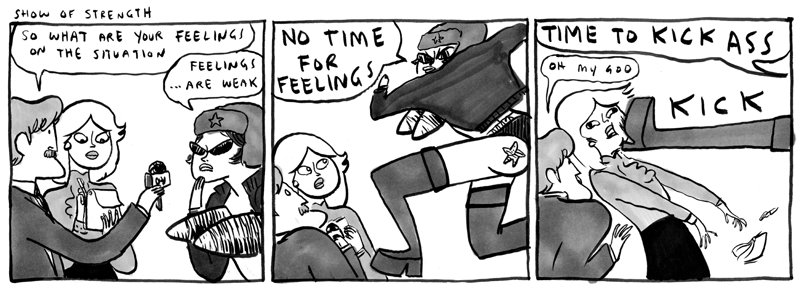
This doesn’t work for me. There’s more than one reason for why we need diverse and well-rounded characters. It seems to me that women leads in media, especially women in sci fi/fantasy and action flicks, have a requirement to be strong (let alone a good many of them aren’t strong characters so much as just strong). They become a Mary Sue of a sort, where they react to challenging situations as we wish women could. So when we find ourselves faced with a similar situation or challenge, we often expect ourselves to be just as flawless. Media creates unrealistic depictions, and then we hold ourselves to these unrealistic expectations.

The problem is we are flawed. Everyone is. Yet when we have an issue with say, harassment, it’s natural to judge ourselves on what we’ve had modeled for us. So what’s the natural outcome when every time we see a woman in a male-dominated environment who responds to harassment by physically or verbally beating up her antagonist? I think it reinforces that we should be able to do this for ourselves. It’s incredibly satisfying to watch, but when it’s the only narrative out there we act as though it’s the woman’s job to overpower their aggressors.  It ignores consequences, forgets the possibility of continued contact, and it plays into this idea that men only need to respect women who are physically stronger than them.

It’s one solution to the Damsel in Distress trope, but it’s also one that puts responsibility squarely on the victims. If the heroine of the story can’t stop what’s going on then it becomes her fault, rather than the aggressor’s.  It doesn’t really challenge rape culture, it just shifts how women are supposed to deal with it.

Maybe that’s why we judge passive reaction more harshlythan we should. We think that if we were confronted with harassment of any sort we would stand up for ourselves and give a verbal equivalent of a beat down. Instead, a lot of us feel threatened, ignore comments, and try to leave as quickly as possible. That doesn’t keep up from blaming victims though. We forget that we need to place the blame solely on the harasser. After all it was their decision to shout things, to grab, to make obscene gestures, or do sexually explicit things that were never asked for in the first place.

By Kate Beaton

Sara is a recent graduate of the University of Denver where she majored in Sociology, International Studies, and minored in Japanese. She has previously written on issues relevant to the Native American community at Le Prestige Du Monde, pulling heavily on her experiences as a mixed-race Kiowa and Chickasaw.

Share

Filed Under: correspondents, street harassment

“The good people outnumber the bad”

December 15, 2013 By Contributor

This story has both the good and the bad in it. Bad news first (it is a harassment story, after all).

I was waiting for the Q train at Union Square, probably about 11:30 or so at night. I hardly ever go out socially at night without my husband. As much as I hate that that’s the only way I actually feel safe enjoying the city at night, it’s my preference. In this case, I was coming from an important function for my law journal – of course I’m not going to let the creeps deter me from my responsibilities and work/school life.

I was standing at the platform, when a man half-swaggers/half-shuffles in front of me, mumbling incoherently. I try ignoring him, but he’s clearly mumbling at me, so I ask, “What?” After more mumbling, I say – tersely, I might add, since I was on my guard about this guy from the start – “I cannot understand a word you’re saying.” He replies with a barely-comprehensible “Can I getchyo number?” I said “No.” without looking at him. He, the mumbling buffoon, immediately takes it upon himself to reply, “Whatever, you’re a fucking slut, anyways.”

Now, I was tired after a very long and active day, but it just made my blood boil so much that I turned around to him as he was shuffling away, “EXCUSE ME? You don’t even know me! I happen to be married and you CANNOT talk to me like that!” Then, losing his mumble, he shouted back. “No you’re not, you’re not married, don’t lie, you’re just a fucking whore.” I lost my head; I could barely see; I was so enraged and exhausted, that I just kept screaming at him “I’m married; leave me alone. Leave me alone. Leave me alone.” He kept at it for a while, calling me every kind of name in the book, all because I had the good sense to not give my number to some creep in the subway at midnight.

People saw. People stared. And he walked away quickly, since by now all eyes were on him, having watched him torment me. Here comes the good part.

As the trembling dissipated and the wave of fear started to dissipate and tears were welling in my eyes, the most wonderful girl, about my age, put her arm strongly around me and asked if I was okay. The Q was approaching and she asked if this was my train, since she wanted to be sure I wasn’t going to be stuck on a train for thirty minutes with this creep. Fortunately, he was long gone. We both got on and then had a great conversation about just the kind of things this blog talks about. I told her about SSH, and she told me about a great non-profit called Groove With Me that she works for, which focuses on empowering young women.

I felt a lot calmer with a kind stranger to talk to, and I also enjoyed being able to talk about these issues right after a perfect example, in front of a bunch of commuters who witnessed the whole t hing. In fact, as I left the train and was walking the short distance to my apartment, a young guy walking a few paces ahead of me turned and also politely asked if I was okay. He had seen it as well. I thanked him and said I was okay now, and just happy to be getting home. I also voiced my frustration at how awful it is to be so disrespected just for being a woman. He was understanding and wished me a good night.

When it comes down to it, the good people outnumber the bad.

– KN

Location: Union Square, Manhattan

Share your street harassment story for the blog.
Check out the new book 50 Stories about Stopping Street Harassers!

Share

Filed Under: Stories, street harassment

Egypt: Put Yourself in Her Shoes

December 14, 2013 By HKearl

I love this PSA from UN Women’s Egyptian office.

Share

Filed Under: Resources, street harassment

Cameroon: Workshop to Raise Awareness and Build Allies with Adolescents

December 14, 2013 By Contributor

By Zoneziwoh Mbondgulo, Buea, Cameroon, SSH Safe Public Spaces Mentee

It is estimated that about 1 in 3 women worldwide experience sexual or physical violence at least once in their lives.  And over 80 percent of women across the globe have also experienced at least one or two or several forms of street harassment from men they do not know, and Cameroon is no exception.

In Cameroon, street harassment is still an overlooked issue. It is common seeing men and even young boys feeling it’s ok to publicly abuse or harass a lady. This long age act on women and girls is more or less seen as a norm to a social issue that must be address.

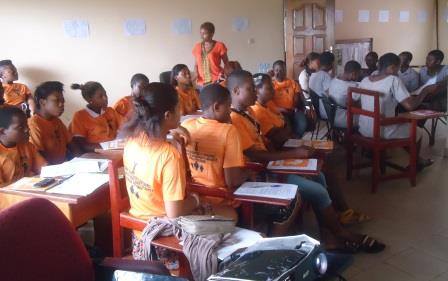
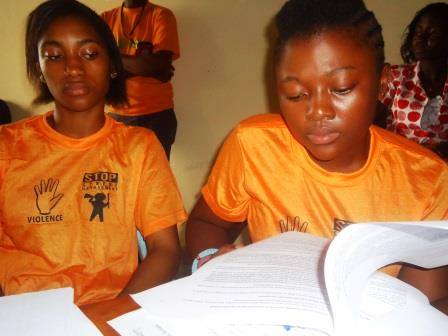
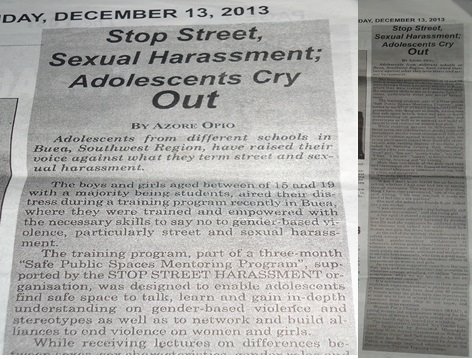
In Buea, Cameroon, on November 30, 2013, during the 16 Days of Activism Against Gender Violence, over 25 boys and girls within the ages of 15-19, the majority been students from different schools across Buea, were trained and empowered with the necessary skills to say no to gender-based violence, particularly, street and sexual harassment.

The training program which was part of 3 months, Safe Public Spaces Mentoring Program, supported by the STOP STREET HARASSMENT organization, was hosted by Women For A Change, Cameroon (WFAC), a young women-led organization working for the promotion of women and girls sexual and reproductive health rights.

Designed to enable adolescent girls and boys find safe space to talk, learn and gain in-depth understanding on gender based violence and stereotypes; as well as to network and build alliance to end violence on women and girls.

The training opened with participants asked to complete the sentence, connecting to the UN’s suggestion to wear orange to stand up against violence: #Iwearorangebecause….

Rocard, 18 years #Iwearorangebecause ” I am a boy and i stand for equality” #16DAYS #16DAYSOFACTIVISM

#Iwearorangebecause ‘I m a girl and i stand for equality” Fatima 17 years

“#Iwearorangebecause I have a voice and it should be heard” Gobina, 17years

Next, participants shared their fears and expectations from the training.  The majority feared that a day would not sufficient to gain enough knowledge and skills to effectively mentor peers, raise awareness, and/or educate the public, families and friends on the negative consequences of gender-based harassment of girls/women. One participant said, “I am always shy and often feel inferior to speak up. I need to take part in many more of such programs so I gain self-empowerment and boldness to speak up.”

Nonetheless, their expectations kept them hopeful that by the end of the day, they would have acquired the necessary tool to face some of their fears, and most importantly they would know how to use the skills gained and reach out to a wider population.

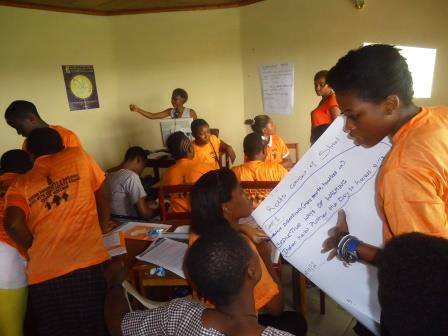
The training, which lasted for six hours, included three lecture seminars, a series of role play, debates, interactive sessions, and Q&A.

The first lecture seminar, facilitated by me, explained to  participants some KEY GENDER CONCEPTS – like differences between sex and gender; examples of sex characteristics and gender roles and stereotypes; what’s gender-based violence and different forms of violence against women and girls – with a particular focus on street and sexual harassment.

During the lecture seminar 1, a participant was nominated by the group to chair and moderate a group discussion, where everyone present was asked to take time to reflect on a situation where s/he thought they experienced / witnessed gender based violence – principally street and sexual harassment- and how they overcame / addressed it.

THE REFLECTIONS

More than 2/3 of the girls said they had experience one or two forms of harassment – be sexual advances or unwanted touch, both in public and on campus – and when this happens sometimes they just ignore or throw insult back at the harasser. The most common experiences were – whistling,  abusive jokes and comments like ‘African baby’,  ‘small girl’ ,’ fine ass’, ’ pretty butts’,  ‘ my size’,  ‘V boot’ ‘a say ehh’ ,’sssshh’ ,’ehhh’ ,  and at times forceful holding, catcalling, touching, ‘air-kiss’…

Two girls, aged 16 and 17, shared individual experiences with harassment online which include sexist comments and unwanted sexual attention. E.g, one said how a guy she doesn’t know texts her on Facebook asking whether she had ever had sex or sexting through messaging.  “This was the most disgusting thing I have ever experience” she explains. “I feel very insulted; it made me kind of feels like a sex-machine”

When it happened, she continues “I had to ask my friends if I looked like a sex worker”. “I was severely affected – psychologically and sometimes traumatized,” she added

One boy, aged 18 shared a negative experience of how he had once been sexually harassed by another man and how his experience with the lesson gathered at the training has helped him understand how women and girls feel when harassed.

Another participant aged 19 spoke of her experience face-to-face with sexism. She explains, “Last youth year, I practiced and rehearsed to perfection to act the role of the president for a drama my school was to perform. But, I was discriminated against by being given the role of a secretary. The teacher said to me that ‘a woman can’t be a president’, he even went on to ask me if the president of Cameroon was a woman.”

“I was bittered about the choice, and the fact that I was deny simply because I was a woman not based on competence”, she added, “Whereas the boy who took the role couldn’t deliver compared to me. Everyone knew I was good at my role and if allowed to act the role of the president, I was going to deliver so well”.  

“In my village,” another attendee said, “Education is meant only for boys. They say because boys inherit, so let more privilege be given to a boy. After my first school, I was asked to go to the market and sell and hope for the day where a man will get married to me. My dad preferred to sponsor my male siblings to boarding schools; he will send girls to day schools.

“At first, in our house,” another said, “Boys wouldn’t cook. Cooking was meant for girls only. But gradually, I used my position as a senior sister, to bring balance in the kitchen. Now at home the boys do cook.”

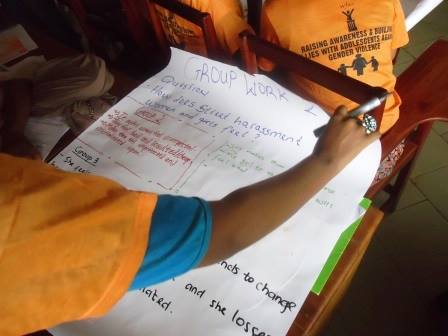
After the first lecture seminar, participants were assigned to group tasks. Each group expected to brainstorm and seek solutions towards combating street harassments and sexual gender based violence on women and girls. Solutions proposed were: government must establish gender-sensitive mechanisms to effectively address gender based harassment and violence on women and other minority groups as a security issue.  Participants also suggested that “more public awareness, seminars and workshops to educate boys especially, who form a great number of the harassers, on the secondary effects of harassment on women and girls”. An exceptional suggestion from the boys group that “girls and women shouldn’t pay attention to what ever strange whistling, catcalling”, “sometimes, when we are ignored, we feel extremely sad and useless!” the boys said.

The next lecture seminar followed shortly after the break and the topic was on Dealing With Sexual Harassment in School in Just Seven Steps. The session was very interactive, and also had group works.

The last lecture seminar of the day was facilitated by Ms. Amshatu Verbe, a visual impaired educationist at the Government Teachers Training College, Buea, and her presentation was focused on self-esteem as an effective tool and weapon adolescents must have while addressing gender based violence (street and sexual harassment)

In culmination, participants expressed satisfaction and attainment of their expectations. Since the training, many have joined our WFAC page on the social media, through which we continue to engaged and share knowledge on weekly basic, on best ways to increase public awareness on gender based harassment, get boys involved as allies and above all gained  empowerment as advocates against Violent on Women and Girls.

Updates on this project can be found at: Women for a Change- Cameroon, or via Twitter @zofem.

Share

Filed Under: 16 days, SSH programs, street harassment

« Previous Page
Next Page »

Share Your Story

Share your street harassment story for the blog. Donate Now

From the Blog

  • #MeToo 2024 Study Released Today
  • Join International Anti-Street Harassment Week 2022
  • Giving Tuesday – Fund the Hotline
  • Thank You – International Anti-Street Harassment Week 2021
  • Share Your Story – Safecity and Catcalls Collaboration

Buy the Book

  • Contact
  • Events
  • Join Us
  • Donate
  • Facebook
  • Instagram
  • Pinterest
  • Tumblr
  • Twitter
  • YouTube

Copyright © 2026 Stop Street Harassment · Website Design by Sarah Marie Lacy