• About Us
    • What Is Street Harassment?
    • Why Stopping Street Harassment Matters
    • Meet the Team
      • Board of Directors
      • Past Board Members
    • In The Media
  • Our Work
    • National Street Harassment Hotline
    • International Anti-Street Harassment Week
    • Blog Correspondents
      • Past SSH Correspondents
    • Safe Public Spaces Mentoring Program
    • Publications
    • National Studies
    • Campaigns against Companies
    • Washington, D.C. Activism
  • Our Books
  • Donate
  • Store

Stop Street Harassment

Making Public Spaces Safe and Welcoming

  • Facebook
  • Instagram
  • Pinterest
  • Tumblr
  • Twitter
  • YouTube
  • Home
  • Blog
    • Harassment Stories
    • Blog Correspondents
    • Street Respect Stories
  • Help & Advice
    • National Street Harassment Hotline
    • Dealing With Harassers
      • Assertive Responses
      • Reporting Harassers
      • Bystander Responses
      • Creative Responses
    • What to Do Before or After Harassment
    • Street Harassment and the Law
  • Resources
    • Definitions
    • Statistics
    • Articles & Books
    • Anti-Harassment Groups & Campaigns
    • Male Allies
      • Educating Boys & Men
      • How to Talk to Women
      • Bystander Tips
    • Video Clips
    • Images & Flyers
  • Take Community Action
  • Contact

Archives for March 2014

USA: Hollaback! Baltimore Launches The Safer Space Campaign

March 2, 2014 By Correspondent

Brittany Oliver, Baltimore, MD, USA, SSH Blog Correspondent

As activists across the nation work to end street harassment in their cities, there is one organization that is doing some serious work in making our streets safer: Hollaback! Baltimore. As a non-profit, Hollaback! Baltimore is currently on a mission to building a network of supportive non-threatening environments in Baltimore City.

This month Hollaback! Baltimore are encouraging local businesses in Baltimore City to sign the Safer Space Campaign Pledge, which declares their commitment to ending street harassment against women and LGBTQUIA people. This pledge would require staff to take complaints seriously, deal with the harasser, and offer support resources as needed.

By signing the pledge, each venue is given a packet of resources to assist them with keeping their space safer for guests. The packet includes a background on the issue, simple things to do and not do, the official Hollaback! Employer’s Guide to Ending Street Harassment, and a poster to hang publicly so guests will know what won’t be tolerated.

Poster Design: Kristen Argenio at Ideal Design Co

According to Hollaback! Baltimore, this campaign began in March 2013 when Hollaback! London formed a partnership with Fabric, a local club that was fed up with hearing that women were being harassed in their venue. The complaints they received motivated the club to make a difference, so they partnered with Hollaback! London to develop a campaign that would work directly with venues to ensure their current employees and security policies are effective. After hearing about their success with the campaign, Hollback! Baltimore felt Baltimore City needed a similar campaign. This is what they created:

THE PLEDGE:

By signing this pledge, we the undersigned do hereby agree to:

* Post the “Safer Space” poster provided by Hollaback! Baltimore in a prominent place for all employees/staff/volunteers and attendees/customers to see
* Take complaints of harassment, discrimination, and violence against customers or staff seriously
* Remove any offending parties from our space
* Ensure our staff, particularly those responsible for security, are aware of our policies
* Use the resources given to us by Hollaback! Baltimore to better understand the issues at hand as well as the best methods for dealing with them
* Inform victims of their right to share their story publicly and anonymously on Hollaback! (via the website or free phone app) by handing out informational postcards

I believe this campaign will not only help to make streets safer, but it will hold venue owners accountable for what goes on during business hours. You shouldn’t have to be an activist to want to make a difference. Whether you’re a teacher, police officer, business owner, janitor, or student, all members of the community should be willing to make our streets safer for everyone.

Ending street harassment has to be a team effort if we want to get the message across that harassment is NOT OKAY. Through this campaign, local businesses can now become effective agents of change by making their establishments harassment free for everyone.

To learn more Hollaback! Baltimore and the Safer Space Campaign, visit http://bmore.ihollaback.org/

Brittany Oliver is a recent graduate of Towson University and works in the non-profit communications sector and supports local anti-street harassment advocacy through Hollaback! Baltimore. She blogs at brittuniverse.wordpress.com and publicly rants on Twitter, @btiara3.

Share

Filed Under: Activist Interviews, street harassment

USA: Reflections on a Women Bike PHL Street Harassment Focus Group

March 1, 2014 By Correspondent

Katie Monroe, Philadelphia, PA, USA, SSH Blog Correspondent

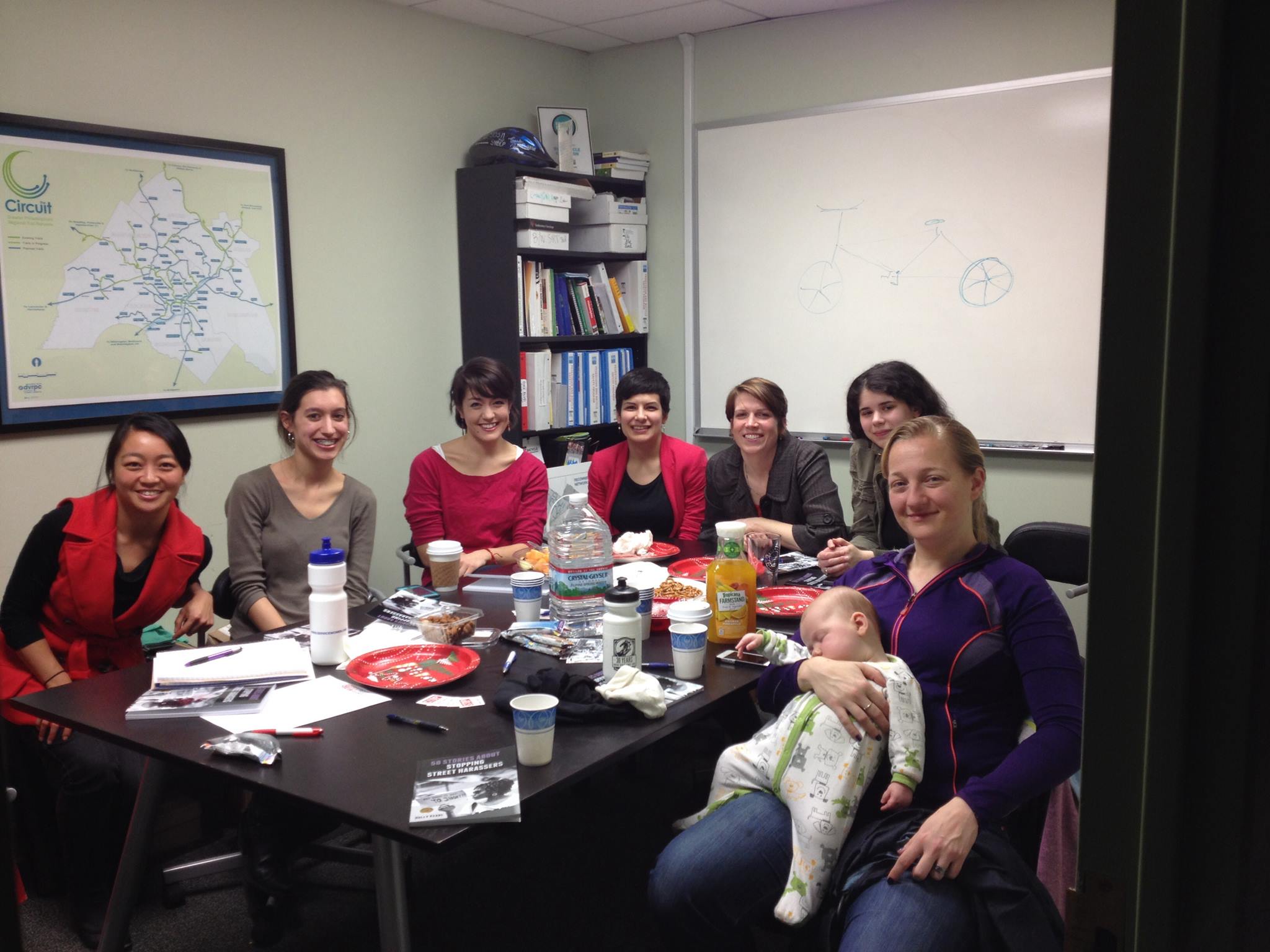
Philly focus group. 2.25.14

This past week I had the opportunity to help orchestrate a focus group for the national study on street harassment currently being conducted by Stop Street Harassment. When Holly asked if I thought Philly bicyclists might make a good “group” for her study, I wasn’t completely sure if I could pull enough interested folks together on short notice. But I sent out a quick email to a small group of women bicyclists I know through Women Bike PHL (the women’s bicycling program I run at the BCGP) – and got an overwhelming response. At 6 p.m. this past Tuesday, almost everyone I emailed showed up to the Bicycle Coalition of Greater Philadelphia office to take part in the focus group – the first of its kind, as far as I am aware. The hour that followed was full of insights that are still bouncing around on my brain, but here are three reflections I felt most compelled to share:

1) While I took care to distinguish between gender-based and transportation-based harassment in my last post, the focus group reintroduced some gray areas to my thinking. Car-on-bike harassment can and does certainly take place with every combination of genders of driver and cyclist, and there can be situations of car-on-bike harassment that simply involve an assertion of power over lane space and nothing more. However, I got the sense in the focus group that for women, harassment because they’re riding a bike can often become increasingly gendered as a situation escalates – for instance, getting called a cunt or bitch by an aggressive driver was a common theme. In addition, it was pointed out that while there may be important distinctions between the two types of harassment, the “gut feeling” women get from being sexually street harassed is a very similar “gut feeling” to the one they get from an aggressive driver. Good food for thought.

2) A great point resurfaced in the focus group that I remember a few women mentioning in the Women Bike PHL Facebook page last fall. That is, the fact that harassment is a reason that people (particularly women) might choose to run a red light rather than waiting for the green at an intersection, even if they generally abide by traffic laws. When we talk in the bike community about following the rules, I don’t think we often acknowledge the different ways that folks of different gender and sexual presentations experience being still versus in motion on our streets and sidewalks. A woman standing with her bicycle waiting for a green light is a sitting duck when it comes to harassment – and when the choice is between standing and taking it or looking both ways and pedaling through the red, it’s hardly surprising that some women would choose to pedal on! I think this aspect of the experience of biking isn’t always understood widely within the bike and bike advocacy community, and it seems important to me.

3) In that vein, the whole conversation just made me realize even more deeply how much street harassment and transportation choices are fundamentally linked. I saw a lot of light bulb moments happen during the focus group – for me and for the rest of the attendees. It was fascinating to hear the stories of how bicyclists – who have made a very particular and still relatively rare transportation choice, to ride a bicycle – perceive their experiences of street harassment. A few of the varied perspectives: biking as a means to escape the harassment that walking entails, biking creating safer ways to interact with strangers because of increased speed, or biking entailing sacrificing the opportunity to tell off street harassers in a satisfying manner. And I’m sure that’s only the beginning!

I’m excited to read the report and hear what resonated with Holly about our discussions on Tuesday, and to read the report as a whole with questions of transportation in mind. I’m so glad I could contribute to this study in my own way and so grateful to the group who came out to discuss this topic – thank you!

Katie Monroe founded the Women Bike PHL campaign at the Bicycle Coalition of Greater Philadelphia and she works at the Philly nonprofit Gearing Up, which gives some of Philadelphia’s most marginalized women – those in transition from incarceration, addiction, and/or abuse – the opportunity to ride bicycles for exercise, transportation, and personal growth. Follow her on Twitter, @cmon_roe.

Share

Filed Under: correspondents, SSH programs, Stories, street harassment

« Previous Page

Share Your Story

Share your street harassment story for the blog. Donate Now

From the Blog

  • #MeToo 2024 Study Released Today
  • Join International Anti-Street Harassment Week 2022
  • Giving Tuesday – Fund the Hotline
  • Thank You – International Anti-Street Harassment Week 2021
  • Share Your Story – Safecity and Catcalls Collaboration

Buy the Book

  • Contact
  • Events
  • Join Us
  • Donate
  • Facebook
  • Instagram
  • Pinterest
  • Tumblr
  • Twitter
  • YouTube

Copyright © 2026 Stop Street Harassment · Website Design by Sarah Marie Lacy