• About Us
    • What Is Street Harassment?
    • Why Stopping Street Harassment Matters
    • Meet the Team
      • Board of Directors
      • Past Board Members
    • In The Media
  • Our Work
    • National Street Harassment Hotline
    • International Anti-Street Harassment Week
    • Blog Correspondents
      • Past SSH Correspondents
    • Safe Public Spaces Mentoring Program
    • Publications
    • National Studies
    • Campaigns against Companies
    • Washington, D.C. Activism
  • Our Books
  • Donate
  • Store

Stop Street Harassment

Making Public Spaces Safe and Welcoming

  • Facebook
  • Instagram
  • Pinterest
  • Tumblr
  • Twitter
  • YouTube
  • Home
  • Blog
    • Harassment Stories
    • Blog Correspondents
    • Street Respect Stories
  • Help & Advice
    • National Street Harassment Hotline
    • Dealing With Harassers
      • Assertive Responses
      • Reporting Harassers
      • Bystander Responses
      • Creative Responses
    • What to Do Before or After Harassment
    • Street Harassment and the Law
  • Resources
    • Definitions
    • Statistics
    • Articles & Books
    • Anti-Harassment Groups & Campaigns
    • Male Allies
      • Educating Boys & Men
      • How to Talk to Women
      • Bystander Tips
    • Video Clips
    • Images & Flyers
  • Take Community Action
  • Contact

Archives for May 2014

New Studies in Chile and Los Angeles

May 9, 2014 By HKearl

As a researcher and public policy nerd, I love data, research and studies so I am excited that this week, there were two new studies about street harassment. These studies are important because they prove street harassment is a problem and they can lead to more awareness about these issues and better policies to address them.

Chile:

In an opt-in survey, the newly-formed Organization Against Street Harassment (OCAC) “found in its first study that almost 40 percent of Chilean women are harassed on a daily basis, while 90 percent of women reported having been harassed at least once in their lives.”

Los Angeles, California, USA:

“A Los Angeles County Metropolitan Transportation Authority survey of nearly 20,000 passengers on the sprawling bus and rail system asked whether they felt unsafe during the last month while riding Metro due to “unwanted touching, exposure, comments, or any other form of unwanted sexual behavior.”


About 21% of rail passengers and 18% of bus passengers said yes. About 17% of bus riders and 13% of train riders said they felt unsafe while waiting at bus stops or train stations.”

Share

Filed Under: Resources, street harassment

Egypt’s New Anti-Sexual Harassment Law

May 8, 2014 By HKearl

At long last! This has been in the works for years.

Via Albawaba:

“Egypt’s cabinet approved on Wednesday a new anti-sexual harassment law…The cabinet had amended the law and sent it to the justice ministry for revision last month. The justice minister then revised it and sent it back to the government for final approval.

Previously, there had not been a specific law proscribing sexual harassment in Egypt. However, three articles in the penal code were sometimes applied in cases of sexual harassment.

The new draft states that a sexual harasser is one who “accosts others in a public or private place through following or stalking them, using gestures or words or through modern means of communication or in any other means through actions that carry sexual or pornographic hints.”

The new law punishes sexual harassment with a prison sentence, a fine or both.”

Thoughts?

Share

Filed Under: News stories, street harassment

“I’ve had people make offers for me to sell my body, as if I were on auction”

May 7, 2014 By Contributor

My story is more than one incident. Growing up I learned not to take walks, to never acknowledge people, and pretend to talk on the phone (with 911 already dialed).

I began riding a bike for exercise, as I receive less comments and gestures, although they still happen.

The most recent was when a car came up right a long side me, a man leaned out and seemed to try and grab me while yelling, “HEY B****!!!” I wasn’t sure what to do, so I kept going and thankfully another car came up, so he had to go back in his lane.

I’ve had people make offers for me to sell my body, as if I were on auction. I’ve had people call me names, whistle, etc. In one walk I could have four incidents. I stopped walking to church, because it got to uncomfortable and someone would follow me consistently.

When I go out with my male friend, it is so NICE not to have the comments or be on guard as much. I was shocked the first time walking around the city with him how NO ONE tired anything. It makes me want to have an escort all the time. Which is extremely sad.

I’ve become to expect the harassment, and am pleasantly surprised when I don’t receive any. However, most of the time I get at least some. I don’t even bring up all the incidents to people, cause I know they will think they aren’t a big deal.

– Anonymous

Location: Where doesn’t it happen?

Share your street harassment story for the blog.
Check out the new book 50 Stories about Stopping Street Harassers!
Share

Filed Under: Stories, street harassment

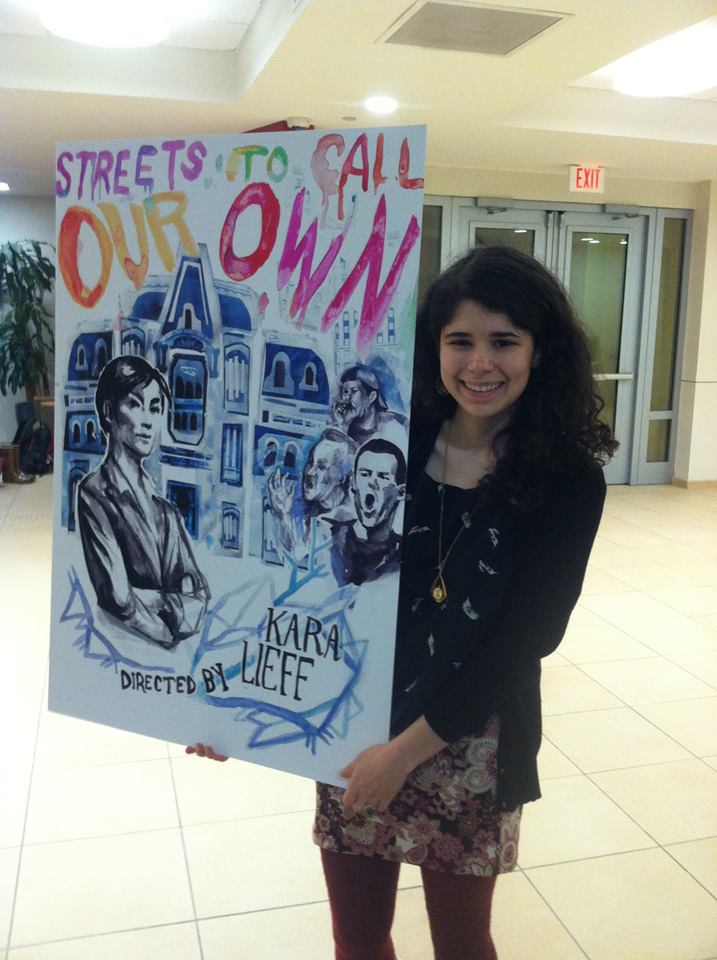
USA: Interview with “Streets To Call Our Own” Filmmaker

May 6, 2014 By Correspondent

Katie Monroe, Philadelphia, PA, USA, SSH Blog Correspondent

Kara at her film premiere

I had the honor of sitting down with Kara Lieff, a Temple University senior getting ready to graduate with a degree in Film & Media Arts and a minor in Women’s Studies. Over the course of her undergraduate career, she’s become a documentarian of street harassment and anti-street-harassment efforts in Philadelphia. Her fifteen-minute documentary on the topic, “Streets To Call Our Own,” premiered last week at Temple University.

What inspired you to make films about street harassment?

My first interest in the topic of street harassment came from my older sister. She has done workshops on street harassment. She was a women’s studies/gender studies major…a super feminist. So I got a lot of that kind of stuff from her; she definitely influenced me. When I moved to Philly for school, it was different from [living in the suburbs.] That kind of opened my eyes.

I did my first project on street harassment during my sophomore year. We had to do an “action project” – something that propelled viewers to action. I wanted to propel viewers to talk about street harassment, or if they engaged in that behavior or see it, to do something about it. So I made this short PSA: Asking For It. Then I did another one junior year for another short class project: “Make A Woman Smile.”

And from there you decided to do your Senior Project about street harassment. It’s such an under-discussed topic – did that affect your choice?

Yeah. There’s not a lot of media about it. Compared to other things…and I feel like a lot of times, the media that’s out there is within “the circle.” So that’s one of my biggest challenges – I have this project, now how can I show it to people who don’t know about the topic, who I actually want to reach? Of course it’s great to have people within the community watch it and appreciate it, but that might not make as big of an impact.

How did you get started?

Last April I filmed the sidewalk-chalking and subway discussions for Anti-Street-Harassment week, which was how I got in touch with Nuala Cabral [she was the organizer]. And I think that’s where I met Rochelle Keyhan and Anna Kegler [from Hollaback! Philly].

“Meet Us on the Sidewalk” | “Meet Us on the Subway, Part I” | “Meet Us on the Subway, Part II”

Then there were a couple of things happening last November. Hollaback! Philly hosted a talk at Wooden Shoe Books, and then the next morning was the City Council Hearing. So I went to the City Council hearing and I filmed that. [Side note – the hearing was where I met Kara!] The following weekend, I did sit-down interviews with [Hollaback! Philly leaders] Rochelle and Anna. And then it just kind of snowballed from there. I wanted them to keep me in the loop about what they were doing, and they’ve been so helpful…they’re so busy themselves, but they’ve taken the time to sit down with me, to answer all my crazy questions, email back and forth a billion times.

And this point I’m geeking out – because I look up to them, you know what I mean? And now I know them as people, not just as “Hollaback Philly.” I feel weird talking about myself, promoting myself…so I never would have imagined that I would be one to know all these people in the community. And now I do!

That’s great! I feel the same way about the bike community in Philadelphia – so welcoming, incorporating me into the fabric of what’s going on…it’s amazing. So what happened next?

At the City Council hearing I met Jordan Gwendolyn Davis, and I knew that I wanted to interview her, because she has a unique perspective on street harassment.

What changed over the course of the project?

Well, my original proposal was just to talk about the Anti-Street-Harassment movement in Philly. And then I realized that I really needed to have people share their stories. I can’t just talk about what people are doing to fight this problem without explaining what the problem is.

Especially if you want it to be accessible to a broader audience.

Yeah. So at some point I made that shift. And I decided I wanted to interview people about their experiences with street harassment – just regular people [not necessarily involved in the movement]. So I interviewed three people – and we went to the location where they were harassed to film. Everyone had such unique perspectives – I didn’t have time to fit it all into my 15 minute project.

My first subject was harassed at Temple. Basically she was taking off her sweater, because it was hot out, and this man driving by yelled out, “Ooh yeah baby, take it all off.” And it really affected her – first of all, it ruined her day. I mean it happened in September, and she still remembers that incident. She reported it to Temple Police and that got nowhere, which is very disappointing…

And the next person talked about how every morning, she walks one block to the train, and she called it “a gauntlet of street harassment.” And someone actually said something to her while we were filming! And she brought in the aspect of how she used to go [a different block], but that’s out of the way, and why should she have to change her route? She should be able to go wherever she wants.

And then a third woman I interviewed was harassed in Fishtown. And she talked about how a bunch of workers harassed her, and so she called the number on their truck and reported it to their supervisor. And she doesn’t know if anything actually happened, but at least the person she talked to was really supportive, which was kind of a nice story. A lot of times don’t want to report it, because they think they’ll be laughed at – and that could totally happen, but at least in her case that didn’t happen, which was really validating.

And then I included Jordan and Sarah’s story from the testimony. And then Erin from Hollaback animated some of the stories – so there’s animation in the film.

Have you gotten any negative feedback as you’ve been filming?

Well, most of the people who’ve seen it are my classmates at this point. One of the criticisms is that my classmates wanted me to include the other side of the story – like, a man who didn’t think it was a big deal and why he thought that. But for various reasons, I ended up not having that viewpoint in this film. I think it’s really nice to have these people [folks who have been harassed] just tell their side of the story and not necessarily have a rebuttal in there. In a longer piece, that might work better…

When will this get screened?

It premier[ed] on April 30th at Temple University, with all of the senior projects.

And then on May 6th, it’ll be part of Diamond Screen, a film festival at Temple. It’s been nominated for Best Nonfiction Film. [For more info on that screening, see the Diamond Screen Film Festival website. Good luck, Kara!]

Will it be available online?

No – it disqualifies me from entering it into other film festivals if I post it online, and also some people who donated to the Kickstarter get the DVD, so I didn’t want to take away from that.

What was the Kickstarter experience like?

We were paired with producers for our projects, and my producer pushed me to do it. And honestly, I really just wanted to pay the people who were helping me: my Editor, my Director of Photography, and Erin who was doing the animations, and then music and sound. So that was most of the budget!

It was a nerve-wracking process…but towards the end, everyone donated – I got alerts on my email, so I’d be checking…but it’s a great feeling when someone you don’t even know donates to your project! And we did make our goal.

So the film will be shown at these screenings, and then is your long-term goal to do a bigger project?

Yes! I have so much more material, and there’s so much more material I could get. My obstacle after graduating will be the equipment – because right now I can rent equipment from Temple – but I won’t have access to it once I graduate. So my first step is saving up to get at least a camera.

Long term, I definitely want to make a longer film. Realistically, features take years…so I’m not going to stress too much about it right now, but I definitely want to at some point. And I really want to plan events over the summer using Streets To Call Our Own – programs, talkbacks, stuff like that. Cause I don’t want to just make it and have it sit there – not do anything with it.

Any closing thoughts?

Well, the structure of the film is that first I want to define what street harassment is. And then move into people’s personal experiences with it, and then end with what people are doing here in Philly to fight back against it. I guess ultimately I just hope that it helps people understand – on some level – this issue. For the people who don’t know about it at all, hopefully I can teach them something. And with the personal stories – I want to humanize the issue. To say, “Look, these are real people in your city who are experiencing this! This is a real thing that happens all the time!”

In talking to Kara, I was struck by two things – one, how inspiring it is that Kara has incorporated this issue so fully into her undergraduate work and is using her filmmaking skills to make a real difference in our community. Two, how lucky Philadelphia’s Anti-Street-Harassment movement is to have a documentarian in its midst – I’m so excited to see what’s next for both this movement and Kara’s career!

Learn more about Streets to Call Our Own by checking out its website, Facebook, and Twitter (@STCOOfilm).

Katie Monroe founded the Women Bike PHL campaign at the Bicycle Coalition of Greater Philadelphia and she works at the Philly nonprofit Gearing Up, which gives some of Philadelphia’s most marginalized women – those in transition from incarceration, addiction, and/or abuse – the opportunity to ride bicycles for exercise, transportation, and personal growth. Follow her on Twitter, @cmon_roe.

Share

Filed Under: Activist Interviews, correspondents

“Talk about awkward!”

May 3, 2014 By Contributor

I remember one time I was walking home and I got honked at. I was going to yell something back but my next door neighbor was there. I felt so humiliated. To top things off my neighbor was a guy. Talk about awkward!

– AR

Location: Los Angeles, CA

Share your street harassment story for the blog.
Check out the new book 50 Stories about Stopping Street Harassers!
Share

Filed Under: street harassment

« Previous Page
Next Page »

Share Your Story

Share your street harassment story for the blog. Donate Now

From the Blog

  • #MeToo 2024 Study Released Today
  • Join International Anti-Street Harassment Week 2022
  • Giving Tuesday – Fund the Hotline
  • Thank You – International Anti-Street Harassment Week 2021
  • Share Your Story – Safecity and Catcalls Collaboration

Buy the Book

  • Contact
  • Events
  • Join Us
  • Donate
  • Facebook
  • Instagram
  • Pinterest
  • Tumblr
  • Twitter
  • YouTube

Copyright © 2026 Stop Street Harassment · Website Design by Sarah Marie Lacy