• About Us
    • What Is Street Harassment?
    • Why Stopping Street Harassment Matters
    • Meet the Team
      • Board of Directors
      • Past Board Members
    • In The Media
  • Our Work
    • National Street Harassment Hotline
    • International Anti-Street Harassment Week
    • Blog Correspondents
      • Past SSH Correspondents
    • Safe Public Spaces Mentoring Program
    • Publications
    • National Studies
    • Campaigns against Companies
    • Washington, D.C. Activism
  • Our Books
  • Donate
  • Store

Stop Street Harassment

Making Public Spaces Safe and Welcoming

  • Facebook
  • Instagram
  • Pinterest
  • Tumblr
  • Twitter
  • YouTube
  • Home
  • Blog
    • Harassment Stories
    • Blog Correspondents
    • Street Respect Stories
  • Help & Advice
    • National Street Harassment Hotline
    • Dealing With Harassers
      • Assertive Responses
      • Reporting Harassers
      • Bystander Responses
      • Creative Responses
    • What to Do Before or After Harassment
    • Street Harassment and the Law
  • Resources
    • Definitions
    • Statistics
    • Articles & Books
    • Anti-Harassment Groups & Campaigns
    • Male Allies
      • Educating Boys & Men
      • How to Talk to Women
      • Bystander Tips
    • Video Clips
    • Images & Flyers
  • Take Community Action
  • Contact

Archives for February 2016

Calling out #ShirtlessShamers

February 23, 2016 By HKearl

Our ally Lindsey of Cards Against Harassment wrote an excellent guest piece for The Daily Beast. Here are two excerpts:

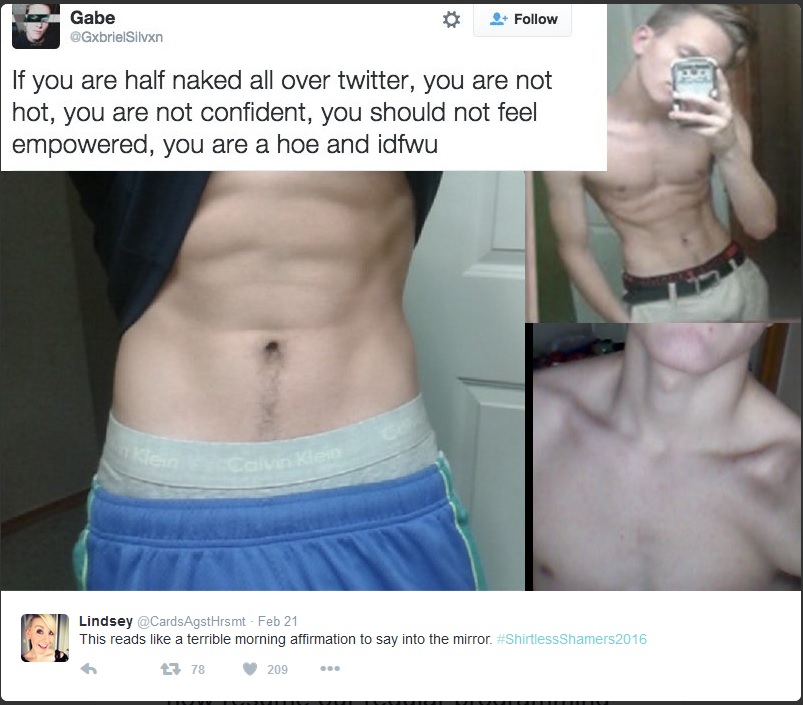
“This January I started #ShirtlessShamers2016, a Twitter hashtag in which I juxtapose men’s sexist, slut-shaming social media posts about women’s bodily respectability with their own bare-chested pictures. This isn’t my first adventure in challenging misogyny through social media; you may also remember me from such other controversial positions as, “Street Harassment: Please Stop Doing It.” …

When I started using the #ShirtlessShamers2016 hashtag, I expected things to stay funny. Light. Playful. Sexism and gender-based double standards aren’t really funny, of course, but lampooning shirtless broskies who are heavy on ego and light on self-awareness has a certain silliness to it. They flex their pecs and regurgitate some casual misogyny, and we marvel, bemused, that they aren’t in on the joke.

But, as is often the case, we laugh to keep from crying.

I am about five weeks into the hashtag, with more than 100 posts (conveniently gathered here for your viewing pleasure) and the recurring themes are far from funny….
ShirtlessShamers

Unfortunately, this isn’t just a problem of young men being doofuses. The double standard is pervasive, and touches on the fundamental right for girls and women to be in their own bodies without being deemed provocative and inappropriate and at risk. That right matters. It matters for all women but especially for black women and girls, whose bodies are hypersexualized from very young ages. It matters for people like my sister, who has had strangers chastise her for breastfeeding her infant even as men jog half-naked nearby. It matters in how we continue to talk about street harassment as a problem related to clothing choices or other respectability proxies, no matter how many marketable white women go viral for reminding us street harassment happens to women in t-shirts and jeans.

This issue also matters for people like me who have survived sexual violence and routinely run into uninformed rape apologists and enablers who desperately want to prop up a myth that sexual violence is a problem contributed to by clothing or other victim choices. (It’s not.) It matters for people who have been bullied and shamed by their classmates and schools for the crime of developing parts unilaterally declared to be inappropriate or distracting. (They’re not.) It matters for people in the sex industry who are treated as if they shed their humanity when they shed their clothing. (They don’t.) The list goes on. Holding men and women’s bodies to a different standard as far as nudity and sexuality is concerned matters for everyone who has come to accept that no amount of fabric can fix an underlying culture problem.”

Thank you for all you do, Lindsey, to call out double standards and fight for women’s right to respect and dignity!

Share

Filed Under: News stories, online harassment, public harassment, Resources Tagged With: double standard, online harassment, shirtless, shirtlessshamers, slut shaming

Street Harassment Began When I was 5 Years Old

February 23, 2016 By HKearl

When was the first time you were sexually harassed in a public space?

This question always has been hard for me to answer.

I have had so many experiences over the years that I usually say I am unsure of my first verbal sexual harassment experience, though I remember the first time I was followed: I was 14 years old, running a few miles from my home in southern California.

But now I have the answer.

My parents kept weekly journals for me and my sisters and what we did that week. Their entries and my childhood artwork fill binders that line a closet in my house. Recently I was digging through some of these binders.

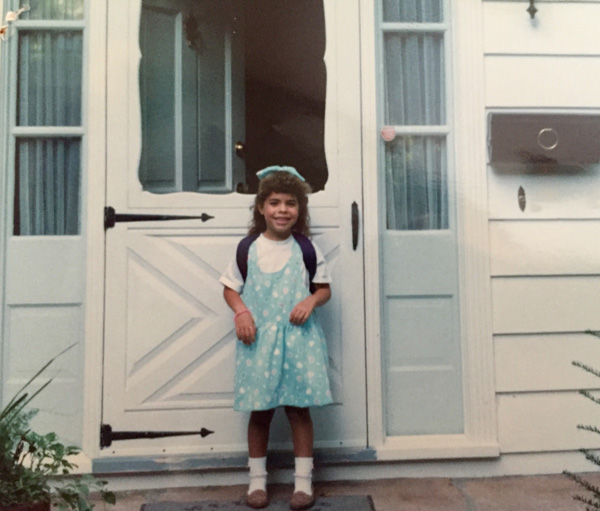
In one I learned that the first time I was harassed in a public space, I was five years old, two months after this first-day-of-school photo was taken:

Holly Kearl First Street Harassed in Iowa City in 1988

At this time, my family and I lived only a few blocks from my elementary school in Iowa City, Iowa. A boy next door was my age and we often walked to school together. From that time period, I have had a vague memory of being scared of older boys and my friend Aaron running away.

In the journal, I read more details. My parents wrote (using first person, as if they were me) about how these older boys “scared me today and I began to cry. They said they wanted to give me candy and they wanted me to come to their house after school. They pinched my cheeks. Aaron ran off but fortunately Martha’s dad [Martha was another neighborhood friend] happened by right then and helped me to school.

We [my parents and I] talked for a long time about this and what to do next time and how boys shouldn’t touch girls. This has been scary for me.”

It’s almost laughable that these boys offered me candy, the stereotypical “stranger danger” strategy that adults warn kids about. But what does not make me laugh and makes me really angry is that they tried to lure me to their house and they actually touched me, pinching my cheeks.

I am grateful to my friend’s dad for intervening and that my parents talked to me about it.

But I’m also mad. I was FIVE years old, just walking to school. What right did those boys have to harass and touch me? To scare me and make me cry? They had no right, yet our culture allows it to happen, and allows them to think that it’s okay.

Too often, people dismiss street harassment as no big deal, a compliment or a minor annoyance. But how would they feel if they knew it was happening to teenagers and adolescents? Because it is.

IT STARTS YOUNG

A 2014 national survey commissioned by Stop Street Harassment (SSH) found that street harassment began by age 17 for half of harassed persons in the United States. The Brazil NGO Think Olga found that nine years old is the average age that women began facing sexual harassment. A 2010 study by the Bangladesh National Women Lawyers Association found that almost 90 percent of girls aged 10–18 years in Bangladesh had faced street harassment.

Stories submitted to the SSH blog describe harassment starting at ages like 7, 8, 13, and 14 years.

Recently, there’s been more attention to this issue.

A few months ago, Think Olga launched the campaign #primeiroassedio (#firstharassment) and thousands of people shared their stories. In May 2015, Twitter user Mikki Kendall invited people to tweet their first harassment experience with #FirstHarassed. Also last year, California teenager Chloe Parker started the Instagram campaign #WhatMySHSaid, encouraging teenage girls to write down the street harassment said to them, their age and location and then take a photo of it and post it.

I encourage you to join these campaigns and help bring more attention to the young age this starts.

Share

Filed Under: anti-street harassment week, SSH programs, street harassment Tagged With: #firstharassed, campaign, young age

Renewed Efforts to Address Harassment on the NYC Subway

February 23, 2016 By HKearl

More efforts are underway in New York City to address sexual harassment on the subway system. This includes training transit police, with input from Hollaback!

Here’s some info about it overall, via the New York Times:

“Opportunistic sex crimes aboard subways are not new, nor are they news to many women. Some have been grabbed or leered at by a man who is masturbating. Many others have heard a story from a friend who felt an uncomfortable touch but was unsure if she should say something.

But cellphone cameras and social media have given women tools to fight back and provided the police a way to identify some offenders. Last year, in an effort to encourage more victims to come forward, the police began training more female officers to work the cases.
 
The police now send out a steady stream of alerts about such crimes using photos from victims’ phones to try to identify suspects. One recent Twitter post shared a photo of a man suspected of grabbing a 27-year-old woman’s buttocks on a No. 7 train in Queens this month. Two days earlier, the police posted a photo of a man who they say exposed himself to women on two trains at Grand Central Station.
 
Reported sex crimes on the subways rose 19 percent last year, to 738 from 620 in 2014. Many of those crimes were forcible touching and public lewdness, the offenses most commonly charged in connection with the sort of sexual misconduct that Detective Cross and his colleagues were on the lookout for that morning on the Lexington Avenue line.
 
Joseph Fox, the chief of the Transit Bureau, said he believed the increase in reported sex crimes was a result of more women coming forward. He expects the number of reports will keep rising as the police continue to talk about the problem.”
Share

Filed Under: News stories, public harassment, Resources Tagged With: MTA, New York City, public transit, subway

Amsterdam Considers an Anti-Street Harassment Law

February 22, 2016 By HKearl

A member of Straatintimidatie speaking at an event with the Amsterdam mayor. Image via their Facebook page.

Our friends at Burgerinitiatief Boete op Straatintimidatie in the Netherlands (read an interview with founder Gaya Branderhorst) told me that they recently had a discussion on street harassment and swayed the mayor of Amsterdam to address it, including by crafting legislation.

Via Dutch News, here is more info:

“One in three women reports being hassled, spat at or insulted while out in the Dutch capital but this is not currently an offence. Now the local branch of the right-wing VVD wants to change this by amending local laws to cover street intimidation.

The city’s mayor, Eberhard van der Laan, told councillors on Thursday: ‘This sort of behaviour goes against the key values of our society.’

‘And it happens a lot,’ the mayor said. ‘However, there are practical implications because it is difficult to prove and there are often no witnesses.’ Nevertheless, the mayor said he would ask the police and pubic prosecution department to look into the options.

The issue was first raised in Amsterdam by VVD councillor Dilan Yesilgoz at the end of last year. Labour MP Ahmed Marcouch is already working on draft legislation to make verbal harassment of women a criminal offence.”

Portugal just passed a law against street harassment.

Share

Filed Under: News stories, street harassment Tagged With: Amsterdam, law, mayor, netherlands, street harassment

USA: Shine Squad Confronts Violence in Activist Organizations

February 22, 2016 By Correspondent

LB Klein, Georgia, USA, SSH Blog Correspondent

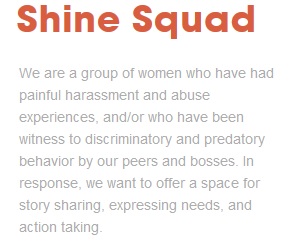
ShineSquadGender-based violence is currently ingrained in our society, and only true culture change will eradicate it. While we want to believe that organizations and groups working to end this violence and advance social justice are immune, abuse happens in these spaces as well. What happens when though when spaces that have a mission to end violence are actually perpetuating it? What happens when the perpetrators are our colleagues, our fellow activists, our leaders?

Enter Shine Squad, a tumblr space by and for folks who have experienced harassment and abuse while they’re working within these movements. As Shine Squad’s first video mentions, we often expect that abuse will be “overt and straight out of Mad Men.” However abusers, particularly those who know the language and values of our movement-building spaces, use more subversive strategies. Shine Squad’s tumblr is full of stories from women and trans folks whose colleagues and supervisors used these spaces against them in overt and covert ways.

It can be challenging to “rationalize [perpetrators’] work in the movement with their abusive behavior.” Because it is so disarming and surreal to experience violence in these spaces that are supposed to be safe, survivors can feel “on an island.” This cognitive dissonance leads to isolation, silencing, and self-blame that shifts the focus from what the perpetrator did wrong to blaming the survivor.

The painful consequences of violence in these spaces can be overwhelming to face alone, so Shine Squad provides a platform for “story sharing, expressing needs, and action taking.” Through their online form, anyone can submit anonymous stories of the harms they have experienced in activist communities and social justice organizations. These reports encompass a wide range of behaviors from subtle workplace discrimination that was “gross but you can’t quite put your finger on it” to intimidation to financial threats to digital harassment to sexual assault and abuse.

Shine Squad is not stopping with story sharing, however, they are also providing connections. They’re introducing survivors to others who have also survived abuse, even connecting those who might name the same perpetrator. They’re offering emotional support, connections with journalists, legal referrals, and opportunities for activist and organizing opportunities around addressing the “systematic problems of discrimination, harassment, and abuse in social justice movements.” They also give opportunities for members to help others through hosting conversations, sharing skills including legal and HR, or offering opportunities to advance the public conversation.

By building networks and sharing stories, Shine Squad is addressing a valuable need. This activist space provides a powerful reminder that for our movements to be successful, we must start at home, by fostering organizational environments that support survivors, prevent violence, and hold perpetrators accountable.

LB is an Atlanta-based researcher, advocate, and educator dedicated to ending gender-based violence, supporting survivors, and advancing social justice.  You can follow her on twitter @LB_Klein.

Share

Filed Under: correspondents, Resources Tagged With: abuse, sexual violence, share story, shine squad

« Previous Page
Next Page »

Share Your Story

Share your street harassment story for the blog. Donate Now

From the Blog

  • #MeToo 2024 Study Released Today
  • Join International Anti-Street Harassment Week 2022
  • Giving Tuesday – Fund the Hotline
  • Thank You – International Anti-Street Harassment Week 2021
  • Share Your Story – Safecity and Catcalls Collaboration

Buy the Book

  • Contact
  • Events
  • Join Us
  • Donate
  • Facebook
  • Instagram
  • Pinterest
  • Tumblr
  • Twitter
  • YouTube

Copyright © 2026 Stop Street Harassment · Website Design by Sarah Marie Lacy