• About Us
    • What Is Street Harassment?
    • Why Stopping Street Harassment Matters
    • Meet the Team
      • Board of Directors
      • Past Board Members
    • In The Media
  • Our Work
    • National Street Harassment Hotline
    • International Anti-Street Harassment Week
    • Blog Correspondents
      • Past SSH Correspondents
    • Safe Public Spaces Mentoring Program
    • Publications
    • National Studies
    • Campaigns against Companies
    • Washington, D.C. Activism
  • Our Books
  • Donate
  • Store

Stop Street Harassment

Making Public Spaces Safe and Welcoming

  • Facebook
  • Instagram
  • Pinterest
  • Tumblr
  • Twitter
  • YouTube
  • Home
  • Blog
    • Harassment Stories
    • Blog Correspondents
    • Street Respect Stories
  • Help & Advice
    • National Street Harassment Hotline
    • Dealing With Harassers
      • Assertive Responses
      • Reporting Harassers
      • Bystander Responses
      • Creative Responses
    • What to Do Before or After Harassment
    • Street Harassment and the Law
  • Resources
    • Definitions
    • Statistics
    • Articles & Books
    • Anti-Harassment Groups & Campaigns
    • Male Allies
      • Educating Boys & Men
      • How to Talk to Women
      • Bystander Tips
    • Video Clips
    • Images & Flyers
  • Take Community Action
  • Contact

Archives for March 2016

New Studies in the Philippines and Israel

March 8, 2016 By HKearl

The UK was not the only country to have a new study about street harassment released for International Women’s Day, statistics were released in the Philippines and Israel, too.

Philippines:

In February 2016, SWS surveyed people in barangays Payatas and Bagong Silangan in Quezon City regarding sexual harassment in public spaces.

Prevalence:

88% of women ages 18 to 24 experienced sexual harassment at least once.

1 in 7 of the surveyed women experienced sexual harassment at least once every week in the past year.

Types:

Across all ages, 12 to 55 and above, wolf whistling and catcalling were the most common forms. However, 34% of women experienced the “worst forms” of sexual harassment: flashing, public masturbation, and groping.

Perpetrators:

Seventy percent of women said they were harassed by a “complete stranger,” while others said it was by “someone they see around the neighborhood,” acquaintances, and “someone they are close to.”

3 out of 5 men surveyed confessed to committing a form of sexual harassment at least once in their lifetime, while 1 in 7 admitted to doing it at least daily over the past year.

When:

The majority of the incidents happen in broad daylight. Seventy percent of cases happen during the day, between 6 am and 6 pm, and only 4% of cases were reported occurring at night.

You can read more survey results and learn about the UN Women campaign underway in the city via this Rappler article.


Israel:

The organization NA’AMAT release a survey about youth and sexual harassment, the following is pulled from a Jerusalem Post article about it.

Prevalence:

68% of girls responded that they were harassed by a man they didn’t know on the street at least once, while 45% said this happened more than once.

Perpetrators:

47% of boys admitted that they had shouted out to a woman or girl that they didn’t know on the street and around 34% said they had done this more than once.

Attitudes:

“A little over a third of youth – both boys and girls – said that if a woman acts or dresses provocatively then she shares in the blame of sexual assault.  Only 53% of youth felt that only the attacker was to blame in the case of sexual assault.”

 

Share

Filed Under: public harassment, Resources, street harassment Tagged With: Israel, philippines, statistics, study, victim blame, youth

The UK’s First National Street Harassment Study

March 8, 2016 By HKearl

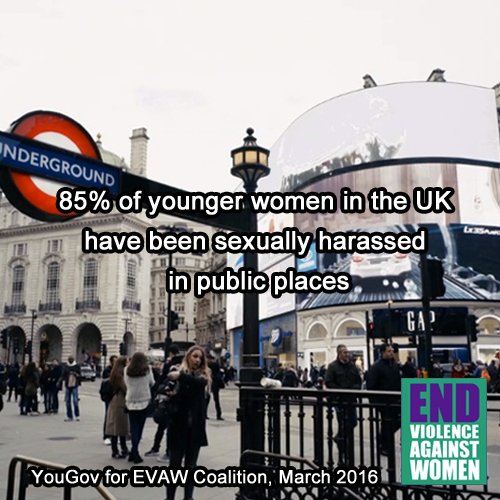
EVAWstudy3.8.16End Violence Against Women Coalition, our allies in the UK, commissioned YouGov to conduct the first national poll on street harassment. The results were released today, for International Women’s Day.

Prevalence:

64% of women of all ages have experienced unwanted sexual harassment in public places. (This is almost the same as the USA, our 2014 study found that 65% of women had been harassed.) Additionally, 35% of women had experienced unwanted sexual touching.

Age:

When they looked at just young women ages 18-24, however, the percentages increased significantly: 85% had faced sexual harassment in public spaces and 45% had experienced unwanted sexual touching.

Related, across all ages of women, most said it began at a young age. More than 1 in 4 said it happened before age 16, and more than 3 in 4 said it happened by age 21.

Bystanders/Upstanders:

Sadly, only 11% of women said anyone had intervened when they were harassed though 81% said they wished someone had.

Changing Their Life:

When it comes to feeling safe, 63% of women (versus 45% of men) said they generally feel unsafe in public spaces and almost half do conscious “safety planning” when they go out in the evenings.

What Can We Do:

When asked what should be done, many said “they supported more police (53%), better street lighting (38%), more transport staff (38%) and public awareness campaigns encouraging others to intervene (35%). No women we asked believed this problem should be ignored and no measures taken.”

Racialized Sexual Harassment:

Because women of color may also face racialized sexual harassment, EVAW partnered with Imkaan to produce a five minute film featuring young women of color talking about their experiences.

In discussing what it feels like to experience racist sexual harassment one woman in the film says:

“My experiences are different as a Black woman than they are for my white friends. I should be ‘up for it’ or I am ‘fair game’, or I shouldn’t care if my body is touched in a specific way.

And another woman says:

“After me ignoring them, that’s when it turns racial, so that’s when it might be ‘you black this’ or ‘you black that…how dare you ignore me’.”

In a press release for the film and survey, Lia Latchford, Policy and Campaigns Coordinator at Imkaan said:

“Our film tells a powerful story of young black women’s everyday experience of racialised sexual harassment. For us, we cannot ‘leave race out of it’ because the way we are treated is based on how our whole identities are perceived as black women. This harassment and abuse often uses racist stereotypes and insults as an attempt to put black women in our place. Everyone, adults and young people alike, need to talk about it and it needs to stop.”

Sarah Green, Acting Director at the End Violence Against Women Coalition said:

“Sexual harassment is an everyday experience which women and girls learn to deal with, but it’s time to hold a mirror up to it and challenge it. We did this survey to find out about the scale of sexual harassment and the impact it has on the way women live. If women are planning their lives around not being harassed or assaulted, they are not free. Women should be free to live their lives without the threat of harassment and violence, not having to plan and limit their choices to make sure they’re safe.”

Share

Filed Under: News stories, race, Resources, street harassment Tagged With: International Women's Day, national, race, statistics, study, UK, young age

“Told him not to say that to me or anyone else”

March 5, 2016 By Contributor

SMILE STENCILI was walking down the street to my car after work, and a guard at a parking garage I pass tells me to smile. I don’t remember the exact comment but it was one of those common ones, something like, “You’d look better with a smile.”

I ignored it and kept walking at first, but I stopped, turned around, and told him not to say that to me or anyone else. I also told him that it really doesn’t make someone feel good to hear that. It was a very light incident compared to many other stories, but I thought I’d share.

Optional: Do you have any suggestions for dealing with harassers and/or ending street harassment in general?

If it’s safe (and only if you feel safe), sometimes it helps to confront the person making these comments. They may not stop, but confrontation forces them to think about it.

– Anonymous

Location: Charlotte, NC

Share your street harassment story for the blog.
See the book 50 Stories about Stopping Street Harassers for more idea
.

Share

Filed Under: Stories, street harassment

“No one should be made to feel uncomfortable like that”

March 4, 2016 By Contributor

I was walking in Egham on my way to Waitrose and two men where standing in the place where I was heading. As I approached them one of them said, “Oooo look at her, she’s amazing,” but in a sarcastic way and started laughing. As I finished my shopping, I walked past them again because they were on route and clearly waiting to harass me again and others. The same man said, “Isn’t she sexy pwoarr” again in a sarcastic manner.

I felt extremely uncomfortable and fairly upset over what happened and I wish I had stood up for myself in the moment. I’m not sure if it’s sexual harassment although the comments were aimed at my appearance and no one should be made to feel uncomfortable like that, ever.

Optional: Do you have any suggestions for dealing with harassers and/or ending street harassment in general?

Educate people on what harassment is, create awareness etc

– IAT

Location: Egham Surrey near Waitrose near a pub, UK

Share your street harassment story for the blog.
See the book 50 Stories about Stopping Street Harassers for more idea
.

Share

Filed Under: Stories, street harassment

“Never be ashamed or afraid.”

March 4, 2016 By Contributor

Here in Pakistan, your clothing doesn’t make a difference at all. If the harasser wants to touch, comment or just “accidentally” collide your shoulder with his, he will do it.

I have learned that you should never ever let anybody go with out having the consequences. But when it’s for the very first time, you get a little shaky.. And I experienced it again today after quite a while.

At first I gave him the benefit of doubt, but to the point where the limit was crossed. I made a scene. I started shouting at the top of my lungs, and that person didn’t dare to look me in the eye. I was scared a little myself but didn’t show it, and most of all don’t expect people to help you.

You’re enough for yourself and that is that. Just take stand for your self once and afterwords it’s gonna be fine. Never be ashamed or afraid. You rule!

– Aliza Khan

Location: Pakistan

Share your street harassment story for the blog.
See the book 50 Stories about Stopping Street Harassers for more idea
.

Share

Filed Under: Stories, street harassment Tagged With: fighting back, Pakistan

« Previous Page
Next Page »

Share Your Story

Share your street harassment story for the blog. Donate Now

From the Blog

  • #MeToo 2024 Study Released Today
  • Join International Anti-Street Harassment Week 2022
  • Giving Tuesday – Fund the Hotline
  • Thank You – International Anti-Street Harassment Week 2021
  • Share Your Story – Safecity and Catcalls Collaboration

Buy the Book

  • Contact
  • Events
  • Join Us
  • Donate
  • Facebook
  • Instagram
  • Pinterest
  • Tumblr
  • Twitter
  • YouTube

Copyright © 2026 Stop Street Harassment · Website Design by Sarah Marie Lacy