• About Us
    • What Is Street Harassment?
    • Why Stopping Street Harassment Matters
    • Meet the Team
      • Board of Directors
      • Past Board Members
    • In The Media
  • Our Work
    • National Street Harassment Hotline
    • International Anti-Street Harassment Week
    • Blog Correspondents
      • Past SSH Correspondents
    • Safe Public Spaces Mentoring Program
    • Publications
    • National Studies
    • Campaigns against Companies
    • Washington, D.C. Activism
  • Our Books
  • Donate
  • Store

Stop Street Harassment

Making Public Spaces Safe and Welcoming

  • Facebook
  • Instagram
  • Pinterest
  • Tumblr
  • Twitter
  • YouTube
  • Home
  • Blog
    • Harassment Stories
    • Blog Correspondents
    • Street Respect Stories
  • Help & Advice
    • National Street Harassment Hotline
    • Dealing With Harassers
      • Assertive Responses
      • Reporting Harassers
      • Bystander Responses
      • Creative Responses
    • What to Do Before or After Harassment
    • Street Harassment and the Law
  • Resources
    • Definitions
    • Statistics
    • Articles & Books
    • Anti-Harassment Groups & Campaigns
    • Male Allies
      • Educating Boys & Men
      • How to Talk to Women
      • Bystander Tips
    • Video Clips
    • Images & Flyers
  • Take Community Action
  • Contact

Archives for April 2016

New Play: Might Never Happen

April 4, 2016 By HKearl

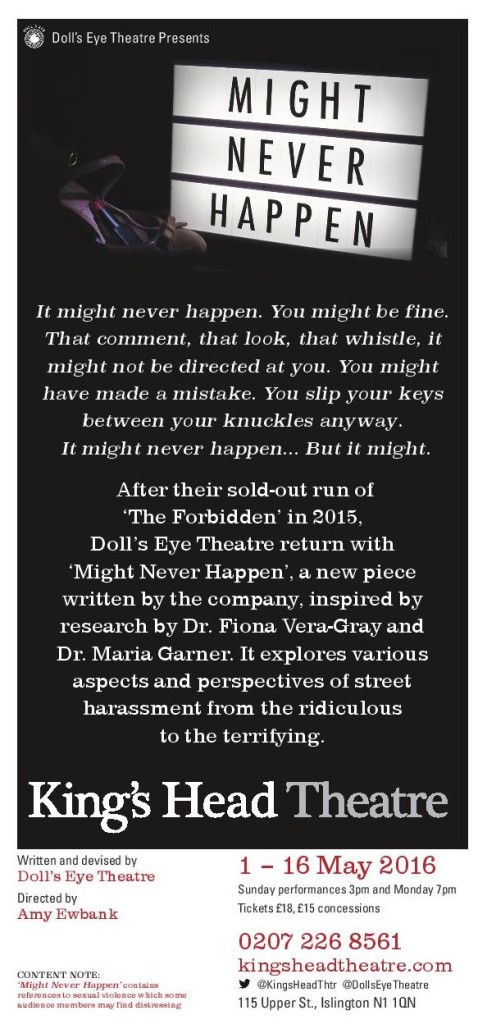
Might Never Happen DL Flyer (2) (1)-page-002 copyFrom the streets to the theatre

The London-based, all woman theatre company Dollseye Theatre have been working with street harassment researcher Dr. Fiona Vera-Gray and masculinities researcher Dr. Maria Garner to translate key themes from their work for the stage. Might Never Happen, directed by Amy Ewbank, is a piece written by the company, to explore various aspects and perspectives of street harassment from the ridiculous to the terrifying.

The first performances will be in London, at the Kings Head Theatre in Angel in May 2016 as an extension of International Anti-Street Harassment Week. A post-performance Q&A will be held on the 2nd of May and the 9th of May, featuring speakers from the Women’s Equality Party, Hollaback London, Purple Drum, Rape Crisis and more.

For Dates and to book tickets please see The King’s Head Website here.

Share

Filed Under: anti-street harassment week, Events, street harassment Tagged With: London, play, research, theatre

“You girl, wanna play?”

April 2, 2016 By Contributor

At the age of 12 (I’m now 14), I was walking down the street wearing a short dress, and a grown old man came to me, and he told me: “You girl, wanna play?”

And I just stared to run and run. I came home, but I didn’t said anything because I didn’t think it was bad enough.

I think that we need a radical change. Places can be safer for women if we’re informed about these sexism and feminism stuff. And I will start to speak out, because this is a big problem.

– Jessica Atencia

Location: Colombia

Share your street harassment story for the blog.
See the book 50 Stories about Stopping Street Harassers for more idea
.

Share

Filed Under: Stories, street harassment Tagged With: colombia, young age

Early April 2016 News Round-Up

April 2, 2016 By HKearl

Here are a few news stories on my radar recently:

Economic Times, “Widespread sexual harassment still persists in Delhi: Study“

“Sexual harassment remains a pervasive problem in Delhi despite tougher laws being enacted after the gruesome Nirbhaya rape and murder case in 2012, according to a new study that found 40 per cent of female respondents were sexually harassed in the past year.

About 40 per cent of women surveyed in Delhi said they have been sexually harassed in a public place such as a bus or park in the past year, with most of the crimes occurring in the daytime, researchers said.

Further, 33 per cent of women have stopped going out in public and 17 per cent have quit their jobs rather than face harassment in public places.

‘What this means is that women, despite Nirbhaya, are still afraid,’ said Mahesh Nalla, from the Michigan State University in US.”

Telegraph, “German rail operator launches women-only train carriages following sex attacks“

“Mitteldeutsche Regiobahn will introduce the option for women passengers on the Leipzig to Chemnitz line, positioning the carriages next to the train conductor.

‘The local proximity to the customer service representative is chosen deliberately,’ a Mitteldeutsche Regiobahn spokesman said.

The carriages are designed to make solo female travellers or women with young children feel safer on trains.

Boys up to the age of ten will also be allowed to ride in the special carriages.”

Yahoo News, “New York City proposes crackdown on taxi driver sexual harassment“

“New York City’s taxi authority plans new rules for drivers that will impose tougher penalties for sexually charged comments and contact with passengers amid growing concern about harassment.

The Taxi and Limousine Commission, which licenses about 150,000 drivers of yellow cabs and other for-hire vehicles such as Uber [UBER.UL] and Lyft, wants to curb unwanted communication and touching as the number of drivers has significantly grown.

The TLC said the regulations are meant to clear up any confusion about what defines sexual harassment as more drivers enter the industry.

The behavior is already prohibited under a broad definition against threats, harassment or abuse, but the commission’s goal is clear up any confusion about what defines sexual harassment said TLC spokesman Allan Fromberg.

The agency plans to debate the proposal at an April 21 meeting.

‘This rule amendment would provide clear definitions of sexual harassment and unwanted sexual contact, which would help TLC prosecution enforce its rules and protect our passengers,’ he said in a statement.”

The Hollywood Reporter, “‘Ovarian Psycos’: SXSW Review“

“For the women of the Ovarian Psycos Bicycle Brigade, riding through the streets of Los Angeles is an act of guerrilla theater, bandanas optional. Taking back the night — and, on tough and disapproving turf, the daytime streets as well — they’ve staked their place in the riot grrrl lineage and are direct descendants of the feminist and Chicano movements of the ’60s and ’70s.

A concise and intimate documentary on the collective illuminates why they find solace as well as purpose in their DIY activism. Many of these tough pedalers are self-described “at-risk adults,” still pushing against the undertow of abuse and trauma.

As a portrait of the group, Ovarian Psycos, which takes its bow in the Documentary Feature Competition at South by Southwest, is incisively personal rather than all-encompassing. It showcases compelling characters and, at its most potent, explores complex territory between mothers and daughters, tradition and independence. The film is a natural for doc platforms with a political edge.”

Odyssey, “How It Actually Feels To Be Catcalled“

“Here is a look inside the mind of someone who has been verbally harassed by strangers since the age of fourteen.”

The Ohio State University, “Why sexual harassment is worse than other types of abuse online“

“A survey of 293 women who played video games online showed that, while they didn’t like general abuse such as swearing and insults about their game-playing skills, they could dismiss these types of comments from their mind pretty easily.

But even after the game was over, women continued to think about the sexist comments, rape jokes and threats, and other sexually related comments that they received while playing with men.

‘Most women players understand trash talking and having their playing skill insulted, even if they don’t like it,’ said Jesse Fox, lead author of the study and professor of communication at The Ohio State University.

‘But what disturbs them is being targeted simply for being a woman. They don’t easily forget those comments and continue to think about them when they’re done playing.’

And while the results suggested women didn’t think it was the responsibility of gaming companies to stop general harassment, they did seem to blame the companies for not doing more to end sexual harassment.”‘

DAWN, “‘Cycle chalao, patriarchy dubao’: Taking to Karachi streets without the company of men”

“Three girls are cycling ahead of me, one trailing with a poster that reads #GirlsOnBikes. Another has one hung on her back:

‘Hamari sarkein, hamara sheher.’

Fifteen bikers — an unusual sight of kameezes, long hair and dupattas— follow at their pace behind me. There is assurance in travelling in a pack, but our collective confidence is intentional and prepared.

Our all-women bike rally is based on a troubling reality: we are protesting street harassment against women.

Earlier this month, a girl in Lahore was hit by a car of boys while cycling to join the Critical Mass group. The girl — Aneeqa — responded with indifference to their initial attempts at harassment. But that did not deter them; they drove closer, and rammed their car into her bike. The reaction was somehow justified in their head.

Our bike-rally is an act of solidarity for Aneeqa, who, I realise, is probably cycling right now with the girls in Lahore, hardly two weeks since her bruises healed.”

Open Democracy, “Sexual harassment in Kosovo: no longer invisible“

“The oddest finding, however, is the excellent ability of male survey respondents, the main perpetrators of harassment, to identify specific acts as sexual harassment – in some instances even better than women. For example, 48.8% men think leaning on another person’s body without their permission is sexual harassment, compared to 25.1% of women. Similarly, being pressured to go out with someone is seen as an act of sexual harassment by 41.9% of men, compared to only 23% of women.   My theory would be that there are some pretty enlightened men in Kosovo, and women so normalized to acts of harassment that they don’t even think of them as such. It may also mean that many men know exactly what sexual harassment is, but still harass others or simply stand by when they see it happening around them (the bystander effect applies to women as well).

This can change. This report has provided the first quantitative data on the prevalence of harassment in Kosovo, and should serve as a great resource to shut down arguments that it isn’t a widespread problem – the kind of arguments I frequently read from young men on the internet whenever the issue of sexual harassment is brought up in Kosovo.”

Vice, “In Mexico, Women Are Protesting a Wave of Brutal Murders with Performance“

“Help me, help me,” screams a stout but strong elderly woman standing on the banks of a garbage-filled canal in Chimalhuacan, Mexico. The woman is Irinea Buendía, and she is acting in a street theater performance, holding a sign with the words: “I didn’t commit suicide, you killed me.” The woman in the photo is her daughter, Marina. Buendía is surrounded by dozens of women dressed in fiery costumes. They are all screaming the names of other women who have been killed in the State of Mexico.

This canal has become the final resting place for an undetermined number of women who have been kidnapped, assassinated, mutilated, and dumped in the sewage-filled water. The group gathered here is composed of various feminist collectives which have reappropiated this harsh environment as a public theater space. Femicides have become an alarming crisis in the state, where more than 1,500 women have been murdered in the past ten years. It is believed that the victims’ gender was a primary motive in the majority of the assassinations.

All over Mexico, various womens’ groups are using creative theater to combat the scourge of gender-based violence. In Mexico City, the Hijas de Violencia (Daughters of Violence) shoot street harassers with confetti guns and sing punk anthems to denounce sexual harassment. In Puebla, a state where women have been murdered by their boyfriends and partners, the organization El Taller hosts a feminist school to help women identity violence in their personal relationships.”

Observers, “Video: Tunisian women share insults they’ve received on the street“

“Why are you so nervous? Do you have your period?” “You’re ugly, go home!” “You’re a girl, you can’t drive.” These are just a couple of examples from a video project in which filmmakers asked 60 Tunisian women to give examples of verbal sexual harassment they’ve faced on the street.

On March 20, Tunisia celebrated 60 years of independence. For the occasion, two women’s rights NGOs created this video, which they titled “60 years of independence and our bodies are still colonised.” It is full of insults, sexist comments and unwelcome propositions. Several of the women are famous in Tunisia, including journalist Lina Ben Mhenni, actress Amira Chebli, and MP Bochra Belhaj Hmida.”

The Guardian, “From Peru to Kosovo, female MPs aim to end abuse of women in politics“

“During her time as mayor of Lima, the Peruvian capital, Susana Villarán experienced brutal and harmful attacks and threats. She says they were designed to ‘diminish my image and make it clear it was not a place for a women like me to try and disrupt that male world of politics and power.’

The British MP Jess Phillips began receiving online threats when she started speaking about women’s rights after winning her parliamentary seat last year. She receives daily attacks and has seen online articles in which ‘people wished to see me raped or come home to see my sons hanging from a tree as I couldn’t possibly care about men.’

Villarán and Phillips shared their stories at the launch of a campaign by the National Democratic Institute (NDI) to stop violence against women in politics.

Launched on the fringes of the Commission on the Status of Women in New York last week, the #NotTheCost campaign is seeking to raise awareness of the different methods of violence women face when seeking positions of power at local, national and international level. This can include physical, sexual, psychological, verbal and economic violence.”

Human Rights Watch, “Sudan: Silencing Women Rights Defenders“

“Sudanese security forces have used sexual violence, intimidation, and other forms of abuse to silence female human rights defenders across the country, Human Rights Watch said in a report released today. The government should investigate all alleged abuses, hold those responsible to account, and undertake legislative reforms to protect women’s rights.

The 61-page report, “‘Good Girls Don’t Protest’: Repression and Abuse of Women Human Rights Defenders, Activists, and Protesters in Sudan,” documents efforts by Sudanese authorities to silence women who are involved in protests, rights campaigns, and other public action, and who provide social services and legal aid, as well as journalists. Women engaged in these efforts are targeted with a range of abuses, from rape and rape threats, to deliberate efforts to tar their reputations. Their male counterparts may be less likely to experience some of these abuses.”

BDnews24, “Ganajagaran Mancha announces signature campaign demanding arrest of Tonu’s killers“

“The Comilla Victoria Government College student was found dead, her head smashed, near her house inside Comilla Cantonment on the night of Mar 20.

Mancha spokesperson Imran H Sarker announced the programme at Dhaka’s Shahbagh on Wednesday, while the killers remain at large and unidentified even nine days after the murder.

Following a Road March to Comilla on Sunday demanding justice for Tonu, the platform had also called for a one-hour strike at all educational institutions across Bangladesh on Wednesday.

The mass signature campaign aims to push the authorities to meet three other demands — implementation of an anti-sexual assault policy as per High Court orders, new law for death penalty for rapists and ensuring security of all women.”

Share

Filed Under: News stories, street harassment Tagged With: bangladesh, catcalls, germany, India, kosovo, mexico, New York City, Ovarian Psycos, peru, Sudan, sxsw, tunisian

7 Ideas for Sexual Assault Awareness Month 2016

April 1, 2016 By HKearl

April is Sexual Assault Awareness Month (SAAM)! In addition to taking part in International Anti-Street Harassment Week (April 10-16), here are 7 ideas for action in 2016.

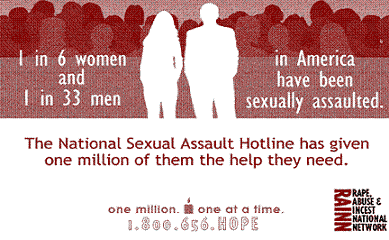
1. Believe/help survivors. Believe survivors when they confide in you. Visit the website of the Rape, Abuse & Incest National Network to find information to help you help the survivor. And to find information to help yourself.

rainnhelp2. Find help. If you are a survivor who isn’t sure where to turn to or how to get help, I highly recommend visiting the RAINN website. I volunteered with them for 2.5 years and applaud their work. You can find information about a phone or online hotline and information about recovery.

* Do you identify as male? Visit the website 1 in 6 for resources specifically for you.

* Are you in the military? RAINN has a helpline called Safe Helpline specifically for survivors in the military.

3. Raise awareness on social media. The National Sexual Violence Resource Center provides a variety of resources each year for SAAM, including free reports and manuals and campaign materials. They also are running daily Instagram contests (#30DaysofSAAM) and have images you can post on your other social media accounts. April 5 is the SAAM Day of Action! Use tweets, posts, and status updates to share the word about #SAAM. Download their social media guide for specifics.

4. Wear jeans. Make a social statement by wearing jeans on April 27 as part of Denim Day in LA & USA. The day is a visible way to protest against misconceptions that surround sexual assault. Register today and raise awareness at your workplace, neighborhood, or community. Encourage each person who participates to donate one dollar to Denim Day to fund prevention programming.

5. Watch The Hunting Ground. This important Oscar-nominated documentary about campus sexual assault is now available for streaming on Netflix. Invite others to watch it (and schedule in some self-care time afterward as it’s an important but also upsetting film).

6. Order We Believe You. Annie C. Clark and Andrea L. Pino, the main subjects of The Hunting Ground film and founders of End Rape on Campus, have a new book coming out April 12, We Believe You: Survivors of Campus Sexual Assault Speak Out. It includes  stories from “students from every kind of college and university―large and small, public and private, highly selective and less so―[who] share experiences of trauma, healing, and everyday activism, representing a diversity of races, economic and family backgrounds, gender identities, immigration statuses, interests, capacities, and loves. Theirs is a bold, irrefutable sampling of voices and stories that should speak to all.”

7. Use the arts or march
. Take part or organize arts-based initiatives or a march to raise awareness about sexual assault. Examples of initiatives include:

kiajStnb* Organize or participate in a Take Back the Night March in your community or on campus and make a statement that women have the right to be in public and to go about their lives without the risk of sexual violence. Order a kit with resources for the event.

* The Clothesline Project, an initiative to bear witness to violence against women. Women affected by violence decorate a shirt and hang the shirt on a clothesline to be viewed by others as testimony to the problem of men’s violence against women.

* V-Day event offers several performance and film screening options for groups to implement in their community in February, March, and April. The purpose of these events is to raise awareness about violence against women and girls as well as raise money for local beneficiaries that are working to end violence. There is no theater or producing experience necessary. Visit the V-Day website to learn how to organize a V-Day event.

* Story of a Rape Survivor (SOARS) is an award winning multimedia performance from A Long Walk Home you can bring to your community that entertains as well as educates the audience about sexual assault prevention. Featuring the music of Nina Simone, Maxwell, and Sade, SOARS tells one woman’s story about how she reclaimed her body, sexuality, and self-esteem after being sexually assaulted in college. SOARS is a cutting-edge theatrical experience that stars a diverse cast of women, combining photographs, dance, spoken-word poetry and music as a way to educate about healing from sexual violence.

* By wearing a white ribbon, White Ribbon Campaign members make a personal pledge to “never commit, condone or remain silent about violence against women and girls.” You can order materials to help challenge the community to speak out on the issue, learn about sexual violence, and raise public awareness.

(And if you’re unsure about the connection between street harassment and sexual assault, listen to a CALCASA Prevention podcast  or watch a video where I talk about the connections. Briefly, some of the connections are that both behaviors fall on the same spectrum of gender violence; street harassment sometimes escalates into sexual violence; and street harassment can be re-triggering for survivors of sexual abuse.)

Share

Filed Under: street harassment Tagged With: clothesline project, denim day, hunting ground, RAINN, rape survivor, Sexual Assault Awareness Month, take back the night, V-Day, we believe you, white ribbon campaign

« Previous Page

Share Your Story

Share your street harassment story for the blog. Donate Now

From the Blog

  • #MeToo 2024 Study Released Today
  • Join International Anti-Street Harassment Week 2022
  • Giving Tuesday – Fund the Hotline
  • Thank You – International Anti-Street Harassment Week 2021
  • Share Your Story – Safecity and Catcalls Collaboration

Buy the Book

  • Contact
  • Events
  • Join Us
  • Donate
  • Facebook
  • Instagram
  • Pinterest
  • Tumblr
  • Twitter
  • YouTube

Copyright © 2026 Stop Street Harassment · Website Design by Sarah Marie Lacy