• About Us
    • What Is Street Harassment?
    • Why Stopping Street Harassment Matters
    • Meet the Team
      • Board of Directors
      • Past Board Members
    • In The Media
  • Our Work
    • National Street Harassment Hotline
    • International Anti-Street Harassment Week
    • Blog Correspondents
      • Past SSH Correspondents
    • Safe Public Spaces Mentoring Program
    • Publications
    • National Studies
    • Campaigns against Companies
    • Washington, D.C. Activism
  • Our Books
  • Donate
  • Store

Stop Street Harassment

Making Public Spaces Safe and Welcoming

  • Facebook
  • Instagram
  • Pinterest
  • Tumblr
  • Twitter
  • YouTube
  • Home
  • Blog
    • Harassment Stories
    • Blog Correspondents
    • Street Respect Stories
  • Help & Advice
    • National Street Harassment Hotline
    • Dealing With Harassers
      • Assertive Responses
      • Reporting Harassers
      • Bystander Responses
      • Creative Responses
    • What to Do Before or After Harassment
    • Street Harassment and the Law
  • Resources
    • Definitions
    • Statistics
    • Articles & Books
    • Anti-Harassment Groups & Campaigns
    • Male Allies
      • Educating Boys & Men
      • How to Talk to Women
      • Bystander Tips
    • Video Clips
    • Images & Flyers
  • Take Community Action
  • Contact

Archives for December 2016

2016: 10 of Our Achievements

December 22, 2016 By HKearl

THANK YOU to everyone who made our work possible this year! Here are 10 highlights from this year.

** You can read more and see photos in our Annual Report. **

1. Oversaw the 6th annual International Anti-Street Harassment Week. Groups in 36 countries and 18 U.S. states and D.C. participated through organizing street demonstrations, flyering, wheatpasting, sidewalk chalking, tweet chats, and workshops.

2. Partnered with the Rape, Abuse & Incest National Network (RAINN) and Defend Yourself, to launch the first-ever national street harassment hotline in the USA! More than 110 people have used it so far.

3. Recruited and worked with three cohorts of 24 total blog correspondents from 10 countries. They each wrote monthly articles about street harassment and/or activism in their communities across their four month cohort.

4. Received more than 200 street harassment story submissions to the SSH blog.

5. Nearly 300,000 people visited the website and there were more than 532,000 page views.

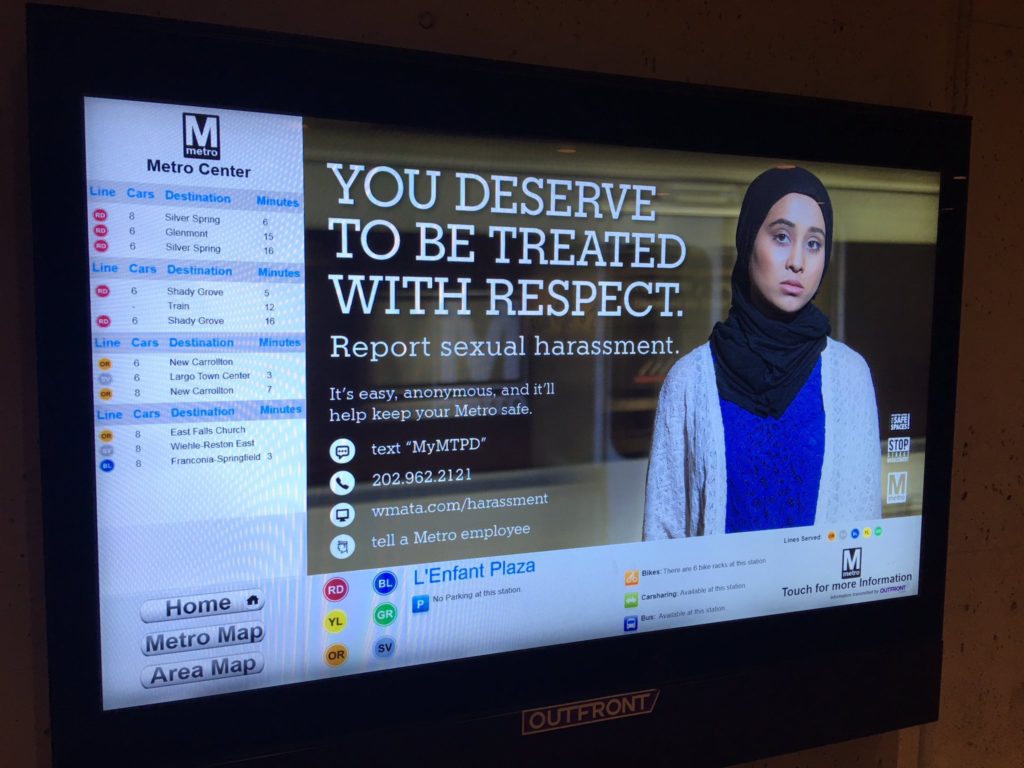
6. Worked for a fourth year on an anti-harassment transit campaign with the Washington Metropolitan Area Transit Authority (WMATA) and Collective Action for Safe Spaces. One of our big successes was designing and launching our third wave of anti-harassment ads. We also worked with WMATA on the first-ever transit-wide survey on sexual harassment (results) and an outreach day at five Metro stations during International Anti-Street Harassment Week. At our encouragement, WMATA also began holding sexual harassment training for their bus operators.
img_0708

7. Advised Runner’s World on their women’s safety survey that 4,670 runners took. SSH supporter Michelle Hamilton wrote an article about the survey and street harassment + running that is in the magazine’s December issue. SSH is mentioned. SSH also joined the Runner’s World Podcast #28 on the subject.

8. Received more than 100 media mentions, including in the New York Times, BBC World News TV, Washington Post, USA Today, UpWorthy, Runner’s World, HLN TV, NPR, and Teen Vogue.

9. Spoke at 12 events, including campus and community talks in DC, MD, MN, NE, NY, and OH. This includes speaking at the National Conference for College Women Student Leaders, International Summit to End Sexual Violence, and the Global Girl Media National #GirlsGovern Town Hall.

10. Received $1,500 in funding from the PinPoint Foundation and $12,500 in donations from individuals.

The SSH board also issued a statement following the U.S. presidential election. We will continue doing our work, no matter what.

Share

Filed Under: street harassment, year end Tagged With: annual report

“I no longer wanted to be beautiful, just sure-footed and militant, shouting back”

December 22, 2016 By Contributor

The first time a man hollered at me in the street
i was barely 13
and managed a few lungfuls of air before freezing in terror
but thought
i might be beautiful

the second time a man hollered at me in the street
he told me to smile
and i did, with a lump in my throat
because i have been taught to please others
and i thought
i might be beautiful

the third time a man hollered at me in the street
telling me he’d like to suck my pussy
i felt so much more than i could explain
and blamed myself
but thought
i might be beautiful

the fourth time a man hollered at me in the street
i learned this is how men act
and i forgave
because i have been taught to forgive
and i thought
i might be beautiful

the fifth time a man hollered at me in the street
his gaze like a heat-seeking missile
i was so conscious of my body
in public space
it felt like a battleground
– for him, a playground

and his approval filled me with shame
and i no longer
wanted to be beautiful
just sure-footed and militant
shouting back

F**K YOU!

– Michelle Ryder

Location: USA

Need support? Call the toll-free National Street Harassment hotline: 855-897-5910

Share your street harassment story for the blog.
See the book 50 Stories about Stopping Street Harassers for idea
s.

Share

Filed Under: Stories, street harassment

“I will continue to be sensitive and be vocal about this issue”

December 21, 2016 By Contributor

Where do I begin? I, unfortunately, have so many stories. As a victim of street and sexual harassment, this is something I had to learn to never shy away from speaking about. I have been told I’m too sensitive and I should let it slide – to hell with that mentality. I will continue to be sensitive and be vocal about this issue.

My most recent incident was with a man (working as security) following me around Georgetown, D.C. He was persistent in trying to get to know me: my name, my number, and where I was going. I told him to leave me alone, and my response made him more aggressive. He grabbed my left arm and demanded an answer from me. I pushed him away and told him to leave me alone, again. Lucky for me, it was busy that night, and I was able to escape him between the crowd. I rushed into a hotel and stayed in the bathroom for 20 minutes – to catch my breath and make sure he was gone.

Optional: What’s one way you think we can make public places safer for everyone?

Raise more awareness and have men step in and help us. We need all the help we can get. I am fed up.

– AAA

Location: M St./Georgetown

Need support? Call the toll-free National Street Harassment hotline: 855-897-5910

Share your street harassment story for the blog.
See the book 50 Stories about Stopping Street Harassers for idea
s.

Share

Filed Under: Stories, street harassment

Spain: How the Media Reports Sexual Violence

December 19, 2016 By Correspondent

Alice C.R., Barcelona, Spain SSH Blog Correspondent
Trigger Warning – Rape

dones-valentesWhen I was a little girl in France I was told to get informed, seek information, follow what was going on in the world. I remember our teacher from primary school recommending us not to go to bed before the end of the news segment on TV. Later on, in high school, our teachers told us to read different media, from different perspectives in order to better form our own opinion. We were taught to question the info we receive, to ask ourselves whether a media was serious or not, was trying to convince us, manipulate us or was positioned.

I loved to read newspapers from different sides and it was very interesting to see the difference. Sometimes, the same news appeared to be completely distinct from one newspapers to another. Sometimes, from one journalist to another. Especially about political issues. That was sometimes quite funny, but sometimes very disturbing.

But there is one topic, only one, I could never really find any difference in the way it was reported: violence against women, including sexual violence (sexual violence towards children and men as well).

I remember reading headlines such as “ Tragedy of love” or “Family tragedy” for cases of domestic violence and murder intra-family. I remember reading the word “seducer” to describe an alleged rapist, “a tentative to hit on” to qualify a deadly aggression. I remember how the facts were often sugarcoated by the use of euphemisms like non consensual sex or imposed sexual relation instead of using the word rape. I remember reading many details of the alleged victim’s sexual life (while I am sure I have never ever read any details about how much donation an alleged victim of robbery might have given to a charity organization). I remember reading horrific details about an aggression. Well, everything I was reading seemed to be written either to horrify the reader and to warn the victims: “You will never recover from that” or to sugarcoat the brutality and seriousness of a crime and put the suspicions on the victims.

The words we use are very important. They define a situation. They define a reality.

We all agree here that calling any catcall or fact of harassment as a “compliment” is very upsetting. The aim of a compliment is to make the person feel happy and confident. I love compliments actually. I love people making me feel good and worthy. Curiously, I never felt comfortable with catcalls or so called compliments that make me feel like a piece of fresh meat. But in many case, when you report it, one of the most common answer you get is, “But that was a compliment! Just take it as it is!”

Harassment vs compliment, seducer vs rapist, tragedy of love vs murder.

Then, how can someone report an aggression when the first words that pop up in her/his mind are the words read and heard in the media? Can someone go the police saying, “Good morning. I met a seducer who started to compliment me before to impose me a sexual relation.” ?

The impact can be huge for the victim. It is like living in two different worlds, two different realities.

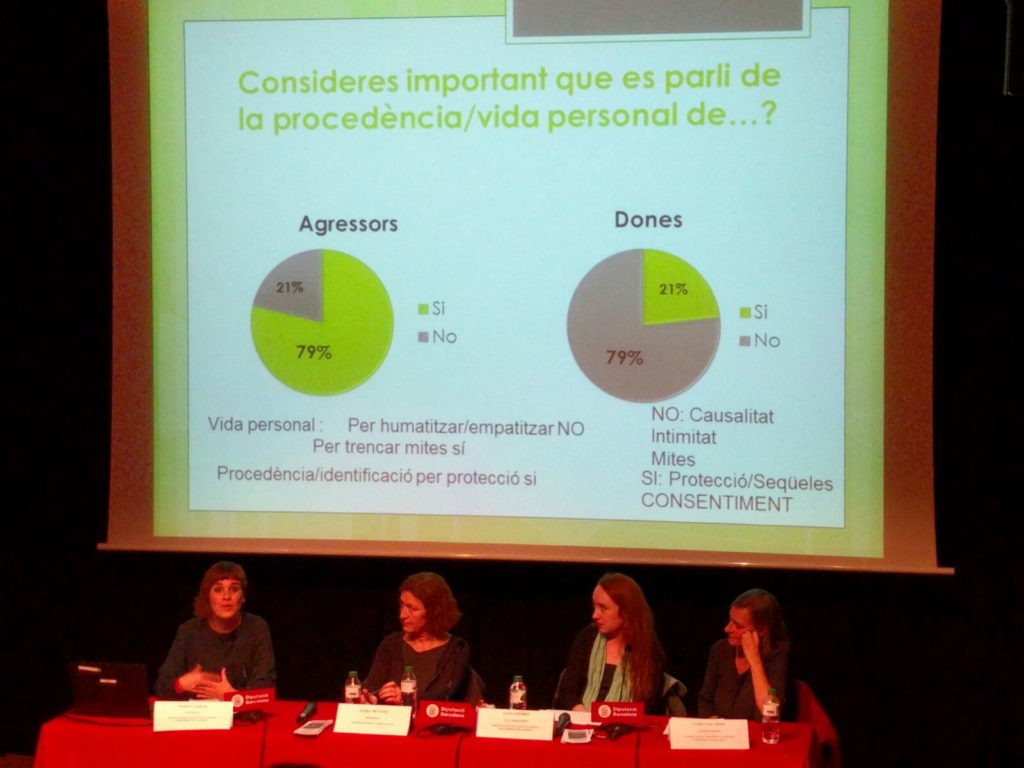
When I learned about a new project launched in Barcelona about how the media cover cases of sexual violence and how people who experienced this kind of violence react to their coverage, I was very interested in it. I read daily news and various French, UK, US and Spanish media and it is very interesting to compare them and see their differences and similarities. So far, I have never read about an imposed sexual relation in Spanish media for instance (I might have missed it, I can’t read everything but it is a relief yet) but I have read about some assault details. The project is organized by Aadas and Master Gender and communication with the collaboration of Barcelona city council and support of the Generalitat with the aim then to be presented during the 25th November International Day of Violence Against Women program.

It consisted first in reading articles from local newspapers both in Spanish and Catalan and explaining what could be triggering, disturbing and how it could be written instead. The aim is to rise awareness of this important issue as media are the ones that first inform us about a case and the words they choose, the way they relate the news influence us. The group of volunteers, all women between 18 and 60 years old, met in July to read a selection of news and take part in the project. All of them suffered sexual violence and accepted to voluntarily read very upsetting and highly triggering news.

The results are not really surprising: all of them felt upset and outraged, 72% felt misunderstood, 93% think these facts of violence are not covered with the seriousness and rigor that should be required. Few of them, only 2, felt strong from reading the news. But this state of strength should not be misunderstood: they felt strong to be part of the project and read such triggering material.

It was clear that a lot of articles were written by journalist who didn’t know anything about the reality of sexual violence, about all of the consequences and sequels it can have. Could we imagine an article about the last basketball competition written by someone who did not know how many players are required to play? So why is it okay to write about sexual violence without having the most basic knowledge about it?

The results were publicly presented the 22nd of November and the project received an Honorary distinction at the 9th Price of 25 November from the city council.  This specific Price is very important for the future of the project. One next step would be to organize meetings between the journalists who wrote the incriminated articles and the organizers of the project and women who took part in it.

We believe in a better understanding of the issue by listening to the ones who suffered from it and the ones who work and help them. This would change a lot of the general perception of sexual violence in our society.

Alice likes researching, analyzing and writing about Women’s Rights, gender bias, and intersectionalism with a special focus on sexual violence, rape, rape culture, the impact of street harassment and how the media deals with these issues. She is currently working on a new project focused on how some media participate in the revictimization of victims. Follow her and her projects on her Facebook page and via Twitter @Alyselily.

Share

Filed Under: correspondents, street harassment Tagged With: media coverage

“This was really scary and unprovoked”

December 17, 2016 By Contributor

I was walking home around 10 pm when I saw a car with tinted windows slow to my walking speed and the passenger seemed to wave, or gesture to me, but I thought that must not be the case and I kept walking. The car sped off but as I walked up to a parking lot in the block ahead of me, the same car was parked, facing me. The driver honked as I approached and the passenger, who was already out of the car, started to approach me and began asking me questions, calling me baby, and started to follow me, but I ignored them. The guy returned to the car and began to follow me in the car, on the street, at walking speed with the window down, heckling me. I could see a local bar ahead of me and hurried to reach the people standing on the curb. I reached the bar patrons and stood with them hoping the car would leave. Instead they pulled up to the curb and began to climb out. This was really scary and unprovoked. I hurried into the bar ready to look for help, and my pursuers sped off. I didn’t know if they had just parked farther down the street again so I waited in the bar, and as I waited, their car went down the street twice, apparently looking to see if I had headed back out.

Optional: What’s one way you think we can make public places safer for everyone?

Practically, lighted main streets is hugely helpful. Additionally, advocating for victims to report to police will help notify law enforcement about particularly unsafe areas.

I think that altering the way that men view women in such a way that women are equals who do not enjoy or deserve harassment is key to preventing street harassment. However, that is obviously a nebulous problem.

– CAT

Location: On College Avenue near Rockridge BART station in Oakland, California USA

Need support? Call the toll-free National Street Harassment hotline: 855-897-5910

Share your street harassment story for the blog.
See the book 50 Stories about Stopping Street Harassers for idea
s.

Share

Filed Under: Stories, street harassment

« Previous Page
Next Page »

Share Your Story

Share your street harassment story for the blog. Donate Now

From the Blog

  • #MeToo 2024 Study Released Today
  • Join International Anti-Street Harassment Week 2022
  • Giving Tuesday – Fund the Hotline
  • Thank You – International Anti-Street Harassment Week 2021
  • Share Your Story – Safecity and Catcalls Collaboration

Buy the Book

  • Contact
  • Events
  • Join Us
  • Donate
  • Facebook
  • Instagram
  • Pinterest
  • Tumblr
  • Twitter
  • YouTube

Copyright © 2026 Stop Street Harassment · Website Design by Sarah Marie Lacy