• About Us
    • What Is Street Harassment?
    • Why Stopping Street Harassment Matters
    • Meet the Team
      • Board of Directors
      • Past Board Members
    • In The Media
  • Our Work
    • National Street Harassment Hotline
    • International Anti-Street Harassment Week
    • Blog Correspondents
      • Past SSH Correspondents
    • Safe Public Spaces Mentoring Program
    • Publications
    • National Studies
    • Campaigns against Companies
    • Washington, D.C. Activism
  • Our Books
  • Donate
  • Store

Stop Street Harassment

Making Public Spaces Safe and Welcoming

  • Facebook
  • Instagram
  • Pinterest
  • Tumblr
  • Twitter
  • YouTube
  • Home
  • Blog
    • Harassment Stories
    • Blog Correspondents
    • Street Respect Stories
  • Help & Advice
    • National Street Harassment Hotline
    • Dealing With Harassers
      • Assertive Responses
      • Reporting Harassers
      • Bystander Responses
      • Creative Responses
    • What to Do Before or After Harassment
    • Street Harassment and the Law
  • Resources
    • Definitions
    • Statistics
    • Articles & Books
    • Anti-Harassment Groups & Campaigns
    • Male Allies
      • Educating Boys & Men
      • How to Talk to Women
      • Bystander Tips
    • Video Clips
    • Images & Flyers
  • Take Community Action
  • Contact

Archives for June 2017

“I’m done with seeing it as normal”

June 15, 2017 By Contributor

Trigger Warning – Rape

I want to cry as I share this, even though none of my story can be considered shocking. It is all too common for people to experience what I have experienced. For so many it is even worse.

My mother was raped when she was 23 while out for a run. She didn’t tell me this until I was in high school. Later I found out the only reason she told us was because my older sister, having heard about it from a cousin, had spent a year thinking she was the child of the rapist (which she was not). I didn’t fully understand the implications of my mother’s story at the time. I felt confusion and anger, which only made me more confused. My mother not only survived the assault, she has thrived and is the strongest person I know. Though she continues to cope with PTSD, she has fully moved on with her life. But I haven’t. It’s been 10 years since she told me. Sometimes I feel like it happened yesterday. I can’t watch movies with rape scenes, I can’t even say the word “rape” out loud. Typing it is easier.

I feel an almost uncontrollable, black and red rage when I am faced with what the majority of women experience: street harassment. Especially when exercising. Fitness is my passion, and is what I consider to be my “safe, happy place”. Yet while running I have been cat-called, stared at, followed for eight blocks by a car filled with jeering men. I’ve read hundreds of stories of other women being blocked, threatened, followed, assaulted or even murdered while exercising. My friend was chased by a 13-year-old boy who hit her on the ass with a stick once he caught her. My other friend was groped while running with me, and after I chased the man (let’s say ‘boy’) he was shocked by the confrontation and said, “It’s okay because I’m gay!”

While traveling, I admit to being intimidated into working out indoors. I feel shame and anger when I do this, thinking I should be brave enough. I’ve been followed by a strange man down a street in broad daylight. I’ve had my ass pinched, slapped, or grabbed at least three times in recent memory. I’ve been called “hey, baby” by strangers in several languages depending on what country I’m in, told how good I look “in those shorts” and that I shouldn’t be offended because he was just “talking to me and giving me a compliment”. I’ve had my knee caressed by a stranger walking past me in a bar, right in front of my male date. Who did nothing. I did nothing – I felt like I missed my opportunity and was almost not even surprised. Even though I try to react in the moment, even though I try to block it all out and stay positive, my night is always ruined. It triggers memories and feelings that aren’t mine – I feel a terrible, terrible sadness, loss of control, and thoughts of my mother – and feelings that are mine. Indignant, angry, disgusted, confused, as if something must be wrong with me because this type of thing is normal, right? Just part of being a woman? Is it normal to feel like you can’t have one night to relax and loosen up because this lets both your emotional and physical guard down? I can’t remember the last time I felt safe to do this.

Well, I’m done. I’m done with seeing it as normal. I’m tired of “sucking it up” and staying silent. The President of the United States has harassed women and subsequently bragged about it. He was elected. I am tired of having this issue downplayed by both men and women — men out of ignorance or spite, women out of fear that they will be seen as “crazy feminists”, “too serious”, “unable to take a joke”, “rocking the boat”. That is almost the worst part — that women can occasionally feel resistance from other women about confronting this issue. I’m done with dressing down or up based on what I think will help me blend in and not attract attention. I’m tired of reading advice for female travelers that they can control the dial of harassment by what they wear. It just isn’t true.

I don’t know if anyone has had the exact same experiences. But I know I’m not alone in having the shitty feelings in the wake of harassment. Reactions and coping mechanisms take many forms and I’m only beginning to understand them. What I hate to see is women avoiding exercise altogether out of fear (I know I have), and I hope to help change this. My mother has competed in 4 marathons, including the Boston, since the assault, and runs 6 miles every day. I am so proud to know her. If she can keep running, I will too and hope other women will as well! I’m grateful to read about the activists taking a stand.

I’m also grateful to Runner’s World for publishing their recent article “Running While Female” and to Holly Kearl for her books and blog. I plan to start my own as I continue to live my privileged, love-filled life, and hope I can pay it forward and make a difference. I want to join the movement.

Optional: What’s one way you think we can make public places safer for everyone?

Make “No Harassment” signs as common as speed limit signs, no smoking signs, children at play signs. Educating young boys and girls, as well as men, about what being a man means and how to confront your friends when they harass women.

– AJD

Location: California, Scotland, Spain, Thailand – street, parking lot,

Need support? Call the toll-free National Street Harassment hotline: 855-897-5910

Share your street harassment story for the blog.
See the book 50 Stories about Stopping Street Harassers for idea
s.

Share

Filed Under: Stories, street harassment Tagged With: running

“I feel as though I’m the one who was wrong”

June 13, 2017 By Contributor

Well, It was 4 days ago and was a normal day as any other but while taking a via bus this strange, old man got on. However at the time I didn’t think anything of it. He then started shouting that he needed sugar because he was a diabetic and when he got some he settled down.

I got off the bus and sat at a stop to wait for my second bus. He followed me and sat next to me and again I didn’t think anything of it. I just wanted to go home. He started talking to me and telling me that i had to talk to him or he would go into a coma, I was scared and just wanted to be at home. I then told him the bus was coming soon and if he really needed help to go into a store and tell them what was happening.

He ignored me and told me about how he had been in jail for four days and proceeded to call me sugar and kiss my bare arm. I completely froze. I didn’t know what to do and he kept touching my arms and trying to hold my hands. At this point I was terrified. I finally came to and told him I was late for work and shot up although this didn’t stop his advances as he shouted “wow” and swung his arm back at an attempt to slap my butt. I panicked and in a split second screamed no and ran.

On my way home all I wanted to do was cry. I felt disgusted with myself. I felt like an object and all I kept thinking was how I let it happen and I was the one at fault because I hadn’t stopped it sooner. I felt like it was my fault because I didn’t immediately say no. It took me a moment or two to convince myself that I didn’t do anything wrong, but it’s still something that’s hard for me to grasp. Even now as I’m writing this I feel as though I’m the one who was wrong.

– E.S.

Location: San Antonio via bus station

Need support? Call the toll-free National Street Harassment hotline: 855-897-5910

Share your street harassment story for the blog.
See the book 50 Stories about Stopping Street Harassers for idea
s.

Share

Filed Under: Stories, street harassment

Indonesia: Stand Up Against Street Harassment

June 12, 2017 By Correspondent

Astrid Nikijuluw, Serpong, Banten, Indonesia SSH Blog Correspondent

(English version below)

Bulan Juni di Indonesia (dan Negara-negara lainnya) umat Muslim merayakan bulan Suci Ramdhan.  Pada bulan ini mereka berpuasa selama satu bulan penuh sampai datangnya hari kemenangan yaitu Idul Fitri.  Bulan Ramadhan  disebut sebagai bulan penuh berkah sehingga banyak digunakan untuk meningkatkan amal dan ibadah.  Namun sayangnya beberapa prilaku buruk tetap tidak berubah.
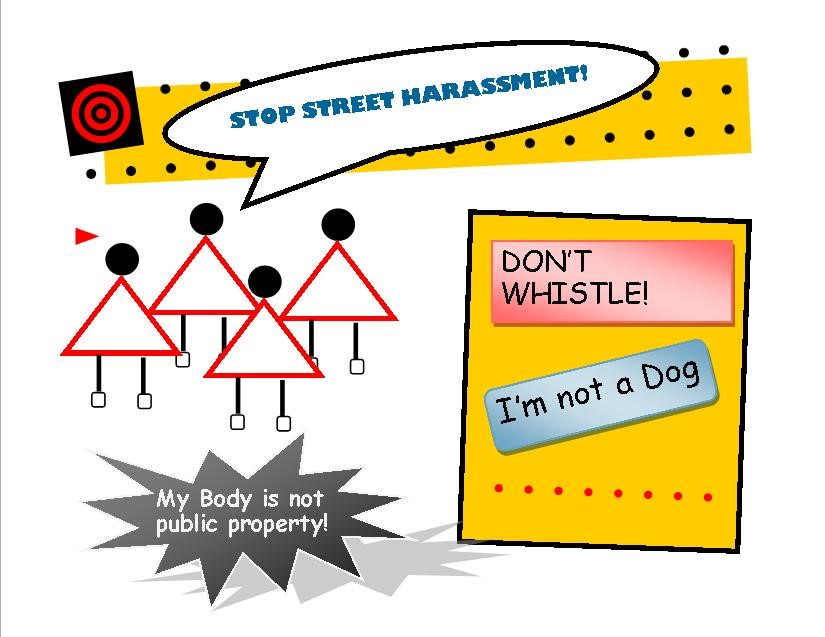
Minggu lalu ketika saya sedang berjalan menuju rumah dari salah satu mini market, ada sebuah kejadian yang sangat mengganggu.  Kebetulan di depan saya berjalan dua anak remaja perempuan mengenakan jilbab/hijab.  Ketika melewati kerumunan (sekitar 4-5 orang) laki-laki, tiba-tiba perlakuan yang meresahkan itu muncul lagi.  Salah satu dari mereka bersiul nakal pada kedua remaja perempuan tersebut.  Dan temannya menyapa dengan nada menggoda “Assalamualaikum mbak, lagi puasa ya? Nanti buka bareng yuk..”  Sementara yang lainnya ikut tertawa-tawa.  Saya sungguh kesal sekali melihat tingkah itu.  Buat saya kelakuan mereka sangat melecehkan dan tidak menghargai para remaja wanita itu.  Salah satu dari remaja itu menoleh dan dari bahasa tubuhnya hendak melabrak/memarahi para lelaki kurang ajar tersebut, namun temannya menarik tangannya untuk segera berjalan menjauhi para lelaki itu.  Dan kembali mereka tertawa seraya salah satu berkata “Lagi puasa nggak boleh marah-marah lho mbak, nanti pahalanya berkurang.”  Apa?!  Bagaimana mereka bisa berbicara mengenai pahala di bulan puasa tetapi kelakuan mereka sendiri sama sekali tidak mencerminkan spirit dari berpuasa dan beribadah di bulan Ramadhan.  Saya sendiri tidak sampai berjalan melewati mereka karena arah rumah saya berbelok di jalan pas sebelum mereka berkumpul.  Walaupun di dalam hati kecil saya ingin juga lewat dan seandainya mereka melakukan hal yang sama, well you’re messing with the wrong girl! Namun saya ingat kalau saya sedang berjalan dengan keponakan laki-laki saya, sehingga saya lebih berpikir untuk memberikan contoh dari kejadian yang dia juga baru saksikan.

Sampai dirumah saya masih tidak habis pikir. Apa sebenarnya yang ada di benak para lelaki tersebut sehingga berbuat sampai sebegitu jauhnya.  Bagaimana bila hal yang sama terjadi pada saudara perempuan mereka, pacar mereka atau bahkan ibu mereka. Apakah mereka akan bersikap santai saja? Saya jadi berpikir mungkin mereka kurang diajarkan untuk menghargai wanita sepenuhnya. Akhirnya saya pun mengalihkan rasa amarah dan kesal saya kepada keponakan saya dengan cara berdiskusi mengenai kejadian tersebut. Intinya saya menjelaskan bahwa prilaku seperti ini sangat tidak terpuji dan menimbulkan efek psikologis yang tidak baik terhadap korban. Dan yang paling penting adalah hal itu mencerminkan rendahnya penghargaan terhadap wanita.  Mungkin mereka bisa berdalih “Ah itu kan hanya bercanda, tidak serius, nggak usah lebay deh.” Well, ini Serius! Kalau hal seperti ini saja dianggap remeh maka tidak heran kasus-kasus yang lebih complex mengenai sexual harassment akan semakin meningkat. Menurut data dari Komnas Perempuan, terjadi 259.150 kasus pelecehan seksual yang ditangani selama tahun 2016 dan tersebar di 34 propinsi di Indonesia. Itu yang dilaporkan, dan saya yakin masih banyak sekali yang belum dilaporkan.

Kembali ke soal tadi, saya juga mencoba menyoroti dari sisi si korban. Dari kedua orang tersebut terdapat dua reaksi yang berbeda. Yang satu stand-up dan melawan, sedangkan yang lainnya lebih memilih untuk mendiamkan. Yang akhirnya si pelawan mengikuti temannya karena sedang menjalankan ibadah puasa, sehingga harus menahan nafsu amarah. Buat saya to stand up against that behavior adalah sangat penting terlepas dari agama apapun dan ritual ibadah yang sedang dijalankan. Bukan berarti dengan melawan kita tidak menjalankan ibadah dengan baik, namun kita menunjukkan bahwa prilaku tersebut salah dan tidak bisa dibiarkan. Bukankah kalau kita membiarkan sama saja secara tidak langsung kita ‘mendukung’ prilaku tersebut berlangsung terus-menerus? Dalam hal ini saya juga tidak menganjurkan dengan cara kekasaran, namun setidaknya mereka mengerti kalau kita tidak suka diperlakukan seperti itu! Itu adalah kelakuan yang tidak menyenangkan bahkan cenderung menjijikan.  Langkah yang diambil dari dua remaja tersebut menurut saya mencerminkan sikap sebagian besar korban street harassment.  Ada yang sudah mau melawan namun ada juga yang masih bersifat ‘membiarkan’ dengan permakluman.  Seperti tulisan saya bulan lalu, susahnya dari street harassment ini masih banyak yang kurang/tidak sadar.  Sekali lagi, menjadi bagian prilaku ‘sehari-hari yang dimaklumi’.  Padahal bisa kita liat akibatnya, bahkan di bulan suci Ramadhan, bulan baik dimana seharusnya dipergunakan untuk memperbanyak ibadah, prilaku ini pun masih terjadi dengan pelaku yang tidak merasa ‘bersalah’ dalam melakukannya.  Sungguh merupakan kenyataan yang membuat frustasi.

Saya berharap semakin banyak orang yang sadar akan street harassment adalah tindakan yang tidak pantas dilakukan dan selanjutnya bersikap untuk melawan tindakan tersebut.  Selain itu sebagai orang tua, kita juga perlu memberikan pengertian kepada anak-anak kita sejak dini baik anak perempuan agar tidak menjadi korban sia-sia maupun anak laki-laki agar kelak tidak menjadi pelaku dari street harassment tersebut.

Astrid received her Bachelors of Business at Queensland University of Technology Brisbane Australia. She finished her Master’s Degree at Gadjah Mada University Yogyakarta where she majored in Human Resource Development. Follow her on Twitter at @AstridNiki or on Facebook.

This June, in Indonesia (and other countries, too) the Moslem people are celebrating the Holy Ramadhan. During this period, they are fasting for 30 days until the celebration of Eid Al-Fitr. It is to be said that the Ramadhan month is full of mercy and blessings and therefore many Moslems are enhancing their worship and charity. Unfortunately, some bad behaviors still have not changed at all.

Last week, I was walking toward my home from a mini-market, when I saw a very disturbing incident. In front of me were two teenage girls, wearing hijab. When they walked through a crowd of men (about 4-5 men), one of them whistled at them, while the other said to them in an improper way, “Assalamualaikum, you both are fasting aren’t you? Let’s go break fasting together later.”

The others were laughing and continued to whistle. I was so pissed and angry seeing that scene in front of me. For me, their behavior was so disrespectful to the teenagers. One of the teenagers turned her head to those guys and from her body language, it seemed that she was going to say something to them. However, her friend, who was also the victim, pulled her hand and made her keep walking. And those guys ungratefully laughed again and one of them said, “You are not allowed to be pissed during fasting, otherwise you would lessen the reward of your fasting.”

WHAT?! How come they talked about rewards during the fasting month but their attitude was not reflecting the spirit of Ramadhan at all? I myself did not walk past them because I had to turn left to my street home, just around the corner of their position. Deep down inside my heart I was just wondering what if I walked passed them and they did the same thing to me? Well, they would be messing with the wrong girl, for sure. I was walking with my nephew though, so instead of getting angry, I decided to talk to him about the scene that he also witnessed.

As I arrived home, I still could not stop thinking about those guys. What were they thinking of behaving like that? How about if this kind of thing happened to their sister, or girlfriend, or mother? Would they sit back and relax? Therefore, I think maybe they were not taught enough about how to treat women respectfully.

Then I entered a discussion with my nephew about it. The point is, I explained to him, that this attitude was not commendable and can cause a psychological effect on the victim. And the most important thing is that it represents low-respect toward women.

Perhaps men quibble by saying something like, “Ah come on, it’s only a joke, nothing serious, don’t overreact.”

Well it is SERIOUS! If this kind of behavior were considered ‘nothing serious’ then no wonder the more complex cases of sexual harassment is increasing. Based on the data from KOMNAS PEREMPUAN (National Commission On Violence Against Women), in 2016 there were 259,150 cases of sexual harassment spread across 34 provinces in Indonesia. They were only reported cases and I am pretty sure that there were still many cases that had not been reported.

Back to the story, I was trying to highlight from the victim’s side.  From the two of them, I saw two different reactions. One who stood up against it and the other who kept silent and let it go. The one who would stand up finally gave up and followed the silent one. I was sure that the main reason is because they were fasting and holding anger is one of the most important things. However for me, to stand up against that behavior is necessary no matter what religion or ritual that you currently are doing. It does not mean that by resisting it we do not perform our religion ritual well, instead we are showing them that their behavior is wrong and cannot be accepted. If we do nothing continuously, we indirectly ‘support’ this attitude. I do not suggest using violence or cruelty, but at least let them know that we do not like to be treated that way and that it’s inappropriate and disgusting behavior!

The way the teenagers reacted in this case reflected the reaction from most of the victims of street harassment. There are some who are ready to stand up against it and there are also some who are still silent and tend to ‘let go’ with the thought of it being ‘understandable behavior’ (last month my article highlighted that many people still do not aware of the street harassment behavior). T

Even during the Holy month of Ramadhan, the good month where we are supposed to enhance our prayer, worship and charity, this attitude still ensues and the perpetrators do not at all feel guilty of doing it. It’s a frustrating fact.

I hope many more people are aware that street harassment is inappropriate behavior and in further can stand up against it.  And also as parents, we must teach our children from a young age, for daughter as though they will not be a vain victim and for sons so they will not be the perpetrators of the street harassment.

Share

Filed Under: correspondents

Brazil: Women-only Carriages in Rio’s Subways: Safe Spaces for Women or Institutionalized Inequality?

June 5, 2017 By Correspondent

Yasmin Curzi, Rio de Janeiro, Brazil, SSH Blog Correspondent

Image Provided by the Author

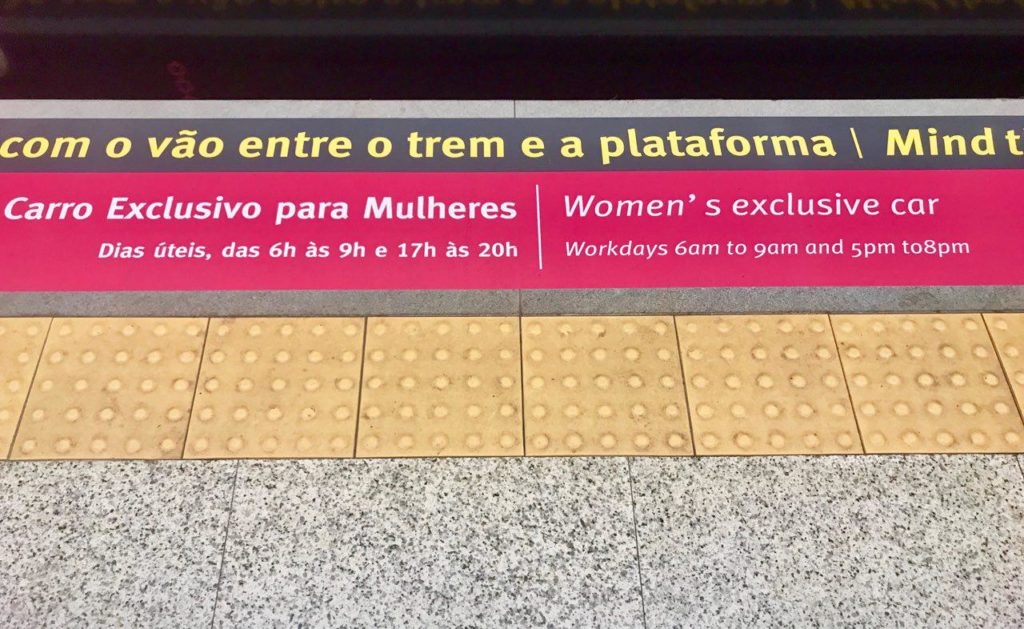
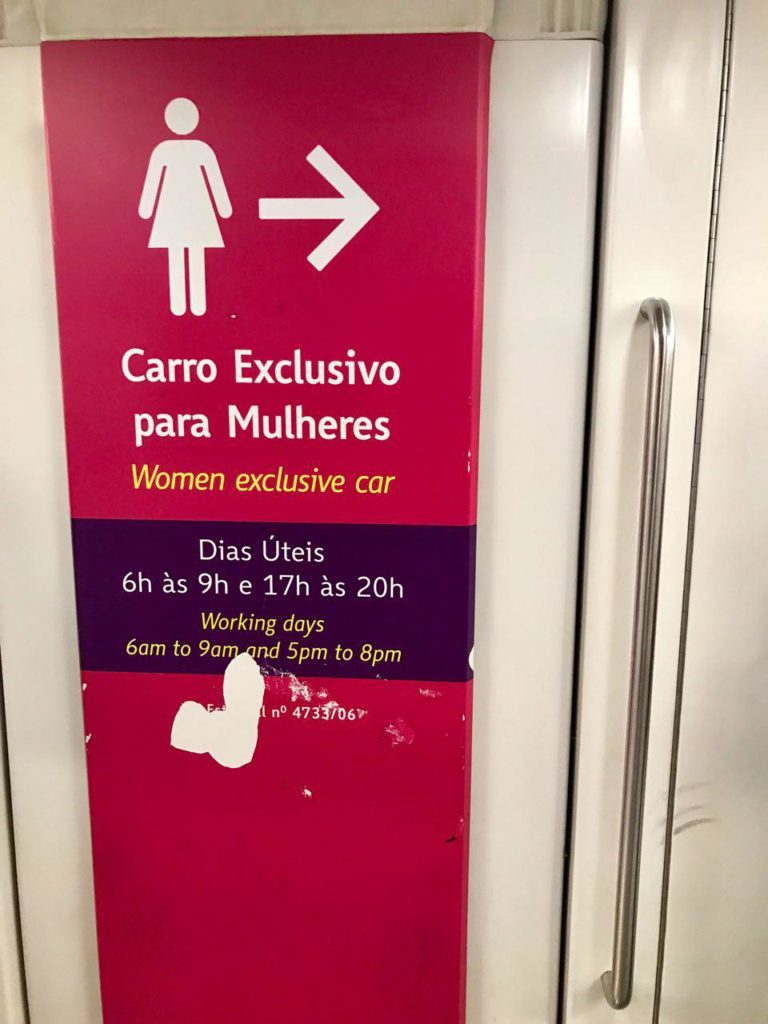
In 2006, the Legislative Assembly of the State of Rio de Janeiro approved a law which enacted segregated areas on public transport for women, commonly known as “pink carriages.”. According to the memorandum of the law, the measure would serve as a remedy in order to avoid severe sexual harassment cases during rush hours on the city’s metro. It enunciates that this measure serves as an immediate remedy, “because the scenario of recurrent gender violence in public transportation is a problem difficult to overthrow.” Also it has few costs for the State or the concession-holder, so the implementation can be faster than other possible measures.

Image Provided by the Author

In effect, women who suffered from abuses would feel welcoming in this “special” spaces – a symptom of the institutional mistreatment directed to them. There are some narratives that corroborates with this approach, but the discussion about the real effectiveness of the law is far to be settled. In this article I’ll try to point some of the controversial topics concerning this public policy.

1. Enforcement: Supervision of women-only carriage is made by the metro guards, only on a few platforms – usually the ones located in richer neighborhoods. The result is that men often disobey the law, specially when the subway is crowded. Also, most of the guards are men and frequently present misogynistic behaviors toward women who suffered abuse in the subways. In most of the cases, they are insensitive about women’s issues and unprepared to deal with these occurrences. Often it results in a double-violation: women are slut-shammed, offended or neglected when try to make a complaint. And the guards themselves also harasses women, usually by leering or starin

2. The law’s definition of “rush hours”: “Rush hour” is settled by the law as being “workdays 6h a.m. to 9h a.m. and 5h p.m. to 8h p.m.”, but the use of the subways increased severely in the last decade. Therefore, “rush hours” are dynamics nowadays. A college student reported to me that she suffered harassment and abuse on a Saturday afternoon. The subway was crowded and a white blond guy started to stare at her breasts, stopped in front of her and masturbated himself. Then, she ran scared and chose not to make a complain. Stories of women that decided not to report harassment and other violations are recurrent, because, not only are institutions often hostiles toward those victims, but also society normalizes these behaviors.

3. LGBT concerns: One problem of the law is that it essentializes women as an homogenous group, excluding lesbian, bissexual and transexual women. For these groups, the space doesn’t bring the same feeling of welcomeness that it does toward cisgender and heterossexual women. A lesbian woman reported to me that, when she is in the companion of another girl, before going to college at 7h a.m. (considered as a rush hour by this law), the staring of other women made her feel like she is a “circus attraction”. The women’s car is, therefore, designed for one specific group of women, nurturing the normalization of conducts in a heteronormative society.

4. It is a merely makeshift: The law memorandum itself affirms that this measure is a quick response to reduce violence towards women. However, it’s possible to assume that public power chose the easiest path. By segregating spaces by gender, the State gets rid of its duty to address the real causes of sexism with more profound and long-term measures, such as education campaigns, in order to change the perception of women’s body as a public property.

5. It corroborates victim-blaming: Another issue of the law is that it implies a perception that if a woman isn’t in the women’s car in a “rush hour”, she is responsible for the harassment suffered. Victim-blaming is recurrent in other abuses/harassment situations and usually materializes in thoughts like “what was the victim’s wearing” and “what was she doing in the street late of the night”. Segregated spaces also spreads the idea that if a woman wasn’t in the women’s car, then she “wasn’t taking the necessary precautions in order to avoid risk situations”.

The discussion about this law is in dispute even inside the feminist’s movement. There isn’t a consensus about its real effectiveness and what other measures the State could implement in order to deal immediately with sexist violence in the public transportation. However, it’s pacified that short-term measures aren’t able to solve these issues in a profound way, thus, State should also institute awareness campaigns and public policies that treat sexism in its structural roots and not only by focusing in its surface results.

Yasmin is a Research Assistant at the Center for Research on Law and Economics at FGV-Rio. She has a BA in Social Sciences from FGV-Rio and a Master Degree in Social Sciences from PUC-Rio, where she wrote her thesis on street harassment and feminists’ struggles for recognition.

Share

Filed Under: correspondents

“I am so young and I feel like I don’t deserve this”

June 4, 2017 By Contributor

So I am 13 years old and I started facing street harassment when I was 12. It scares me because the older I get, the more I hear those kind of comments. It is always about my body and when I hear those comments I get really scared and I fear saying something because I don’t know how they will react. I started watching these experiments on YouTube and now I realize how much this happens in the world. It’s the scariest when you’re such young age because you don’t know how to react, you don’t know if you should say something or not. Most of the time when I go somewhere it is with my friends or family, but when I have to go home or go to school that’s when they harass me. This is starting to become like a fear and now I’m scared that these things will happen again and I am so young and I feel like I don’t deserve this. I’m trying to find help because I don’t know what to do when these things happen.

– Kyla

Location: In the mall and in town

Need support? Call the toll-free National Street Harassment hotline: 855-897-5910

Share your street harassment story for the blog.
See the book 50 Stories about Stopping Street Harassers for idea
s.

Share

Filed Under: Stories, street harassment

« Previous Page
Next Page »

Share Your Story

Share your street harassment story for the blog. Donate Now

From the Blog

  • #MeToo 2024 Study Released Today
  • Join International Anti-Street Harassment Week 2022
  • Giving Tuesday – Fund the Hotline
  • Thank You – International Anti-Street Harassment Week 2021
  • Share Your Story – Safecity and Catcalls Collaboration

Buy the Book

  • Contact
  • Events
  • Join Us
  • Donate
  • Facebook
  • Instagram
  • Pinterest
  • Tumblr
  • Twitter
  • YouTube

Copyright © 2026 Stop Street Harassment · Website Design by Sarah Marie Lacy