• About Us
    • What Is Street Harassment?
    • Why Stopping Street Harassment Matters
    • Meet the Team
      • Board of Directors
      • Past Board Members
    • In The Media
  • Our Work
    • National Street Harassment Hotline
    • International Anti-Street Harassment Week
    • Blog Correspondents
      • Past SSH Correspondents
    • Safe Public Spaces Mentoring Program
    • Publications
    • National Studies
    • Campaigns against Companies
    • Washington, D.C. Activism
  • Our Books
  • Donate
  • Store

Stop Street Harassment

Making Public Spaces Safe and Welcoming

  • Facebook
  • Instagram
  • Pinterest
  • Tumblr
  • Twitter
  • YouTube
  • Home
  • Blog
    • Harassment Stories
    • Blog Correspondents
    • Street Respect Stories
  • Help & Advice
    • National Street Harassment Hotline
    • Dealing With Harassers
      • Assertive Responses
      • Reporting Harassers
      • Bystander Responses
      • Creative Responses
    • What to Do Before or After Harassment
    • Street Harassment and the Law
  • Resources
    • Definitions
    • Statistics
    • Articles & Books
    • Anti-Harassment Groups & Campaigns
    • Male Allies
      • Educating Boys & Men
      • How to Talk to Women
      • Bystander Tips
    • Video Clips
    • Images & Flyers
  • Take Community Action
  • Contact

Archives for July 2017

“I even tried to commit suicide because of it”

July 15, 2017 By Contributor

I am a Muslim girl from Pakistan. I just want to share my story so people know how it feels. I am 19 now and this happened when I was in 8th grade.

I was at the market with my friend and it was quite crowded. We saw a man looking at us, as we were kids we didn’t get the signs and carried on with our exciting talk. Just as we passed him he quickly started to follow us and then out of nowhere a hand groped my butt. I was in shock but as my wits returned I went after him. I called out after him he started running and nobody stopped him. I was pissed off and I cried so much. I went home and told my parents, they too got worried.

It stressed me out and I got mentally sick. I even tried to commit suicide because of it. I never got out of the pain it caused. I will never forgive him for taking away my child self from me. It still hurts. I will avenge myself if I see him ever again. He caused me mental torture and he needs to pay.

– Anonymous

Location: Pakistan

Need support? Call the toll-free National Street Harassment hotline: 855-897-5910

Share your street harassment story for the blog.
See the book 50 Stories about Stopping Street Harassers for idea
s.

Share

Filed Under: Stories, street harassment

USA: Latinx Women: Our Experiences with Street Harassment

July 13, 2017 By Correspondent

Dee Rodriguez, Reading, PA, USA, SSH Blog Correspondent

I like to walk and when the warmer weather hits, I go for walks as part of my self-care routine.  I also walk to work and during work. As a domestic violence and sexual assault advocate, I sometimes have to respond to calls at our local services center or hospitals so I usually walk to these places to avoid wasting time looking for parking.
Being an advocate does not protect me from being harassed. In fact, I’ve been harassed literally walking out of work by a group of men driving by in a vehicle. Another time, I was walking back from a medical facility to my job and a guy said to me, “Why don’t you smile, ma?”

On both occasions, I did not respond. I’m actually less inclined to engage when harassed now that I am an advocate because of the violence I see every day. Many of the survivors that come through our doors are women. While the violence they experience is typically at the hands of an intimate partner, I know that women experience many forms of violence; I don’t respond to harassment due to the fear of what might happen if I do.

When I returned to the offices after being at the medical center, my coworkers asked me how my time there went. I cannot go without mentioning that many of my coworkers are women and women of color, particularly Latinx, and our organization is located in a city with a high Latinx population. While I told my colleagues about my work that day, I couldn’t stop talking about the guy that harassed me on my way back. It bothered me. My coworkers’ reactions were pretty blasé and that’s probably because they too have had their share of experiences with street harassment. When I think back to how I’ve reacted when women tell me of their experiences with street harassment, I was not shocked either.

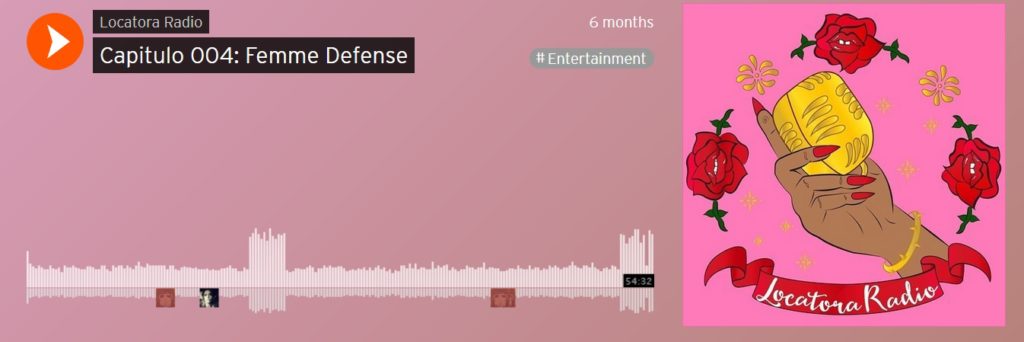
So the day I was listening to Locatora Radio’s Capitulo 004: Femme Defense, where hosts Mala Muñoz and Diosa Femme discuss their experiences with street harassment and how they use femme defense to deal with it, I was blown away. I was blown away because never in all the times I’ve discussed street harassment did anyone talk about how to respond. Locatora Radio “is a Radiophonic Novela …. Las Locatoras make space for the exploration and celebration of the experiences, brilliance, creativity, and legacies of femmes and womxn of color. Each Capitulo of Locatora Radio is made with love and brujeria, a moment in time made by brown girls, for brown girls.”

As Mala states, femme defense is not just defending oneself but one’s community and you can be any gender and be femme.

The discussion between Mala (who is a fellow domestic violence and sexual assault advocate) and Diosa (who advocates for immigrant women) really struck a chord with me. They discussed having their bodies policed by their family (as way to prevent being harassed), being aware of their surroundings, and using techniques such as the eye gouge if one must engage in physical defense. One particular piece of the discussion that really resonated with me is the “Fuchi face.” The Fuchi face is your mean face, bitch face, mean mug, or whatever you call it, that you put on when you don’t want to be approached or messed with.  I used to call it my “train face” while growing up in NYC so I wouldn’t get bothered while taking public transit.

It’s funny that while out with my “Fuchi face” I was still harassed but I felt less angry about it after listening to the Locatoras because I am not alone and learned useful tips for what do in situations of street harassment.

While we are 3,000 miles apart, we share many of the same experiences. To know that there are other Latinx women out there dealing with this and talking about it, makes me feel like I have a community.

Editor’s Note: Here are suggestions for dealing with street harassment from the SSH site, in Spanish and English.

Dee is a volunteer coordinator and domestic violence/sexual assault advocate for a non-profit social services agency and works on a project to better serve Latinx women survivors. She has a bachelor’s degree in Global Studies with a focus on Latin American Culture from Penn State University. She originally hails from New York City and is a proud daughter of immigrant parents from the Dominican Republic. You can follow Dee on Instagram at @missdeerodriguez.

Share

Filed Under: correspondents, race, Resources, street harassment

“I felt so helpless and uncomfortable”

July 10, 2017 By Contributor

I was eating a donut by the window of a donut shop, and a guy stopped in front of me, pointed to me, pointed to his mouth, pointed to his crotch, and showed me a ten dollar bill. I had no idea what to do, so I just tried to avoid looking at him, but he wouldn’t go away. Luckily, there was a person next to me who shook his head no. I felt so helpless and uncomfortable.

– EK

Location: Buckeye Donuts in Columbus, OH, USA

Need support? Call the toll-free National Street Harassment hotline: 855-897-5910

Share your street harassment story for the blog.
See the book 50 Stories about Stopping Street Harassers for idea
s.

Share

Filed Under: Stories, street harassment

“He said things like we were cute and he had secret games”

July 7, 2017 By Contributor

Wow, I was 10 and was at the park. I was playing with a friend and the park seemed empty so we were climbing on the monkey bars and sliding down the slides. I had a sun dress on and my friend had on shorts. Anyway like I said we didn’t see anyone around or I wouldn’t have been climbing around in a dress. We were hanging upside down on the monkey bar when I heard his voice. He said, “Hi” and “Are you girls wanting some fun?”

I freaked and attempted to keep my dress pushed up covering my panties as I was stuck in front of him hanging on the monkey bars. My friend who was 12 climbed down and held my dress in place as I got down from the hanging position. He kept talking and we started to walk away. He said things like we were cute and he had secret games. We left and were afraid to come back to the park all summer.

Optional: What’s one way you think we can make public places safer for everyone?

Not sure as a girl it has happened a few times. Guess people just need to stay aware. People say it doesn’t hurt anyone but if freaked me out.

– HY

Location: Oblong Illinois City Park

Need support? Call the toll-free National Street Harassment hotline: 855-897-5910

Share your street harassment story for the blog.
See the book 50 Stories about Stopping Street Harassers for idea
s.

Share

Filed Under: Stories, street harassment

Brazil: Female solidarity and cyberfeminism: collectivist measures against street harassment

July 4, 2017 By Correspondent

Yasmin Curzi, Rio de Janeiro, Brazil, SSH Blog Correspondent

In philosophy, the concept of “disrespect” describes situations of injustices that marginalized groups and minorities suffer in a society. In my thesis “My name isn’t pssst!”: Street harassment and feminisms’ struggle towards legal recognition”[1], I explain that street harassment, itself, expresses disrespect in two different ways:

  1. As a form of legal disrespect because it deprives women from exercising fundamental rights – basically, freedom, in its many forms, and equality in the uses of the city.
  2. As a form of social disrespect because it devaluates women socially, inhibiting the full development of their self-esteem, provoking trauma, stress, feelings of self-depreciation, anger and disgust of their own bodies, as several investigations[2] pointed out.

As Axel Honneth says in “The struggle for recognition” (1992), experiences of disrespect fuel social movements. It drives them to engage in fights to put an end to these situations of injustice. In brief, what Honneth says is that what makes individuals commit to the same cause is sharing the same situations of disrespect. In other words, disrespect generates negative emotional reactions that, in turn, when shared by others, provokes the union of these individuals in order to combat it. This bond that emerges from experiencing situations of similar sufferings can be defined as “solidarity”.

“Solidarity” expresses the true interest in the well-being of another individual. It evokes fights for a social coexistence free of experiences of injustice, that is to say, not troubled by disrespect. Thus, sharing stories and personal narratives are fundamental to identify others with the same suffering or even to raise consciousness of an interaction as a form of violence.

Social media platforms have provided a revolution in the feminist movements by creating new spaces where collective action can be organized and information can be shared. With social networks as their main tool, women began to articulate what was conceptualized as cyberfeminism by Donna Haraway in the book “The Cyborg Manifesto” in 1985.

As Holly Kearl[3] shows, significantly, these new spaces have served to mobilize women’s activism to cope with street harassment – especially by allowing the realization of surveys and by creating the possibility to women of sharing their narratives, in various parts of the globe, that are otherwise made invisible.

Also, in Brazil, in face of the scenario of structural inequality and absence of public policy for women[4], some important initiatives have been developed in the scope of civil society.

There is the campaign “Fiu Fiu Enough” (“Chega de Fiu Fiu”) of the NGO Think Olga and the movement “Women go together” (“Vamos juntas?”). The NGO Think Olga is now producing a documentary, with crowdfunding resources, that intends to expand the debate over sexual harassment in public places. The second action was idealized by the journalist Babi Souza, from Porto Alegre city, and it’s a call to women to get united with other women (strangers or not), when they’re alone in the streets. Also, there’s multiple groups in Facebook where women can arrange to go together to the same place or direction. In a partnership with “99 Taxis” (a taxi ordering app), this organization promoted workshops of non-sexist behaviors directed to the taxi-drivers associated with the app.

A third action, idealized in 2015 by the student Catharina Doria, is the app “Back Off!” (“Sai Pra Lá!”). It enables women to record where and when they were harassed and what was done to them. The purpose is to create a “harassmap” in order to alert which are risky places and also to pressure the public to assume the responsibility of assuring women’s safety.

Cyberfeminism has been, therefore, fundamental to the confrontation of street harassment as it enables resistance actions, led by women. But collectivist measures, in the scope of civil society, can’t be addressed, by material reasons, to the whole country. There should be no opposition to collectivist measures in the civil society scope, and in the elaboration of public policy toward women’s rights. Public authorities should, instead, be working along with these organized groups in order to eradicate violence against women.

Endnotes:

[1] To be published in the next year.

[2] GARDNER, Carol. Passing by: gender and public harassment, 1980. Also BOWMAN, C. Street Harassment and the Informal Ghettoization of Women, 1993.

[3]         KEARL Holly. Stop Global Street Harassment: Growing Activism Around the World, 2015.

[4]         See my first article for the SSH Blog: https://stopstreetharassment.org/2017/05/public-policy-women/

Yasmin is a Research Assistant at the Center for Research on Law and Economics at FGV-Rio. She has a BA in Social Sciences from FGV-Rio and a Master Degree in Social Sciences from PUC-Rio, where she wrote her thesis on street harassment and feminists’ struggles for recognition.

Share

Filed Under: correspondents, street harassment

« Previous Page
Next Page »

Share Your Story

Share your street harassment story for the blog. Donate Now

From the Blog

  • #MeToo 2024 Study Released Today
  • Join International Anti-Street Harassment Week 2022
  • Giving Tuesday – Fund the Hotline
  • Thank You – International Anti-Street Harassment Week 2021
  • Share Your Story – Safecity and Catcalls Collaboration

Buy the Book

  • Contact
  • Events
  • Join Us
  • Donate
  • Facebook
  • Instagram
  • Pinterest
  • Tumblr
  • Twitter
  • YouTube

Copyright © 2026 Stop Street Harassment · Website Design by Sarah Marie Lacy