• About Us
    • What Is Street Harassment?
    • Why Stopping Street Harassment Matters
    • Meet the Team
      • Board of Directors
      • Past Board Members
    • In The Media
  • Our Work
    • National Street Harassment Hotline
    • International Anti-Street Harassment Week
    • Blog Correspondents
      • Past SSH Correspondents
    • Safe Public Spaces Mentoring Program
    • Publications
    • National Studies
    • Campaigns against Companies
    • Washington, D.C. Activism
  • Our Books
  • Donate
  • Store

Stop Street Harassment

Making Public Spaces Safe and Welcoming

  • Facebook
  • Instagram
  • Pinterest
  • Tumblr
  • Twitter
  • YouTube
  • Home
  • Blog
    • Harassment Stories
    • Blog Correspondents
    • Street Respect Stories
  • Help & Advice
    • National Street Harassment Hotline
    • Dealing With Harassers
      • Assertive Responses
      • Reporting Harassers
      • Bystander Responses
      • Creative Responses
    • What to Do Before or After Harassment
    • Street Harassment and the Law
  • Resources
    • Definitions
    • Statistics
    • Articles & Books
    • Anti-Harassment Groups & Campaigns
    • Male Allies
      • Educating Boys & Men
      • How to Talk to Women
      • Bystander Tips
    • Video Clips
    • Images & Flyers
  • Take Community Action
  • Contact

Archives for August 2017

End-Of-Summer SSH Programmatic Updates

August 31, 2017 By HKearl

Dear Friends,
First, thank you for your support in helping us serve more than 300 people in the first year of the National Street Harassment Hotline! Special thanks go to monthly donors Alan Kearl and Beckie Weinheimer for their consistent support.

You, too, can help people in need all across the nation by making a $10 or more donation today. You can also help by spreading the word about the hotline to ensure that the people who need it know about it!

Volunteer as a Blog Correspondent:
We’re looking for a few more volunteer blog correspondents for our last cohort of 2017 — Sept. to Dec. Apply today!! Past correspondents can apply. We are especially seeking people outside the USA.

Many thanks to our latest cohort that just wrapped up their session. Hailing from Brazil, Indonesia, Nepal and USA, they wrote on topics like the psychological effects of street harassment, Latinx women’s experiences with street harassment, the line between humor and harassment and women-only transit.

Recent Board Member Actions:
The SSH community was horrified by the events in Charlottesville, VA, and the growing boldness of Nazis and White Supremacists. SSH board member Maureen Evans Arthurs was among those who took to the streets and marched in solidarity with Charlottesville.

SSH board member Lani Shotlow-Rincon worked with the Chicago Veterans Affairs Medical Center on a campaign aimed at eliminating sexual harassment at their facility. They adapted her anti-street harassment artwork “Hello, My Name is NOT HEY BABY” as part of their campaign. All of the people featured in the campaign are veterans.

SSH board member Patrick Ryne McNeil wrote an article for the Huffington Post, “These Resources Are Critically Important During Trump’s Toxic Presidency.”

Groping is Sexual Assault:
When Taylor Swift went to court in Denver, CO, for two lawsuits stemming from a former DJ allegedly groping/assaulting her, she took a strong stance against victim-blaming. Then her win was a win for abuse survivors everywhere. I did an interview about the lawsuits for the Associated Press and two TV interviews for the Morning Dos (and aired in six major cities). I also penned a piece for Huffington Post.

Meetings, Events & Initiatives:
We partnered with Free Women Writers, an initiative by and for Afghan women, as they fundraise to be able to print booklets with resources for survivors of violence (including street harassment) to distribute them in Afghanistan. While the booklet is available online, many women in need do not have access to the Internet. You can donate online to help them reach their goal — they’re only about $100 from achieving it!

SSH is supporting the New York-based Sydnie L. Mosley Dances’ The Window Sex Project Community Workshop presented in collaboration with I, Too Arts Collective on Sept. 14 and Oct. 16 (10 a.m. to 3 p.m.). Harlem women and genderqueer folks ages 18-40 are invited to participate in a FREE workshop rooted in movement, storytelling, discussion and healthy living. RSVP + more info.

Our partner Safecity in India and The Red Elephant Foundation are launching a mobile app on Sept. 21. Via Project 21, people will be able to report sexual violence globally as well as access help for their communities. If you would like to collaborate and join in as a partner either for the solidarity event on Sept. 21 or for a longer period, you can sign up.

Lastly, I gave talks to the Institute for a Democratic Future cohort in D.C. and the Women’s Network at Exiger Diligence in Maryland. On Sept. 20, I’ll be a speaker at the University of New Hampshire. This month I also joined Jessica Raven, the Executive Director of Collective Action for Safe Spaces, in a meeting with the Washington Metropolitan Area Transit Authority (WMATA) to discuss launching anti-harassment audio announcements on the transit system this fall and to meet with a new staff member who will work on more comprehensive sexual harassment training for WMATA staff.

Thank you, and please do consider making a $10 or more donation today to support the National Street Harassment Hotline as we enter year two of service!

In Solidarity,Holly Kearl
SSH Founder, CEO

Share

Filed Under: SSH programs, street harassment

End-Of-Summer 2017 News Round-Up

August 30, 2017 By HKearl

New Research:

A new study conducted in the MENA region sheds light on why men street harass.

A study published in the Australian and New Zealand Journal of Public Health found strong links between women’s experience of sexual violence – including street harassment — and poor mental health.

A study in the British Journal of Social Psychology shows street harassment negative impacts how women think about themselves.


Global News:

Women in Lebanon speak out against street harassment.

Australian women are receiving unsolicited “dick pics” via AirDrop.

Reports of sexual harassment are up on Brussels’ (Belgium) public transport.

Pressure is mounting for music venues in Canada to address sexual harassment.

A man in China stabbed a woman on the bus after she protested his harassment.

Young women in Egypt face harassment in public spaces and restrictions at home.

In France, the Gender Equality Minister wants to outlaw street harassment.

A new survey shows harassment on public transport is rampant in Chennai, India.

A teenager’s account of harassment went viral in Italy.

A new cartoon character tells people to report street harassment in Japan.

There was a death penalty ruling in a forced public stripping case in Kenya.

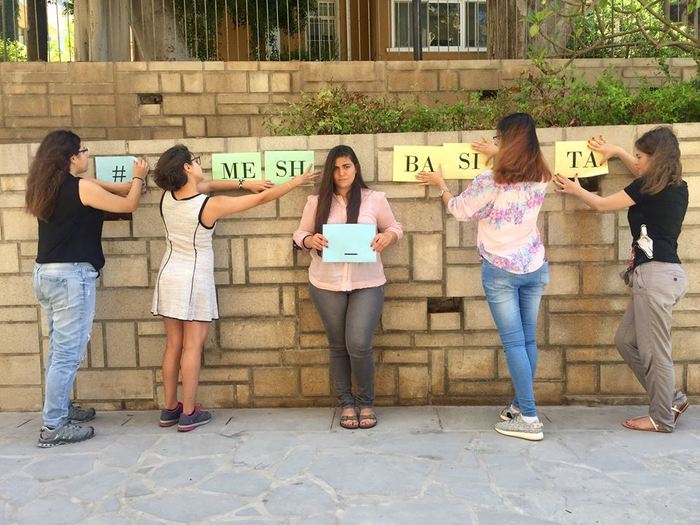
There’s a new anti-harassment campaign in Lebanon, #mesh_basita.

The gang rape of a woman on a bus in Morocco led to protests and promises of action by the Prime Minister.

Stop Straatintimidatie launched a new anti-harassment campaign in the Netherlands.

A new fine and jail time will be enforced on street harassment in Rotterdam, the Netherlands.

42 gay men in Nigeria were arrested simply for organizing a HIV awareness event in a public venue. Sign a petition for their release.

Combatting street harassment in Pakistan.

A senator in the Philippines will propose to criminalize street harassment.

A woman in South Africa wrote about wishing she was a man so she didn’t face harassment.

There’s a new dress code being enforced in Uganda, including against mini-skirts.

From Uganda to Tajikistan, women are fighting to enjoy the freedom of bicycling.

A Labour MP in the UK has suggested women-only train carriages – but the idea is insulting.

Women in Bristol (UK) are mapping street harassment.

“Cheer Up Luv” is a new UK-based photo series project.

Women of color in Washington, D.C. (USA) organize against street harassment.

Why street harassers speak the same language across the USA.

Latina and African American women in the USA created a choreo-film on street harassment.

A guitarist in the USA stopped his performance after witnessing sexual harassment in the audience.

American actress Ashley Judd calls out “everyday sexism”.

A high percentage of Missoula (MT, USA) patrons experience sexual harassment.


Powerful Pieces:

“My body doesn’t belong to you.”

“The thrill and fear of ‘Hey, Beautiful’”

“I don’t accommodate uncontrolled men”

“9 types of street harassment you’ve probably experiences if you’re a woman”

“After fighting off mid-run attack, she’s using her voice to help others”

Share

Filed Under: News stories, Resources, street harassment

Brazil: ”A few small nips” and the devaluation of women’s lives

August 29, 2017 By Correspondent

Trigger warning – mentions of rape and homicide

Yasmin Curzi, Rio de Janeiro, Brazil, SSH Blog Correspondent

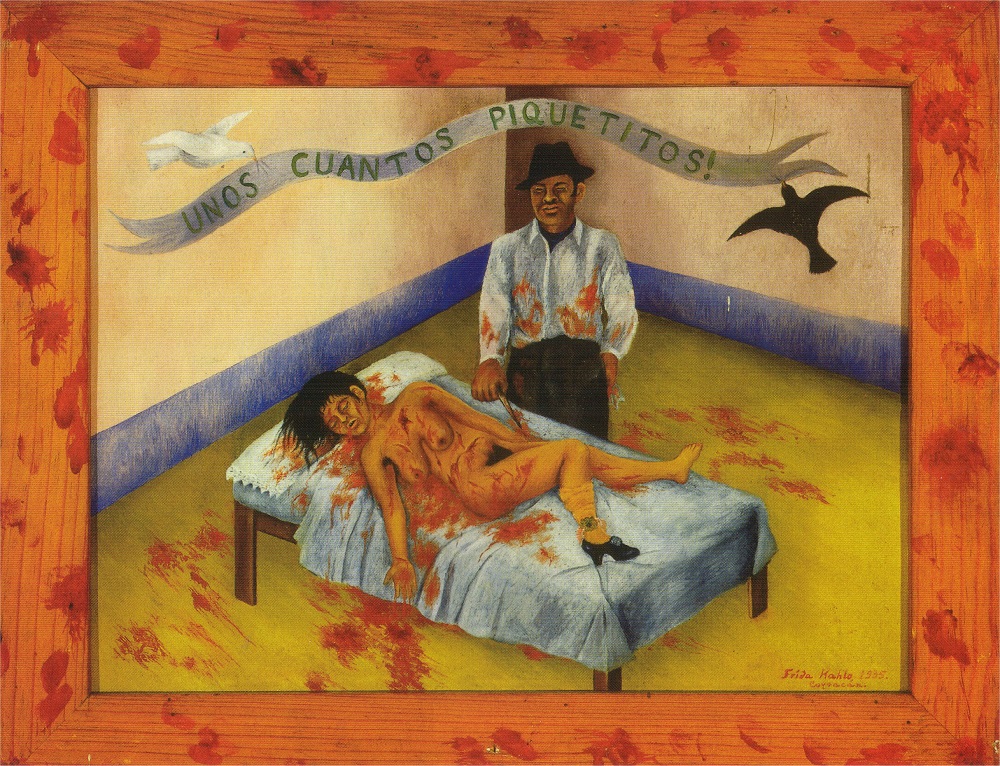
The painting is by Frida Kahlo. Sofia Mandelert aptly described in this article , “Painted in 1935, it’s inspired in a news report about a bloody homicide. A drunk man that stabbed his girlfriend twenty times on a bed and, when interrogated by the police, said that there were only “a few small nips”. The painting is crude and impactating, retracting the crime scene: the woman’s body lies naked over a bloody bed, while the man faces her in an apathetic way, with the crime weapon in his hands. The woman had her body covered with open wounds (…) To complete the aggressiveness of the scene, as a result of the bestial attack, the woman’s blood sprays all over the frame. However, not everything is death and grief in the scene. (…) Sneakily, the horrifying scenario is transformed into a caricature with the presence of bucolic elements, as the delicate silk pillowcase and the walls are painted with a happy combination of pink and blue. The joke is finished with a romantic pennant held by two doves, one white and one black, where the title of the work can be seen.”

Maré’s Favela (Rio de Janeiro/RJ): Valdina de Souza Araújo, 44 years old, street vendor. Constantly assaulted by her partner, the taxi-driver Eduardo Martim da Silva, one day she went missing. Her clothes were found covered with blood in his house.

Mickey’s Community (Niterói/RJ): Michelle Ferreira Ventura, 30 years old, maid. After being constantly harassed by her neighbored, Leonardo Bretas Vieira, Michelle stood up to him. He beat her until she lost consciousness. After four months in the hospital, she died.

São Paulo: Clara Averbuck, writer and feminist activists. She was raped by an Uber driver but did not report it to the authorities knowing how the system operates against women’s dignity and she didn’t want to be violated again by the State. In order to give voice to victims of this type of violence, she started a campaign entitled “#myharasserdriver/ #myabuserdriver”.

Recently released information from Women’s Dossier[1] shows the dimension of the dramatic scenario of violence against women in Rio de Janeiro. In the last three months of 2016, 42 attempts of murder of women were qualified as gendered crimes, signifying 27,3% of the total. A woman’s life was threatened, simply for being a women, every two days. The notifications of rape shows that 39,8% of the aggressors were somehow related with the victims (8,9% her partner or ex-partner). In addition, 55,5% of the victims were young girls, under 14 years old.

The stories of Valdina and Michelle, selected among thousands, show us that neither public spaces nor the domestic sphere are safe for women. Violence against women is the norm in this society.

It’s usual to associate the male protagonists of cruelty crimes against women as psychopaths, monsters, or mentally ill men that, by their nature, are “inherently violent”. This type of discourse intends to dissociate those who commit a violent act from the rest of the society. We can apply penalties toward them. We can exclude them from our social lives.

Except that, in fact, these men are ordinary men. They are men that live with these women who have regular lives, regular jobs and regular social relations. Thus, it’s a much more complex scenario, one that, maybe, people don’t want to face. It’s easier not to think about the changes that society really needs to make. In other words, to realize that these men are ordinary men implies that it’s not the individual behavior that is the real cause of the violence against women, but instead it’s the whole mindset that permeates our society that makes this violence possible. There are no “bad apples” needing to be removed from a barrel of pretty apples. The whole barrel is putrefied. It is a whole culture funded in the disrespect of women and a whole history of deprivation of equal value informing all of our relations.

Devaluation of women starts in the very first years of their lives: boys are more wanted than girls in some religions and societies. Then, usually parents raise their girls without the same freedoms that are given to boys and socialize them with the idea that they are fragile or incapable of doing things on their own. They are also forced to do housekeeping, while boys aren’t. Often, teachers opt to hear boys instead of girls in schools. So girls are more silenced. Media and propaganda leads them to think that they are never good enough – not pretty enough, nor smart enough. All of these are types of psychological violences which cause several traumas in women’s lives. Young girls are also the very first victims of trafficking of persons for sexual exploitation, domestic abuse and rape. Women are disrespected in the work sphere – in Brazil, black women are the main group in the informal market. Also, women are generally not recognized by their attributions in the formal market, suffering from sexual harassment, inequality of payment, demission after giving birth, etc.

Both private and public sphere are unsafe for women because they are not protected from abuse, rape, homicide and others types of violences.

My intention in this article is to show that violence against women, in all its forms, is a symptom of a mindset that constitutes the structure of our society. And this mindset is the fundamental root of that putrified barrel. All violence is connected by disrespect and by the devaluation of women that makes them a second-class group in our society.

In order to put an end to violence against women we must face this structure, change the way women are perceived at a much more profound level. This involves discussing education, intimate relations, media, democracy and public institutions. This involves the true recognition of women as human beings.

[1]  Dossiê Mulher 2017 / Instituto de Segurança Pública; Organizadores: Andréia Soares Pinto, Flávia Vastano, Orlinda Claudia R. Moraes. – Rio de Janeiro: Instituto de Segurança Pública, 2016.

Yasmin is a Research Assistant at the Center for Research on Law and Economics at FGV-Rio. She has a BA in Social Sciences from FGV-Rio and a Master Degree in Social Sciences from PUC-Rio, where she wrote her thesis on street harassment and feminists’ struggles for recognition.

Share

Filed Under: correspondents, street harassment

“I was harassed with sexually explicit slurs”

August 28, 2017 By HKearl

I was harassed with sexually explicit slurs near the PATCO train station.

– Anonymous

Location: Haddonfield, NJ

Need support? Call the toll-free National Street Harassment hotline: 855-897-5910

Share your street harassment story for the blog.
See the book 50 Stories about Stopping Street Harassers for idea
s.

Share

Filed Under: Stories, street harassment

Needed: Research participants in California

August 28, 2017 By HKearl

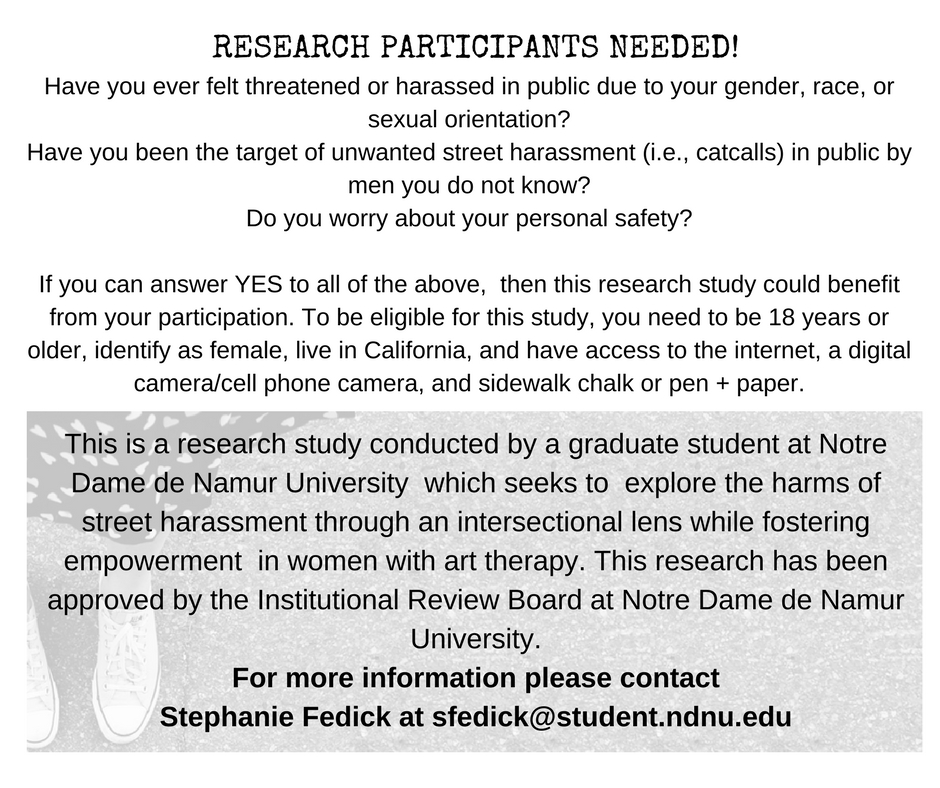
A graduate student in California studying Art Therapy is recruiting individuals to take part in her project — they must be between the ages of 18-64, live in California, identify as female and have experiences with street harassment. Part of her research includes a brief art directive in the form of sidewalk chalking and she’s looking for people to help! Here is more information.


Share

Filed Under: street harassment

Next Page »

Share Your Story

Share your street harassment story for the blog. Donate Now

From the Blog

  • #MeToo 2024 Study Released Today
  • Join International Anti-Street Harassment Week 2022
  • Giving Tuesday – Fund the Hotline
  • Thank You – International Anti-Street Harassment Week 2021
  • Share Your Story – Safecity and Catcalls Collaboration

Buy the Book

  • Contact
  • Events
  • Join Us
  • Donate
  • Facebook
  • Instagram
  • Pinterest
  • Tumblr
  • Twitter
  • YouTube

Copyright © 2026 Stop Street Harassment · Website Design by Sarah Marie Lacy