An alarming new study released last month found that nearly all Native women in Seattle, Washington, USA, have been raped or forced to have sex and 69% also reported experiencing street harassment. A study released this month in the UK found that 66% of girls and young women ages 14 to 21 have experienced street harassment.
In France, in late July, a man verbally harassed Marie Laguerre in Paris, France, as she walked home. When she told him to “shut up,” he physically and brazenly attacked her. A man in Iowa, USA, in July verbally harassed Mollie Tibbett during her run and when she threatened to call the police, he killed her. A man in Melbourne, Australia, raped and murdered Eurydice Dixon as she walked home from a comedy gig in June.
Street harassment continues to be a serious issue that affects most women and girls, it is connected to sexual violence and it can escalate into physical violence and even murder. This is why even seemingly benign “catcalls” can be scary and why so many of us “choose” to limit our time in public and curtail our lives in order to try to stay safe.
In order to create a world where everyone is safe and welcome in public spaces and everyone has equal access to the resources there, it’s important that we speak out against street harassment, that we support efforts to prevent it through education, training and awareness-raising, and that we model respectful interactions for the children and youth in our lives.
New Legislation
In late June in Washington, D.C., the Council of the District of Columbia passed the Street Harassment Prevention Act of 2018 (SHPA), the first legislation of its kind in the United States. It is one of more than 20 laws addressing street harassment to pass globally since 2012 (including laws that passed recently in France, Romania, Chile, and the Philippines. This month, a review is to take place into whether misogynistic conduct, including street harassment, should be treated as a hate crime in the UK.)
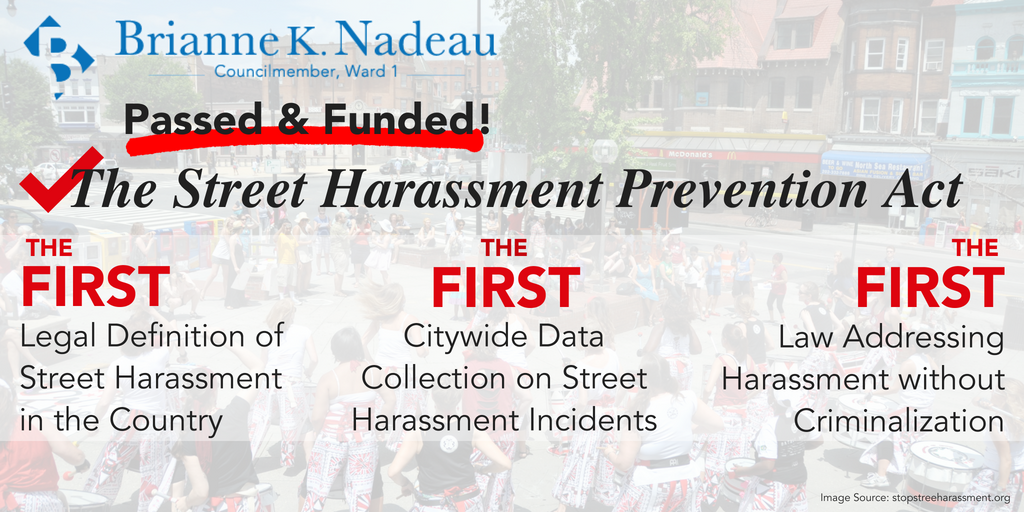
The SHPA, which our allies Collective Action for Safe Spaces took the lead in advocating for and we helped support, is groundbreaking for creating the first legal definition of street harassment in the United States, calling it “disrespectful, offensive or threatening statements, gestures or other conduct directed at an individual in a high-risk area without the individual’s consent and based on the individual’s actual or perceived … protected trait identified in the [DC] Human Rights Act of 1977.” It also uniquely focuses on prevention through education instead of criminalization.
As I noted in an article for Women’s Media Center, “Specifically, the SHPA establishes an advisory committee on street harassment that will propose model policies and training materials to be implemented in the District; require the Office of Human Rights (OHR) to conduct the first citywide survey on street harassment; and require OHR to conduct a public information campaign about street harassment. Further, grant money will be provided for street harassment awareness programs.”
In research I’ve conducted about laws against street harassment, too often there is no education component. (Indeed, the French activist organization Stop Harcelement de la Rue is disappointed in the French law because the lawmakers ignored their suggestion for mandating education.) Too often there is no money earmarked for training law enforcement or advertising the law. Too often the law is barely used and offers no real deterrent to harassers.
Hopefully educational campaigns, awareness programs and training in the DC-area can actually create change, especially when there is money to fund these initiatives. And if it does, I hope other regions of the world will follow this model of prevention legislation.
New Faces
I’m excited to share that Dr. Meghna Bhat, a former SSH blog correspondent, has joined the team as a volunteer social media and website manager! She’ll primarily be managing the twitter and Instagram accounts and content for our blog.
This month we also welcome five new board members, all from the Washington, DC-area. Meet them! I’m excited to work with them.
A few of our long-serving board members are leaving this month as their terms have ended. This includes two of our founding board members, Liz Bolton and Layla Moughari, who have contributed a great deal to SSH over the years, from fundraising to editing research reports and press releases to organizing events for Anti-Street Harassment Week! I am grateful for their help in establishing SSH as a nonprofit in 2012 and all that they’ve done since then.
Hey Baby VA Campaign Update
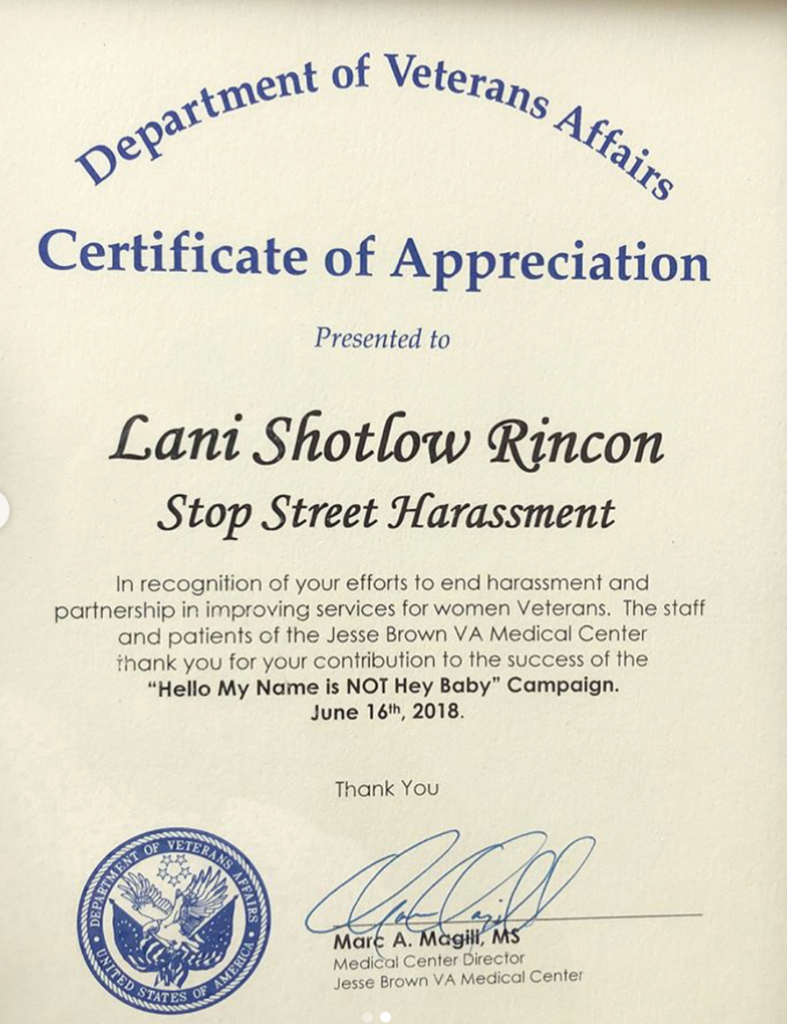
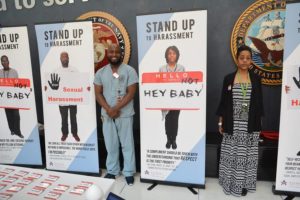 Our board member Lani’s “Hey Baby” graphic was used last year by a Veteran Affairs (VA) center in Chicago for an anti-harassment campaign. The campaign has reduced harassment at the facility. Jenny Sitzer, the program manager, that implemented the campaign will be attending and presenting the campaign success in an internal VA conference this fall. When Lani was in town this summer, they presented her with a certificate and showed her the banners.
Raising Awareness
 In June, I gave a presentation to the CDC’s Intimate Partner Violence/Sexual Violence (IPSV) Workgroup about street harassment and our two research reports, and I wrote articles for HuffPost, Ms. Magazine, Women’s Media Center and New Moon Girls magazine (print).
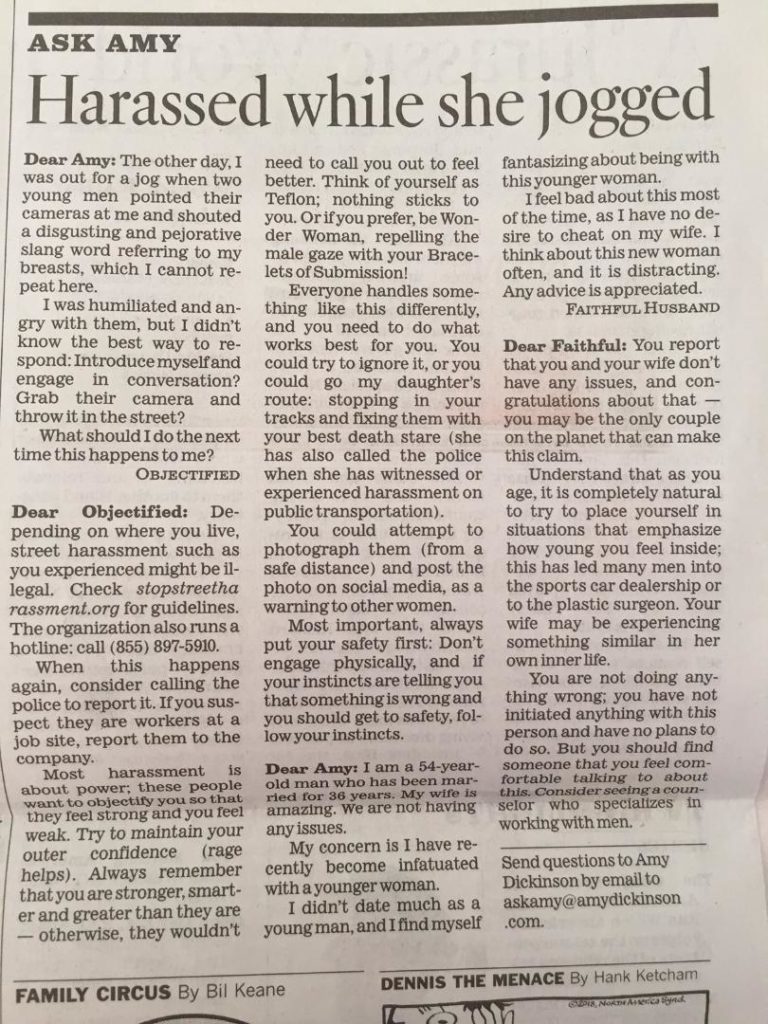
SSH was covered in a range of media outlets, including BBC, Yahoo, Morning Dose, and Next City. In exciting news, SSH’s hotline was mentioned by CNN and “Ask Amy” and our latest study has been used by legislators and journalists.
