By: Delia Harrington, Massachusetts, USA, SSH Correspondent

Hollaback! Boston released their State of the Streets report today, based on data collected from over 500 Bostonians during the month of August. A startling 88% of respondents had experienced street harassment, proving that there is absolutely a place in Boston for the work of organizations like Hollaback!, Everyday Feminism, and of course Stop Street Harassment.
As readers may know, Hollaback! was co-founded in New York City by Emily May, and has since become a worldwide movement. The organization strives to end street harassment; conducting workshops and campaigns, and empowering those affected by street harassment by gathering and sharing their stories.
The Boston chapter was co-founded by current leaders Britni de la Cretaz and Kate Ziegler in 2011. While each branch operates autonomously, they share strategies with one another. According to today’s Report, the Boston branch was inspired by Hollaback! Ottawa’s own fact-finding. Similarly, some recommendations mention the successes of other Hollaback! branches.
The report details how Bostonians define harassment, where and how often they experience it, how it makes them feel, as well as recommendations moving forward from Hollaback! According to the report, Hollaback! Boston decided to collect information not only to see the scope of the issue in Boston, but also to educate others. While the site leaders hear stories of street harassment often, many others don’t. As they say in the report,
“We wanted to find a way to communicate this fact to people, especially people that may not think that street harassment is really a problem or people that don’t experience street harassment themselves. We wanted to put the reality of what we face when we walk out the doors and out onto the streets of Boston in black and white.”
Respondents to the survey were overwhelmingly women (86%) and people in the LGBTQIA community (31%). Of those respondents, 87% were female-identified, 90% were LGBTQIA-identified, 94% identified as a person of color, 96% identified as both LGBTQIA & POC, and 90% identified as being a person with a disAbility, reported experiencing street harassment. This supports the notion long held among those attempting to end street harassment that POC, LGBTQIA folks and those with a disAbility experience particularly high levels of street harassment.
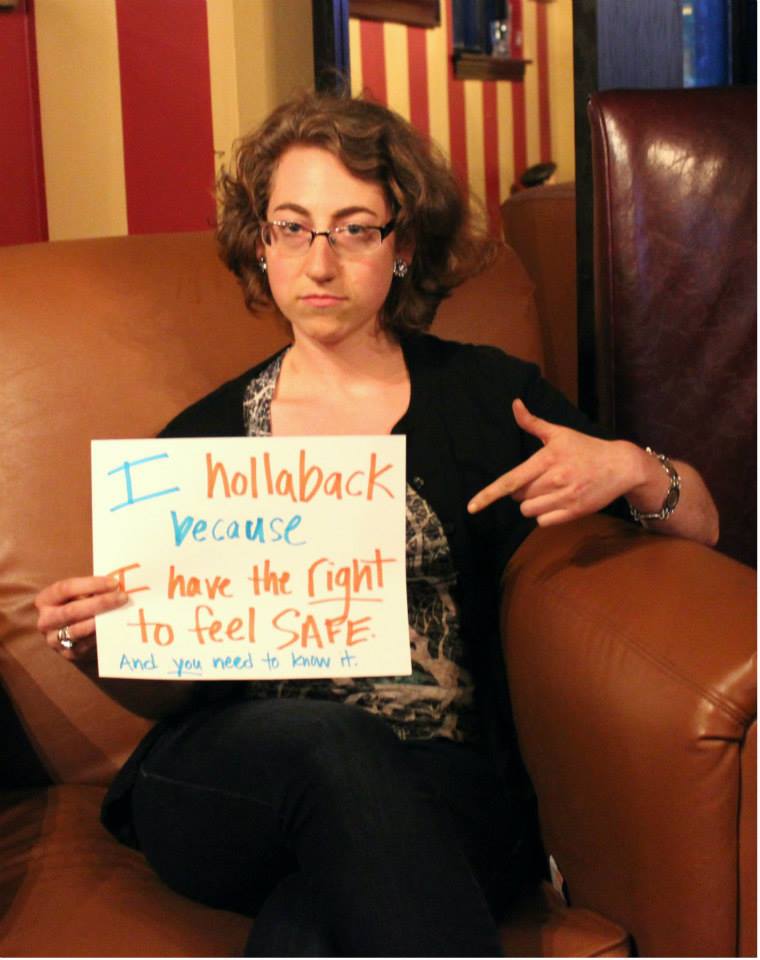
Harassment is largely taking place on the street (97%), on the MBTA (63%), in bars or clubs (37%), in public parks (32%), and at school (14%). Not surprisingly, those respondents experiencing harassment said it made them feel angry (85%), nervous (80%) , annoyed (78%), disgusted (72%) , and scared (64%). And for those who claim street harassment is enjoyable for the victim, or that it is not a big deal, only 14% of respondents said they were ‘flattered’, and only4% said street harassment ‘didn’t bother’ them. While the report refrained from editorializing, I’d like to note that while some respondents were flattered or not bothered, it is impossible to tell whether the person you’re seeing on the street will be nervous or flattered by the attention, so it’s best to err on the side of caution (and the numbers) and treat everyone as though they wouldn’t like it.
Like many working in this space, Hollaback! Boston sees bystander intervention as a key tool to combat street harassment. Unfortunately, only 14% of respondents reported an instance of someone intervening on their behalf. As a result, Hollaback! suggests the, “creation of a public education campaign that focuses on tangible ways that people can safely intervene.”
The data is likely unsurprising to readers of this site and fans of Hollaback’s work, but it is incredibly valuable to have hard statistics to show to potential partners moving forward. For example, given that 63% of respondents reported feeling harassed on the MBTA, the report’s suggestion of an ad campaign (similar to that created by Hollaback! Philadelphia and run on SEPTA trains), training for MBTA employees on how to respond to street harassment, and an awareness campaign (à la “See Something, Say Something”) about available reporting mechanisms may all be seen as higher priorities by MBTA officials. Moreover, while Hollaback! makes several suggestions moving forward, they are all constructive and include next steps for themselves as an organization. Hopefully this approach will continue to be successful as they use their model of presenting a problem and a potential solution that includes their assistance at the same time.
I hope that other Hollaback! branches and similar organizations are able to conduct a similar survey in the future, so other cities can wield statistics that accurately reflect the unique picture of street harassment in their area. I hope Hollaback! Boston continues to receive good local press coverage, which could pressure businesses and city officials to prioritize street harassment. Congratulations to Hollaback! Boston, and we look forward to the implementation of the recommendations.
Delia Harrington is a recent graduate of Northeastern University and calls Boston home. In recent years, she has found herself studying, working, and volunteering in Egypt, Cuba, France, Benin, the Dominican Republic, Turkey, Germany, and Greece. You can read more of her writing on her blog, or follow her on Facebook and Twitter, @deliamary.
