Minying Huang, Amman, Jordan, SSH Blog Correspondent
TW: Rape, sexual violence, honour killings
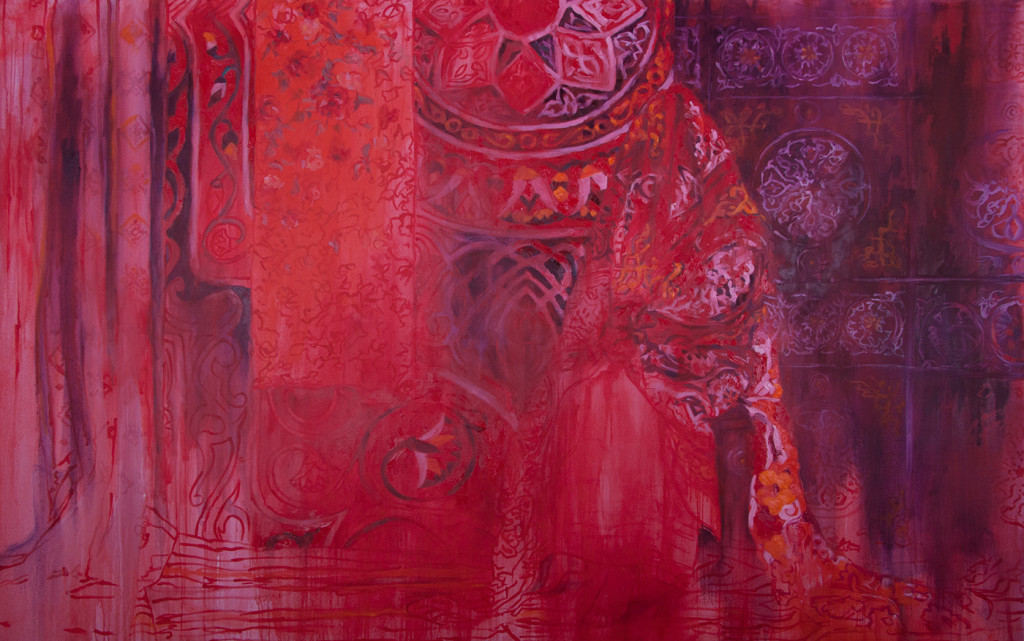
Barely discernible beneath heavily patterned fabrics – those used at weddings, funerals, and parliamentary elections – are the faint figures of women who have been raped. Silent and caged in tradition, the obscured female presence is at once a sign of oppression and a mark of resilience as she fights to retain her identity, refusing to disappear.
Earlier this year, I attended Rand Abdul Nour’s first solo art exhibition at Artisana & Gallery 14 in Amman, the capital of Jordan. ‘Woman II: Adorned with Jasmin’ offered a powerful visual commentary on how pervasive concepts of ‘honour’ hurt communities of women in Jordanian society. In her work, the artist condemns a brutal and rigid honour code enshrined in – and thus championed by – law: her paintings, beautifully rendered in oil on canvas, are a direct criticism of Article 308 of the Jordanian Penal Code which controversially allows rapists to go unpunished if they marry their victim and stay with them for a minimum of five years.
Lacking social support and legal protection, victims of rape and other forms of sexual abuse are left vulnerable and isolated. The dangers they face are twofold: honour killings* carried out by other family members are a widespread phenomenon in Jordan due to the severe social stigma surrounding sexual activity out of wedlock, the culture of victim blaming, and the way in which the identities and behaviours of a man’s female relatives have come to be bound up in both his own sense of male worth and societal conceptions of masculinity and morality; meanwhile, the legal structures in place at the moment – including those relating to abortion and parental lineage – not only endorse marriage to one’s attacker as a means of preserving the reputation of the victim and their family, but can also be said to strip victims of any real choice. Women’s rights activists in the country say that the majority of rape cases that do not result in pregnancy go unreported because revealing the truth is considered too great a risk; there is too much to lose and little certainty of a fair outcome. It has been estimated that 95% of rapists face no punishment for their crimes.
Four years ago, hundreds of Jordanians gathered together to form a human chain in the streets of Amman demanding basic rights for women, protesting against Article 308 in addition to the prevalence of honour crimes, harassment, and nationality discrimination in society. Last year, the Sisterhood Is Global Institute/Jordan (SIGI/J) launched a campaign, along with a civil coalition, with the aim of eliminating Article 308 and securing better psychological and legal provisions for those affected by sexual violence. The results of a study they conducted on local attitudes to rape and impunity showed that in reality many Jordanians are against Article 308 and believe that rapists should be punished regardless of whether or not they intend to marry their victims. After these findings were presented, the Legislation and Opinion Bureau in Amman finally began to review the article and consider SIGI’s proposals.
In April this year, it was announced that the Cabinet was in favour of cancelling the clause in Article 308 that permits perpetrators of sexual assault to walk free if they marry their victims and that the draft laws were being forwarded to Parliament for review. This important move towards achieving justice and equality comes after years of lobbying and campaigning on the part of various civil community organisations, legal experts, journalists, and activists. Progress is being made, thanks to the persevering spirit of communities of women fighting to reclaim control of their own bodies.
However, whilst change looks to be on the horizon, there is still much cause for concern. Today, in spite of the recent amendments, people continue to campaign for the complete cancellation of the article. As it stands, the article maintains that in cases of consensual sex with female minors aged 15 to 18 men may escape conviction through marriage. But it is especially difficult to differentiate between forced and consensual sex when the victim is underage. Furthermore, this remaining clause dangerously puts young girls under vast amounts of pressure to accept marriage as a resolution so as to avoid bringing dishonour and social disgrace upon themselves and their families.
Lubna Dawany, president at SIGI Jordan, has received heart-breaking letters from young girls coerced into – and now trapped in – these marriages: they detail the trauma they have sustained and their prolonged suffering at the hands of their rapists and their families; they urge other girls to resist, to never to agree to marriage under similar terms. She comments, “The new proposed change in law, which suggests that the clause be deleted but kept in place for girls under 18 years old, is unacceptable. How can it be allowed that perpetrators of sexual violence marry their teenage victims who are not treated as adults in any other aspects of their lives? On the contrary, I think that this is the age where we should support them and not leave them to such a vague future. Girls this age are still children and under no circumstances should we let them get married even to decent men, let alone their abusers.”
There is no honour in pardoning a rapist, nor is there any honour in sentencing a young girl – or a grown woman – to live in the same house as the man who abused her, to be wed to a man who would do her harm, and to be subject to his will. SIGI’s survey is a testament to the fact that traditional surface attitudes do not reflect the shifting realities within Jordanian society. We should celebrate the strength and resilience of the individuals and communities petitioning for systematic reform, unafraid to make their voices heard. Artists and activists alike are committed to redefining social values in the face of adversity and raising awareness of the issues at hand. An important and much-needed conversation on female agency in a patriarchal society has been started; hopefully increasing numbers of people will join the discussion, push for change, and help put an end to the numerous human rights violations carried out against women in the name of ‘honour’.
Here in Jordan, women are breaking the silence and painting themselves back into the narrative.
*For more information, read Rana Husseini’s book Murder in the Name of Honour.
Minying is a 19-year-old British-born Chinese student from Cambridge, England. She is studying for a BA in Spanish and Arabic at Oxford University and is currently on her Year Abroad in Amman, Jordan. You can follow her on Twitter @minyingh.
