

Making Public Spaces Safe and Welcoming
You can download copies of these anti-street harassment cards from DC NOW’s website!

Our board member Lindsey has cards too, at Cards Against Harassment.
Trigger Warning for Rape, Domestic Violence, and Murder
“LATELY, people have been bombarded with the notion that universities and colleges are hotbeds of sexual violence. Parents fear that sending their teenagers to school is equivalent to shipping them off to be sexually victimized.
But the truth is, young women who don’t go to college are more likely to be raped. Lynn A. Addington at American University and I recently published a study based on the Department of Justice’s National Crime Victimization Survey data from 1995 to 2011. We found that the estimated rate of sexual assault and rape of female college students, ages 18 to 24, was 6.1 per 1,000 students. This is nothing to be proud of, but it is significantly lower than the rate experienced by women that age who don’t attend college — eight per 1,000. In other words, these women are victims of sexual violence at a rate around 30 percent greater than their more educated counterparts.
The focus on sexual violence against some of our most privileged young people has distracted us from the victimization of those enjoying less social and economic advantage…
Women at the margins are the ones who bear the brunt of the harshest realities, including sexual violence, and they do so with the least resources. Am I saying that we should ignore sexual violence against the wealthy and educated? Of course not. Nor is it wrong to pay special attention to college-age women: The one risk factor that remains consistent whether women are advantaged or disadvantaged is age, and women ages 16 to 20 are sexually victimized at the highest rates.
But we cannot let attention to a particular group, or the suggestion of an epidemic where one does not exist, distract us from the pressing needs of others.”
“We need to stop seeing these various manifestations of misogyny—aggression, stalking, domestic violence, sexual assault—as a separate species of problem. Certainly men who engage in violence against women often do so for gendered reasons. Sometimes men are angry when women don’t obey them. Sometimes men feel that women owe them something. And women often suffer when they don’t act the way men want them to. But the consequences of misogyny and gendered violence don’t stop with women.
Unsurprisingly, research has linked violence by men against women with other antisocial behavior. Researchers have long known that those who abuse their domestic partners are also more likely to abuse children and animals. While some perpetrators of domestic violence limit their violence to family members, research has shown that many others engage in violence in the community at large. Another study found that 68 percent of men in a sample of batterers exhibited other “problem behaviors,” such as fights, previous arrests, or drunk driving…
Certainly ending violence against women is a worthy aim in and of itself. But we also need to see misogyny as a warning sign both of violence against women and of violence, period. What if Seung-Hui’s stalking behavior had resulted in concrete punishment? What if Rodger’s aggression toward women had been taken more seriously? What if the various charges against Monis had been deemed sufficient to warrant his incarceration prior to trial?
“In families of police officers, domestic violence is two-to-four times more likely than in the general population — from stalking and harassment to sexual assault and even homicide. As the National Center for Women and Policing notes, two studies have found that at least 40% of police officer families experience domestic violence, in contrast to 10% of families in the general population.
America’s police domestic abuse problem was on full display in Monday’s horrific murder of Valerie Morrow, who police say was shot to death by her ex-boyfriend, Stephen Rozniakowski, a Philadelphia-area police officer. Morrow, 40, had just been granted a protection from abuse order against Rozniakowski, who had been charged with 75 counts of stalking.”
“Amnesty International is due to release a bombshell report on Tuesday detailing the manner in which hundreds of Yazidi girls and women in Iraq were forced into sexual captivity by Islamic State gunmen, according to British newspaper The Times of London.
The report cites interviews with dozens of young women who managed to escape the horrors of IS enslavement. Amnesty International believes that the number of females who were forced into sexual slavery may exceed 1,000.”
“Rental housing sexual harassment or rental harassment is different from office-based sexual harassment because the predator isn’t just bothering victims in their cubicle, they’re installing cameras in showers or opening their tenants doors whenever they feel like it, says Malchow’s lawyer Jill Gaulding of the nonprofit Gender Justice.
“There’s this notion of ownership and entitlement,” Gaulding said. “There seems to be a sense by some landlords, that when they’re renting property to women, that’s also in a sense giving them access to the women as sex objects.””
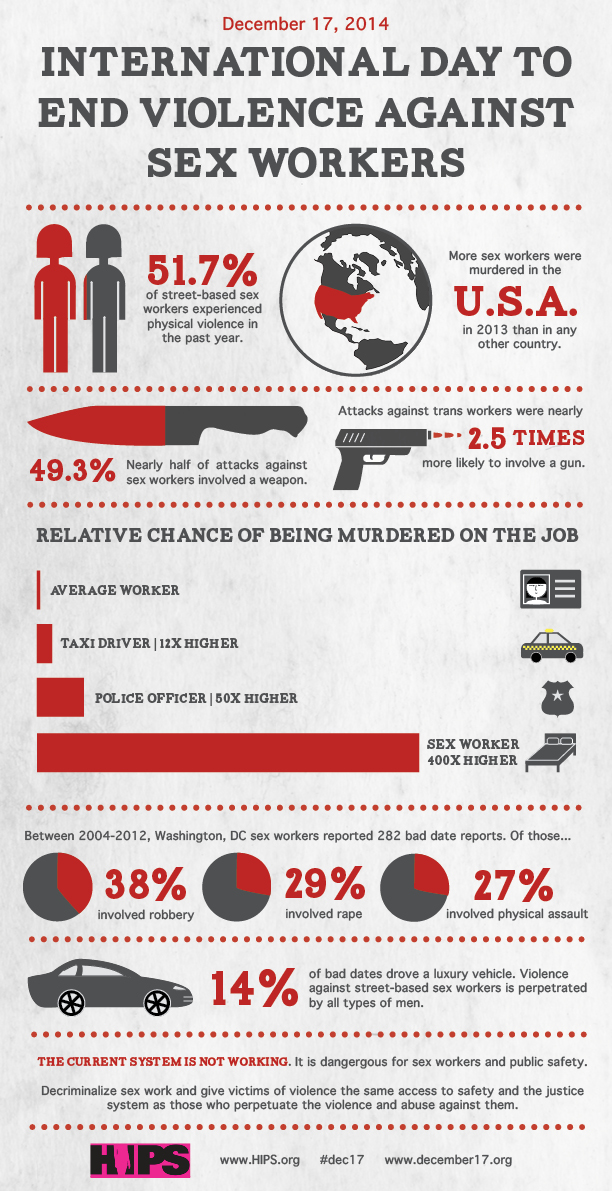
“According to advocacy group the Sex Worker Outreach Project, yesterday more than 21 cities in the United States and 33 cities internationally held events to recognize the International Day to End Violence Against Sex Workers. This annual day started in 2003 in Seattle as a memorial for the women murdered by the Green River Killer and is now a recognition of the dangers sex workers face around the world. “Criminalizing sex work has not worked,” wrote Lindsay Roth, the board chair of the Sex Worker Outreach Project-USA, in a statement. “We know that criminalization leads to more violence by stigmatizing sex workers and contributing to unsafe working conditions. If you fear arrest, negotiating your personal safety becomes a secondary concern.”
So much YES
This will surprise no one who has experienced street harassment, but it is good to have the evidence and data to support how we feel:
“New research provides evidence that sexual harassment is, in fact, traumatizing for women—especially for those who have experienced sexual abuse. The study, conducted by a team of seven women from theUniversity of Mary Washington Psychology Department, sought to explore the effects of “body surveillance” and “unwanted sexual advances” (translation: uncomfortable stares and harassment). They gathered women of various ethnicities and had each fill out an online survey. Researchers specifically designed the questions to test how women felt about the appearance of their bodies, and to identify feelings of shame.
Subjects were then asked directly about harassment. Did it happen often? What kind (verbal, physical) did they endure? In what must have been the most emotionally draining survey ever, participants were finally asked about their history of sexual abuse.
What did the researchers find? That objectification resulted in, and we quote, “insidious trauma.”
The effects on the psyche, researchers found, are long-term, piling up slowly. Women who experienced frequent sexual harassment displayed signs of trauma and PTSD. Those who had a history with sexual abuse endured a greater degree of trauma, regardless of how often they were harassed. Many women reported body shame—feelings that, not surprisingly, paralleled those who suffer from an eating disorder. The researchers concluded:
“Interpersonal objectification has the potential to have serious negative consequences, and unfortunately, failure to recognize these events may leave women wondering if the discrimination they believe they have experienced is real . . . Women become caught in a Catch-22; if they speak out about how they are treated, they are likely to be labeled as ‘overly sensitive,’ and if they say nothing, they have to live with these experiences without the chance of social support or vindication. The ambiguous and subtle nature of sexual objectification, particularly the experience of body evaluation, can make this experience of discrimination difficult to acknowledge, discuss, and cope with. Gender-based discrimination in the form of interpersonal sexual objectification can have a significant impact on the psychological health of women and, although some may wish to minimize the impact that these events can have, studies such as ours indicate that these are not matters to be taken lightly.”
More to come when I get my hands on the study. H/T Collective Action for Safe Spaces.