• About Us
    • What Is Street Harassment?
    • Why Stopping Street Harassment Matters
    • Meet the Team
      • Board of Directors
      • Past Board Members
    • In The Media
  • Our Work
    • National Street Harassment Hotline
    • International Anti-Street Harassment Week
    • Blog Correspondents
      • Past SSH Correspondents
    • Safe Public Spaces Mentoring Program
    • Publications
    • National Studies
    • Campaigns against Companies
    • Washington, D.C. Activism
  • Our Books
  • Donate
  • Store

Stop Street Harassment

Making Public Spaces Safe and Welcoming

  • Facebook
  • Instagram
  • Pinterest
  • Tumblr
  • Twitter
  • YouTube
  • Home
  • Blog
    • Harassment Stories
    • Blog Correspondents
    • Street Respect Stories
  • Help & Advice
    • National Street Harassment Hotline
    • Dealing With Harassers
      • Assertive Responses
      • Reporting Harassers
      • Bystander Responses
      • Creative Responses
    • What to Do Before or After Harassment
    • Street Harassment and the Law
  • Resources
    • Definitions
    • Statistics
    • Articles & Books
    • Anti-Harassment Groups & Campaigns
    • Male Allies
      • Educating Boys & Men
      • How to Talk to Women
      • Bystander Tips
    • Video Clips
    • Images & Flyers
  • Take Community Action
  • Contact

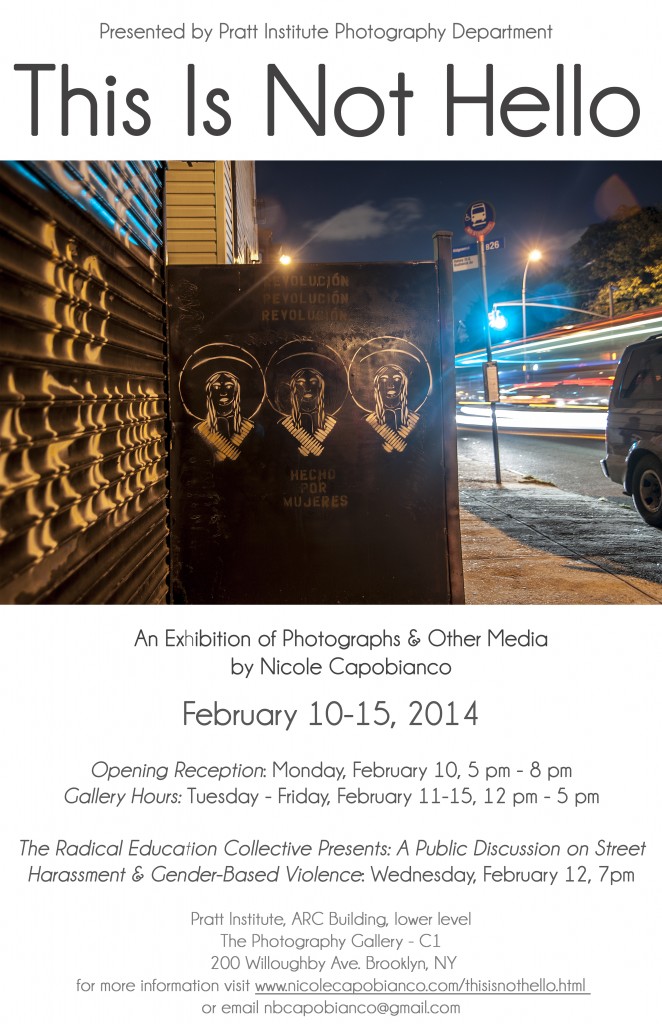
Art Exhibit: “This Is Not Hello”

February 7, 2014 By HKearl

Nicole Capobianco is hosting an exhibit of photography and other media focused on street harassment next week in Brooklyn, New York.

Here’s more information about it from Nicole, if you’re in the area, I hope you can attend!

“This Is Not Hello” examines street harassment through various street art applied by women. Too often our voices are silenced and dismissed as street harassment continues to be trivialized in our culture and in public policy. This work bridges the connection between public space and the female body, as this art is surfacing on city streets for a reason.

Our presence in public signifies our independence, and thus we are so often reduced to mere sexual objects when we enter it. The contradiction in street harassment lies with our bodies being treated as public property while the behavior simultaneously reinforces that public space is not a space we are allowed to occupy safely. I hope this project allows for men to learn what it means to be an ally to our struggle and how important it is that they too participate in dismantling these behaviors.

This is about finding our voice, and finding the strength in ourselves, alongside others, to speak out fearlessly against patriarchal belittlement and abuse in all aspects of our lives. We will resist your culture and produce another.

Share

Filed Under: Events, Resources, street harassment

Youth Film: “I’m Not Your Girl”

February 6, 2014 By HKearl

This film was made as part of the Girl Tech program in New Mexico. It was recently screened at the Media Literacy Project’s 20th anniversary party in Albuquerque.

See video

From the Media Literacy Project website:

“Set in Albuquerque, New Mexico, this short video gives us a brief glimpse into the life of a young woman and the street harassment she encounters one day while riding the bus. This film raises awareness on both street harassment and how one is more likely to encounter street harassment due to a reliance on public transportation. Directors: Mercedes Turner and Marina Oya.

Mercedes Turner is a graduate student of New Mexico Highlands University School with a degree from the School of Social Work and is currently pursuing her master’s degree in social work as well. Mercedes has worked with youth as a programs department intern with Mothers Against Drunk Driving and as an intern with the YWCA of New Mexico. She enjoys volunteering in the community, watching movies, and spending time with family and friends. She wants to continue working with nonprofit organizations who work with young people to help them pursue their dreams.

Marina Oyá is currently a junior at the Public Academy for Performing Art and will graduate in 2015. She loves filmmaking, dance, visual art, and working with kids. In the summer of 2013 she volunteered at Eugene Field Elementary School in Albuquerque working with students in their summer school program. She plans to study marine biology in college.”
Share

Filed Under: Activist Interviews, Resources, Stories, street harassment

Survey: Harassment Common in Public Spaces in Bangladesh

January 30, 2014 By HKearl

Here’s another study showing just how common street harassment is — this time in Bangladesh.

Via The Daily Star:

“Women almost regularly face sexual harassment in public places, mostly on streets, in markets and on public transport, according to a government survey.

About 43 percent of the 12,600 women surveyed recently have said public places are the most common spot where they are sexually harassed.

The survey, jointly done by the Bangladesh Bureau of Statistics and United Nations Population Fund, covered all the seven divisions of the country. The women were randomly chosen from city, urban and rural areas.

“I hardly know a woman who has not been verbally harassed or groped in the streets,” said Umme Nahar, an official of a private firm in the capital.
She claimed she was first groped at the age of twelve and that she is sexually harassed every day on the streets….

Asked for her comments, Ayesha Khanam, president of Bangladesh Mahila Parishad, said women’s attire was not the issue here. “Women wearing all types of clothing face sexual violence. It cannot be generalised that women wearing a certain kind of clothing face more sexual harassment,” she said.”

Share

Filed Under: News stories, Resources, street harassment

Laverne Cox on Harassment and Being a Trans Woman of Color

January 29, 2014 By HKearl

Via Feminism for All:

“Laverne Cox (Orange is the New Black) made a powerful speech about her experiences with street harassment, cissexism, sexism and racism as a trans woman of color.”

Share

Filed Under: LGBTQ, street harassment

Let’s keep fighting for equality!

January 17, 2014 By HKearl

If you missed it earlier this month, Amanda Hess’s essay for the Pacific Standard titled “Why Women Aren’t Welcome on the Internet” is an important read. Her thorough article looked at both the harassment that women endure and the toll it takes on them, both mentally and financially.

Amanda Marcotte wrote an excellent response piece for The Daily Beast that connects well to the issue of street harassment. Here is an excerpt:

“If we understand online harassment to be an outgrowth of other forms of abuse of women, from cat-calling to rape and domestic violence, then the pat assertion that it’s a modern, Western phenomenon is much harder to pull off. That’s particularly true when trying to claim sexual liberation somehow causes the harassment. Countries that have a more sexually repressive culture than the U.S. —think Egypt or India—have plenty of sexual harassment and assault problems to go around. The blunt truth is that why some men harass women—or beat women or rape women—is not at all complicated. They do it because it makes them feel powerful. They do it because they want women to be submissive, second-class citizen. They want women to know our place is as servants and sex objects instead of real people, and are willing to resort to violence and harassment to get their way. This is true whether your society is feminist or patriarchal, sexually liberated or repressed.

This is not a matter of speculation. Studies show a strong link between a man’s embrace of traditional gender roles and his propensity for domestic violence. Even just exposing a man to sexist jokes is linked to that man expressing more tolerance for violence against women. Violence and harassment against women is not some inexplicable phenomenon of nature, but an expression of an ideological belief that women should be subservient. The Internet doesn’t create the urge to harass women, and it probably doesn’t even magnify it. What it does is it makes harassment more efficient and personal, all at the same time. A man who likes to abuse and harass women is limited by physical proximity, time restraints, and legal considerations in the real world. There are only so many waitresses whose butts you can pinch in a day, especially without being thrown out of restaurants or even having the police called. You can holler at women on the sidewalk, but they can move along. Online, however, a man who enjoys harassing women can attack dozens in a very short period of time. He can recruit his friends to make the attacks more intense and has a lot more avenues for attack, going through email, Facebook, Twitter, and blog comments. It’s harder for women to just walk away from your cat-calling online; they have to actively block the harasser. (Which in turn is also exciting for the harasser, who can use the blocking as evidence that he successfully got under his victim’s skin.) Following women without getting the cops called on you is much easier online than in public. If a particular woman catches a harasser’s attention in public, odds are low he will be able to figure things like her name and how to find her. But online, you not only have all sorts of details about the object of your obsession’s life, but you have multiple venues to get to her.

While these specifics can and should be addressed through technological and legal means, we also need to understand that none of this online harassment is happening in a vacuum. It’s all just a new way of expressing a very old—indeed, an ancient—sentiment, that a woman’s place is to be silent, submissive, and servile to men and that any women who disagree are to be put down with violence. The long-term solution to the problem is to fight for women’s equality, and keep fighting until the idea that a woman is anything but equal to a man is a relic of the past.”

AGREED!! Street harassment, online harassment, sexual violence and rape are largely symptoms of gender inequality. Any effort we can make to close the equality gap will lead to a decrease in these issues. How will you help?

Share

Filed Under: News stories, street harassment

« Previous Page
Next Page »

Share Your Story

Share your street harassment story for the blog. Donate Now

From the Blog

  • #MeToo 2024 Study Released Today
  • Join International Anti-Street Harassment Week 2022
  • Giving Tuesday – Fund the Hotline
  • Thank You – International Anti-Street Harassment Week 2021
  • Share Your Story – Safecity and Catcalls Collaboration

Buy the Book

  • Contact
  • Events
  • Join Us
  • Donate
  • Facebook
  • Instagram
  • Pinterest
  • Tumblr
  • Twitter
  • YouTube

Copyright © 2026 Stop Street Harassment · Website Design by Sarah Marie Lacy