
• About Us
    • What Is Street Harassment?
    • Why Stopping Street Harassment Matters
    • Meet the Team
      • Board of Directors
      • Past Board Members
    • In The Media
  • Our Work
    • National Street Harassment Hotline
    • International Anti-Street Harassment Week
    • Blog Correspondents
      • Past SSH Correspondents
    • Safe Public Spaces Mentoring Program
    • Publications
    • National Studies
    • Campaigns against Companies
    • Washington, D.C. Activism
  • Our Books
  • Donate
  • Store

Stop Street Harassment

Making Public Spaces Safe and Welcoming

  • Facebook
  • Instagram
  • Pinterest
  • Tumblr
  • Twitter
  • YouTube
  • Home
  • Blog
    • Harassment Stories
    • Blog Correspondents
    • Street Respect Stories
  • Help & Advice
    • National Street Harassment Hotline
    • Dealing With Harassers
      • Assertive Responses
      • Reporting Harassers
      • Bystander Responses
      • Creative Responses
    • What to Do Before or After Harassment
    • Street Harassment and the Law
  • Resources
    • Definitions
    • Statistics
    • Articles & Books
    • Anti-Harassment Groups & Campaigns
    • Male Allies
      • Educating Boys & Men
      • How to Talk to Women
      • Bystander Tips
    • Video Clips
    • Images & Flyers
  • Take Community Action
  • Contact

21,000 Girls Agreed…

November 2, 2018 By HKearl

Plan International’s new report, based on interviews with 21,000 girls around the world, found that street harassment is a pervasive problem for them.

This is unacceptable – everyone should feel safe in public spaces. The real impact it has on millions of lives is is a big reason why we work to change the cultural acceptability of street harassment. We use research and story-telling to document it and then encourage community and government action to end it.

As the holiday season approaches, you can support us in your shopping by using our Amazon Smile link and you can donate to our forthcoming Giving Tuesday and Year-End giving campaigns in honor of the people in your life whom you want to feel safe.


If we raise enough money, we can fund a five-year update to our 2014 national study on street harassment in the US, oversee our 9th annual International Anti-Street Harassment Week, re-launch our Safe Public Spaces Mentoring Program and more! 

Recent SSH Activities

  • In September, we held our first board meeting with our newest board members – and held an in-person welcome session for the local DC-area members!

  • Board member Patrick McNeil took the lead on crafting a “We Believe Survivors” letter for SSH in light of the US Supreme Court hearings earlier this fall.
  • SSH volunteer Dr. Meghna Bhat represented SSH during the YWCA Week Without Violence campaign.
  • Board member Maliyka Muhammad represented SSH in New York at a Ladies First Astoria workshop on sexual harassment.

  • On Nov. 10, SSH Board members Lauren Pires and Ashley Badgley and I will present at Georgetown University’s WERC Summit in Washington, DC.

In the News:
It’s been one year since the #MeToo hashtag went viral and our study from earlier this year has been cited in many news articles, as has SSH’s work in general. Examples include: USA Today, Vox, Mother Jones, Daily Times – Pakistan, Times of India, San Diego Union Tribune, Lexington Herald-Leader 

Again, if you want to take action now, please consider a tax deductible-donation to support our work.


Share

Filed Under: Resources, SSH programs, street harassment

SSH Believes and Supports Survivors of Sexual Assault

September 19, 2018 By HKearl

We believe survivors of sexual assault.

As a national nonprofit organization working to end gender-based street harassment worldwide, we know that the public sexual harassment that we’ve documented for years doesn’t happen in a vacuum: It is part of a broader rape culture that minimizes and perpetuates sexual violence. At its core, street harassment is about exerting power over someone else, disrespecting them, and in most cases sexually objectifying a person without consent. It is on the same spectrum of behavior as sexual assault and rape.

It is this understanding that compels us to speak out about the sexual assault allegations against Supreme Court nominee Brett Kavanaugh. Since coming forward publicly with her allegations, Dr. Christine Blasey Ford has faced questions – including from members of the U.S. Senate – about her honesty and credibility. She has faced unreasonable requests to testify before the Senate Judiciary Committee prior to the FBI conducting a thorough and independent investigation. She has faced death threats and has reportedly had to move out of her home and hire private security. All for sharing her story.

And this is not unusual, this is the system survivors have come to expect, and is one of the many barriers that prevent so many from coming forward to reclaim their narrative.

Dr. Blasey Ford does not deserve this treatment. No survivor does. And we demand better.

We stand with survivors of sexual violence and call on senators to do right by them and this nation. When someone comes forward and courageously shares their story, we must listen to them – not attack their character. As this process moves forward, we’ll be watching.

–Stop Street Harassment Board of Directors

For help and resources, contact RAINN’s national sexual assault hotline at 800-656-HOPE or online here. Along with RAINN and Defend Yourself, SSH operates the national street harassment hotline. Call toll-free at 855-897-5910.

Share

Filed Under: SSH programs Tagged With: hotline, RAINN, sexual assault, supreme court, surviors

New SSH Board Members

September 11, 2018 By HKearl

A big welcome to our five new board members!

Ashley Badgley is a DC-Based advocate who works in Program Management at the American University Washington College of Law Clinical Program. Ashley received her bachelor’s degree in Journalism in 2009 from Columbia College Chicago and received her master’s degree in Women’s Studies from The George Washington University in 2012. She has spent her career working primarily with survivors of domestic and sexual violence as well as immigrant populations seeking legal assistance in the DC region. As an avid bicyclist, she works to get more women on the saddle, exploring the streets of DC. She believes in equal access and opportunity for all.

Morgan Fincher is a DC-based international development professional who works on promoting good governance in Southeast Asia. As part of her work, she supports programming that builds the capacity of women members of parliament to govern effectively and advocate for the needs and interests of their constituents in emerging democracies. Recently, Morgan launched Whistles for Women, an advocacy effort to combat street harassment and keep women safe on the streets of Capitol Hill in DC. She received her Master’s degree in Security Studies from Georgetown University in 2018 and her Bachelor’s in International Relations from University of Redlands in 2013. In her free time, Morgan enjoys advocating the benefits of equality for all to anyone who will listen.
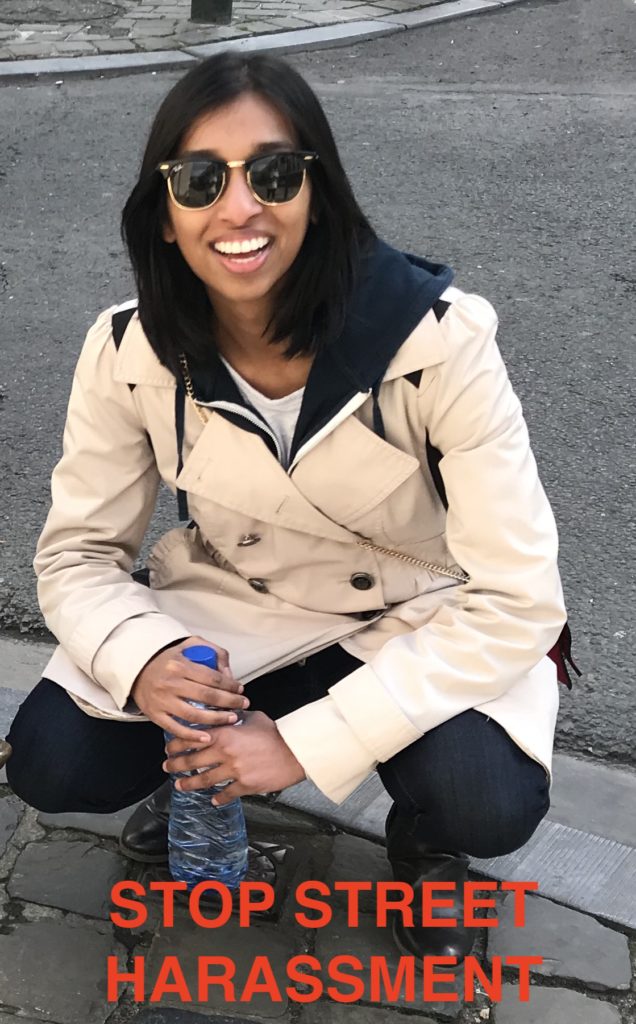
Lauren Pires is currently the Outreach and Training Program Manager at the Domestic Violence Resource Project in Washington DC, and brings several years of international gender and women’s empowerment programming to the SSH board. With a Masters degree from the London School of Economics in Gender & Policy, her professional expertise is in gender mainstreaming, training and communications. A third-culture kid, she has grown up and lived in 6 countries across 3 continents and values intersectionality in everything we do, cultural humility and most of all the chance to appreciate new places, cultures and of course the food. 

Britnae Purdy works in college campus gender-based violence prevention and education. She holds a BA in International Affairs/Women’s and Gender Studies from the University of Mary Washington and an MA in Global Affairs from George Mason University, and is is currently pursuing an MSc in Public Health through the London School of Hygiene and Public Health. Britnae has been volunteering with SSH since 2013 as blog correspondent and digital manager for International Anti-Street Harassment Week.

Nancy Xiong‘s work has been mainly in the higher education setting with women and gender issues and gender-based violence. She has organized events such as Take Back the Night, Fear 2 Freedom, Self Care, Self Love events, film screenings on domestic violence/sexual assault and Anti-Street Harassment Week at George Mason University. Academically, she has taught courses such as global representations of women, introduction to women and gender studies and healthy relationships. Nancy has worked, studied and/or lived in Burma, India, Japan, Laos, Nepal, and Thailand. Outside of work, she enjoys cultivating her artistic side by sewing, making art, and crafting, traveling, connecting with the world and just be. Currently, she’s interested in trauma and healing and ways to foster well-being, self-care, and self-love in everyday life.
Share

Filed Under: SSH programs Tagged With: board members

End of Summer 2018 News Updates

September 10, 2018 By HKearl

Afghanistan: What it’s like for women to get around Kabul.

Australia: Why do men perform lewd acts on the train?

Australia: What can men do to prevent the street harassment, assault and murder of women?

Canada: Good Night Out Vancouver launched a new pilot project aimed at finding out when and where street harassment in happening in the city.

Chile: Street harassment is a criminal offence in these suburbs.

Egypt: Egyptian women take back the streets with parkour.

Europe: One in three EU member states have applied legal restrictions on Muslim women’s dress, with almost half having applied bans – including on headscarves – within workplaces and public institutions.

India: Delhi’s all-female motorbike police force has helped reduce street harassment.

Indonesia: A man who groped a woman’s breasts while he was on a motorcycle was sentenced to a one-year prison sentence.

Kenya: FloNe Initiative shared the findings from their baseline study on sexual harassment on public transit.

New Zealand: A serial sexual assailant has been attacking women on Wellington streets.

Philippines: Street harassment became illegal in Manila and Dagupan City.

Romania: Street harassment became illegal in the country!

Russia: Men harass female sports reporters at the World Cup.

Uganda: The threat of harassment (and worse) is a daily occurrence for a lesbian in Kampala, Uganda.

USA: How five women saved a woman from a harasser.

USA: One out of every four young men does not disagree that “when a woman is raped, she usually did something careless to put herself in that situation.”

USA: Girls who reach puberty earlier are sexually harassed more than their peers, regardless of whether they’re engaging in sexual behaviours earlier

USA: A Human Rights Commission report says almost 40% of Muslim, Jewish and Sikh residents of NYC have experienced harassment, including, 1 in 5 Black Muslim women who had been physically assaulted in the months in question.

USA: Sexual assaults on airplanes are rising at “an alarming rate” the FBI said.

UK: Two-thirds of women worry about sexual harassment at music festivals.

UK: More than half of men in the UK think catcalling is unacceptable.

UK: Expanding the “Catcalls of NYC” idea, women in other areas, like London, are writing in chalk the things men say on the street.


Share

Filed Under: News stories, street harassment, weekly round up

End of Summer 2018 SSH Updates

September 10, 2018 By HKearl

An alarming new study released last month found that nearly all Native women in Seattle, Washington, USA, have been raped or forced to have sex and 69% also reported experiencing street harassment. A study released this month in the UK found that 66% of girls and young women ages 14 to 21 have experienced street harassment.

In France, in late July, a man verbally harassed Marie Laguerre in Paris, France, as she walked home. When she told him to “shut up,” he physically and brazenly attacked her. A man in Iowa, USA, in July verbally harassed Mollie Tibbett during her run and when she threatened to call the police, he killed her. A man in Melbourne, Australia, raped and murdered Eurydice Dixon as she walked home from a comedy gig in June.

Street harassment continues to be a serious issue that affects most women and girls, it is connected to sexual violence and it can escalate into physical violence and even murder. This is why even seemingly benign “catcalls” can be scary and why so many of us “choose” to limit our time in public and curtail our lives in order to try to stay safe.

In order to create a world where everyone is safe and welcome in public spaces and everyone has equal access to the resources there, it’s important that we speak out against street harassment, that we support efforts to prevent it through education, training and awareness-raising, and that we model respectful interactions for the children and youth in our lives.

New Legislation

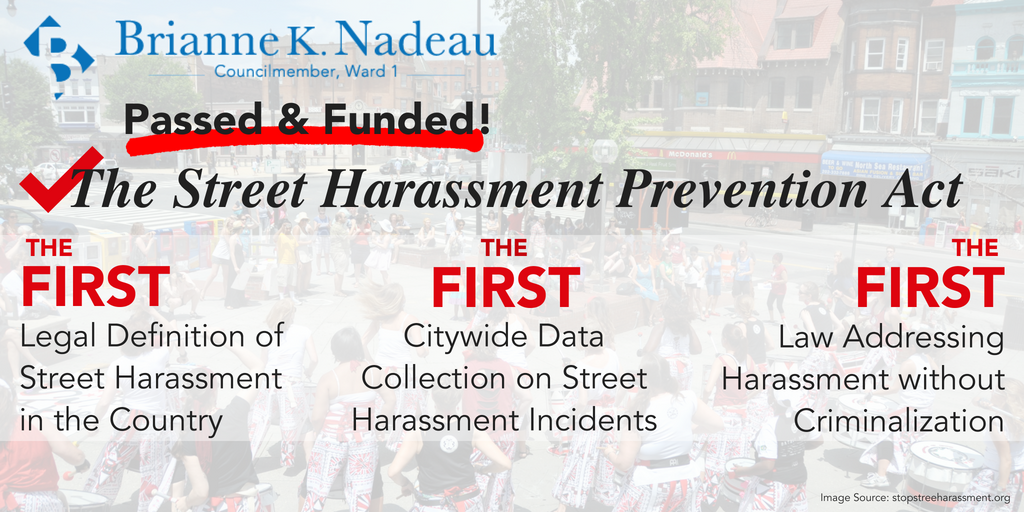
In late June in Washington, D.C., the Council of the District of Columbia passed the Street Harassment Prevention Act of 2018 (SHPA), the first legislation of its kind in the United States. It is one of more than 20 laws addressing street harassment to pass globally since 2012 (including laws that passed recently in France, Romania, Chile, and the Philippines. This month, a review is to take place into whether misogynistic conduct, including street harassment, should be treated as a hate crime in the UK.)

The SHPA, which our allies Collective Action for Safe Spaces took the lead in advocating for and we helped support, is groundbreaking for creating the first legal definition of street harassment in the United States, calling it “disrespectful, offensive or threatening statements, gestures or other conduct directed at an individual in a high-risk area without the individual’s consent and based on the individual’s actual or perceived … protected trait identified in the [DC] Human Rights Act of 1977.” It also uniquely focuses on prevention through education instead of criminalization.

As I noted in an article for Women’s Media Center, “Specifically, the SHPA establishes an advisory committee on street harassment that will propose model policies and training materials to be implemented in the District; require the Office of Human Rights (OHR) to conduct the first citywide survey on street harassment; and require OHR to conduct a public information campaign about street harassment. Further, grant money will be provided for street harassment awareness programs.”

In research I’ve conducted about laws against street harassment, too often there is no education component. (Indeed, the French activist organization Stop Harcelement de la Rue is disappointed in the French law because the lawmakers ignored their suggestion for mandating education.) Too often there is no money earmarked for training law enforcement or advertising the law. Too often the law is barely used and offers no real deterrent to harassers.

Hopefully educational campaigns, awareness programs and training in the DC-area can actually create change, especially when there is money to fund these initiatives. And if it does, I hope other regions of the world will follow this model of prevention legislation.

New Faces

I’m excited to share that Dr. Meghna Bhat, a former SSH blog correspondent, has joined the team as a volunteer social media and website manager! She’ll primarily be managing the twitter and Instagram accounts and content for our blog.

This month we also welcome five new board members, all from the Washington, DC-area. Meet them! I’m excited to work with them.

A few of our long-serving board members are leaving this month as their terms have ended. This includes two of our founding board members, Liz Bolton and Layla Moughari, who have contributed a great deal to SSH over the years, from fundraising to editing research reports and press releases to organizing events for Anti-Street Harassment Week! I am grateful for their help in establishing SSH as a nonprofit in 2012 and all that they’ve done since then.

Hey Baby VA Campaign Update

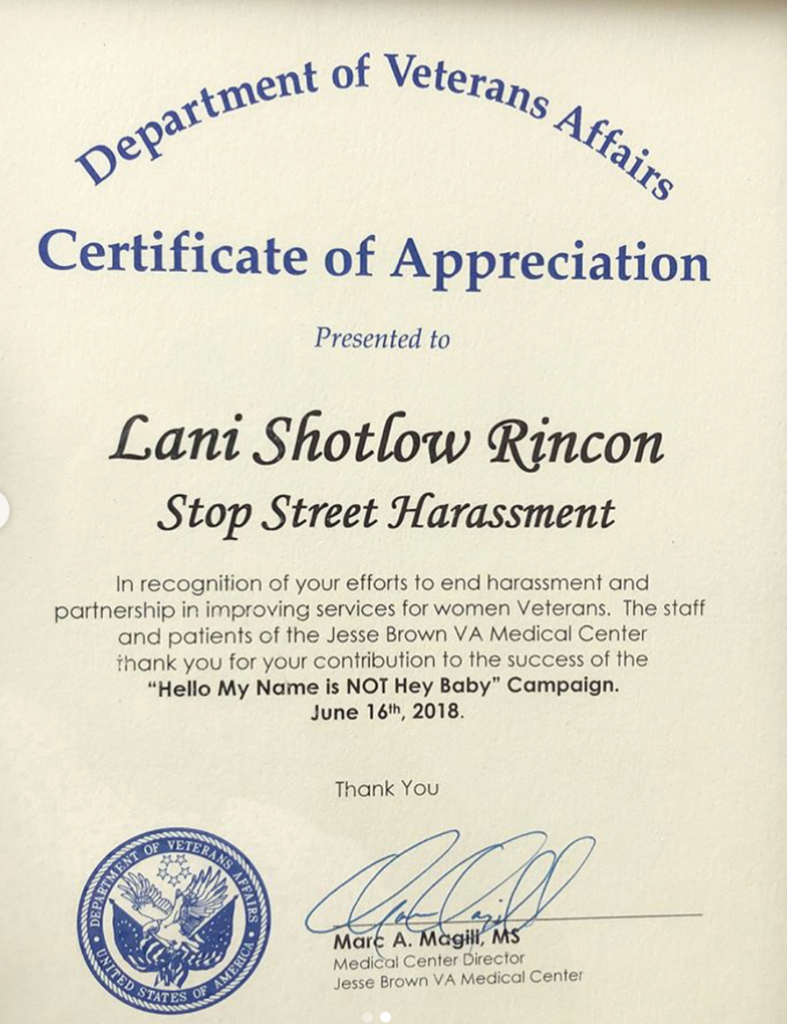
Our board member Lani’s “Hey Baby” graphic was used last year by a Veteran Affairs (VA) center in Chicago for an anti-harassment campaign. The campaign has reduced harassment at the facility. Jenny Sitzer, the program manager, that implemented the campaign will be attending and presenting the campaign success in an internal VA conference this fall. When Lani was in town this summer, they presented her with a certificate and showed her the banners.
Raising Awareness

In June, I gave a presentation to the CDC’s Intimate Partner Violence/Sexual Violence (IPSV) Workgroup about street harassment and our two research reports, and I wrote articles for HuffPost, Ms. Magazine, Women’s Media Center and New Moon Girls magazine (print).

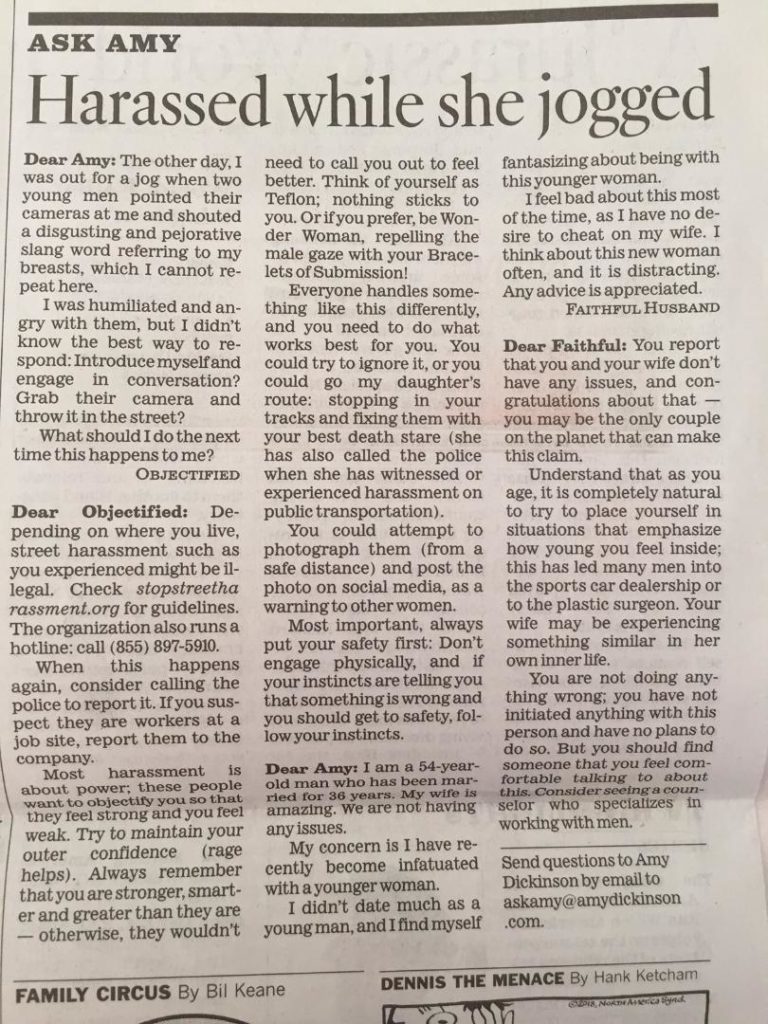
SSH was covered in a range of media outlets, including BBC, Yahoo, Morning Dose, and Next City. In exciting news, SSH’s hotline was mentioned by CNN and “Ask Amy” and our latest study has been used by legislators and journalists.

Share

Filed Under: SSH programs, street harassment

« Previous Page
Next Page »

Share Your Story

Share your street harassment story for the blog. Donate Now

From the Blog

  • #MeToo 2024 Study Released Today
  • Join International Anti-Street Harassment Week 2022
  • Giving Tuesday – Fund the Hotline
  • Thank You – International Anti-Street Harassment Week 2021
  • Share Your Story – Safecity and Catcalls Collaboration

Buy the Book

  • Contact
  • Events
  • Join Us
  • Donate
  • Facebook
  • Instagram
  • Pinterest
  • Tumblr
  • Twitter
  • YouTube

Copyright © 2026 Stop Street Harassment · Website Design by Sarah Marie Lacy