“Like a Bird with Broken Wings”: new report from Afghanistan. UN Women Report chronicles stories of violence suffered by Afghan women through the decades of conflict. Harrowing tales of sexual violence during the years of conflict are a grim reminder of the suffering that Afghan women have experienced. As one woman puts it: “We have all suffered.” The testimonies contained in the report cover the timespan between 1978, when Soviet Union tanks rolled into Afghanistan, up until 2008. The reporting itself took place between December 2007 and June 2008 in seven provinces: Kabul, Kandahar, Jowzjan, Balkh, Bamyan, Daikundi and Herat.”

Video: Street Harassment and the Law
Two weeks ago, we held a briefing in Washington, D.C. about our new toolkit, Know Your Rights: Street Harassment and the Law.
This is an excerpt from the talk the lead author Talia Hagerty gave. She covered an overview of the toolkit and relevant laws, as well as the pro’s and con’s of reporting. This included touching on why some people and communities may choose not to engage police — and how that is ok!
Call for Blog Correspondents: 2014 Cohort 1
Last year, Stop Street Harassment launched a Blog Correspondents Program with two cohorts. In 2014, we’re revising it a bit and will have three cohorts of correspondents. The members of each cohort will write four total posts, one per month (cohort 1: Jan. – April, cohort 2: May – Aug., cohort 3: Sept. – Dec.).
SSH is accepting applications for the first cohort. This is an unpaid, volunteer opportunity and is a great resume builder and chance to make a difference on an important global topic! And your words will be read: the SSH blog has tens of thousands of readers each month.
Assignment:
From January to April, correspondents in the first cohort must commit to writing one blog post per month about street harassment issues in their community, region or country, four posts total. The topics could include incidents of street harassment, activism to stop it, and street harassment in popular culture, traditions or the news.
We aim to have geographic diversity among our cohort members.
Applying:
By January 6, 2014, please e-mail: 1) your name, 2) the region of the world or the USA where you’re from, 3) a writing sample of a blog post or article (in the range of 500-1000 words), and 4) a few sentences about why you want to be part of the Stop Street Harassment team.
If you prefer to write in a language other than English, please also indicate what language is most comfortable for you and you can send your writing sample in that language.
E-mail to: hkearl @ stopstreetharassment.org. Address to Holly.
India: New PSA on Leering
This new PSA from Whistling Woods International, a film school in India, forces men to consider how creeping and inappropriate their leering is. No one is entitled to another person’s body!
Buzzfeed reports, “The ad was released exactly one year after a horrific gang-rape in New Delhi started a nation-wide conversation about women’s safety in India.”
The Problem with “Anchorman 2”
The movie industry is still primarily run and owned by rich white men and it shows, right?
Generally women and girls are relegated to roles where they are to be looked at/desired or they are hell bent on getting a man. There are few roles for older women. Persons of color are often caricatures, stereotypes, and sidekicks, especially women of color. Apparently that’s how a lot of white men view us.
For this reason, I rarely go to the movies. Two of the few films I saw in theaters this year were “Fruitvale Station” and “Catching Fire.” On occasion, however, I watch movies about and written by white men for white men and I did last night when I watched “Anchorman 2” with my partner and two of his white male coworkers.
“Anchorman 2” had a few funny jokes, fewer than the first “Anchorman” film and the representation of women was way worse. Come on, did they really have to make Linda, the only black character, angry, sexually aggressive, and then apologetic to Ron Burgandy after he was racist at her family dinner?!? It wasn’t good on disability or animal rights either.
They also managed to make unfunny jokes about street harassment, sexual harassment, sexual assault, domestic violence, and murdering women. Is that some kind of record? Not only were they offensive but none of those jokes added to the plot line. I know they tried out tons of jokes during the script-writing and filming and I have a hard time believing that out of all of the jokes they must have tried out, those were the “best” ones for the film.
One of the worst moments for me was when news team sidekick Champ said (paraphrasing from memory), “Ron, do what men have been doing to women for thousands of years, hit her,” as the audience around me laughed. Ha ha ha, domestic violence is so funny. NOT.
I have a really hard time imagining these jokes would have happened if there were more women involved with the film, especially in roles of authority where they could decide what jokes stay or go.
Increasing gender equality and decreasing gender violence in our society is such a complex and multifaceted endeavor. One element of it is changing the normalization of sexism, racism, and gender violence in the media we consume. Having more women involved in media and having diverse roles for female characters could help make that happen.
Here are resources for creating that change in media:
* Geena Davis Institute on Gender in the Media
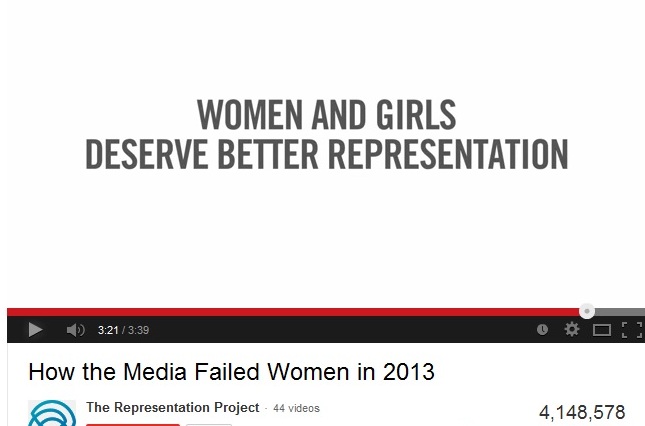
Check out their video about how the media failed women in 2013