• About Us
    • What Is Street Harassment?
    • Why Stopping Street Harassment Matters
    • Meet the Team
      • Board of Directors
      • Past Board Members
    • In The Media
  • Our Work
    • National Street Harassment Hotline
    • International Anti-Street Harassment Week
    • Blog Correspondents
      • Past SSH Correspondents
    • Safe Public Spaces Mentoring Program
    • Publications
    • National Studies
    • Campaigns against Companies
    • Washington, D.C. Activism
  • Our Books
  • Donate
  • Store

Stop Street Harassment

Making Public Spaces Safe and Welcoming

  • Facebook
  • Instagram
  • Pinterest
  • Tumblr
  • Twitter
  • YouTube
  • Home
  • Blog
    • Harassment Stories
    • Blog Correspondents
    • Street Respect Stories
  • Help & Advice
    • National Street Harassment Hotline
    • Dealing With Harassers
      • Assertive Responses
      • Reporting Harassers
      • Bystander Responses
      • Creative Responses
    • What to Do Before or After Harassment
    • Street Harassment and the Law
  • Resources
    • Definitions
    • Statistics
    • Articles & Books
    • Anti-Harassment Groups & Campaigns
    • Male Allies
      • Educating Boys & Men
      • How to Talk to Women
      • Bystander Tips
    • Video Clips
    • Images & Flyers
  • Take Community Action
  • Contact

A Study for the People, Funded by the People

November 1, 2013 By HKearl

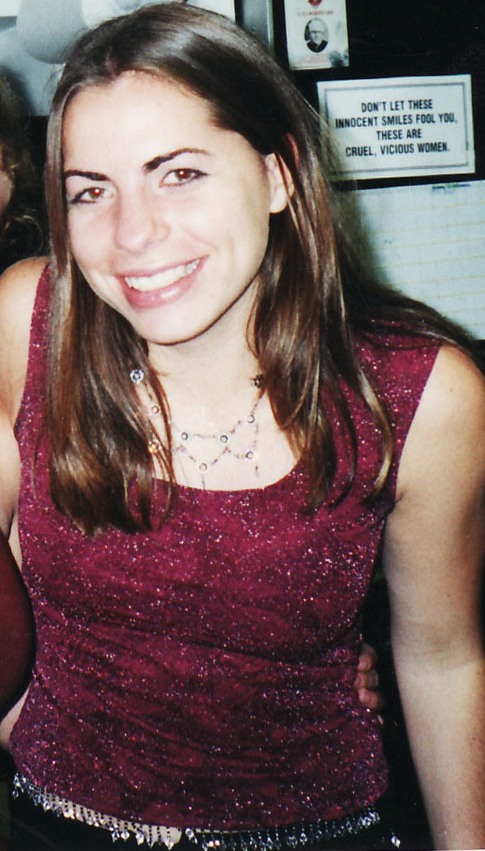
Nov. 2001, my 1st semester in college, a man grabbed my crotch as I stood on the sidewalk outside a friend’s house after this party (I was waiting for another friend).

College is when I experienced the most street harassment. Some days it seemed like I faced hoots, hollers, honks — and worse — whenever I left campus. When I went running, walked to volunteer at a domestic violence shelter, or took the bus to restaurants or the mall with friends.

Despite the fact that I was part of the social justice organization at my school and I picked up a second major in women’s and gender studies, I did not know the term “street harassment” then, nor what to do. Instead, I just felt frustrated, angry, and upset a lot and eventually changed my life to try to avoid it.

That was nearly a decade ago, and fast-forward to today, and it seems the term street harassment is much more commonly understood and there are so many groups speaking out against it now, including even the United Nations!

In the last eight years, many countries across the world have conducted studies on the topic, including in Egypt, Yemen, India, Peru, France, and the UK. They are using the study findings to better address the problem and to gain more widespread support in stopping it.

In the U.S., however, this is not happening. More than 15 years ago, there were two academic studies conducted in Indianapolis and the California Bay Area showing that 100 percent of women experienced street harassment. In 2000, there was a quick phone poll showing that at least 80 percent of women across the nation had – with no significant difference if they lived in urban, suburban or rural areas.

But the U.S. has no national comprehensive study looking at the types of harassment that happens, how often, its impact on people’s lives, or why people harass. And, there is no national study that surveys both women and men on these topics or includes harassment based on sexual orientation or gender expression.

After studying, writing about and speaking about this topic for more than six years, I feel SO strongly about the need for this study that I spend a lot of my “free time” (outside  of work and family time/obligations) trying to raise $47,000 to be able to fund this comprehensive national study so I can use the best surveying firm available. We’re nearly half-way toward that amount.

I have also spent my free time and my own money traveling and conducting focus groups to bring forward under-represented voices. This includes paying my way to places like South Dakota, Los Angeles, Kansas City, and New York City to conduct them with groups like Native Americans, queer women of color, and GBTQI men of all races.

I REALLY REALLY believe we need this study to better prove this is a problem and to galvanize more support for stopping it and also so we as activists can create more targeted awareness campaigns, educational materials, and work to prevent it from happening in the first place.

I say all this to ask you to please donate what you can (minimum $10) to make this study possible. I cannot do this alone. If you have been harassed, please consider making a donation. If someone you know has been harassed, please consider making a donation.

This will be a study about the people, for the people… funded by the people. There are no big foundations or granters, this is about us, our experiences, and our desire to make a change for us, for the next generation, and for the betterment of our country.

Share

Filed Under: street harassment

2013 Global Gender Gap Report

October 26, 2013 By HKearl

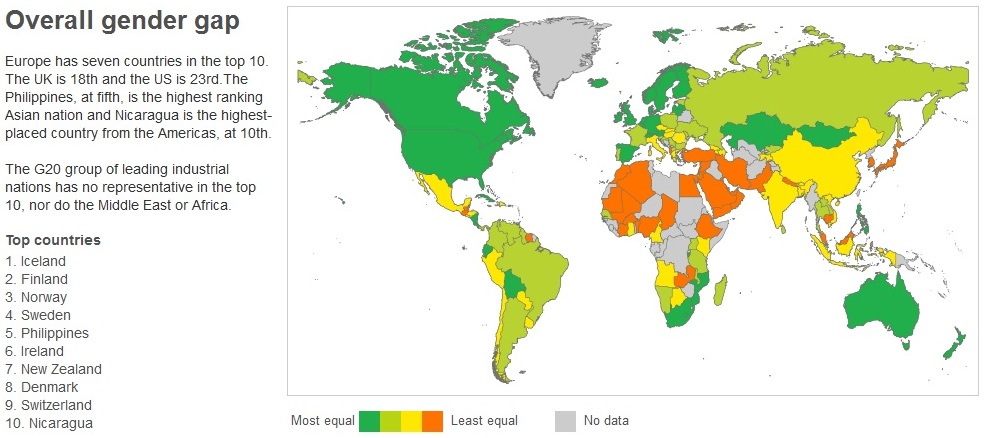
Every year, the World Economic Forum determines the global gender gap country by country, by analyzing different factors, such as women’s versus men’s education, political representation, and health.

This year, Iceland ranked number one in The Global Gender Gap Report and is followed by Finland, Norway and Sweden. This means women in these countries enjoy the most equal access to education and healthcare and they’re most likely to be able to participate fully in the country’s political and economic life.

BBC Reports:

“Overall, the gender gap narrowed slightly across the globe in 2013, as 86 of 133 countries showed improvements. However, “change is definitely slow”, says one of the report’s authors, Saadia Zahidi.”

Via BBC

The U.S. comes in at number 23. We’re pretty good on issues like education and health (e.g. very few women die at childbirth), but we’re very bad on political participation.

I often note that no country has achieved gender equality and this is always the report I have in mind when I say that. Year after year, this fact remains true. I see street harassment as a symptom of this inequality and a contributor to it — women are less likely to be in the workforce, receive an education, and be in politics if they face harassment simply trying to go to those venues.

Ending street harassment is one of many inter-related pieces we need to work to address before we can see true equality.


Share

Filed Under: News stories, Resources

UNiTE to Make Public Places Safer!

October 25, 2013 By HKearl

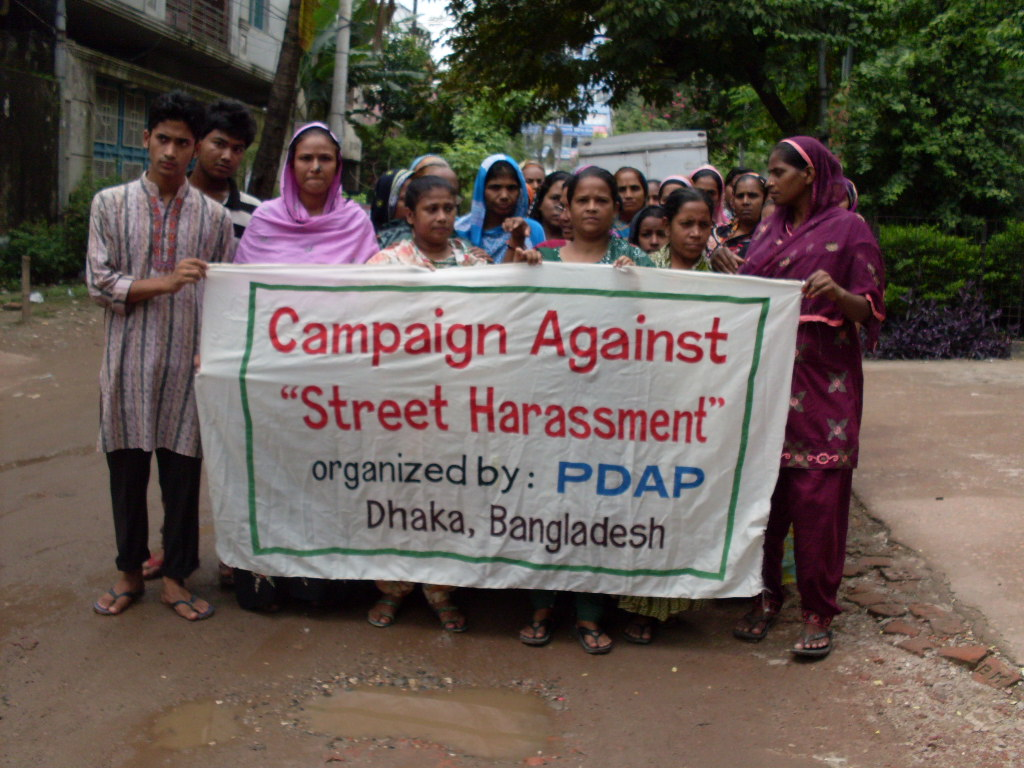
Community Members in Bangladesh recently met to discuss how to make their public places safer for girls & women.

On the 25th of every month, the UNiTE to End Violence against Women campaign focuses on different types of violence against women and girls. Today they are focusing on harassment and violence in public places and how we can make those spaces safer for women and girls. This is something we at Stop Street Harassment strive to do every day and we are happy to support the campaign!

From the UNiTE’s website:

“Violence and the fear of violence reduces women’s freedom of movement and rights to access education, work, recreation, and essential services, and can restrict their participation in political life. It also negatively affects their health and well-being. Despite these wide-ranging consequences, violence against women and girls in public spaces remains a neglected area, with few laws or policies in place to prevent and address it.

At the 57th Session on the Commission of the Status of Women, governments made specific commitments directed towards making public spaces safer for women and girls.

For the first time the Commission on the Status of Women, the highest global normative body on women’s rights, during its 57th Session specifically included several clauses in its Agreed Conclusions document devoted to safety of women and girls in public spaces, and particularly, in the cities.  It expressed “deep concern about violence against women and girls in public spaces, including sexual harassment, especially when it is being used to intimidate women and girls who are exercising any of their human rights and fundamental freedoms.”  (23, p4)

It called on the States “to increase measures to protect women and girls from violence and harassment, including sexual harassment and bullying, in both public and private spaces, to address security and safety, through awareness-raising, involvement of local communities, crime prevention laws, policies, programmes such as the Safe Cities Initiative of the United Nations. (ZZ, p13)“

What YOU can Do:

1. Learn more about the issue, why it matters, and what you can do about it. Here is an article I wrote for Ms. Magazine’s blog about how street harassment can escalate to assault – and three ideas for what we can do to change our culture so street harassment is no longer acceptable.

2. Join the Tweet chat throughout the day, led by UN Women and UN Habitat (#OrangeDay). Our friends at the Huairou Commission are hosting it at 10 a.m. EDT.

3. Donate to Stop Street Harassment — we’re working to fund the first-ever national study on street harassment. This data is sorely needed before we can adequately tackle the problem. We also do a lot of other work that is solely funded by donations.

 Update: Read what groups around the world did to speak out in support of space public spaces for women and girls!

Share

Filed Under: SSH programs, Stories, street harassment

Saudi Arabia: Men Harass Women at Shopping Mall

October 23, 2013 By HKearl

This week, a group of young men harassed a group of young women outside a shopping mall in Saudi Arabia and many people who have seen the video footage blame the women — for not covering their faces, for wearing makeup, and for not having a male chaperon. Learn more from a Global Voices article.

This is not okay. Women all over the world deserve equal access to public spaces and should be safe from harassment!

Share

Filed Under: News stories, street harassment

Passenger stops air marshall from taking upskirt photos

October 21, 2013 By HKearl

Federal air marshal Adam J. Bartsch is accused of using his cell phone to take pictures underneath women’s dresses as they boarded a flight Thursday morning at Nashville International Airport. He was on official duty and he was thwarted by a fellow passenger!

Via WSMV:

Passenger Rey Collazo “was sitting next to Bartsch when he noticed the alleged actions of the federal air marshal.

“He did it at least three or four times,” Collazo said. “After that, that’s when I looked at him. I says, ‘Man, you ought to be ashamed of yourself.'”

Collazo alerted the flight crew, and in the midst of the confrontation, grabbed Bartsch’s cell phone to keep him from deleting the pictures.

“He was trying to combat me, but I grabbed the phone and crimped on it. Twisted his wrists,” Collazo said.

Bartsch escaped and soon ran from the plane, right into police.

The flight was delayed by about an hour as officers investigated, and Bartsch was then booked into the Metro Jail downtown on a charge of disorderly conduct.

The man who confronted him seems to just wonder how long it had been happening.

“I have a wife. I have a daughter, and I have a granddaughter. And I have zero tolerance for disrespect to any lady,” Collazo said.

“Taking pictures of ladies without them even knowing that you’re doing that? That’s bad,” Collazo said. “I mean, he’s a law enforcement officer. C’mon!”

Bartsch posted bond Thursday evening and remains out of jail. He lives in Maryland but will return to Nashville to face his disorderly conduct charge next month.”

Way to go, Rey! Thanks for speaking out and stopping harassment.

Share

Filed Under: News stories, Stories, street harassment

« Previous Page
Next Page »

Share Your Story

Share your street harassment story for the blog. Donate Now

From the Blog

  • #MeToo 2024 Study Released Today
  • Join International Anti-Street Harassment Week 2022
  • Giving Tuesday – Fund the Hotline
  • Thank You – International Anti-Street Harassment Week 2021
  • Share Your Story – Safecity and Catcalls Collaboration

Buy the Book

  • Contact
  • Events
  • Join Us
  • Donate
  • Facebook
  • Instagram
  • Pinterest
  • Tumblr
  • Twitter
  • YouTube

Copyright © 2026 Stop Street Harassment · Website Design by Sarah Marie Lacy