• About Us
    • What Is Street Harassment?
    • Why Stopping Street Harassment Matters
    • Meet the Team
      • Board of Directors
      • Past Board Members
    • In The Media
  • Our Work
    • National Street Harassment Hotline
    • International Anti-Street Harassment Week
    • Blog Correspondents
      • Past SSH Correspondents
    • Safe Public Spaces Mentoring Program
    • Publications
    • National Studies
    • Campaigns against Companies
    • Washington, D.C. Activism
  • Our Books
  • Donate
  • Store

Stop Street Harassment

Making Public Spaces Safe and Welcoming

  • Facebook
  • Instagram
  • Pinterest
  • Tumblr
  • Twitter
  • YouTube
  • Home
  • Blog
    • Harassment Stories
    • Blog Correspondents
    • Street Respect Stories
  • Help & Advice
    • National Street Harassment Hotline
    • Dealing With Harassers
      • Assertive Responses
      • Reporting Harassers
      • Bystander Responses
      • Creative Responses
    • What to Do Before or After Harassment
    • Street Harassment and the Law
  • Resources
    • Definitions
    • Statistics
    • Articles & Books
    • Anti-Harassment Groups & Campaigns
    • Male Allies
      • Educating Boys & Men
      • How to Talk to Women
      • Bystander Tips
    • Video Clips
    • Images & Flyers
  • Take Community Action
  • Contact

Help Art Campaign “Stop Telling Women to Smile” Travel Around The Country

September 3, 2013 By HKearl

Our friend artist Tatyana Fazlalizadeh – the woman behind the “Stop Telling Women to Smile” wheat pasting and t-shirts – is launching a Kickstarter today for an exciting new project!

From Tatyana:

Stop Telling Women to Smile is my public art project about gender based street harassment. I started this project in Brooklyn last fall and to my surprise, it has been viewed and shared around the globe. This work is very important to me, and I the huge response to it just shows me that it’s important to other people as well. Therefore, the next logical step for this project is to take it across the country to new cities.

I plan to create all new pieces in several cities that address the type of harassment that happens specifically in that area. I’ll sit down with women to interview them and hear their stories of harassment. I’ll then draw their portraits and use them to design new posters, including text that is inspired by their words. Those posters will be wheat pasted in that particular city – allowing women to use their faces and voices to speak out against the exact type harassment that happens to them in their communities.

I’m launching a Kickstarter campaign to fund traveling to specific cities around the country. Funding I receive will go towards travel expenses, lodging, materials, producing and shipping the donation rewards, and bringing on board a filmmaker to document this entire process. I’ll be giving away shirts, prints, original art, and more.

I encourage you to donate to her campaign if you can! Her art is so powerful and has already raised a lot more awareness around the problem of street harassment. I just made a donation 🙂

Share

Filed Under: Activist Interviews, Resources, street harassment

Women’s Equality Day: Share Your Story

August 26, 2013 By HKearl

Today is Women’s Equality Day and while we’ve come a long way since women gained the right to vote in the USA in 1920, there is still so far to go since sexism and gender violence are very real issues.

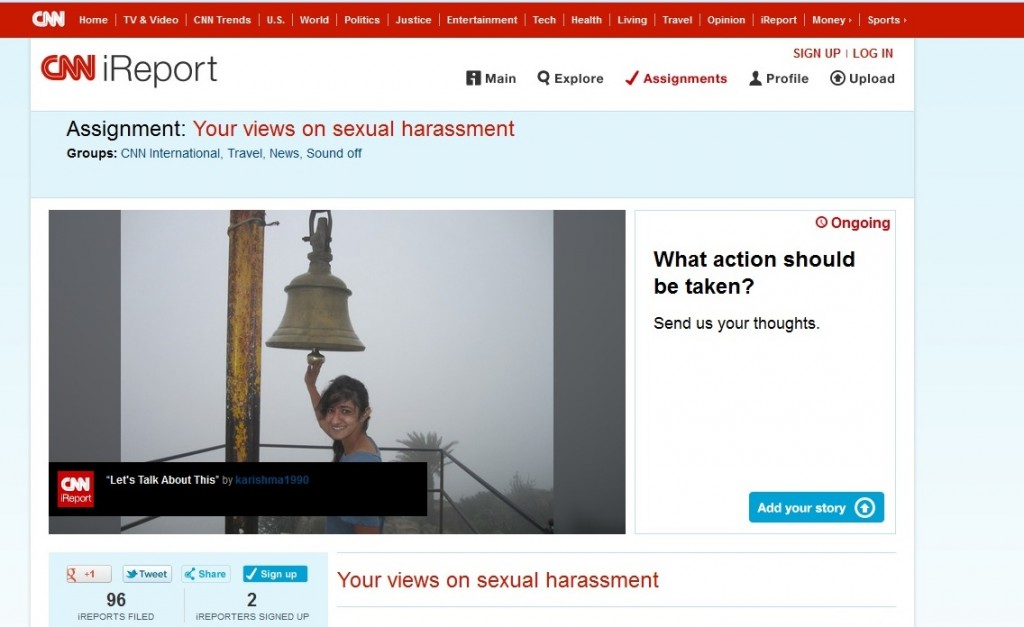
Help bring attention to the issue of street harassment by sharing your story with CNN via their iReport assignment.

I shared mine and then linked my story and the issue to Women’s Equality Day.

Street harassment is a global problem. Studies show that more than 90% of women in countries like Egypt, India, Yemen, and the USA experience it. More than 80% do in Canada. A recent study in France found that 25% of women ages 18-29 feel scared when they walk down the streets. In London, 43% of women ages 18-34 had experienced street harassment just during the prior year.

If you add to that the thousands of stories women have shared on my blog Stop Street Harassment, on the Hollaback! sites, and through the The Everyday Sexism Project, as well as the stories they share on personal blogs, Tumblrs and other social media sites, you can see that this is a huge problem.

Repeated street harassment and severe forms of it cause many women emotional distress and significantly impact their lives, including prompting them to avoid going places alone, to change routes and routines, and even to move neighborhoods or quit jobs.

I’ve seen this over and over through the stories shared on my blog Stop Street Harassment. There was the woman in Kansas who considered dropping out of her PhD program because she was routinely harassed by men near her campus; a woman in Mississippi who quit her job at a retail store because male customers began following her to her car after her shift; and a woman in California who was harassed so many times while she waited for a bus to campus that she finally went home, feeling upset and powerless, and missed the class.

Most telling is how unsafe street harassment makes women feel. Gallup data from surveys conducted in 143 countries in 2011 show that in every single county, women are considerably more likely than men to say they feel unsafe walking alone at night in their communities. Women in low-income countries and high-income countries reported the same rate: 41% felt unsafe. In the USA, 38 percent of women felt unsafe, compared with 11 percent of men.

I also want to bring up the young age street harassment begins. For my book, I surveyed 811 women from 23 countries and 45 US states and nearly 1 in 4 had been harassed in public by men by age 12. That’s seventh grade. Nearly 90% had been harassed by age 19.

Some women even say that the first time they heard sexual comments from men on the street was the moment when they felt they transitioned from girlhood to womanhood. This is a sad statement about womanhood in our society.

In the USA, Monday is Women’s Equality Day. I argue that the USA – and no other country – will achieve women’s equality until street harassment ends. Until we can travel and study abroad, walk to the corner store, wait for a bus, and go to a park without fearing or experiencing sexual harassment, we are not equal.

What can we do?

If you’ve faced street harassment, share your stories, especially with men in your life. Make visible this too-often invisible problem. If someone shares a story with you, don’t dismiss it, don’t tell them it’s a compliment, don’t tell them it’s their fault because of what they’re wearing or that they shouldn’t have been there or out alone. Instead, believe them, offer them support, and tell them you’re sorry that happened.

If you have children, nieces/nephews, teach or mentor youth, talk to them about sexual harassment, about respect, and about how to get help. Let’s ensure that the next generation can be in public spaces safely.

 Most of all, don’t harass others, be respectful. Ask for consent before talking to someone. Never use sexual language on the street with someone you don’t know without permission to do so. Treat people how you would want someone you love to be treated.

 Let’s make public places free from sexual harassment.

Share

Filed Under: Resources, street harassment Tagged With: women's equality day

Share your Street Harassment Story with CNN!

August 24, 2013 By HKearl

Via CNN –

“An iReport by University of Chicago student Michaela Cross, in which she says she experienced relentless sexual harassment during a study abroad trip in India last year, has sparked huge debate online and become the most viewed iReport of all time.

Much of the reaction has been from India, with both men and women apologizing to Cross and in many cases relating their own experiences of harassment.

Others, however, have pointed out that the problem is not confined to India’s borders and warned against singling out one country when the problem is faced by women worldwide.

We want to hear your thoughts on Cross’ iReport and the reaction it’s generated. What do you think men and women should do to combat sexual harassment, both in India and where you live? Have you had personal experiences with sexual harassment?

Send us your thoughts in a personal essay or short video and you could help shape CNN’s coverage of the issue.”

I shared my story. Share yours too!

(Here are some stories by women in India about the harassment they face daily.)

Share

Filed Under: News stories, street harassment

20th Anniversary of Anti-Harassment Book!

August 21, 2013 By HKearl

This is an excerpt of an interview I conducted with Marty Langelan for Fem2pt0. Read the full interview on their website.

I spent years feeling annoyed, angry, and scared by gender-based street harassment. In 2007, when I began research for a master’s thesis on the topic, I was very grateful to find the book Back Off: How to Confront and Stop Sexual Harassment and Harassers. This ground-breaking book was authored by Marty Langelan, the former president of the DC Rape Crisis Center, an economist, activist, and martial artist. I read every page of it, relieved that there was both an explanation for my experiences and a toolkit of tactics for what to do about it.

This summer marks the twentieth anniversary of the publication of Back Off, and Langelan is still tackling all kinds of harassment. She’s working with the Washington Metropolitan Area Transit Authority to design sexual harassment trainings this fall for more than 3,000 frontline bus and subway employees.

Because her work – and her book – is so essential to the on-going efforts to address sexual harassment in workplaces, schools, and public spaces worldwide, I was thrilled when she agreed to an interview.

interview holly

Q. Holly Kearl (HK): Why did you write your book?

 Marty Langelan (ML): Harassment was “normal” back then. It was happening everywhere. If you managed to sidestep the sleazy professors, bosses, and coaches, you ran into slimy landlords, creeps in the park, gropers on the bus, and gangs of sexual bullies on the corner.

They did it anytime they felt like it. They did it for a sexual turn-on, or an ego-boosting sense of power, or just because they liked humiliating women. They did it because they could.

I was teaching self-defense for women and kids at the DC Rape Crisis Center, and doing research on how to stop sexual assault. My friends at Women against Rape in Columbus, Ohio, were doing the same.

We learned that harassment is more than just creepy. Some harassers were “rape-testing” women, using sexual harassment to select victims for assault, looking for women who seemed unlikely to fight back. It might start as a simple verbal intrusion, but any harasser, any time, could decide to escalate:  Follow you, grab you, and shove you up against a wall. It made me so angry.

Being silent did nothing to stop the aggressors. Cussing-crazy-lady tirades just turned into violence.

We needed to change the predator-prey dynamics. We needed tactics that would make women safer (stop the harasser fast, without escalation) and create social change (make him think twice about ever trying it again). We needed verbal self-defense.

So we began to challenge harassers with nonviolent confrontation. Instead of scurrying away like scared rabbits, we began to walk up to the harassers, try some carefully structured verbal judo, and analyze the results. We tested and fine-tuned tactics to find out what worked. (We had plenty of opportunities for testing – we were all getting harassed, all the time.)

By 1986 we declared Washington DC a “Hassle-Free Zone,” with public speak-outs, leaflets and posters, and training sessions all over town. We took back neighborhood parks and street corners with ethical, direct, nonviolent action.

When Anita Hill testified at the Clarence Thomas hearing, I got furious all over again. Women everywhere talked about it — people were shocked to find out that almost every single woman they knew had been harassed. But most women still felt defeated. They still just quit the job, dropped out of school, stopped using that park or bus stop, and crossed the street to avoid harassers. I hate it when people feel helpless.

So I sent out a nationwide survey, asking, “Have you ever successfully stopped a harasser? Tell us what you did, what worked.” That survey flew across the country.  Responses flooded in, first from the U.S., then from around the world.

And when I analyzed the results, all the successful tactics had the same core structure. They were all versions of the same verbal judo we were using in DC – fast, clear, principled nonviolent action that changed the power dynamics and stopped harassers cold. We had an entire toolkit of tactics that worked.

It was a turning point. I don’t know whether we can stop rape in our lifetime, but we sure can stop harassers. I wrote Back Off so that no harasser could ever make us feel helpless again.

Read more.

Share

Filed Under: Activist Interviews, street harassment

NYC: New App for Reporting Harassment

August 20, 2013 By HKearl

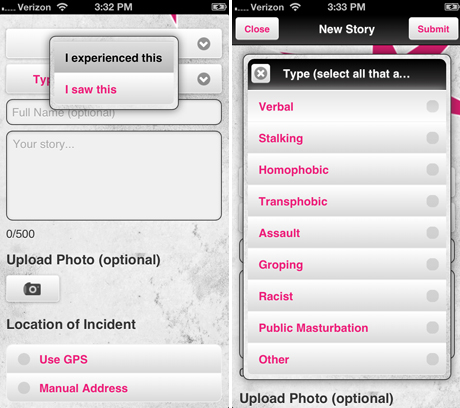
Building on a recommendation from the SSH Book to document where street harassment is happening to better be able to address it, Hollaback! has teamed up with the New York City Council to launch the Hollaback! app.

Via Think Progress:

“The new app allows victims or witnesses to upload, in real time, information about where they experienced harassment on the street. It creates a map of pinned locations where harassment occurs, providing near-instant feedback to the city council’s and mayor’s offices. The app collects demographic data, too, to help officials better understand the details of where harassment occurs and who it happens to.”

This easier way to report incidents to Hollaback’s database and the option to report it to city council members has the potential to make a difference in how street harassment is documented and understood. It’s great that the app isn’t just for tracking gender-based street harassment, but also forms like racial harassment. It also lets you report harassment  you witness, not just what you experience.

However, it’s important to note that often the people who are most vulnerable to harassment may not have access to a phone with an app (such as young teenagers, homeless people, poor people) so they will still have a harder time reporting incidents.

And, city council speaker and mayoral candidate Christine Quinn is the main backer of the app, yet she favors a form of street harassment: Stop and Frisk (which, as of last week, is now unconstitutional).

Via Jezebel:

“Mariame Kaba (@PrisonCulture), founder of Project NIA, an advocacy organization that supports youth in trouble with the law, argued in a series of tweets that it’s “not as simple as throwing around slogans about ‘keeping women safe.”

“Which women?” she asked. “What do you mean by ‘safe?; HOW are you proposing to create that safety? ALL of these questions are gendered, racialized + age-specific, geographically-specific, etc… It isn’t neat and it isn’t simple.”

Street harassment is complex and there are no easy answers for how to deal with it… in fact there will never be just one answer because it impacts so many groups of people in various communities differently.

I do see it as promising that city council members want to address this issue, and I hope they will listen to the concerns of people like Kaba so they can improve their efforts and make them more inclusive and effective. It will be interesting to see how the app is used and what impact it may or may not have on stopping street harassment.

Share

Filed Under: hollaback, News stories, street harassment

« Previous Page
Next Page »

Share Your Story

Share your street harassment story for the blog. Donate Now

From the Blog

  • #MeToo 2024 Study Released Today
  • Join International Anti-Street Harassment Week 2022
  • Giving Tuesday – Fund the Hotline
  • Thank You – International Anti-Street Harassment Week 2021
  • Share Your Story – Safecity and Catcalls Collaboration

Buy the Book

  • Contact
  • Events
  • Join Us
  • Donate
  • Facebook
  • Instagram
  • Pinterest
  • Tumblr
  • Twitter
  • YouTube

Copyright © 2026 Stop Street Harassment · Website Design by Sarah Marie Lacy