• About Us
    • What Is Street Harassment?
    • Why Stopping Street Harassment Matters
    • Meet the Team
      • Board of Directors
      • Past Board Members
    • In The Media
  • Our Work
    • National Street Harassment Hotline
    • International Anti-Street Harassment Week
    • Blog Correspondents
      • Past SSH Correspondents
    • Safe Public Spaces Mentoring Program
    • Publications
    • National Studies
    • Campaigns against Companies
    • Washington, D.C. Activism
  • Our Books
  • Donate
  • Store

Stop Street Harassment

Making Public Spaces Safe and Welcoming

  • Facebook
  • Instagram
  • Pinterest
  • Tumblr
  • Twitter
  • YouTube
  • Home
  • Blog
    • Harassment Stories
    • Blog Correspondents
    • Street Respect Stories
  • Help & Advice
    • National Street Harassment Hotline
    • Dealing With Harassers
      • Assertive Responses
      • Reporting Harassers
      • Bystander Responses
      • Creative Responses
    • What to Do Before or After Harassment
    • Street Harassment and the Law
  • Resources
    • Definitions
    • Statistics
    • Articles & Books
    • Anti-Harassment Groups & Campaigns
    • Male Allies
      • Educating Boys & Men
      • How to Talk to Women
      • Bystander Tips
    • Video Clips
    • Images & Flyers
  • Take Community Action
  • Contact

DC’s New Law Against Street Harassment

August 4, 2018 By HKearl

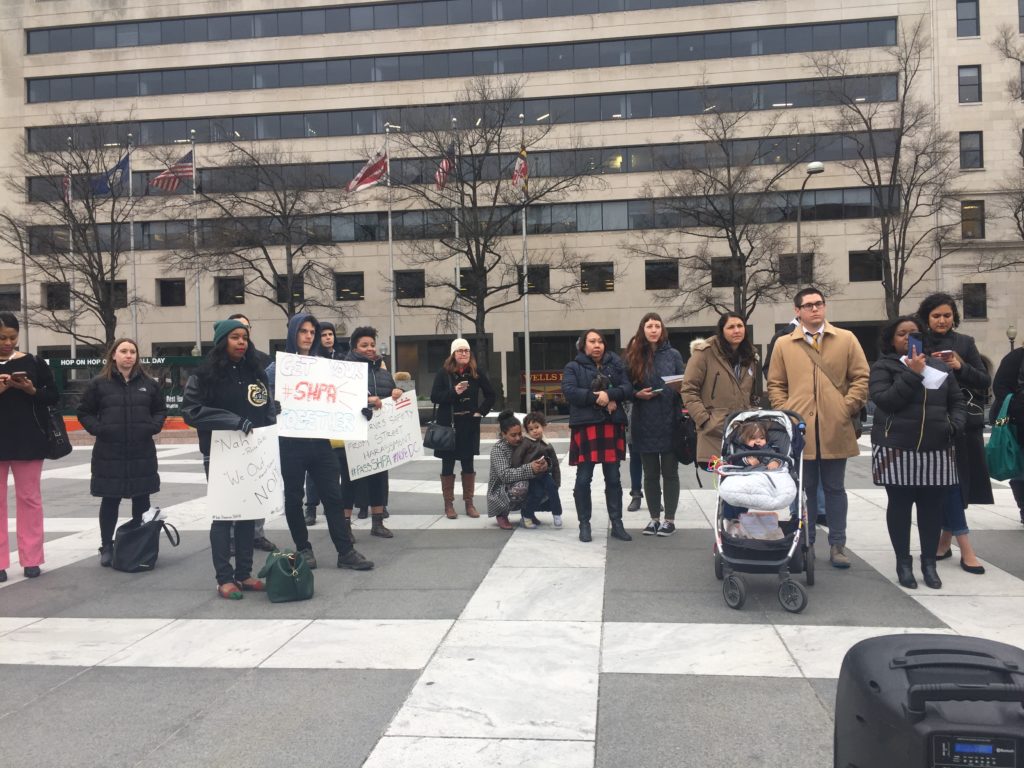
April 2018 rally in support of SHPA led by Collective Action for Safe Spaces in DC

The Council of the District of Columbia recently passed the Street Harassment Prevention Act of 2018 (SHPA), the first legislation of its kind in the United States. It is one of more than 20 laws addressing street harassment to pass globally since 2012, and laws are under consideration in a dozen more places.

The SHPA is groundbreaking in creating the first legal definition of street harassment in the United States, calling it “disrespectful, offensive or threatening statements, gestures or other conduct directed at an individual in a high-risk area without the individual’s consent and based on the individual’s actual or perceived … protected trait identified in the [DC] Human Rights Act of 1977.” It also uniquely focuses on prevention through education instead of criminalization.

Specifically, the SHPA establishes an advisory committee on street harassment that will propose model policies and training materials to be implemented in the District; require the Office of Human Rights (OHR) to conduct the first citywide survey on street harassment; and require OHR to conduct a public information campaign about street harassment. Further, grant money will be provided for street harassment awareness programs.

The advocacy organization Collective Action for Safe Spaces (CASS), which uses community-based solutions through an intersectional lens to address street harassment, was instrumental in the passage of SHPA. Deputy director Chantal Coudoux noted that one of its strengths is that is was “developed and advocated for by directly impacted community members and organizations led by survivors of harassment and assault” through speak-outs and in-person and online story-sharing.

Read how SHPA compares to laws elsewhere in this article I wrote for Women’s Media Center.

DC Councilmember Nadeau

DC Councilmember Brianne Nadeau introduced the SHPA and did an interview for me about it.

HK: Why did you feel it was important to see the Street Harassment Prevention Act pass?

BN: I pushed for the first-ever Council roundtable hearing on street harassment, and introduced this bill because I experienced this kind of harassment on a regular basis, and so did many of the women I spoke to. At the hearing, Councilmembers heard heartbreaking stories that really demonstrated how pervasive street harassment is for many of our vulnerable populations. The District is a place where everyone should feel welcome, but the unfortunate truth is that street harassment is a shared experience facing many of our vulnerable populations.


HK: What do you think has led Washington, D.C. to be a leader in the USA on addressing street harassment?

BN: I think it took women being in power and feeling like their concerns would be taken seriously, as well as strong support from organizations in the community. It’s not an issue that’s unique to Washington, but there was a political will to deal with the issue, and strong community based organizations working on this issue like Collective Action for Safe Spaces who were instrumental in helping craft this bill.

Our understanding is that this is the first time any US state or city has legally defined street harassment. There are existing laws that are sometimes applied when street harassment is taking place, but they’re typically laws that are about other kinds of assault or harassment. Our understanding is that this is the first time a US state or city has legally defined street harassment, the first citywide data collection on the issue in the US and the first law to address the issue without criminalization. Again, our understanding is that most other countries have tried to implement fines for street harassment so this is the first to address street harassment without criminalization. Here is an article that has some good information: Citylab


HK: What do you hope DC will look like in 5 years because of the law?

BN: We wrote this bill while being sensitive to the fact that young people, members of the LGBTQ community, people from communities of color, people experiencing homelessness, and people from low-income communities experience more frequent and severe harassment. The law is focused on education and culture change because any solution to the problem shouldn’t be an excuse to disproportionately target those same communities through criminalization.

The legislation establishes an advisory committee which will develop policies, guidelines and procedures to educate District employees to identify and address street harassment; evaluate and make recommendations regarding reporting street harassment; and conduct a survey to collect data so that we have a better understanding on the pervasiveness of street harassment. Grant money will be provided for street harassment awareness programs. The bill targets areas where harassment is more common such as public transportation, cabs and ride-sharing services, bars, restaurants, night clubs, schools, colleges, sidewalks, parks and other public spaces.

This law sends a strong message that harassing one another on the street is not something that Washingtonians will stand for. In five years, I hope street harassment is much less common than it is today. I want people who have experienced harassment to feel safer on our streets and I want all residents to understand what street harassment is, to understand how to call it out, and how to intervene. In five years, I hope our culture shifts and it’s viewed as an unacceptable public behavior, as it should be.

Share

Filed Under: street harassment Tagged With: CASS, DC act, DC city council, laws, legislation, street harassment

Apply: SSH Board Member

August 4, 2018 By HKearl

A bunch of SSH’s board members’ terms are up in September, so we’re looking for new board members! Here’s the form with information about what being a board member entails.

Share

Filed Under: SSH programs Tagged With: ssh board, volunteer

“Made me feel unsafe in a place where I usually feel safe”

July 22, 2018 By HKearl

I had just gotten off from work after a 2-9 shift at a local restaurant. I stopped at the atm up the street from my house to deposit my tips from the day. While I was finishing up the deposit, a man walks in behind me and says “big winner,” to which I reply “yeah” without looking back. I retrieved my card and made for the exit, but the man was already standing to the side of me and goes “my turn” and then a few seconds later when I was at the exit he calls me a dick.

Not wanting to engage any further, I said nothing and made for my car. When I was about half way to my car, he runs into the parking lot and yells, “F**king c*nt!”

I sprint to my car and drive off as quickly as possible, thinking he is in pursuit. I drove to the exit of the parking lot and stopped to call the police. He saw me stop and was banging on the glass pointing at me from inside of the ATM. He must have figured I was calling the cops because he ran to his pickup truck and drove off. I decided it was not worth it to speak to an officer as I had no idea who this man was.

This incident made me feel unsafe in a place where I usually feel safe, it made me feel confused as to what set this man off, and it made me feel angry that he was able to get away with it. It also makes me feel bad for his next victim, as I’m sure there will be one.

Forgive me for not jumping up and down to befriend you at 10 p.m. while I’m completing an ATM transaction after a 7 hour shift. I will definitely be more cautious the next time and hope I am never caught in a situation like this again.

– BC

Location: Milford, CT

Need support? Call the toll-free National Street Harassment hotline: 855-897-5910

Share your street harassment story for the blog.
See the book 
50 Stories about Stopping Street Harassers for ideas.

Share

Filed Under: Stories, street harassment

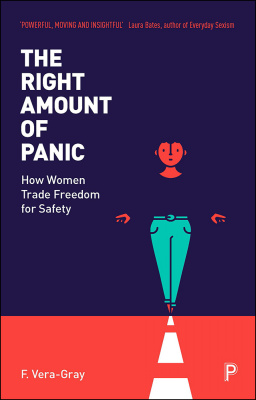
New Book: The Right Amount of Panic

July 21, 2018 By HKearl

Dr. Fiona Vera-Gray has written a new book on street harassment called The Right Amount of Panic: How Women Trade Freedom for Safety. It’s available for sale here.

Here’s a description:

Have you ever thought about how much energy goes into avoiding sexual violence? The work that goes into feeling safe goes largely unnoticed by the women doing it and by the wider world, and yet women and girls are the first to be blamed the inevitable times when it fails.

We need to change the story on rape prevention and ‘well-meaning’ safety advice, because this makes it harder for women and girls to speak out, and hides the amount of work they are already doing trying to decipher ‘the right amount of panic’. With real-life accounts of women’s experiences, and based on the author’s original research on the impact of sexual harassment in public, this book challenges victim-blaming and highlights the need to show women as capable, powerful and skillful in their everyday resistance to harassment and sexual violence.”

I was asked to give a quote/review for it: “By re-interpreting women’s daily safety strategies as successful forms of resistance, this book presents fresh ideas for sexual violence prevention.”

Share

Filed Under: Resources, street harassment Tagged With: book, research, resource

Apply: Social Media and Website Manager (Unpaid)

July 12, 2018 By HKearl

SSH is seeking someone who can work 5-10 hours a week, primarily managing the organization’s social media and website content. This is an unpaid, remote position. This is an ideal job for someone seeking volunteer experience in the nonprofit field, a student seeking course credit and/or someone who is passionate about ending street harassment! We will be happy to work with colleges/universities to ensure that the experience meets the requirements necessary for course credit.

The main job duties would entail:

  • Posting information about street harassment on social media (primarily Facebook, Twitter and Instagram).
  • Posting street harassment story submissions on the blog
  • Writing short blog posts about relevant issues in the news.
  • Conducting a few interviews for the blog with anti-street harassment activists or highlighting new anti-street harassment initiatives on the blog.
  • Writing up the annual 16 Memorable Stories of Standing up to Street Harassers article for the Pixel Project (see the 2017 article for an example), to be cross-posted on the SSH blog.
  • Coordinating SSH’s online action for the 16 Days of Activism Against Gender-Based Violence Campaign (Nov. 25 to Dec. 10).
  • Assisting with #GivingTuesday (November 27, 2018) online fundraising.

The person would report directly to SSH’s founder Holly Kearl.

This position would start in late-August (exact date can be flexible) and conclude sometime in December (exact date can be flexible), with the option to extend into 2019.

Qualifications:

An ideal candidate will be:

  • An excellent writer.
  • Experienced at using social media, particularly for campaigns/causes.
  • A self-starter who requires minimal supervision.
  • Knowledgeable about gender issues and/or social justice activism.
  • Well-versed about what street harassment is and why stopping it is important.

Familiarity with online fundraising would be a plus.

Please send a one-page cover letter and resume/CV to Holly Kearl, stopstreetharassment@gmail.com by August 18, 2018.

Share

Filed Under: SSH programs, volunteer

« Previous Page
Next Page »

Share Your Story

Share your street harassment story for the blog. Donate Now

From the Blog

  • #MeToo 2024 Study Released Today
  • Join International Anti-Street Harassment Week 2022
  • Giving Tuesday – Fund the Hotline
  • Thank You – International Anti-Street Harassment Week 2021
  • Share Your Story – Safecity and Catcalls Collaboration

Buy the Book

  • Contact
  • Events
  • Join Us
  • Donate
  • Facebook
  • Instagram
  • Pinterest
  • Tumblr
  • Twitter
  • YouTube

Copyright © 2026 Stop Street Harassment · Website Design by Sarah Marie Lacy