• About Us
    • What Is Street Harassment?
    • Why Stopping Street Harassment Matters
    • Meet the Team
      • Board of Directors
      • Past Board Members
    • In The Media
  • Our Work
    • National Street Harassment Hotline
    • International Anti-Street Harassment Week
    • Blog Correspondents
      • Past SSH Correspondents
    • Safe Public Spaces Mentoring Program
    • Publications
    • National Studies
    • Campaigns against Companies
    • Washington, D.C. Activism
  • Our Books
  • Donate
  • Store

Stop Street Harassment

Making Public Spaces Safe and Welcoming

  • Facebook
  • Instagram
  • Pinterest
  • Tumblr
  • Twitter
  • YouTube
  • Home
  • Blog
    • Harassment Stories
    • Blog Correspondents
    • Street Respect Stories
  • Help & Advice
    • National Street Harassment Hotline
    • Dealing With Harassers
      • Assertive Responses
      • Reporting Harassers
      • Bystander Responses
      • Creative Responses
    • What to Do Before or After Harassment
    • Street Harassment and the Law
  • Resources
    • Definitions
    • Statistics
    • Articles & Books
    • Anti-Harassment Groups & Campaigns
    • Male Allies
      • Educating Boys & Men
      • How to Talk to Women
      • Bystander Tips
    • Video Clips
    • Images & Flyers
  • Take Community Action
  • Contact

Invisible No More: A Day to Eliminate Violence Against Women

November 25, 2012 By HKearl

Today is the International Day for the Elimination of Violence Against Women and the start of 16 Days of Activism Against Gender Violence. The theme this year focuses on the intersections of gender-based violence and militarism.

Did you know, militarism and street harassment are connected? Public spaces become extra unsafe for women in times of war and military occupation. Rape is a common weapon of war and just leaving one’s house or the refugee camp increases the chances of that kind of attack – or at the very least, increases the chances of being harassed.

Also, a new study shows that the overall status of women decreases in countries with high militarism. Soraya Chemaly wrote about it for Women Under Siege:

“Gender is the fundamental construct for how a society understands difference. Regardless of which state we are talking about, tolerance for street harassment, rape, domestic violence, and restrictions on reproductive freedom are among several indicators of gender inequality rooted in such difference. These behaviors correlate to state security in multiple dimensions. In the simplest terms, states in which women are subjected to violence and uncontested male rule at home, where they are not allowed equal freedoms and rights to bodily integrity, privacy, and equal protection under the law, are those most likely to engage in violence as nations, the authors report. Microaggression against women in private connects to macroaggressive national behavior. The larger a nation’s gender gap in equality between men and women or the more violently patriarchal their structures, the greater the likelihood that a nation will resort to force and violence in the form of aggressive nationalism.”

The US is not immune. In my day job as a program manager at AAUW, I’ve had the honor of meeting and working with brave American military veterans – and their lawyer – who are speaking out against rampant military sexual assault, suing the military for doing very little about it, and put their personal lives on the big screen so a wider audience could understand the issues. The Invisible War documentary is available for rent through Netflix and I highly recommend watching it. If you live in the US, you can also write to your congressperson, asking them to support legislation that would better address military sexual assault.

I always think about how if 20 percent of women in the military are sexual assaulted and raped by their own “brothers”/comrades, how many women in occupied lands, how many women who are the “enemies” are raped? This is an American disgrace. It’s criminal. It must stop.

Visit the sites of Women Under Siege, Stop Rape in Conflict, and Invisible No More for more information about the issues and how you can become involved.

Share

Filed Under: 16 days

Butt grabbing is not an offense in Austria!

November 23, 2012 By HKearl

A few weeks ago, a 43-old-woman was waiting to cross the street in Graz, Austria, when a man came up to her and said, “Wow, a woman with a fantastic arse, can I touch it?”

She said no, but he ignored her and grabbed her anyway.

Mad, the woman slapped him, then ran when he began chasing her and threatening her, saying he would not accept “being hit by a woman.” The police showed up and intervened, and the woman pressed charges of sexual assault.

However, this week, the local prosecutor Hansjörg Bacher dropped the charges “because the conditions that needed to be met had not been fulfilled.”

He said, “The incident itself needs to involve physical contact with sexual parts, simply touching the woman on the bottom does not qualify as sexual harassment. That would not have been the case if he had for example grabbed her breasts or touched her improperly in the sexual region.”

The woman said the decision by prosecutors was a second insult completely incomprehensible. She said that she had had to get counselling after the very public assault by the man and is demanding they reconsider the decision.”

What a horrible decision – the law needs to be updated, but good for the woman for speaking out and fighting back.

Share

Filed Under: News stories, Stories, street harassment

Share your story about stopping a street harasser!

November 23, 2012 By HKearl

Have you ever shut up or confused a street harasser, gotten an apology from one, or successfully reported one?

Then I want to hear your story! Please fill out this form.

Your story may be included in a forthcoming book featuring 50 empowering stories about stopping a street harasser.

Please also email a photo of yourself (any kind, but please send the highest resolution you have) to go along with the story and send it to StopStreetHarassment AT yahoo D O T com.


Share

Filed Under: street harassment

14th Annual Transgender Day of Remembrance

November 20, 2012 By HKearl

Since January 1, 2012, at least 63 transgender individuals have been hatefully murdered. Today we remember them on the 14th annual Transgender Day of Remembrance, a day of commemoration started by Gwendolyn Ann Smith. Today she wrote in the Huffington Post:

“We’ve seen an increase in legislation that helps prosecute those who participate in anti-transgender violence, including the Matthew Shepard and James Byrd, Jr. Hate Crimes Prevention Act. We’ve seen a much greater awareness of the issue of anti-transgender violence. We’ve seen successes in other battles for transgender rights.

Yet we still see anti-transgender violence. Every year, we still find ourselves with a list of people who have been violently murdered for simply being themselves.

The Transgender Day of Remembrance is not an event for fundraisers and beer busts. It’s not an event we “celebrate.” It is not a quick and easy one-day way for organizations to get credit for their support of the transgender community. It’s not something to trot out on the 20th of November and forget about. We should be working every day for all of us, living and dead.”

Transgender individuals face some of the most vicious forms of street harassment, including murder. Earlier this year, I attended a vigil for Deoni Jones in the Washington, DC area, along with several other anti-street harassment activists. Deoni was a young woman who was murdered at a well-lit bus stop at 8 p.m. earlier this year. It was heartbreaking to hear from her loved ones and to hear from so many people who were angry, discouraged, and tired of hearing about the murder of their friends.

In response to the alarming trend of murder, recently the DC government launched a “Gender Identity Respect” campaign (on image is included on the right). It’s sad that this kind of campaign is even necessary — everyone should be afforded respect, dignity, and the right to live — but I am glad to see the DC government address the issue head on.

Each of us must do our part every day to speak out against discrimination and hate. And today, we remember those who’ve been unjustly taken from this earth this year:

Popinha
Unidentified person
Carla White
Crain Conaway
Brilli
Guilherme Augusto de Souza
Maicon Roux
Mateo Vicente
Sabrina
Peter “Hair” Tamiarana
Paola Cristiano
Deoni Jones
Tiago da Silva Garcia
Paulo Roberto Campos
Montserrat Pineda
Carla
Junior Richardo de Jesus
Agnes Torres Sulca
Chiquinha
Soraya
Rene “Rosita” Hildalgo
David William de Oliveira Cândido
Coko Williams
Tyrell Jackson
Menakshiammal
Paige Clay
Rebekah
Leandro Eduardo Campos Ferreira
Brandy Martell
Unidentified person
Anil Aayiramthengu
Jaime Antonio Lopez
Lorena Escalera
Chrissie Azzopardi
Thapelo Makutle
William Geovanni Aguilar Pérez
Alison
Unidentified person
Jeimy Tamara Perez
Unidentified person
Camila de Mink
Tracey Johnson
Seçil Anne
Sapphire
Barbarita
Tania
Silva
Tiffany Gooden
Sirena Paola
Unidentified person
Unidentified person
Laryssa Silveira
Tiago da Silva Oliveira
Robson Franco Pereira
Dewayne “Deja” Jones
Unidentified person
Kendall Hampton
Kyra Cordova
Victoria
Unidentified person
January Marie Lapuz
Madonna
Cassandra

Share

Filed Under: street harassment Tagged With: Deoni Jones, gender identity respect, hate, LGBQT, transgender day of remembrance

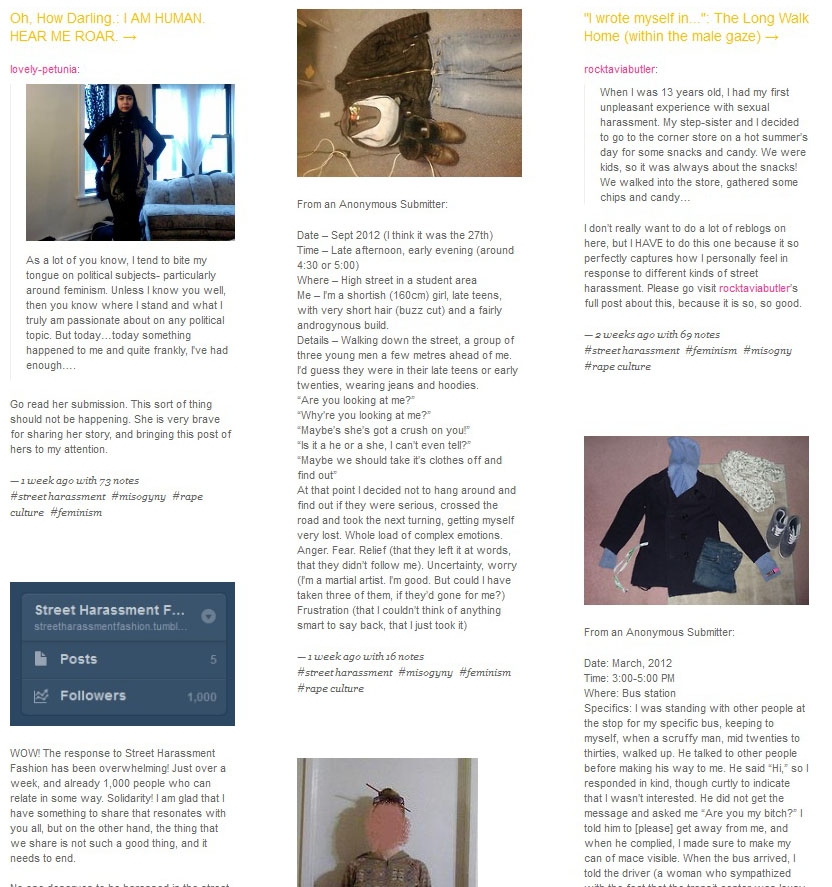
Street Harassment Fashion Tumblr: Interview with the Creator

November 20, 2012 By HKearl

Have you heard about the new Tumblr Street Harassment Fashion that documents clothing people wear when they are harassed to challenge notions of victim-blaming? It’s compelling and growing fast. Creator Ellis Gainsboro agreed to answer a few questions so that Stop Street Harassment readers can learn more about the project.

Stop Street Harassment (SSH):  Hi Ellis, thanks for agreeing to the interview. What is a three sentence biography  for you?

Ellis Gainsboro (EG): I was raised in American suburbia by conservative, working-class, religiously-and-socially-conservative, divorced parents. My life since, has involved a small number of not-so-extreme screw-ups (mostly bad boyfriends and drinking), then afterwards, MUCH reading, educating myself in general, and exploring the world of visual and audio arts. I currently divide my free time amongst painting, recording, spending time with my Significant Other, cooking vegan food, and learning about feminism and social justice issues.

SSH: Was there a particular experience or event that inspired your Tumblr project?

EG: Not really. I have consistently experienced street harassment from the tender age of about 12, but I’ve never had any constructive way to deal with it. Speaking back against it and calling your harasser out on their rudeness is not always the safest action to take, ignoring it feels like you’re letting them win, and basically those are the only two options! It makes me (and many other people, I’m sure) feel so powerless! In addition, when I try to share those experiences with some people, I am often told that I “must have been asking for it,” which is JUST NOT TRUE. NO ONE is asking for it! I don’t care what you’re wearing! I created Street Harassment Fashion so that I could document what happened, what was said, and what I was wearing, as a way to back up my belief that I am not the problem in this situation. The victims of street harassment are extremely varied, and I wanted to have a space on the internet to exhibit that. It’s not our fault and we don’t cause it. The blame falls squarely on the shoulders of those who harass others.

SSH: When you started it, what was your goal/purpose? Has that changed at all based on the response to it?

EG: I wanted to have a place to document the every-day sorts of harassment I get when I am out and about. I wanted to have a link I could share when someone said to me, “Well, you must have been asking for it.” I wanted to document my (and others’) outfits to PROVE that it is NOT what we are wearing that incites this harassment. Already, there is a variety of outfits and looks, different styles, and different fits. Stories with conservative outfits, form-fitting outfits, scarves, bulky jackets, leggings, long hair, short hair, updos, shaved heads. It’s already becoming very clear that the way victims of street harassment dress and style themselves has nothing to do with the reasons that they are harassed.

I don’t think my purpose for this blog has changed since I have started it–I still want to use it as a reference against ignorance and for awareness, but I think that since I have amassed so many followers, with additional new followers every day…It is bittersweet! I am SO grateful for the support and solidarity, but at the same time, it deeply saddens me that so many people can relate.

SSH: What kind of response has the Tumblr had and how do you feel about that?

EG: So far the response has been very supportive, and a bit overwhelming! I didn’t know I would get so many followers so quickly (1,000+ in the first week!) I wasn’t really looking/hoping to find a following of any sort really, but just knowing that other people can relate in some way? That means so, so much to me! But again, it is a double-edged sword, because if people can relate to this blog, it means that they have had some experience with street harassment in their lives (either personally, or second-hand at least). This is a much bigger problem than I can tolerate on my own, and something needs to be done about it.

SSH: Is there one particular story/photo that stands out to you and why?

EG: Since Street Harassment Fashion is young, all of the posts so far carry equal weight in my mind. The posts about my own experiences are important because they happened to ME: I was there, it was a direct part of my personal life, and I will never forget how I was made to feel emotionally as a result of those interactions. The posts submitted by others are just as important though, as they demonstrate very clearly that the street harassment I receive is not isolated to my own experience. It solidifies the fact that this happens to so many people, under so many different circumstances, and that it is not the fault of the victims. I am so grateful that others have been brave enough to submit their stories and pictures. I think it is so important to have a variety of posts from a variety of people about street harassment.

SSH: Is there anything else you want to add?

EG: Yes! I want to reiterate again that the victims of street harassment are NOT TO BLAME. If any of your readers have been the victims of street harassment, and would like to share their stories with me and my followers, or if they just need an ear to talk to and someone to empathize with them, they can send me an email at streetharassmentfasion@gmail.com.

Share

Filed Under: Activist Interviews Tagged With: street harassment, street harassment fashion, victim blaming

« Previous Page
Next Page »

Share Your Story

Share your street harassment story for the blog. Donate Now

From the Blog

  • #MeToo 2024 Study Released Today
  • Join International Anti-Street Harassment Week 2022
  • Giving Tuesday – Fund the Hotline
  • Thank You – International Anti-Street Harassment Week 2021
  • Share Your Story – Safecity and Catcalls Collaboration

Buy the Book

  • Contact
  • Events
  • Join Us
  • Donate
  • Facebook
  • Instagram
  • Pinterest
  • Tumblr
  • Twitter
  • YouTube

Copyright © 2026 Stop Street Harassment · Website Design by Sarah Marie Lacy