• About Us
    • What Is Street Harassment?
    • Why Stopping Street Harassment Matters
    • Meet the Team
      • Board of Directors
      • Past Board Members
    • In The Media
  • Our Work
    • National Street Harassment Hotline
    • International Anti-Street Harassment Week
    • Blog Correspondents
      • Past SSH Correspondents
    • Safe Public Spaces Mentoring Program
    • Publications
    • National Studies
    • Campaigns against Companies
    • Washington, D.C. Activism
  • Our Books
  • Donate
  • Store

Stop Street Harassment

Making Public Spaces Safe and Welcoming

  • Facebook
  • Instagram
  • Pinterest
  • Tumblr
  • Twitter
  • YouTube
  • Home
  • Blog
    • Harassment Stories
    • Blog Correspondents
    • Street Respect Stories
  • Help & Advice
    • National Street Harassment Hotline
    • Dealing With Harassers
      • Assertive Responses
      • Reporting Harassers
      • Bystander Responses
      • Creative Responses
    • What to Do Before or After Harassment
    • Street Harassment and the Law
  • Resources
    • Definitions
    • Statistics
    • Articles & Books
    • Anti-Harassment Groups & Campaigns
    • Male Allies
      • Educating Boys & Men
      • How to Talk to Women
      • Bystander Tips
    • Video Clips
    • Images & Flyers
  • Take Community Action
  • Contact

What Could Women and Girls Achieve If They Were Safe

March 8, 2018 By HKearl

Many, many studies demonstrate the myriad ways that women are discriminated against and unequal in countries world-wide. In the United States, our latest nationally representative study, done in partnership with Raliance and UCSD Center for Gender Equity and Health, adds to the stark picture.

For just a few of the many alarming data points:

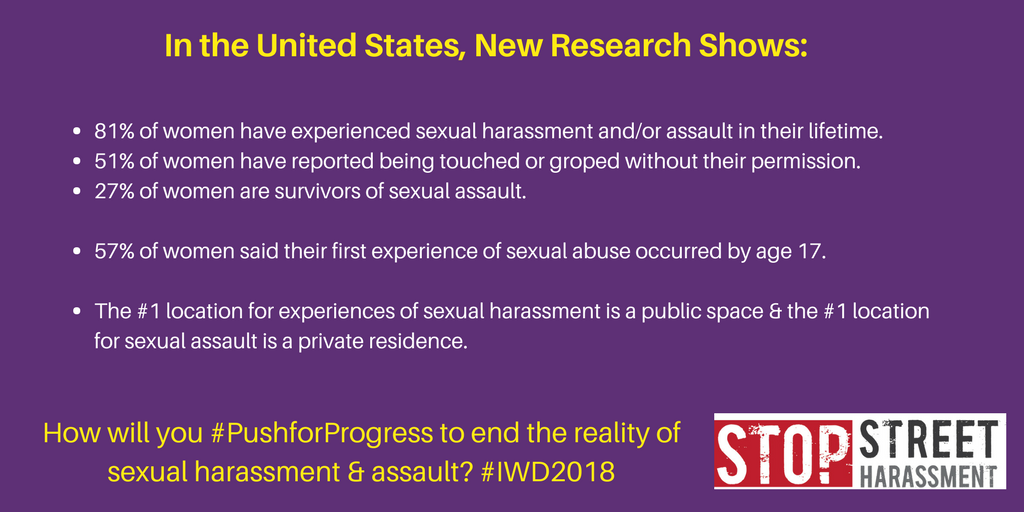
  • 81% of women nationwide have experienced sexual harassment and/or assault in their lifetime.
  • 51% of women nationwide have reported being touched or groped without their permission.
  • 27% of women nationwide are survivors of sexual assault.

Among women who experienced sexual harassment and/or assault:

  • 57% said their first experience of sexual abuse occurred by age 17.
  • 88% said they’d experienced sexual harassment or assault in multiple locations.
  • The #1 location for experiences of sexual harassment was a public space and the #1 location for sexual assault was a private residence.
How can women and girls ever hope to achieve equality with men and boys when we are disproportionately harmed, and harmed across many spaces of our life (private homes, public spaces, schools, workplaces, online, etc.)?

And what could women and girls collectively achieve if we were not worrying about staying safe? If we were not regularly practicing avoidance strategies to try to reduce encounters of harassment and assault? If we were not being harassed as a tactic to exclude us from decision-making and leadership positions? If we were not coping with the aftermath of trauma from sexual harassment and assault?

Would world hunger be solved? Would climate change not be an issue? Would gun violence be reduced?

We expend so much time and energy just dealing with the threat of, the actual experiences of, and the aftermath of sexual harassment and assault that it robs us of valuable time and energy that we could use in more productive, fun and useful ways. We lose. Our community loses. The world loses.

This International Women’s Day, the theme is #PushforProgress. What will you do to push for the elimination of sexual harassment and assault?

  • Will you speak up against abusive behavior?
  • Will you teach the boys in your life to be respectful, accept “no” graciously and make room for women and girls?
  • Will you lead local campaigns?
  • Will you share your own stories to raise awareness?

Whatever you choose to do, you can make a difference and help ensure that the world becomes a more equitable place for women and girls.

And if you have the means, you can be our hero by making a tax-deductible donation today and help fund our initiatives (like national research, International Anti-Street Harassment Week and transit campaigns). Our work is made possible by generous individual donors.

Share

Filed Under: street harassment Tagged With: International Women's Day, IWD

February 2018 News Round-Up

February 28, 2018 By HKearl

Here are some of the news stories on my radar this month:

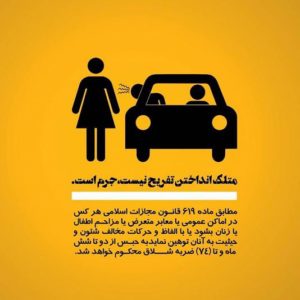
“It’s not fun to ‘taunt’ women in the street, it is a crime.” COURTESY SAMAN SALIMIAN

Muslim women globally shared their stories of sexual harassment with the hashtag #MosqueMeToo.

A TV reporter in Australia was sexually threatened on the street and then told it wasn’t a crime.

Men raped 21 women on public transport in Bangladesh.

A poster campaign against street harassment went viral in Iran.

New research came out about sexual harassment and children in Pakistan.

A Palestinian-American brought #MeToo to the West Bank.

Women spoke out about sexual harassment during Hajj in Saudi Arabia.

If you’re in the UK, share your views on SH with a government entity by March 5.

The Alabama Senate passed a bill to criminalize non-consensual upskirt photos.

New research is out about how US women respond to and cope with catcalling.

Why I’m teaching my daughters to be rude.

How first-generation New Yorkers deal with street harassment.

Cities are designed around men. It’s time for equality in city planning.

Share

Filed Under: News stories, street harassment, weekly round up

81% of Women and 43% of Men Have Experienced Sexual Abuse in USA

February 21, 2018 By HKearl

I’m excited to share that our new study was released this morning!

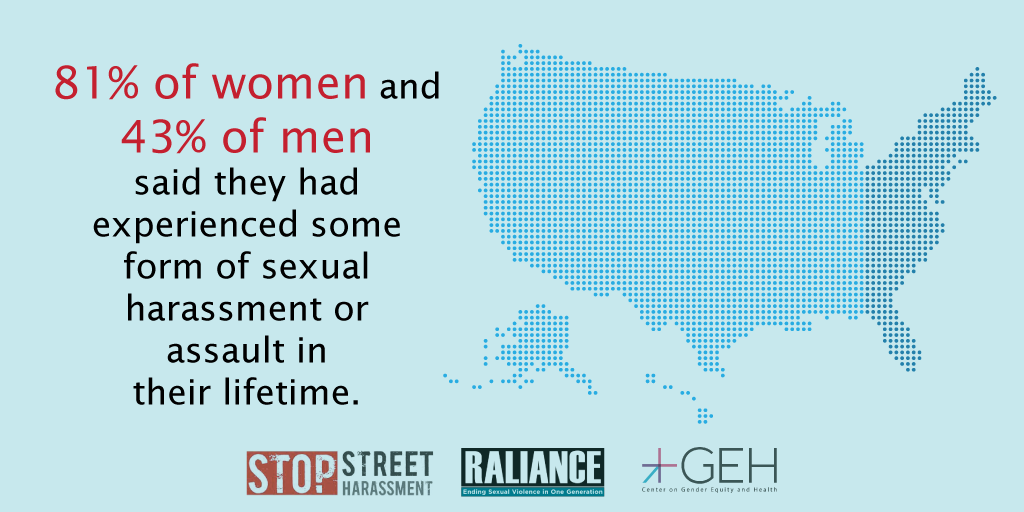
In January 2018, SSH commissioned a 2,000-person, nationally representative survey on sexual harassment and assault, conducted by GfK. It found that nationwide, 81% of women and 43% of men reported experiencing some form of sexual harassment and/or assault in their lifetime.

While verbal sexual harassment was the most common form (77% of women and 34% of men), an alarming 51% of women and 17% of men said they were touched or groped in an unwelcome way, and 27% of women and 7% of men survived sexual assault.

This survey is the first to look at a range of sexual harassment behaviors, track the various locations where people experience sexual harassment and assault (from public spaces to homes to schools to workplaces to online etc), and identify who perpetrators are in relation to the respondents (e.g. strangers, coworkers, family members).

When the sample size allowed, the report breaks down people’s experiences by demographics like race/ethnicity, sexual orientation, household income, disability status, age, and region of the country.

READ: Full Report | Two-Page Executive Summary | Survey Questions | Press Release 

Pro bono data analysis for the survey was completed by the UC San Diego Center on Gender Equity and Health. Their team, the team at Raliance and a dozen advisory committee members offered input and invaluable help throughout the process.

Here’s the media coverage so far!

New York Times, “Numbers Hint at Why #MeToo Took Off: The Sheer Number Who Can Say Me Too.“

NPR, “A New Survey Finds 81 Percent Of Women Have Experienced Sexual Harassment.“

VOX News, “Measuring #MeToo: more than 80 percent of women have been sexually harassed or assaulted.“

Ms. Magazine Blog, “What the Numbers Behind the #MeToo Movement Show Us.“

Many thanks to our donors, board and advisory committee for helping make this happen, as well as our partner orgs!!

Share

Filed Under: LGBTQ, national study, News stories, online harassment, race, Resources, SSH programs, street harassment Tagged With: metoo, national study, research

Latest Survey Update – Feb. 21 Release

February 12, 2018 By HKearl

Just a quick update on our national study about sexual harassment and assault… it’s on track to be released next week, on February 21st!! Stay tuned for more information.

Share

Filed Under: Resources, SSH programs Tagged With: research

January 2018 News Round-Up

January 31, 2018 By HKearl

Here are some of the big stories from this month!

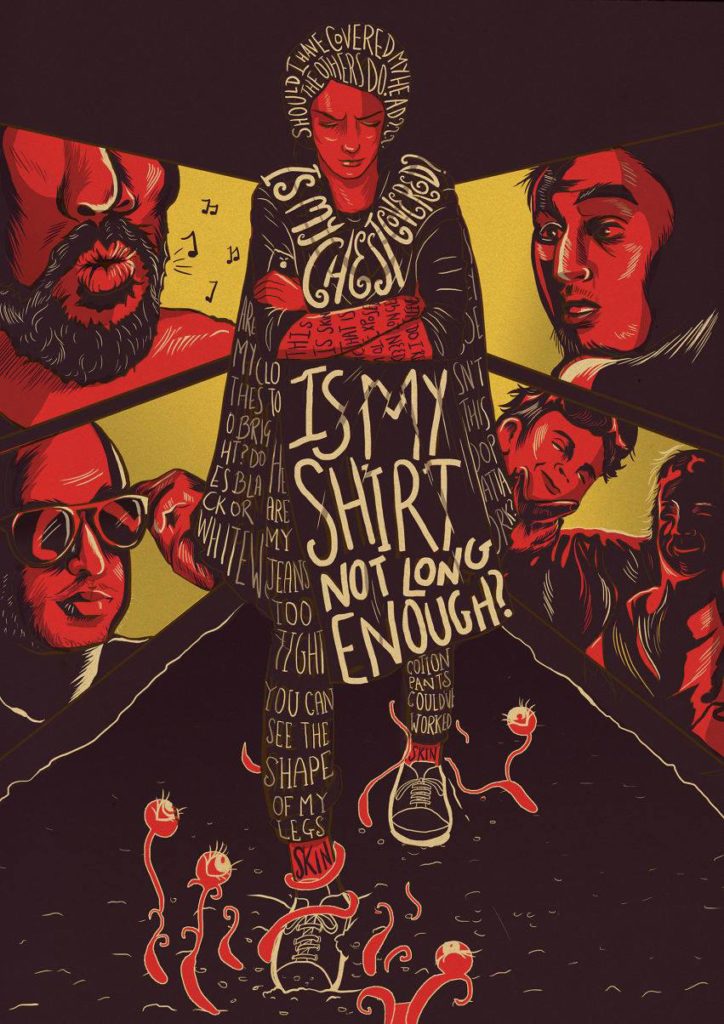
Artwork by Shehzil Malik

Global: Apps that let women say #MeToo about street harassment.

Street harassment in Melbourne, Australia.

Politicians in France continue to consider making street harassment a fine-able offense.

In Paris (France) there is a new policy of “on demand bus stops” to help reduce harassment.

Rema Rajeshwari is a female superintendent of police in India working to stop sexual violence.

In Indonesia, a woman’s video of a man assaulting her on the street went viral and became the country’s most high-profile “Me Too” movement.

A woman in New Zealand fought a man who groped her at a concert.

In Pakistan, several young girls were abducted, raped and murdered by men, sparking national protests.

Pakistani artist Shehzil Malik creates graphics on feminist topics, including street harassment.

Scotland is considering making misogyny (including street harassment) a hate crime.

Promundo released research about sexual abuse by men in Mexico, UK and USA.

A woman in the UK helped another woman who was facing harassment.

The Women and Equalities Committee’s in the UK is conducting an inquiry on the sexual harassment of women and girls in public places as part of a plan to potentially pass a national law.

The number of sexual assaults committed by taxi or private hire drivers is on the rise in the UK.

Recy Taylor, a U.S. Civil Rights hero who fought for justice after white men harassed and raped her in 1944, died.


Share

Filed Under: News stories, street harassment, weekly round up

« Previous Page
Next Page »

Share Your Story

Share your street harassment story for the blog. Donate Now

From the Blog

  • #MeToo 2024 Study Released Today
  • Join International Anti-Street Harassment Week 2022
  • Giving Tuesday – Fund the Hotline
  • Thank You – International Anti-Street Harassment Week 2021
  • Share Your Story – Safecity and Catcalls Collaboration

Buy the Book

  • Contact
  • Events
  • Join Us
  • Donate
  • Facebook
  • Instagram
  • Pinterest
  • Tumblr
  • Twitter
  • YouTube

Copyright © 2026 Stop Street Harassment · Website Design by Sarah Marie Lacy