• About Us
    • What Is Street Harassment?
    • Why Stopping Street Harassment Matters
    • Meet the Team
      • Board of Directors
      • Past Board Members
    • In The Media
  • Our Work
    • National Street Harassment Hotline
    • International Anti-Street Harassment Week
    • Blog Correspondents
      • Past SSH Correspondents
    • Safe Public Spaces Mentoring Program
    • Publications
    • National Studies
    • Campaigns against Companies
    • Washington, D.C. Activism
  • Our Books
  • Donate
  • Store

Stop Street Harassment

Making Public Spaces Safe and Welcoming

  • Facebook
  • Instagram
  • Pinterest
  • Tumblr
  • Twitter
  • YouTube
  • Home
  • Blog
    • Harassment Stories
    • Blog Correspondents
    • Street Respect Stories
  • Help & Advice
    • National Street Harassment Hotline
    • Dealing With Harassers
      • Assertive Responses
      • Reporting Harassers
      • Bystander Responses
      • Creative Responses
    • What to Do Before or After Harassment
    • Street Harassment and the Law
  • Resources
    • Definitions
    • Statistics
    • Articles & Books
    • Anti-Harassment Groups & Campaigns
    • Male Allies
      • Educating Boys & Men
      • How to Talk to Women
      • Bystander Tips
    • Video Clips
    • Images & Flyers
  • Take Community Action
  • Contact

“Not sure I’m in the right bathroom? I’m not sure you are either, but I’m not going to ask you about it.”

March 24, 2012 By HKearl

For International Anti-Street Harassment Week, a few student groups at George Washington University in Washington, DC, worked with the DC Trans Coalition to create fliers to post in public restrooms about the harassment most transgender individuals face there.

The campus would not let them. Via the DCist:

“The GW Graduate Feminists has been attempting to post signs in bathrooms around campus warning against the harassment transgender people often report experiencing when using gender-specific restrooms. But to the group’s consternation, campus officials have said fliers are not permitted to be mounted in the bathrooms inside the Marvin Center, GWU’s student center at 21st and I streets NW.

Elizabeth Owens, a member of the Graduate Feminists, told DCist that given the subject matter, it would have made sense for administrators to bend the rules and allow signs warning against violence in restrooms to be mounted inside restrooms. Instead, according to an email from a university employee that was forwarded to DCist, fliers are only allowed near the Marvin Center’s elevator banks.

But given recent violent crimes around D.C. in which transgender people have been assaulted and killed, Owens feels that there ought not to be such a limitation on where precaution can be advised.

“In the context of the violence that is going on in the D.C. area and a perception that trans issues are not being highlighted—even within the LGBT community—we saw a need to bring offer some resources,” she said in a phone interview.

Owens’ fliers implore bathroom visitors to give transgender people as much privacy as they would expect from themselves. “Let transgender folk pee in the restrooms we feel safest in,” some of the notices read. The fliers also cite a 2009 survey taken by the D.C. Trans Coalition reporting that 70 percent of transgender people interviewed reported being either harassed or assaulted while using a gender-specific bathroom. These trends, the Trans Coalition’s report said, can lead to a withdrawal from public life, deeply affecting a person’s education, employment and health.”

The GWU campus paper published an article about the issue too.

I received my master’s degree from GWU and I’m disappointed they wouldn’t let the students post the fliers. While Anti-Street Harassment Week is coming to a close, that doesn’t mean it’s time to stop bringing attention to public harassment/street harassment. Here are four of the fliers they made, feel free to download them and post them wherever you can.

Share

Filed Under: anti-street harassment week

“Be a Hero and Stop Harassment!”

March 24, 2012 By HKearl

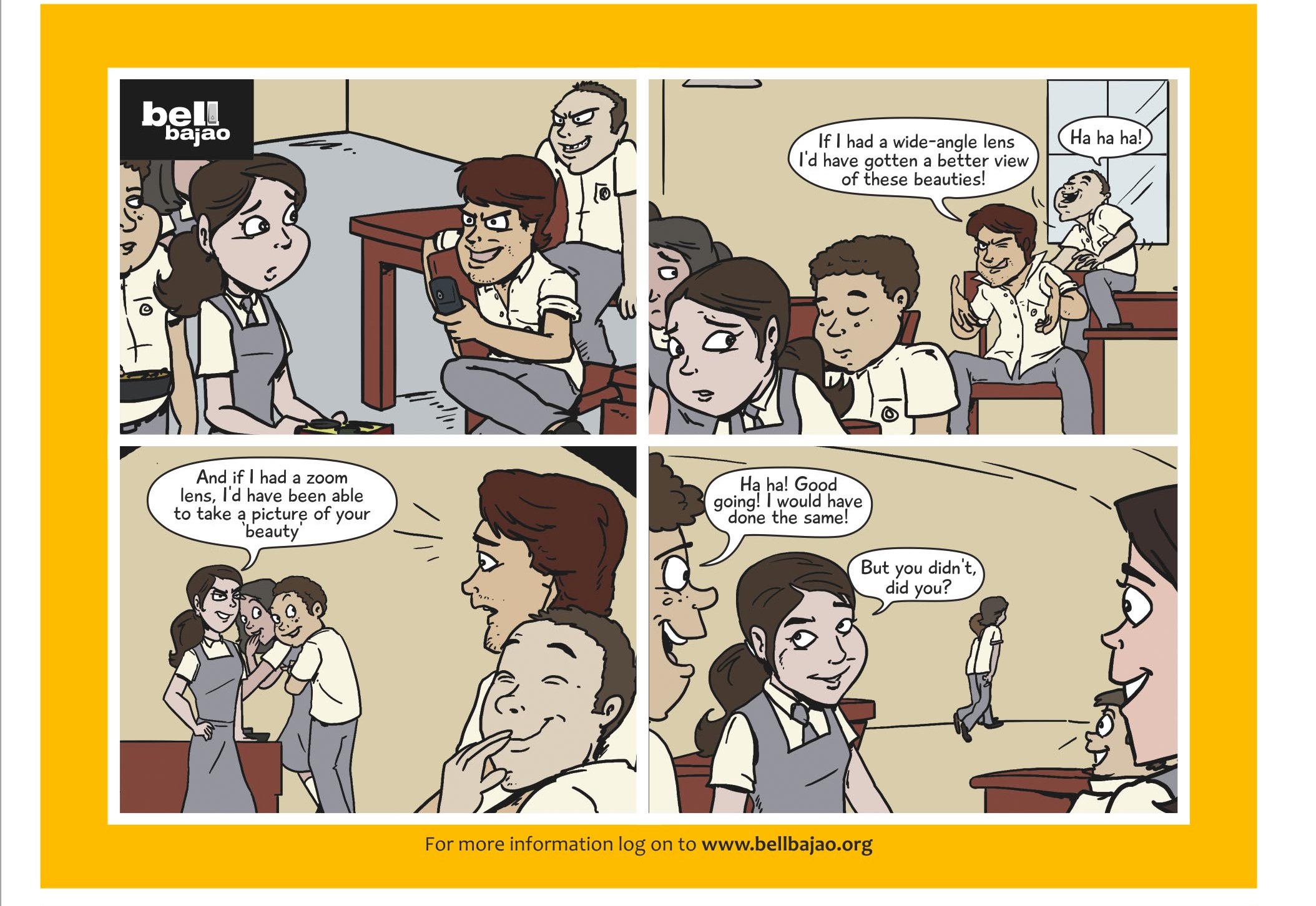
Breakthrough is a Delhi, India-based amazing, award-winning “global human rights organization that uses the power of media, pop culture, and community mobilization to inspire people to take bold action for dignity, equality, and justice.”

I first learned about them because of their innovative bystander campaign around domestic violence called “Bell Bajao” or “Ring the Bell.” It encourages people to ring a neighbor’s doorbell if they hear domestic violence occurring because that can interrupt the situation, and then to call the police if it continues.

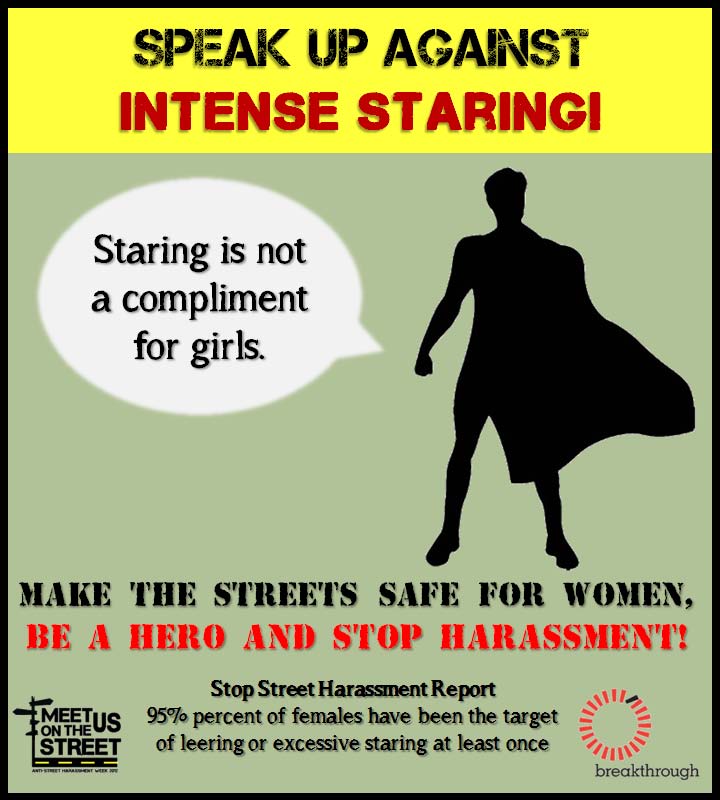
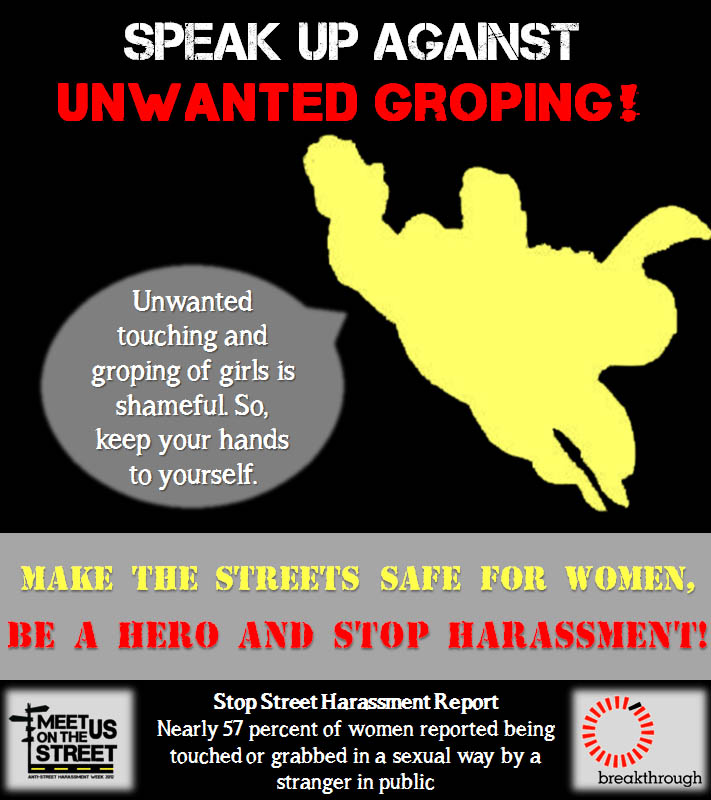
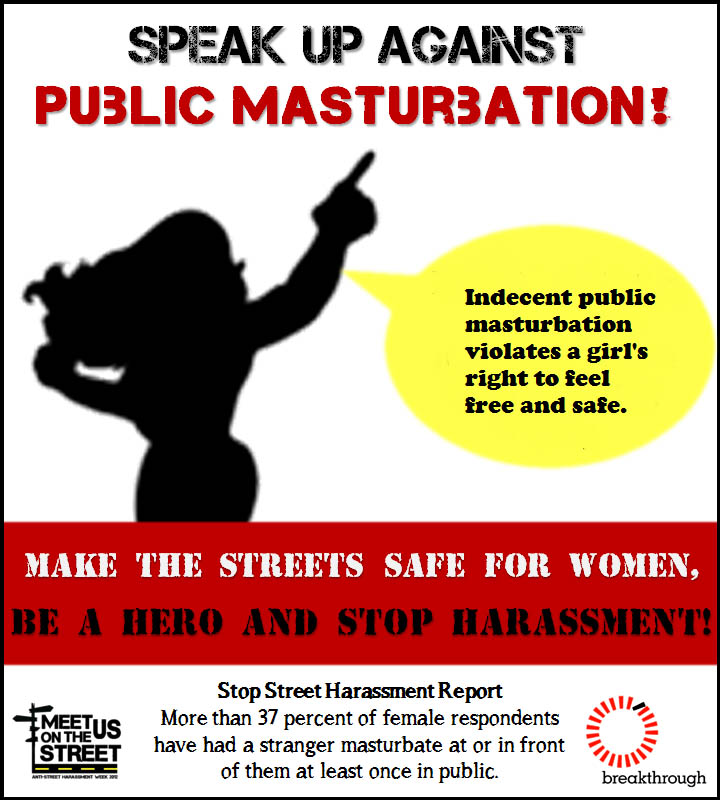
I connected with a few staff at Breakthrough a few months ago (including Veronica Weis, the author of yesterday’s blog post about street harassment in Delhi, India) and invited them to participate in International Anti-Street Harassment Week. I was thrilled when they accepted the invitation and created this amazing bystander poster campaign for street harassment. Please the posters share widely!


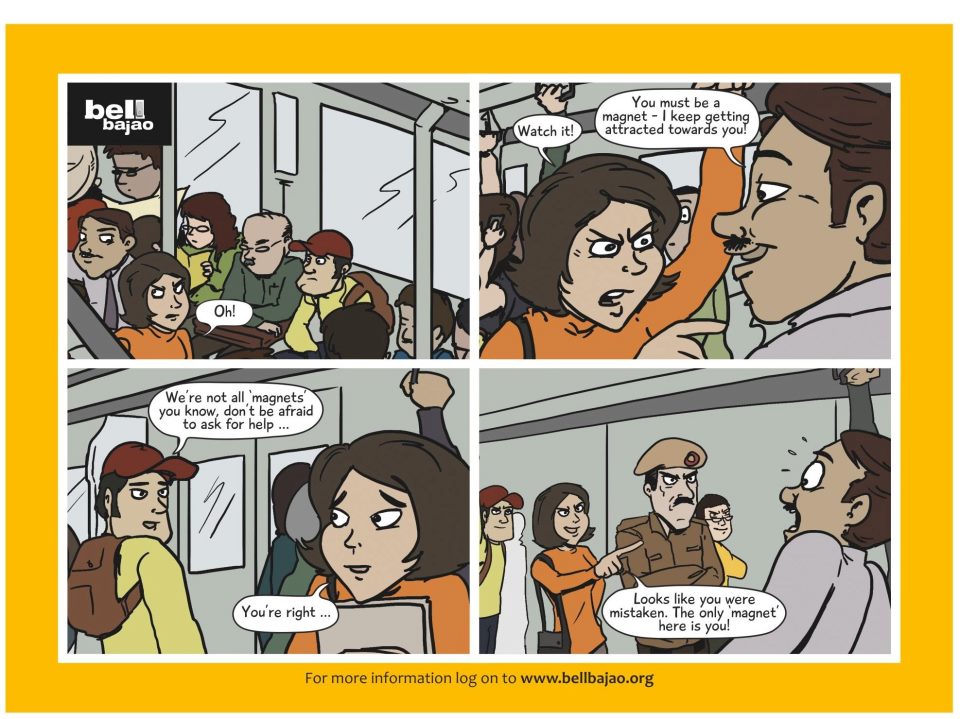
They also created two comics about bystander interventions.

Share

Filed Under: anti-street harassment week, street harassment Tagged With: breakthrough, bystander, India

Final Events of Anti-Street Harassment Week

March 23, 2012 By HKearl

There are several offline events for the final day of International Anti-Street Harassment Week.

* Rallies will take place tomorrow in New York City, Philadelphia, and Delhi, India,

* There will be a chalkwalk in Brussels, Belgium, a Girls Forum in San Luis Obispo, CA, and street theater and a speakout in Washington, DC.

I hope you can attend if you’re in one of those areas, and bring a friend or two!

Online activism will continue tomorrow, too. Here are three examples:

* Every day from March 18th to 24th, Hollaback Ottawa in Canada is posting a photo of your creative Hollabacks! to inspire others to do the same.

* GotStared.At in India is still collecting images of clothes people wore when they were harassed to counter victim-blaming.

* Black Feminist UK will post a final story on their blog.

Share

Filed Under: anti-street harassment week

Day 6 – Anti-Street Harassment Week Blogs

March 23, 2012 By HKearl

As the week comes to a close, there are still many people blogging and writing about street harassment for the week of activism. Since I didn’t have a chance to do a post rounding up the blogs and articles from yesterday, this is a round-up of some of the blogs and articles from March 22 and 23.

Women Lead Nepal:

Sonu in Nepal shares her street harassment stories: “One day I was going home late because there was some urgent work I needed to finish that day. There was no public transportation around there because it was almost 8 pm so I was in hurry and afraid because there was no one besides me in the street. In the opposite side of the footpath, there was one young boy of about 20 years old standing in the street and watching me. Unexpectedly, that boy started masturbating in front of me. Oh my god! I then walked off quickly and didn’t look at him. After that incident, I stopped going that way in the evening.”

Ebony:

“I remember growing up and learning how to “holler” at girls. I’ll be honest, I’ve never found it particularly natural to stand in a group of other guys and whistle, catcall, or bark compliments to women, but somehow it was supposed to be a rite of passage. In my younger days, I thought of street harassment as bad, but shrugged it off a bit because there were a lot of worse things that I could do toward women and since I didn’t catcall, I wasn’t really an offender. However, each day I see greater connections between street harassment and violence against women….You may not be someone who harasses women who pass on the street, which is good. But to be someone who stops your friends and loved ones from harassing would be even better. Joe Samalin of the group Men Can Stop Rape created a hilarious and empowering video entitled, “Sh*t Men Say to Men Who Say Sh*t to Women on the Street” that gives some ways to interrupt harassment. We often tell our kids, “it takes one bad apple to spoil the bunch” but when it comes to ending street harassment and ending violence against women it could take just one good apple standing up. As men, we can start to curb the unsafe environments we create for women by losing our fear, interrupting street harassment, and engaging our brothers in honest discussion.

Georgia Mae:

“I hurried back to my studio apartment, took a shower, and cried. I was not crying because some jerk called me a bitch. That had happened before. I didn’t care that his punk friend thought I was square. I didn’t even cry because the sexual comments made me feel dirty. That wasn’t new either. I cried because I was angry with myself. The eyes of the men flirting with me all went straight to my thighs. If only I’d worn jeans this wouldn’t have happened, I told myself.

There I was blaming myself even though if any of my friends came to me with the same story I would say, “Don’t you dare think that this is your fault.”

But in the midst of my tears I also remembered that I should count my blessings. I remembered that back when I was in high school a girl in my hometown was approached by a group of guys while she was hanging out in a local park. When she blew them off the leader of the crew threw a beer bottle at her head. When she turned around and to yell at him for the assault he shot her. She was only 15.”

WomenSpeak (Trinidad and Tobago):

“It is so clear to me that the high rates of domestic violence and rape in this country have very much to do with the way men see themselves in relation to women. That they have the right to dominate, in any space, even in a public space, any woman whatsoever. And to challenge that entitlement is to invite increased aggression, and violence if necessary, in order to maintain the status quo.

All those people who looked at me as I confronted this man also participated in the perpetuation of this status quo. Perhaps they were as disgusted as I was. Perhaps they too wanted to say something. But, it’s simply not a part of the script. We accept that men will accost, verbally abuse, intimidate, threaten and say whatever they want to women, and women will either keep silent or face the wrath of a man who feels his entitlement is being challenged.”

The Marquette Tribune:

“Since summers in middle school, I’ve been weary of walking past construction sites and male-dominated bus stops. Like virtually all women, I’ve seen and heard it all: whistles, minute-long stares, hip thrusts and, yes, requests to mother strangers’ children, among a list of more unspeakable pleas.

I’ve never taken catcalls as compliments, but I’ve also never felt violated upon hearing them, largely because they don’t threaten me physically. At most, the attention is embarrassing, but my comfort is restored as soon as I’m out of earshot.

Maybe this is why I’ve had trouble explaining to the men in my life, who claim they’d be “flattered” to be met with whistles every day, why street harassment is as terrible as it is: I don’t truly understand.”

Black Feminist UK:

“The walk home from school was short, and the strip of shops with the little green on the way was even shorter. But it petrified me.

There was a bench just on the green, and two or three men (old men) would sit all afternoon, drink cans of beer and shout absurdities at little girls walking by. ‘Hello sweetheart’, ‘you’re beautiful’ etc etc. But it wasn’t their words, it was that feeling of being watched that upset me. The gaze searing into my skin, my back, my legs, my bum, my breasts. It weighed so heavy on me. I changed my route. But they were everywhere. Men everywhere staring at me, saying things, making me feel obliged to hide, or respond faintly, in the hope that it would just go away.

I was only eight or nine years old, and it hasn’t let up since.”

My Street My Body My Right:

“…I was sexually harassed on a regular basis from the year I turned fourteen until the year I left for college. I tried so hard, every day, to ignore it. But I couldn’t. It changed me. The irrepressible nervousness when a stranger approached. Being afraid to look any man on the street in the eyes. Worrying I was being followed. Not wanting to leave my house unless I had to. Crying. Not crying until I got home, then crying. Hating myself for crying. Playing the faces of dozens of men back in my mind—I remember them all. Wondering what would have happened if I had bumped into them in a deserted area. The rape nightmares…

I have never shared my full experience with sexual harassment before. I didn’t tell my parents because I didn’t want to burden them. I didn’t tell my friends because I didn’t think they would understand. And I didn’t tell anyone else because I didn’t think they cared. As a result, I believed that I was alone in how I felt, that I was “overreacting” to normal, socially accepted behavior.

I am sharing my personal experiences now as part of the first-ever International Anti-Street Harassment Week in the hopes that it can inspire people I know, and people of my generation as a whole. As a child, I felt completely helpless about my own situation. I hope that today, I am at least able to encourage others to treat sexual harassment in public as a serious issue, and to take action to protect themselves and those around them….”

Feminist Teacher:

“For me, stopping street harassment is a part of my work in making the lives of my students safer, just, and whole. The numbers alone should make every educator wince and take action….Given all of this sobering data about the harassment that both girls and queer youth face daily, if we want to create safe schools and safe communities for our students, then as educators, it is absolutely our moral imperative to address both the harassment occurring at school and the harassment happening on our streets….I’m honored that I can stand alongside my students and stand up for making their lives that much more safe. Will you join us tomorrow with your students?”

The Independent Collegian:

“Diane Docis, coordinator of the event and of the Sexual Assault Education and Prevention Program, said street harassment is anything which is degrading, including sexual comments, catcalls, leering, whistling at a girl, public masturbation or even assault.

“It’s a form of gender violence and it’s a human rights violation and it needs to stop” Docis said.

Gordon said “Hey Baby, Smile,” was created to raise awareness of street harassment and ways to stop it.

“For men, I hope it makes them realize how bad it is; for girls, to speak out and not normalize harassment,” she said. “The problem is with people who stare [and] girls being unsure of intentions [of the harasser].”

The main goal of the event is two-fold. The first part is to eliminate harassment on campus and in the city. The second part is to educate men and women on ways to recognize and stop harassment as it happens.”

Get Loud with Rae:

“Honestly, I’m not truly aware of a “correct” response to such behavior. Sometimes I lash out, sometimes I cower. Other times I run circles of intellect around their tiny little noggins. Simply, a lot of times, no matter how I react, I am fearful. Because a person who acts that way towards women does not respect women. And who am I to predict whether he will or will not attack me? If I am quiet, do I appear weak? If I respond, did I make him angry? It shouldn’t matter, but no one wants to be raped.

In self-defense class I was taught to look at passer-bys and perpetrators in the eyes, because you can identify them if necessary, and in that regard you intimidate them. Why is this relevant? Well, it’s simple. It’s a slippery slope, harassment. If sexual harassment is okay, rape is okay. Violence against women is okay. And that’s not okay.

Like I said, ladies, it’s not your fault. And to men who have done this, or will do this, remember, it’s inappropriate. It’s simple. No cat-calls. No friends cat-calling. How about this: act respectful and be respected in return?”

Bedsider:

“Ick. Last night, an older man followed me out of a drugstore near my school. For almost a block, he relentlessly questioned me about anything and everything to get a response. “Where are you from? What’s your major? Do you wanna be texting buddies?” I could’ve sworn that my body language and rapid eye rolls would keep him moving…moving away. But my non-answers motivated him even more. The creep wouldn’t stop until he almost collided with another car.

The street jeers—you know, “Aye, girl!” “Excuse me, miss…” and “Lemme talk to you for a minute, sweetheart!”—are something I’ve grown used to. At first, I found them flattering. Then I found them annoying. And now I find them commonplace. A guy once told me that most males do it as a sport—the whistles and gestures are the bait. It’s up to us to decide if we want to bite. I figured that most women are used to brushing off and ignoring the lewd comments on the streets. Holly Kearl isn’t one of them…This week marks the first annual International Anti-Street Harassment Week.”

Masculinity U:

“Imagine that same fear that woman felt. That’s a fear that many women face every single day. Now couple that with a group of men staring, whistling, “complimenting” screaming, or following her. Our intentions aside, we have to be aware that historically, some men have screwed up this system and now we’re all paying. We get a bad name and get judged before people even know us… and women have to live hyper-vigilant and even fearful every day when on the street. I’m certainly not saying that as men we have it “just as bad” as women, I’m just pointing out that we’d all benefit from ending street harassment.”

Bad Angel Rules for Running:

“Dear Catcallers of the World,

Why? Why do you shout these things as I run by? Why do you feel the need to vocalize your perverted inner-monologue? Why won’t you just let me train for my next race in peace?

You might say it’s a compliment or that I should be flattered. I don’t. I feel threatened. I’m proud of the body that running has given me, but when a man eyes me up and down as I jog past and says something like, “Damn, girl, work that ass,” I feel embarrassed, ashamed, uneasy, annoyed, angry. I question my outfit, my route, myself.”

Awesome Women of Twitter (Rachel England):

“How can there exist a culture whereby a group of men can surround a girl and make disgusting, derogatory and threatening comments, and yet she is the one told by the surrounding population to “just leave it” in the knowledge that actually yes, the police probably wouldn’t do anything? Because people are cowardly and do “just leave it”, when actually they should get in the face of the offending scum and stick up for themselves. If I hadn’t adhered to the bleats of my companions – one of which whom actually apologised to this asshole in an attempt to defuse the situation – I would have stood there in the hopes that he actually had tried to “fuck me up”, because then I could have legitimately kicked his head in – or at least tried to, which would have made me feel a Hell of a lot better. Instead, I went home shaken, furious and upset. He went home with an inflated ego and the admiration of his peers.”

Awesome Women of Twitter (Rebecca Taylor):

“…Then one of them said,

“Come back with us. Three of us, three holes.”

It just cut me dead. I was horrified, and ran back to my friends where I promptly burst into tears and sobbed all the way home, all the rest of the night, and eventually cried myself to sleep. I wouldn’t tell my friends what was said because I just couldn’t get the words out. It still makes me feel tearful now. To the credit of the guy’s friends, they were horrified too and told him angrily that he couldn’t say things like that, but I still haven’t got over it.

I still feel that I was completely violated. In a way it feels like I’m overreacting because it was just words, no one touched me, and maybe I feel somehow responsible, chatting away to strange men with my boyfriend trailing behind. But it’s difficult to see those words in print, and there’s still no way I could repeat it out loud. I’m a 27 year old woman who still feels weak thinking about what one drunk man said to me years ago – how dare he make me feel like that. I’d love to see him again and tell him what he did to me – I bet he doesn’t even remember saying it.

I hope that no-one else has had a similar experience to this, but I know that won’t be the case. So I’m standing up to it, telling people what happened, telling you what happened, in the hope that I can put it behind me and finally see that guy for the pathetic excuse for a man that he really is. But that’s not to say that it’s been easy to move on from. Street harassment is serious, it’s not just ‘banter’, it is a big deal. Let’s speak up.”

A few journalists conducted interviews with me about the week too:

* Washington Post |  * Howard University (DC) | * Reston Patch (VA)

Some quick posts about the week:

* Racialicious | * Feministing | * Men’s Anti-Violence Council | AAUW California Online Branch | UC Speac


Share

Filed Under: anti-street harassment week

Day 5 – Anti-Street Harassment Week

March 22, 2012 By HKearl

It’s very exciting to see the momentum continues to build on Day 5. Here is a sampling of events occurring today and some that happened yesterday!

Some of the events occurring today:

* In Montréal, Canada, Hollaback Montréal will host a screening of “War Zone” and “Walking Home” at 7 p.m. INFO.

* A screening of War Zone will take place at Santa Monica College, CA, at 5:30 p.m. INFO.

* A forum about harassment on the transit system at 5:30 p.m. in Washington, DC. INFO.

* Stop street harassment discussion at 3:30 p.m. at Western Illinois University, IL. INFO.

* A campus discussion on street harassment at 6:30 p.m. at the University of Toledo, OH. INFO. PDF Flier.

Miss Representation screening in Istanbul

Some of the events that occurred yesterday:

* In Istanbul, Turkey, Hollaback Istanbul held a screening of Miss Representation and then a discussion about its connection to street harassment.

* From Nuala Cabral: “[It was a] great turnout at tonight’s event [in Philadelphia, PA]! We watched films, shared spoken word and testimonies. We discussed street harassment, gender policing, sexual identity, racial profiling, anger/love and community. It was a beautiful night.”

A Long Walk Home's Girl/Friends

* From A Long Walk Home: “Girl/Friends teen girls [in Chicago, IL] created a youth led march in the area that they often experience street harassment, their school community. Girl/Friends made t-shirts and signs for the march. During the march the youth gave out anti-street harassment materials and created awareness on the streets about street harassment.


* From Sarah Harper: “The Meet Us on the Street San Francisco, CA, event was a success! Our crew of activists, students, and

San Francisco, CA

community members spoke with a variety of passersby at the 16th St. BART station on the issue of harassment. We engaged many in dialogue about the effects of harassment as a reality in many women’s daily lives.  We also provided fliers for passersby (in English and Spanish) so that they may share the information with others.  The fliers included quick “how to’s” for dealing with harassment in-the-moment:  effective body posturing and phrases victims and witnesses may use to remain empowered while keeping themselves safe. The fliers also detailed what constitutes harassment, so that potential harassers may begin to identify and change their harassing behavior.”


MICA students with their artwork

* At the Maryland Institute College of Art (MD) last night, Hollaback Baltimore worked with students to brainstorm about how to end street harassment, and they designed images and slogans to fight back against it.

* George Washington University students and faculty in Washington, DC, talked about their research on the street harassment of LGBQT individuals both on- and off-line. (You can watch videos of their presentations via a post tomorrow.)

GWU discussion about the street harassment of LGBQT individuals

Another piece of news for today is that Hollaback launched their new “We’ve Got Your Back Campaign.”

“We’re partnering up with the bystander program Green Dot to help you intervene when you see street harassment happen – and to celebrate and document your success using our website and apps.  Starting March 22nd, you’ll be able to map your bystander intervention stories in green dots on our site.  Your story will inspire others to provide real-time solutions to street harassment.   You’ll also find our new “I’ve Got Your Back” button under each story. You can anonymously click the button and the person who shared their story will receive an email saying the number of people who have their back! With each click, you will give others in the Hollaback! community the support they need to keep holla’ing back.”

Engaging bystanders and having them speak out is crucial and can help take the onus off harassed persons to always be the ones to end a situation or get away safely. Try it out!

Share

Filed Under: anti-street harassment week, Stories, street harassment

« Previous Page
Next Page »

Share Your Story

Share your street harassment story for the blog. Donate Now

From the Blog

  • #MeToo 2024 Study Released Today
  • Join International Anti-Street Harassment Week 2022
  • Giving Tuesday – Fund the Hotline
  • Thank You – International Anti-Street Harassment Week 2021
  • Share Your Story – Safecity and Catcalls Collaboration

Buy the Book

  • Contact
  • Events
  • Join Us
  • Donate
  • Facebook
  • Instagram
  • Pinterest
  • Tumblr
  • Twitter
  • YouTube

Copyright © 2026 Stop Street Harassment · Website Design by Sarah Marie Lacy