• About Us
    • What Is Street Harassment?
    • Why Stopping Street Harassment Matters
    • Meet the Team
      • Board of Directors
      • Past Board Members
    • In The Media
  • Our Work
    • National Street Harassment Hotline
    • International Anti-Street Harassment Week
    • Blog Correspondents
      • Past SSH Correspondents
    • Safe Public Spaces Mentoring Program
    • Publications
    • National Studies
    • Campaigns against Companies
    • Washington, D.C. Activism
  • Our Books
  • Donate
  • Store

Stop Street Harassment

Making Public Spaces Safe and Welcoming

  • Facebook
  • Instagram
  • Pinterest
  • Tumblr
  • Twitter
  • YouTube
  • Home
  • Blog
    • Harassment Stories
    • Blog Correspondents
    • Street Respect Stories
  • Help & Advice
    • National Street Harassment Hotline
    • Dealing With Harassers
      • Assertive Responses
      • Reporting Harassers
      • Bystander Responses
      • Creative Responses
    • What to Do Before or After Harassment
    • Street Harassment and the Law
  • Resources
    • Definitions
    • Statistics
    • Articles & Books
    • Anti-Harassment Groups & Campaigns
    • Male Allies
      • Educating Boys & Men
      • How to Talk to Women
      • Bystander Tips
    • Video Clips
    • Images & Flyers
  • Take Community Action
  • Contact

College men share tips for stopping street harassers

February 13, 2012 By HKearl

I love the work that Men Can Stop Rape (MCSR) does to challenge harmful definitions of masculinity and to empower men to be allies with women in ending gender violence. Their latest project is a new campus bystander campaign called Where Do You Stand? aimed at men.

This comprehensive campaign uses billboards, posters, T-shirts, bystander intervention trainings, and peer-education sessions to equip young men with the necessary skills and tools to intervene when they see a situation that doesn’t look right, including street harassment.

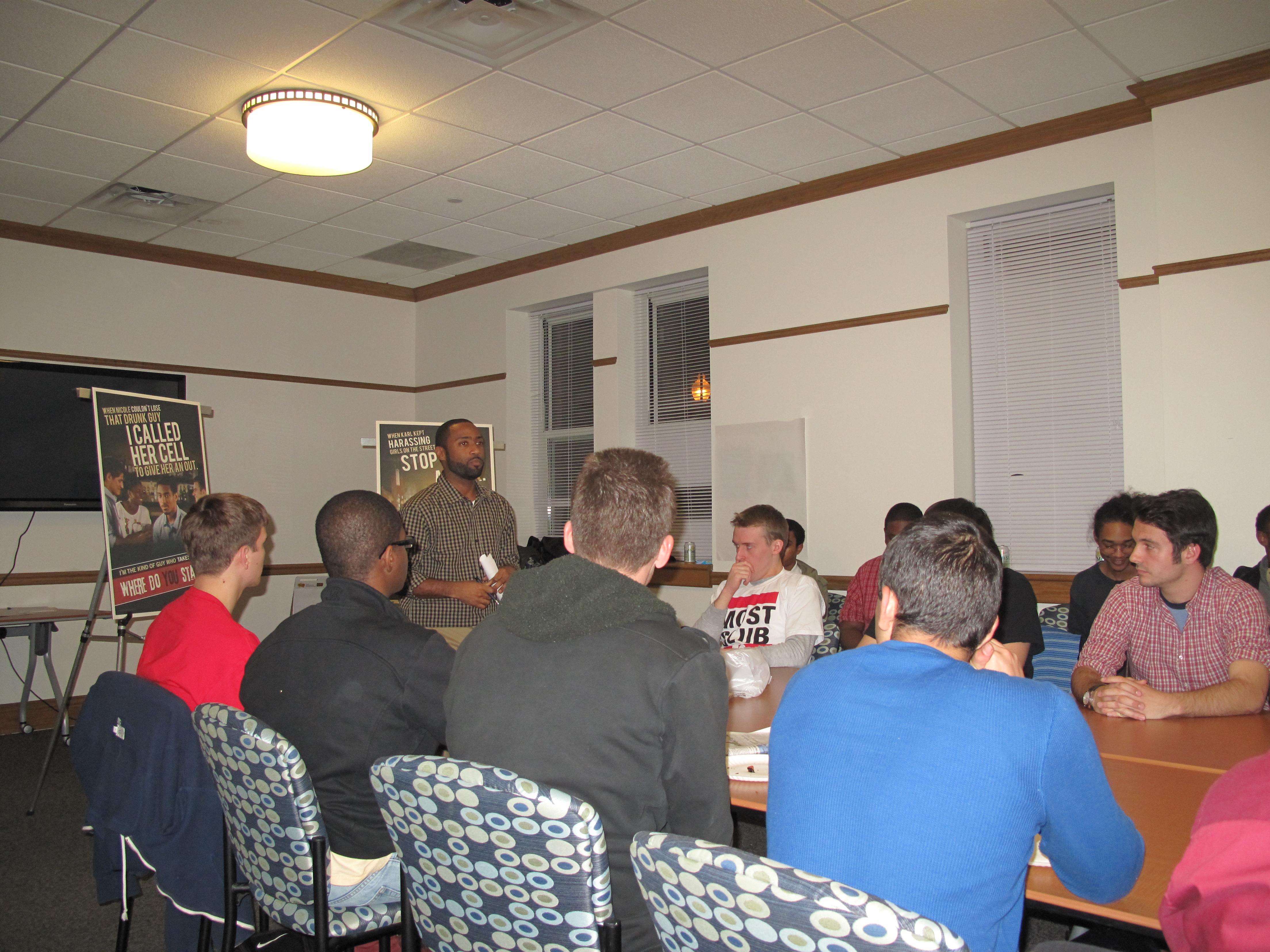
On January 31, they officially launched the campaign during an MCSR bystander training for about 30 young men at Georgetown University in Washington, DC. I attended and spoke at the beginning for a few minutes.

The main portion of the workshop was role playing and brainstorming responses to scenarios.
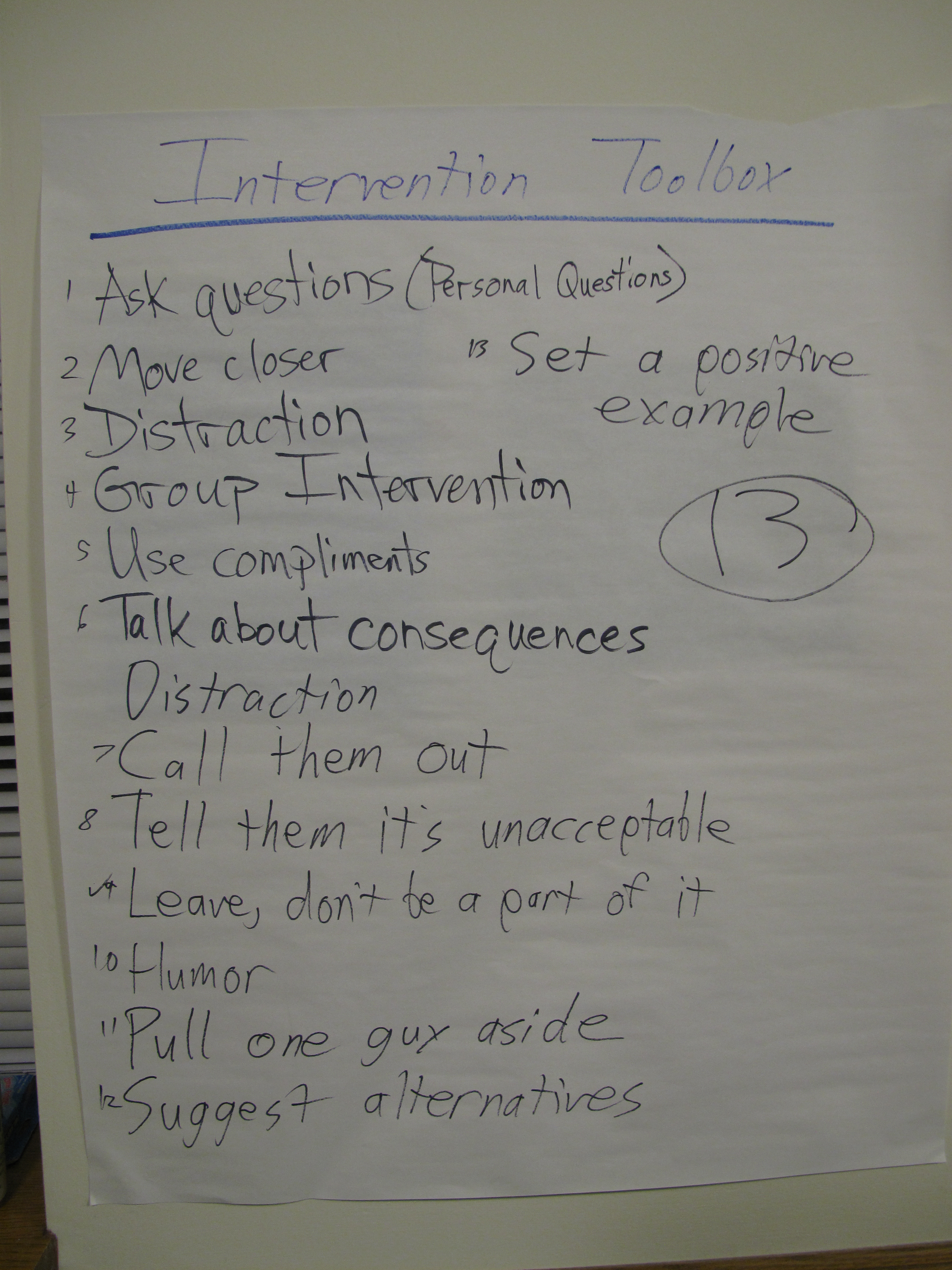
They also talked about barriers that prevent bystanders from intervening and brainstormed a list of methods for intervening, such as providing a distraction or addressing the harasser head on (see a photo of the list they created).

The first few scenarios they discussed focused on intervening in questionable situations at college parties. The last example on street harassment kept me furiously scribbling notes.

One of the facilitators described a group of men standing on a corner near a building, street harassing women going by. He asked the young men how many of them had seen that happen before and more than half of them raised their hand. Then he asked the for their ideas for dealing with this scenario. Here are some of them:

1. Say, “Yo, chill son,” to slightly call them out on the behavior.

2. Directly point out what they’re doing and say, “This is unacceptable.”

3. Use public ridicule to call them out or silence them…though a few young men pointed out that is okay if you know the harassers, but if you don’t and you call them out like that, you may “get whooped.”

4. If it’s your group of friends, tell them, “That’s not cool,” and if they keep it up, say you’re out and walk away. Chances are they’ll back down then. Another guy similarly suggested saying, “If this is how you’re going to spend your night, I’m leaving. This is not okay.”

5. Reverse catcalling the men can be effective. They don’t know how to respond or what to do.

6. If it’s a friend doing it, tell him that it’s not the right approach to take but to be the respectful gentlemen he is if he wants to meet someone.
Some other interesting things the young men said:

* Guys who catcall wouldn’t be my friends because that’s the rudest thing they can do and I’m not okay with that.

* Men catcall because there are other men around. It’s a way to demonstrate their masculinity while riding with your crew or walking down the street. So figure out why your friends feel they have to prove their masculinity to you and address that.

* If you establish yourself as a person who doesn’t laugh at catcalls, then it won’t happen around you because they won’t use that as a way to try to impress you.

* Intervening is hard, but once you do it, it will pay off. People will know you’re the guy who doesn’t like that behavior and others will call them out on it if they do it around you. Maybe they will still catcall when you aren’t around, but it’s a start. The benefits of intervening far outweigh the consequences.

I left the workshop pumped. I know there are plenty of men out there who want to help stop gender violence and harassment, but I’d never been in a room full of them before. It gives me hope! I hope you will share their bystander tips (and others from the Stop Street Harassment website) with friends and family. And if you’re on a college campus, consider bringing the Where Do You Stand? campaign to your school!

Share

Filed Under: male perspective, street harassment Tagged With: bystander, georgetown university, intervention, men can stop rape, men of strength club, sexual harassment, street harassment, where do you stand

Snapshot of street harassment stories, news, announcements & tweets: February 12, 2012

February 12, 2012 By HKearl

Read stories, news articles, blog posts, and tweets about street harassment from the past week.

** Sign up to receive a monthly e-newsletter from Stop Street Harassment ***

Street Harassment Stories:

Share your story! You can read street harassment stories on the Web at:

Stop Street Harassment Blog

HarassMap Egypt

Resist Harassment Lebanon

Many of the Hollaback sites

In the News, on the Blogs:

Image via The Guardian

* Common Ground, “On the revolution’s anniversary, men stand up for women’s rights in Egypt“

* Lauren Bravo is My Real Name, “In which I launch Operation Creep-be-Gone“

* Human Rights First, “Egyptian Women Face Setback at “Virginity Tests” Trial“

* Al Jazeera, “Egypt’s feminists prepare for a long battle“

* Thought Catalog, “Dear Gross Dude In The Club, Please Stop Touching Me“

* IBN Live, “Father dies after being thrashed by eve-teasers“

* The Guardian, “Uni Lad website closure highlights the trouble with male banter“

* PC Advisor, “Video: Commuter crush? Snap photo, post to new network of sites“

Activism Announcements:

New:

* Read an interview with Ghaidaa al-Absi, an anti-street harassment activist from Yemen who founded the Safe Streets Campaign.

* Read an interview with photographer Hannah Price, whose images of street harassers were displayed at the Philadelphia Museum of Art last fall.

* SSH blogged about an offensive Fiat ad that aired during the Super Bowl last weekend which made light of street harassment and objectified women. The post brought a record number of viewers to the SSH website.

* SSH founder Holly Kearl is quoted in the March 2012 issue of Cosmo magazine with advice on dealing with gropers. Read an extended version of her advice on the blog.

Reminders:

* If you live in the Washington, DC-area, you can testify about harassment on the Metro system at a hearing on Feb. 22. Details.

* What were you wearing when you got stared at or street harassed? Submit your photo

* Start planning for International Anti-Street Harassment Week, March 18-24

* Sign the Petition: “Demand Justice for Two Men Killed Trying to Stop Street Harassment“

* Read a Baltimore, Maryland, college student’s thesis on street harassment

* The Adventures of Salwa campaign has a hotline for sexual harassment cases in Lebanon: 76-676862.

* In Bangalore, India, there is a helpline for street harassment 080 – 22943225 / 22864023

10 Tweets from the Week:

1. EmptyNestExpat stunned today to learn a good friend is leaving #Istanbul because she doesn’t feel safe on the street due to street harassment.

2. sarahhuny I’m really tired of some men thinking that a woman should automatically be grateful and flattered by his attention #streetharassment

3. DaliaHosny Please report any sexual harassment incidents to 6069, if you got harassed during marches today . @harassmap #endSH #Feb11 #harassmap

4. iHollaback The Dept of State wants to come and visit us and learn more about #streetharassment! Very cool.

5. DesignerTi Catcall of the day: (me: walking and looking at my phone) Fool: u trying up call me? Me: who are u?

6. MareeGPhotos When your gonna catcall to a point where it pisses me off yes, I will make you look stupid.

7. hollabackWY Did you know Wales now has its first hollaback site to fight street harassment? Check them out here @GwynHollaback

8. MadamJMo Reading ‘Ann Veronica’ by HG Wells, written 1909. She has moved to London and experienced #streetharassment but won’t be frightened. Yep.

9.  MaiiNewaishy What’s amazing to me is the shock on a harasser’s face when the woman stands up for herself, yes we’re not silent anymore #endSH

10. ilibico #Tripoli #Libya the stop street harassment campaign “don’t tell me what to wear, tell them not to harass me” pic.twitter.com/uwxTHbGu

Share

Filed Under: Activist Interviews, hollaback, News stories, Stories, street harassment

Vigil for Deoni Jones

February 8, 2012 By HKearl

Deoni Jones - via DCist.com

Last Thursday at 8:13 p.m., 22-year-old Deoni Jones, was stabbed in the cheek at a Metrobus stop at East Capitol Street and Sycamore Road NE in Washington, D.C. She died from the wound.

Deplorable. What senseless violence and end to such a young person’s life.

From video footage in the area, police described the suspect as “a black male between 30 and 40 years old wearing blue jeans, a gray hooded sweatshirt and black jacket. Anyone with information on the person of interest is advised to contact detectives investigating Jones’ death via the MPD tip line at (202) 727-9099 or texting to 50411.”

Via the DCist.com:

“Jones’ death brings up memories of a wave of attacks last year against members of D.C.’s transgender community. Perhaps most jarring was the killing last September of

Vigil on Feb. 7, 2012

Gaurav Gopalan, an aerospace engineer and theater director. One activist told DCist last week that 61 percent of transgender people experience some kind of violence against them, and in the case of transgender people of color, like Jones, the rate is even higher.”

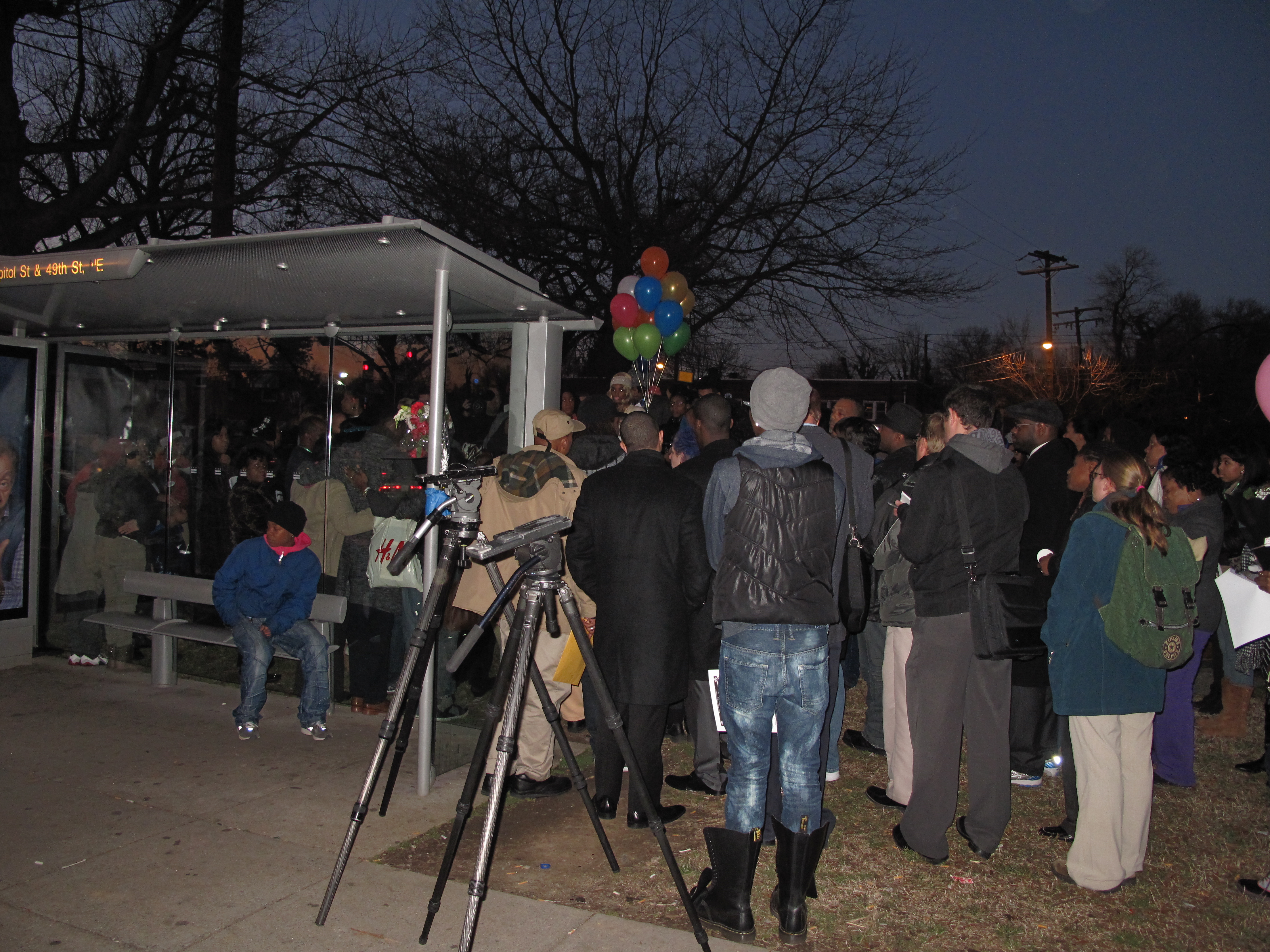
Last night I joined two of my fellow Collective Action for Safe Spaces board members and about one hundred community members, family members and friends of Deoni at the bus stop for a vigil. We held lit candles and listened to prayers, memories shared of Deoni’s life, and condemnations of the senseless killing from trans-rights organizations and representatives from the mayor’s office and the police department.

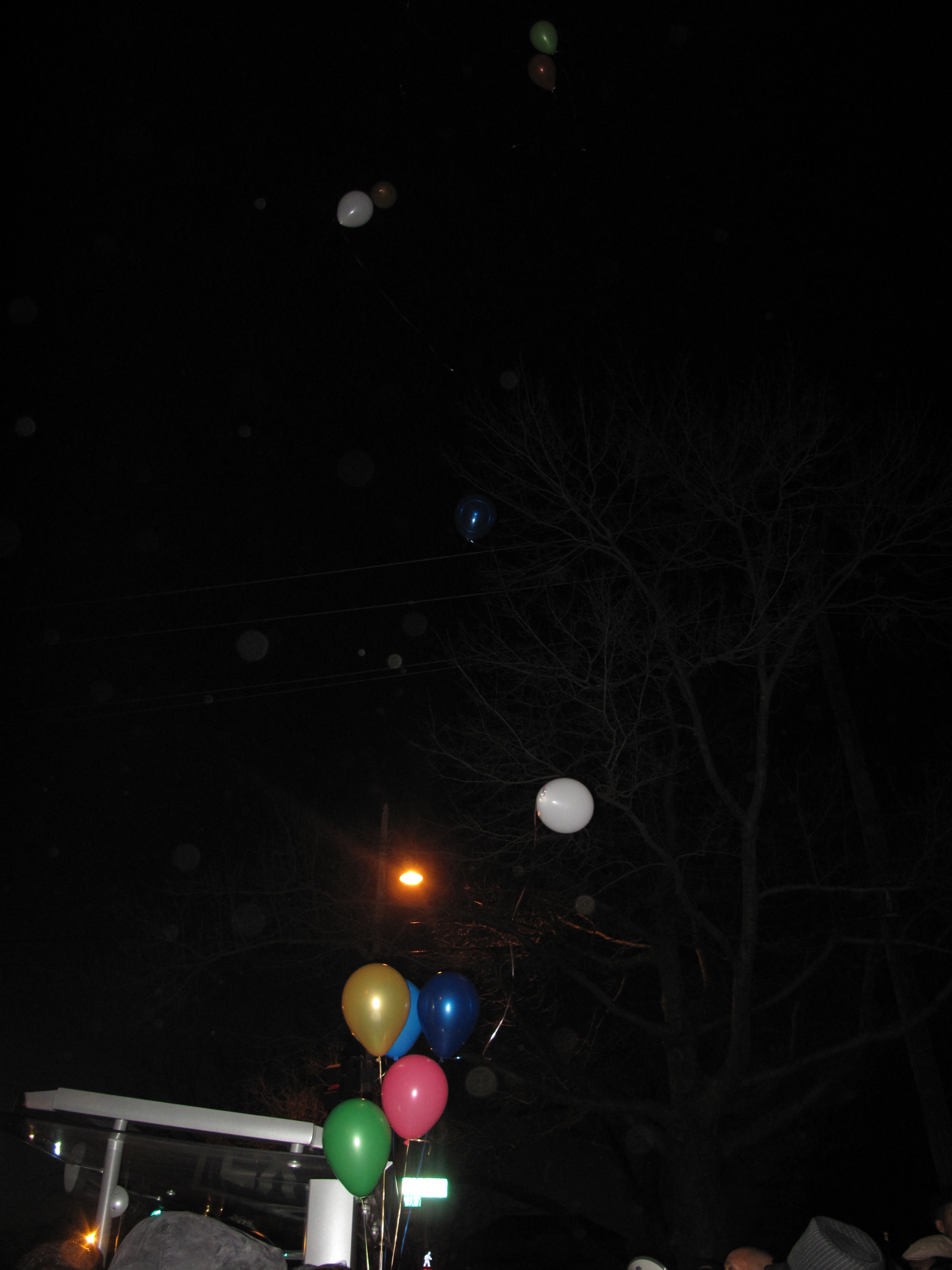
Releasing balloons that represent the lives of murdered transgender individuals like Deoni Jones

Near the end of the vigil, someone let loose a bunch of colorful balloons. Each balloon represented the life of a transgender person who was murdered in DC over the last few years. People shouted out the names of their loved ones, including Deoni’s. It was a touching tribute and also sobering to see the visual showing just how many hateful murders have taken place.

The streets should be safe for everyone.

Via the DC Trans Coalition site:

“If you have been a victim of violence, or if you know someone who has, you can reach out to us at 202.681.3282 or email dctc@dctranscoalition.org. You can also call Transgender Health Empowerment at 202.636.1646 or HIPS via their 24-hour hotline at 1.800.676.HIPS. If you need police assistance, dial 911 or call the Gay and Lesbian Liaison Unit at 202.506.0714.”


Share

Filed Under: street harassment Tagged With: DC Trans Coalition, Deoni Jones, murder

Groping: The Sex Crime No One Talks About

February 8, 2012 By HKearl

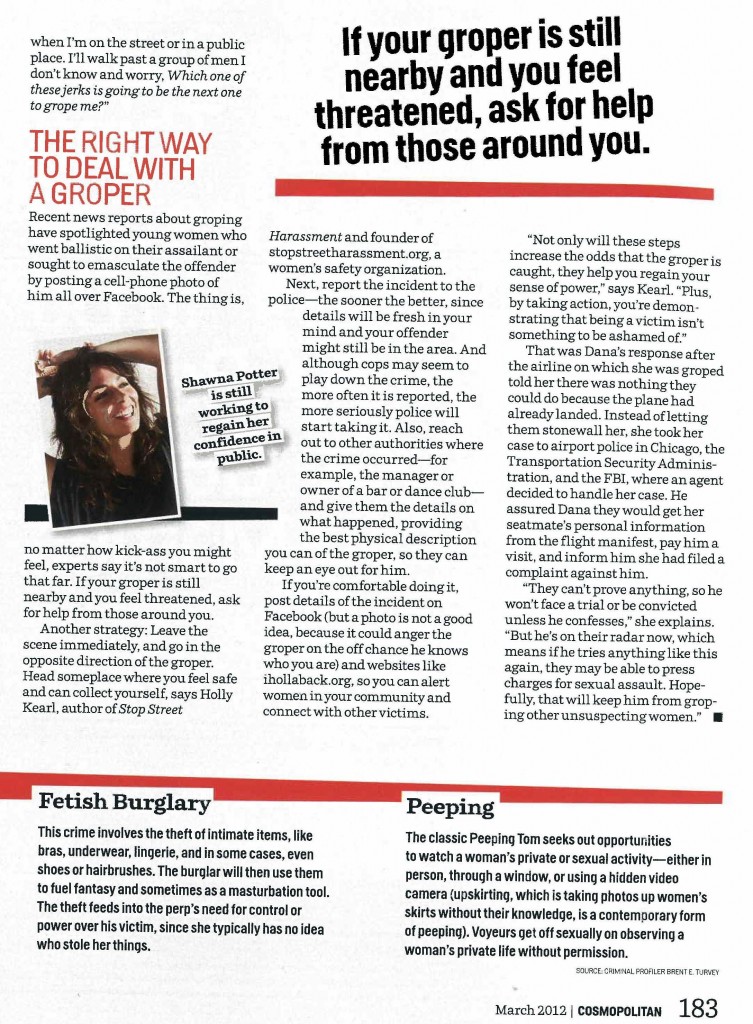
If you pick up the March 2012 issue of Cosmopolitan magazine, which just hit newsstands today, and turn to page 180, you can find a four-page article about the problem of men groping women in public places. (And I know some men have been groped too, but the article focused on men groping women.)

I’m glad to see Cosmo take on this under-reported and under-acknowledged, but widespread problem. When I conducted a survey of 816 women for my book Stop Street Harassment, over half of the women, including me, had been groped by a stranger on the street at least once. Cosmo said that 77 percent of respondents in a survey they did reported being the target of this behavior.

I did an interview for the article author, Stephanie Booth, and shared my advice for how to respond if that happens to you. Given the article length and how long my responses were, only some of my advice made the cut. I’m including my longer responses below in case they’re useful to readers. Feel free to share your own advice in the comments.

1. Stephanie Booth (SB): What is the best way for a woman to respond to a groping incident?

Holly Kearl (HK): Every situation is different so there is no one perfect response that will work in all scenarios. A primary piece of advice is to assess the situation quickly and decide how safe you are before choosing a response. If you feel safe (e.g. there are people around, it’s daylight, you’re in a familiar area, and you’re with friends or family), telling the harasser to stop or to back off, shouting out to bystanders about what just happened, demanding some kind of apology or accountability from the harasser are all good options. If you are quick on your feet, using humor can also be effective. This is one of my favorite stories, included in my book, about how a woman handled her harasser after the slapped her backside:

Living in France, I often felt harassed and didn’t know how to deal with the harasser/language and culture barrier. One night while walking home, a group of young men who often whistled at me or called at me began their usual routine. I usually ignored them, but this time the ringleader slapped my butt as I walked by. I turned around and in French said to him, “Congratulations. Is that the first time you’ve touched a woman?” I turned around and walked away while his friends laughed at him. I felt that I had really turned their game against them, and they never bothered me again.

If you feel unsafe, leave the situation as quickly as possible and get someplace where you do feel safe.

Regardless of how you respond in the moment, if someone has groped, grabbed, or slapped you, that is assault and it can be reported to the police, and/to transportation authorities, and/or to business owners/managers (depending on where the harassment happened and what outcome you hope to see). A lot of harassers are repeat harassers so reporting them to ensure they face some kind of penalty for their behavior can hopefully help deter them from harassing someone else.

2. SB: Of course, police should take such a complaint seriously, but is it there a chance it will get blown off? Are there certain “buzz words” a woman should use when she calls police to get them to pay attention?

HK: Yes, based on feedback from women who have reported harassers, there is a chance that police will not take the report seriously. But many police officers do, so it’s worth trying (if people have the time/energy to do so).

I haven’t heard of any buzz words women should use, but looking up their city’s laws and then citing the specific law that was violated may help. For example, in Washington, DC, “misdemeanor sexual abuse” is defined as engaging “in a sexual act or sexual contact with another person . . .  without that other person’s permission,” where “sexual contact” is “the touching with any clothed or unclothed body part or any object, either directly or through the clothing, of the genitalia, anus, groin, breast, inner thigh, or buttocks of any person.”

So a person who is groped in Washington, DC, can call the police to report a case of “misdemeanor sexual abuse.” There’s no guarantee that describing it in those terms will make the police pay more attention than if the person called it “groping,” but it’s worth a try.

3. SB: Is it ever smart to verbally confront a man who is groping you? (Like a woman recently did in the NY subway?) What do you say?

HK: Yes, if you feel safe, it can be very impactful to verbally confront a groper or any type of harasser. People grope and harass because they think they can get away with it and if you’re silent after being groped or harassed (which is sometimes necessary for safety reasons) that often lets them continue to get away with it. Calling them out lets them know you won’t stand by and let them abuse you and calling them out can inspire others around you to help stop the harasser or groper and to stand up to their own harassers or gropers.

If gropers/harassers can no longer grope and harass and then carry on their merry way because suddenly they are being confronted by their target, they will hopefully be less inclined to harass or grope again.

Additionally, as the former Executive Director of the Washington, D.C. Rape Crisis Center, Martha Langelan, teaches in her sexual harassment seminars, there are a few men out there who use street harassment, including groping, as a rape test. They may attempt rape depending on how a woman responds to street harassment. If she is assertive and forceful, they will leave her alone, but if she cowers, freezes, or humors them, they may escalate the harassment to rape.

4.  SB: Should you ever snap his photo with your cell phone and post to a hollaback website?

HK: Yes, you can snap a photo, but if you do, it’s usually more productive to submit it with a police report than to post it on a website. Since harassers are strangers, snapping a photo can help police identify the harasser. Very few police check the Hollaback sites (although last year Holla Back DC! did have a case where a photo of an upskirter posted on their site led to his arrest because a police officer visited their site and saw the photo). Since probably no harassers go on the site either, it’s not a very effective way to deter them from harassing again. A better deterrent may be to print his photo on a flier and post it all around the place where the harassment occurred. He may often pass by that area and see it or someone he knows may walk by and see it.

But sharing one’s story on the Hollaback sites or my site Stop Street Harassment with or without a photo is important because it helps document the problem and it often makes women feel empowered to share what happened with a supportive audience.

Share

Filed Under: Advice, News stories, street harassment Tagged With: cosmo, groping, street harassment

Interview with Yemen Safe Streets Campaign Founder

February 7, 2012 By HKearl

Ghaida'a AlAbsi

Ghaidaa al-Absi is an anti-street harassment activist from Yemen and she founded the Safe Streets Campaign. She identifies as a feminist and gender activist, and her passion is helping women. One of her projects has been to empower Yemeni women in new media. She also authored a booklet about stories of women revolutionaries who participated in the Current revolution.

Via e-mail she answered several questions about street harassment in Yemen and her campaign.

Stop Street Harassment (SSH): What inspired you to start the Safe Streets campaign?

Ghaidaa al-Absi (GA): Every day I walk in the streets, and every day I face  sexual harassment. Unfortunately, it becomes daily life, and we women are forced to adapt to it either by being silent or yelling at the harassers. One day, something happened to me, and that made me found Safe Streets campaign. I am always facing harassment, but what happened in that day affected me.

After visiting my friend, I went back to my home. While I was walking in the street a man came to me from behind, and tried to touch me. I hit him with my bag, but I felt very depressed at that moment because he deserved more.

My friends and I talked about what happens to us in the street. I told myself to stop complaining, and to do something instead. So I proposed the campaign to Tacticaltech, and they funded it.

SSH: What does the campaign entail?

GA: There’s an electronic map where women have space to report what happened to them in the streets, and where happened. Through this map we aim to detect the hot spot streets, and to have some data, because this information will help us in the future for two main reasons. First, we are planning to extend the campaign and start cooperating with police officers to distribute more moral patrols in these hot spot areas. Second, this kind of information will show how this problem is serious, and then we can put a pressure on the decision makers to form a law to punish the harassers.

The campaign also hosted an exhibition of local artists work on the subject of street harassment and produced a video to bring attention to the issue.

SSH: What is your goal/s for the campaign? What do you think it can achieve?

GA: Actually we have two goals. First, we want women to speak out about what is happening to them in the streets instead of keeping this behind closed doors. Second, we want to mobilize people, decision makers, and police officers to form a law so the harasser can be punished.

SSH: How is the campaign being received by the general public?

GA: So far we are getting many interactions from people. Of course some people still deny that there is sexual harassment in the streets in Yemen and keep telling us there many important issues in Yemen we should care about instead. As you know this campaign was born during the Yemeni revolution, so all people are concerned about the political, economical issues in Yemen more than anything else. Thus, women’s rights issues are not a priority for some men and women. However, in the middle of this, there are many people interacting with the campaign. As you can see on the Facebook page there are more than 1600 likes, and the viewers of the movie of the campaign more than 3,000.

SSH: I know ATHAR Foundation undertook a street harassment survey and campaign in Yemen a few years ago, do you think it paved the way for people to be more willing to discuss street harassment?

GA: Athar foundation was the first NGO to talk about sexual harassment in the streets in Yemen. We appreciate the survey they have done, because they gave us a rate of sexual harassment, which is 90 percent of women are suffering from this serious problem. Because of their survey, we can bring people’s attention to this issue.

SSH: Do you have any advice you have for people who want to start their own campaign in their community?

GA: The first step is the hardest, and it takes a long time before you can go to the next step. Second, you might not find support or a response at the start of your campaign, especially if it is touching sensitive issues. Just Be Patient.

SSH: Anything else you would like to add?

GA: This campaign would never come to life without the help and the support of my husband Fathi Al-Dhafri. Personally I thank every one who worked for this campaign because they believed in the cause, and never waited to be paid. They are heroes and heroines.

SSH: Thank you!

Share

Filed Under: Activist Interviews, street harassment Tagged With: ghaidaa al absi, safe streets campaign, street harassment, Yemen

« Previous Page
Next Page »

Share Your Story

Share your street harassment story for the blog. Donate Now

From the Blog

  • #MeToo 2024 Study Released Today
  • Join International Anti-Street Harassment Week 2022
  • Giving Tuesday – Fund the Hotline
  • Thank You – International Anti-Street Harassment Week 2021
  • Share Your Story – Safecity and Catcalls Collaboration

Buy the Book

  • Contact
  • Events
  • Join Us
  • Donate
  • Facebook
  • Instagram
  • Pinterest
  • Tumblr
  • Twitter
  • YouTube

Copyright © 2026 Stop Street Harassment · Website Design by Sarah Marie Lacy