• About Us
    • What Is Street Harassment?
    • Why Stopping Street Harassment Matters
    • Meet the Team
      • Board of Directors
      • Past Board Members
    • In The Media
  • Our Work
    • National Street Harassment Hotline
    • International Anti-Street Harassment Week
    • Blog Correspondents
      • Past SSH Correspondents
    • Safe Public Spaces Mentoring Program
    • Publications
    • National Studies
    • Campaigns against Companies
    • Washington, D.C. Activism
  • Our Books
  • Donate
  • Store

Stop Street Harassment

Making Public Spaces Safe and Welcoming

  • Facebook
  • Instagram
  • Pinterest
  • Tumblr
  • Twitter
  • YouTube
  • Home
  • Blog
    • Harassment Stories
    • Blog Correspondents
    • Street Respect Stories
  • Help & Advice
    • National Street Harassment Hotline
    • Dealing With Harassers
      • Assertive Responses
      • Reporting Harassers
      • Bystander Responses
      • Creative Responses
    • What to Do Before or After Harassment
    • Street Harassment and the Law
  • Resources
    • Definitions
    • Statistics
    • Articles & Books
    • Anti-Harassment Groups & Campaigns
    • Male Allies
      • Educating Boys & Men
      • How to Talk to Women
      • Bystander Tips
    • Video Clips
    • Images & Flyers
  • Take Community Action
  • Contact

National Survey Update – $3,300 to Go!

December 4, 2017 By HKearl

To date, there is no nationally representative survey to document the pervasiveness of sexual harassment and other forms of abuse across all the places it occurs in the U.S., including public spaces, schools, campuses, workplaces, places of worship and private homes. There’s no better time than now to collect these data to back-up the outpouring of personal #MeToo stories.

We are partnering with Raliance, which works on sexual violence issues (it is a coalition comprised of National Alliance to End Sexual Violence (NAESV), the National Sexual Violence Resource Center (NSVRC), and California Coalition Against Sexual Assault (CALCASA)/PreventConnect), and survey firm GfK to conduct this timely survey.

We are *so close* to having enough funds raised, thanks to our generous #GivingTuesday donors, Raliance and Pinpoint Foundation. We just need to raise about $3,300 more!! Will you help?

You can donate directly to Razoo (tax-deductible) or we also now have an Etsy store with various items for sale — and 100% of the proceeds will help fund the survey!
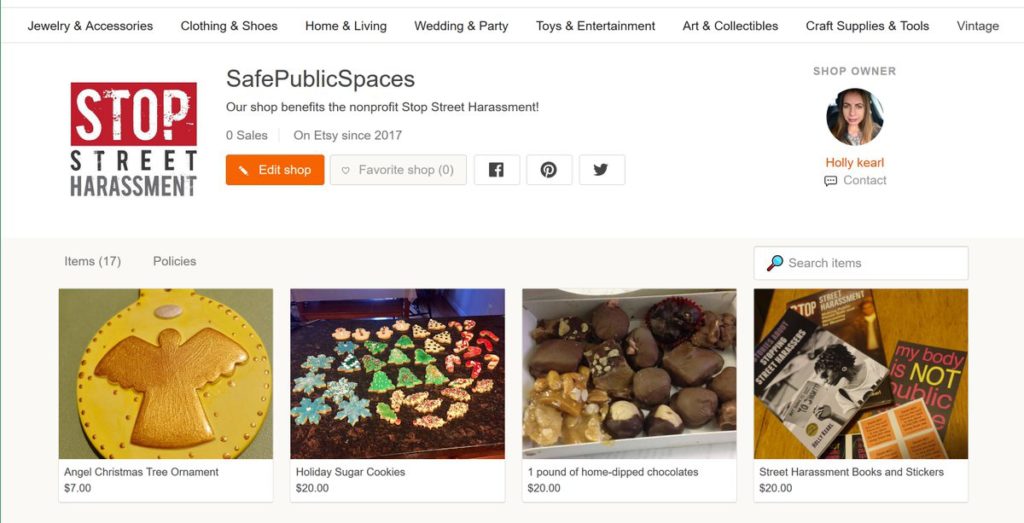
Please help us out today.

Share

Filed Under: national study, SSH programs Tagged With: etsy, fundraiser, giving, holiday, survey

Announcing a New Project!

November 25, 2017 By HKearl

Today is the first day of the 16 Days of Activism Against Gender-Based Violence as well as International Day for the Elimination of Violence Against Women, and this year’s theme is “Leave No One Behind.”

Building on this theme as well as the outpouring of #MeToo sexual abuse stories from women around the world (H/T to the hashtag creator Tarana Burke), the SSH board and I are excited to announce a new project. 

Exciting New Survey
We plan to partner again with national survey firm GfK (they worked with us in 2014) to conduct a nationally representative survey on sexual harassment and abuse in all the places it occurs, including public spaces, schools, campuses, workplaces, places of worship and private homes. We hope the survey will show just how all-encompassing sexual harassment and abuse can be nationwide, as well as illuminate other information, like the young age it begins. To date, there has not been a survey like this undertaken.

Because this national sample of 2,000 people ages 18+ will reflect the demographics of the country, the experiences of smaller demographics won’t be as well documented, including demographics of people who face high rates of abuse. Thus, we will also conduct three separate online surveys that target three main demographics: transgender people, persons with disabilities and youth (of course acknowledging that some people span two or all three categories).

How can you be involved? 
1) Donate, $10 or more. We need to raise $11,000 to cover the costs. The sooner we raise the funds, the sooner we can undertake this timely project.

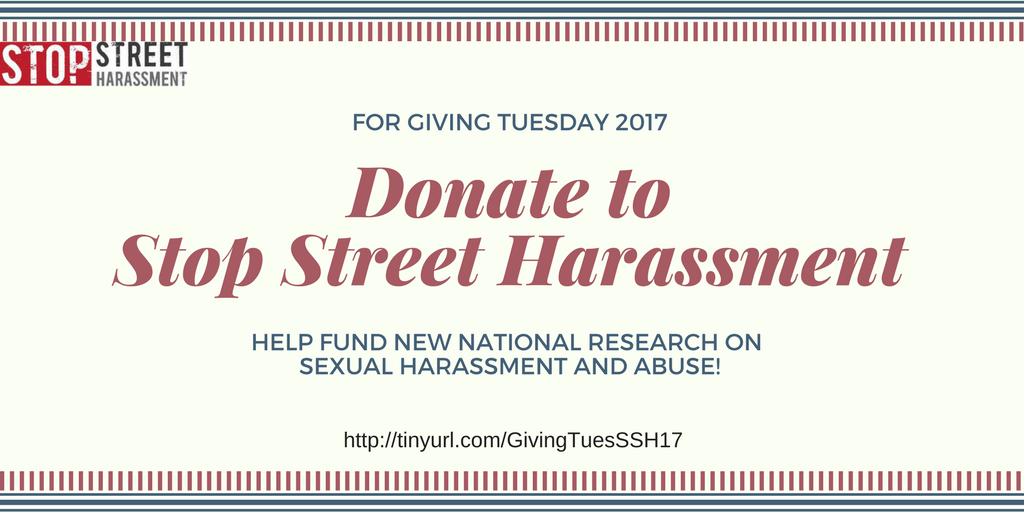
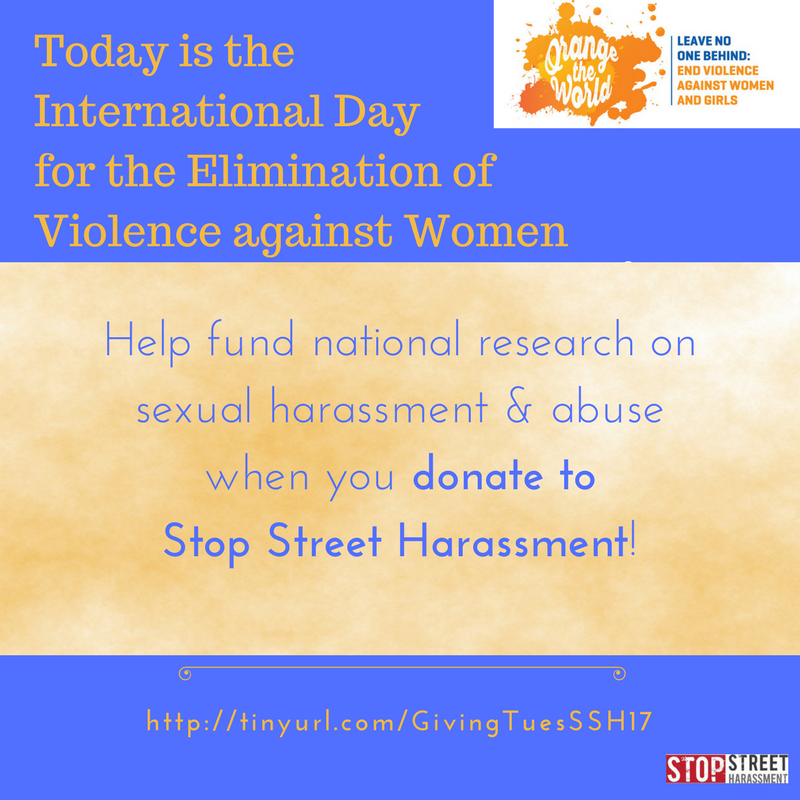
2) Encourage your networks and friends to donate, particularly for #GivingTuesday in three days. Here is a sample message and graphic for social media.

If you were moved by the #MeToo stories, you can bring more facts to light about the extent of #sexualharassment by helping @stopstharassmnt fund a ground-breaking national survey. https://www.razoo.com/team/Shanationlsurvey #EndSH

3) If you would like to participate in any of the three online surveys (the main survey is randomized and conducted by GfK), help solicit responses for them or give input on the questions, please be in touch.

Thanks!

Holly
SSH Founder

Share

Filed Under: 16 days, national study, nonprofit, SSH programs, street harassment, UN events and efforts Tagged With: fundraiser

Late Fall News Round-Up 2017

November 22, 2017 By HKearl

Here are some of the relevant stories, resources and research that’s come forward across September, October and November!

Global News:

BBC’s global 100 Women campaign included harassment on public transit.

Argentina’s Lower House approved a bill that will criminalize street harassment nationally and set-up a free hotline.

Rapper Drake called out a sexual assaulter in the audience of his show in Australia.

A new mobile app is launching in Belgium to help survivors and witnesses of sexual harassment.

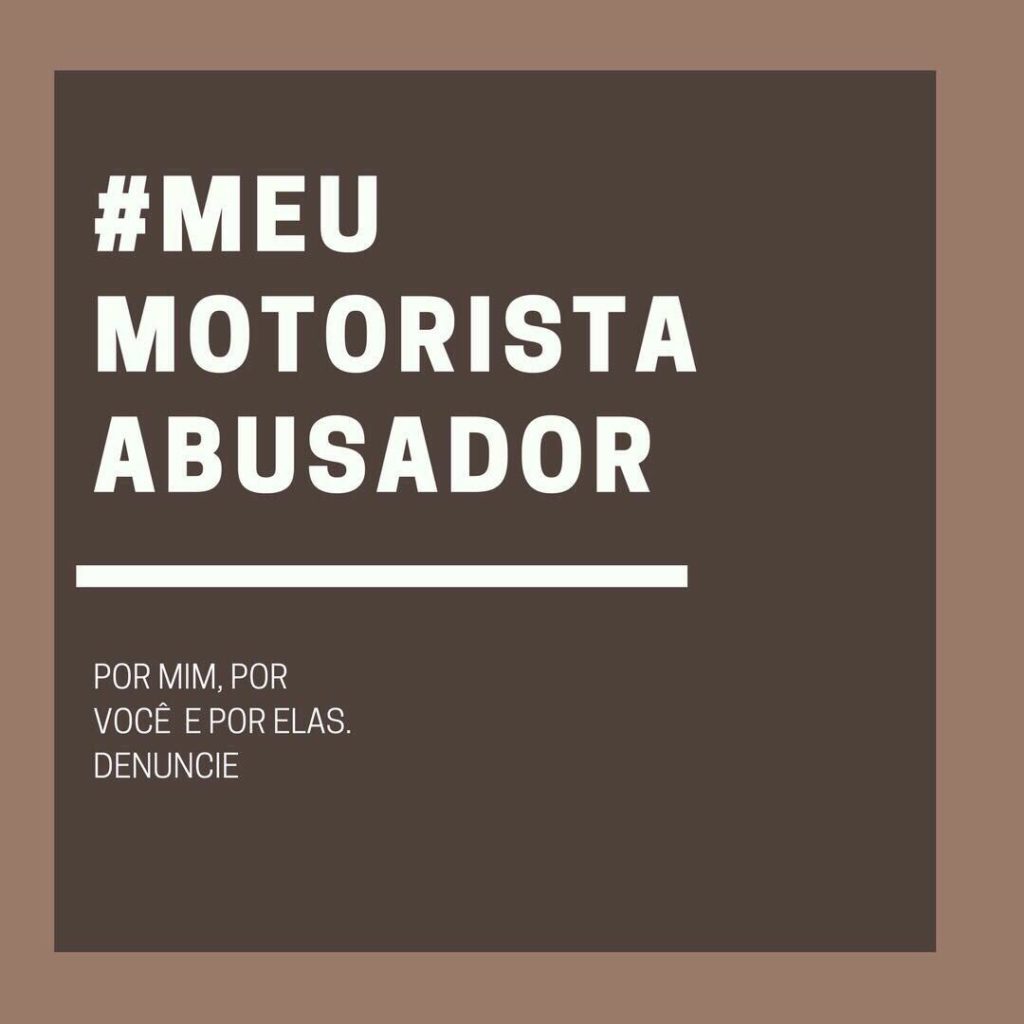
Women in Brazil shared their stories of harassment and abuse by taxi and rides-sharing drivers.

The city of London in Ontario (Canada) is planning efforts to prevent street harassment.

Street artists in Colombia challenge sexism, street harassment with spray paint.

The new film “The People’s Girls” about street harassment in Egypt is now available.

Women in France rallied against sexual violence while a national law against street harassment inched closer to passage.

An anti-harassment hotline in France quickly had to shut down due to trolls.

Activists in Guyana discussed how to address street harassment in their country.

Safecity in India released a new mobile app.

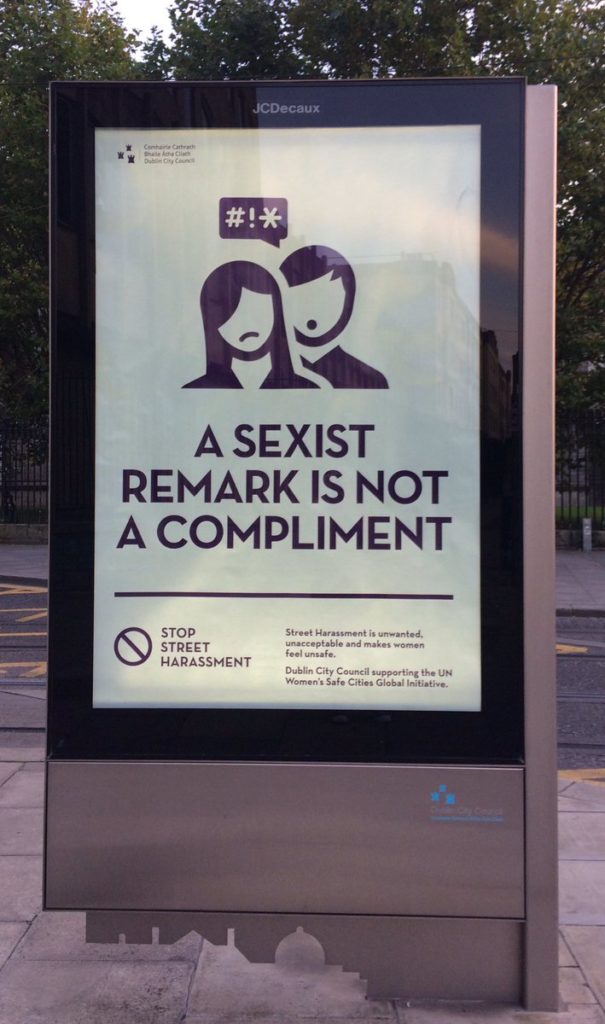
New posters by the Dublin City Council (Ireland) say, “A sexist remark is not a compliment.”

There’s a new sexual harassment hotline for transit riders in Kathmandu (Nepal).

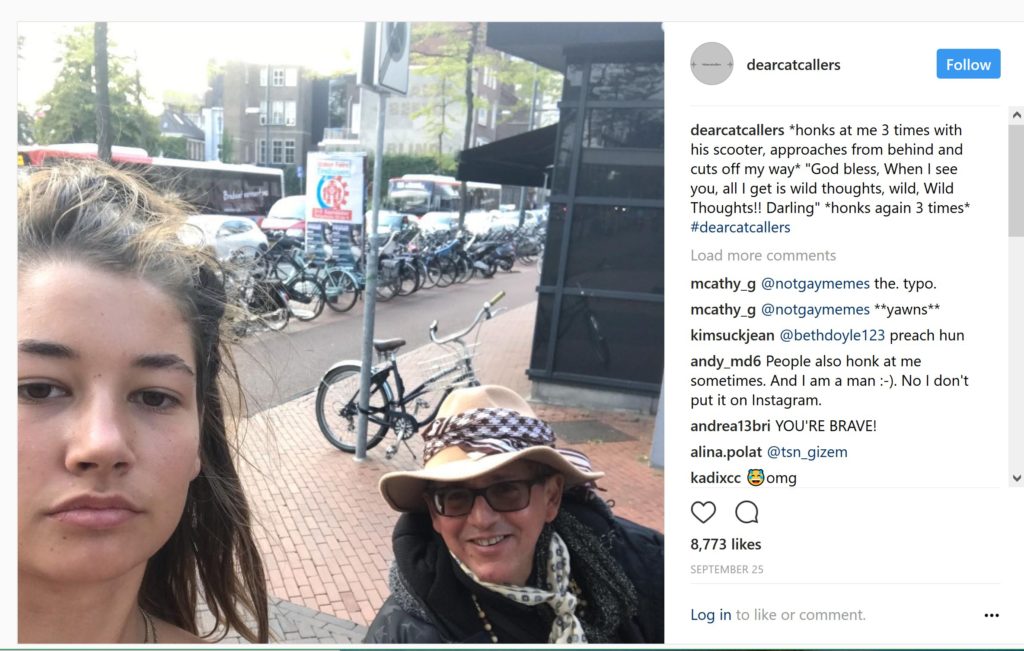
A college student in the Netherlands took selfies with many of her street harassers across one month.

Staying safe in Pakistan (and elsewhere) may be easier if you have money.

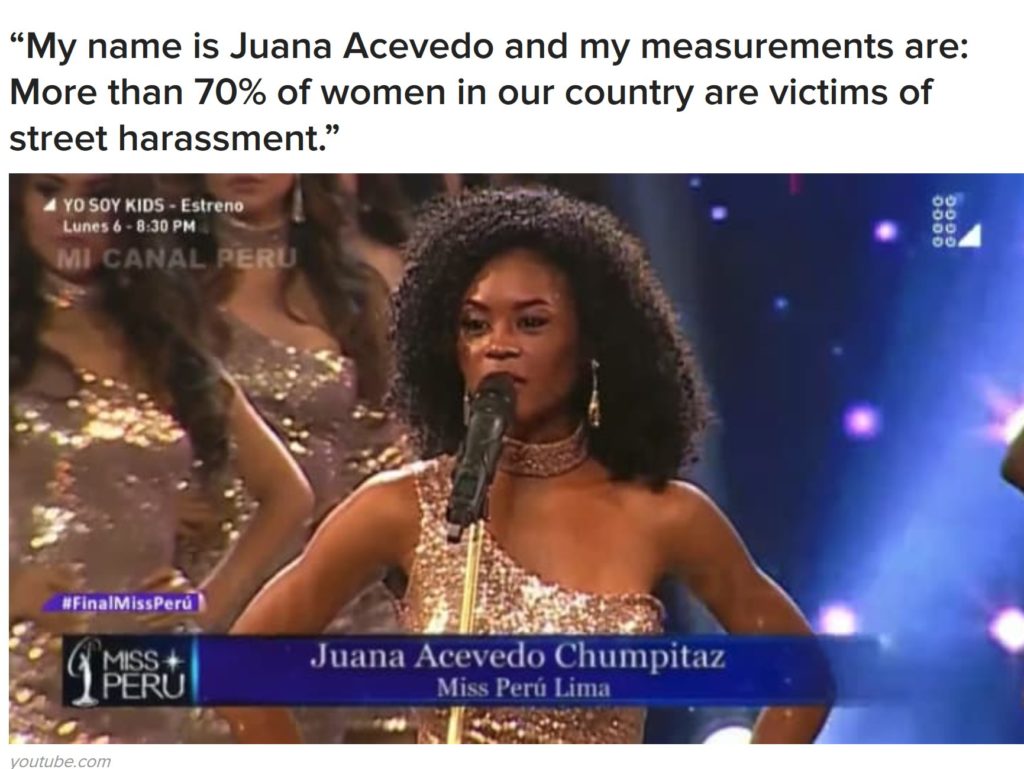
Beauty pageant contestants in Peru gave PSAs about sexual violence, including street harassment.

Two harasser police officers were the first ones tried under Quezon City’s anti-harassment ordinance (Philippines).

An anti-harassment ordinance was proposed in Baguio City (Philippines).

A woman in Singapore wrote about street harassment and the right to public spaces.

Bars and clubs in Switzerland are doing more to address sexual abuse.

A woman in the UK made a map of street harassment hotspots.

The “Unmute” badge fosters bystander action on public transit in the UK.

The category of “gender hate crime” is now recognized in Bristol (UK).

Upskirt photos and videos may become a crime in UK.

Womanability released a new video on women’s safety in public in Uruguay.

The Mary Sue in the USA invited women to give persistent harassers the number of their rejection hotline

Some migrants from Venezuela face harassment in Peru.


New Research:

The Global Mobility Report (by World Bank-led partner SuM4All) shows that “harassment and physical abuse are preventing women around the world from being able to use public transportation safely.”

43% of women in Germany have faced some form of sexual abuse, with most occurring in public spaces.

In the UK, a poll showed that younger women face higher rates of harassment and are more likely to see wolf-whistling as unacceptable compared with older women.

Almost 80% of women and 26% of men ages 18 to 24 have been sexually harassed during “a night out” in the UK.

In the UK, 34% of teenage girls worry about being followed by a stranger and many girls cited experiences of street harassment.

A new survey shows 1 in 3 men don’t think catcalling is harassment (USA)


Powerful or Notable Pieces:

“Where do Harvey Weinsteins come from?”

“My daughter got her first catcall [at age 11, from an adult man], and I didn’t know what to tell her.”

“On being a woman alone in the woods.”

“Paying to stay safe: why women don’t walk as much as men.”

“Black woman viciously attacked after rejecting advances of cat callers.”

“Jogger stabs man with knife after he groped her.”

“Flagstaff police looking for man accused of grabbing teen girls near schools.”

“Why it’s never okay for men to ask women to smile.”

“I recorded every time I was catcalled this summer: Here’s what I learned.”

Share

Filed Under: News stories, weekly round up

A Talk Show Segment on Street Harassment

November 10, 2017 By HKearl

Thanks so much Rctv28 and Elaine Espinola Keltz for hosting an important discussion this week on street harassment, including points like what’s a compliment and what’s not, how to deal with harassers & men’s roles in stopping harassment! It was great to be a guest alongside Noorjahan Akbar of Free Women Writers & Women for Women International and Jessica Raven of Collective Action for Safe Spaces.

Share

Filed Under: Resources, SSH programs, street harassment

#MeToo Ends Here Unless Men Step Up

October 18, 2017 By HKearl

Millions of people have tweeted #MeToo and Facebook shared that 45% of people’s friends have posted it on their timeline to indicate they have experienced some form of sexual abuse (rape, sexual assault, sexual harassment at work or school or street harassment). The hashtag was started in 2007 by Tarana Burke and brought forward again a few days ago by actress Alyssa Milano in the wake of women coming forward revealing sexual abuse they faced from Harvey Weinstein, a very powerful man in Hollywood who could make or break people’s careers.

I began receiving google alerts about the story before it really got going but it took me days to finally engage with it on my own social media accounts, let alone here for Stop Street Harassment.

I know that the hashtag has done a lot of good and it’s created space for more people to share stories and others to read them. But my knee-jerk reaction was not positive. This is what I wrote on my personal Facebook page two days ago, at the height of people sharing #MeToo online:

While I’m glad #MeToo is trending and blah blah blah people are paying attention to sexual harassment and assault again for a minute, I just honestly feel TIRED. Do any of my other activists allies who’ve been working on this issue for a long time feel similarly? I feel worn down from the accumulation of stories I hear daily and have heard nearly daily for 10 years and periodically for years before that and by my own 100s of experiences of sexual harassment (school, work, public spaces, online, interpersonal), including 3 street harassment incidents in the past 9 or so days. I just wish sexual abuse would STOP. Don’t make us have to keep telling our stories and living through this and then when the new cycle shifts, forget about us. I just wish and wish it would stop. Just STOP.

It received over 165 likes (one of my most popular posts all year) and nearly 50 comments, mainly from people who also work on sexual abuse issues for a day job or as a volunteer activist. So many of them voiced fatigue, too. Like literal fatigue of their bodies shutting down. Many said they were getting triggered by seeing so many stories and others just felt too overwhelmed to engage. Yes, they said, they too felt tired.

Those of us working on these issues know all about the problem and I know the hashtag wasn’t for us. But we’re still impacted. Who will be the ones continuing with the work once the hashtag fades away? Who will still be facing sexual harassment and abuse in our day-to-day lives and having to figure out ways to cope with it and keep moving through our day? Us. Us. Us. Us. Us.

Don’t get me wrong, at an individual level, I think story-sharing is the best way to raise awareness about this issue. But at a community, national or global level, I’m tried of us having to pour open our souls and then seeing the attention end there. WHERE are the policies that can actually make a dent in stopping this? WHERE are the male allies who are vowing to speak up and do something proactive to stop this?

Yesterday and today I noticed several articles asking similar questions and challenging additional action, like Jessica Valenti who suggested in her Guardian piece that we now call out the perpetrators.

Or Rozina Sini who wrote at BBC, “I’d love to see a counter trend of men posting ‘I’m sorry and I’ll do better’ if they feel they’ve ever made a woman uncomfortable, unheard or unsafe. This one’s on you, dudes, and yet I still see all the mobilisation and conversational labour being held by woman.”

Or Wagatwe Wanjuki who wrote for Daily Kos, “If we really want to reduce sexual violence, we need more than social media statuses by survivors. We need more than just our stories of trauma to stop sexual assault. We’ve had many similar efforts (#BeenRapedNeverReported, #YesAllWomen, #IBelieveHer, etc.) in the past, but gendered violence remains a serious issue. It’s because we need more. Listening and believing survivors is great, but it should be the first step of many in doing our part to end sexual violence. We need everyone to participate in raising awareness and taking concrete actions against rape culture, rather than leaving it to survivors to do the heavy lifting.”

I agree with them. And I will add this:

I know there are many good men out there who don’t harass or abuse women but I think the bar should be higher than not raping someone or not catcalling them on the street. That doesn’t make you a good guy. The bar should be truly treating women as equals.
 
What does this mean?
 
Do you actively try to ensure women are paid fairly, are not ignored or spoken over in meetings, and are not sexually objectified behind their backs? Do you reject forcing your last name on women at marriage and do you perform an equal share of the childcare/housekeeping/cleaning? Do you raise your daughters to believe they can be as strong, as brave and as competent as your sons? Do you accept no when women don’t feel into having sex?
 
I think there are A LOT of “good guys” who don’t do these things or at least not all of them. That’s a problem. Treating women as less than, as objects, as property, as your personal thing is connected to sexual abuse and sexual violence. If you don’t respect someone and treat them as an equal, it’s much easier to objectify and abuse them or to tolerate it when someone else does it.
 
Unless men are actively working to respect women in all aspects of their life, they are part of the problem. Sadly, sharing our stories until we are BLUE in the face and worn out and exhausted won’t do a damn thing at the macro level. Men, please step up and examine ALL of your behaviors toward women. Please, be better


Share

Filed Under: street harassment Tagged With: male allies, metoo, sexual violence

« Previous Page
Next Page »

Share Your Story

Share your street harassment story for the blog. Donate Now

From the Blog

  • #MeToo 2024 Study Released Today
  • Join International Anti-Street Harassment Week 2022
  • Giving Tuesday – Fund the Hotline
  • Thank You – International Anti-Street Harassment Week 2021
  • Share Your Story – Safecity and Catcalls Collaboration

Buy the Book

  • Contact
  • Events
  • Join Us
  • Donate
  • Facebook
  • Instagram
  • Pinterest
  • Tumblr
  • Twitter
  • YouTube

Copyright © 2026 Stop Street Harassment · Website Design by Sarah Marie Lacy