• About Us
    • What Is Street Harassment?
    • Why Stopping Street Harassment Matters
    • Meet the Team
      • Board of Directors
      • Past Board Members
    • In The Media
  • Our Work
    • National Street Harassment Hotline
    • International Anti-Street Harassment Week
    • Blog Correspondents
      • Past SSH Correspondents
    • Safe Public Spaces Mentoring Program
    • Publications
    • National Studies
    • Campaigns against Companies
    • Washington, D.C. Activism
  • Our Books
  • Donate
  • Store

Stop Street Harassment

Making Public Spaces Safe and Welcoming

  • Facebook
  • Instagram
  • Pinterest
  • Tumblr
  • Twitter
  • YouTube
  • Home
  • Blog
    • Harassment Stories
    • Blog Correspondents
    • Street Respect Stories
  • Help & Advice
    • National Street Harassment Hotline
    • Dealing With Harassers
      • Assertive Responses
      • Reporting Harassers
      • Bystander Responses
      • Creative Responses
    • What to Do Before or After Harassment
    • Street Harassment and the Law
  • Resources
    • Definitions
    • Statistics
    • Articles & Books
    • Anti-Harassment Groups & Campaigns
    • Male Allies
      • Educating Boys & Men
      • How to Talk to Women
      • Bystander Tips
    • Video Clips
    • Images & Flyers
  • Take Community Action
  • Contact

Our Streets, Too! Post-DC Rally Wrap-Up

June 27, 2011 By HKearl

Note: Stop Street Harassment helped organize an Our Streets, Too, march and rally against street harassment in Washington, DC. Holla Back DC! was another co-organizer and this is their wrap-up of the events. The photos are courtesy of my partner.

Cross-posted from Holla Back DC!
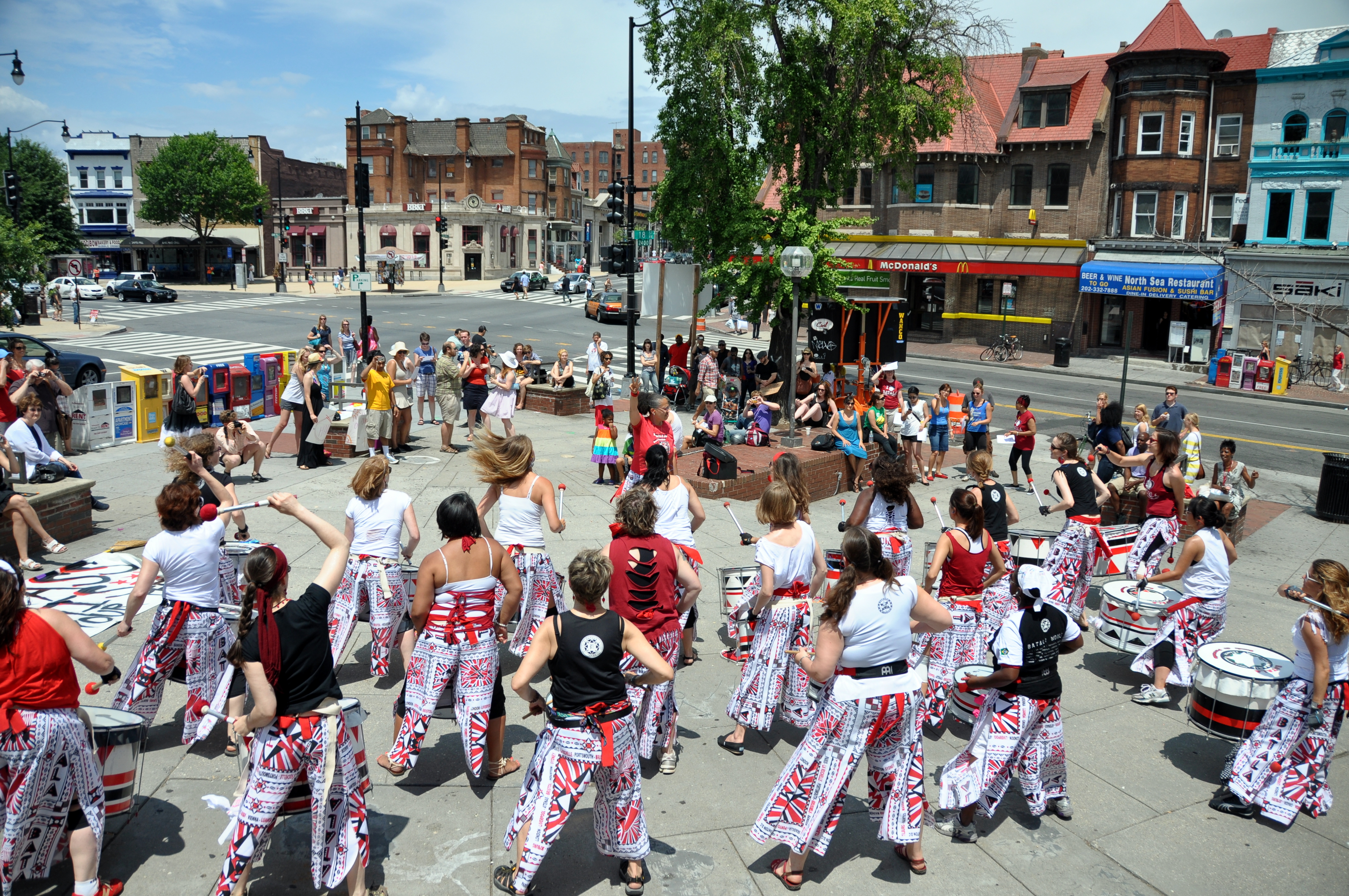
What we love about DC is that it can be so unpredictable!! With only two weeks of preparation, and all the organizers organizing via email, we were scared if anyone would show up. The rally, Our Streets, Too! A Big Queer/Feminist/Allies Street Fest, started off at SunTrust plaza on 18th and Columbia. We never realized, until yesterday, under the blazing sun, how there really aren’t many places in DC to gather that aren’t related to parks (which, let’s be real, are mostly dog parks). People started making signs, assisting with the incredible banner, and sharing their stories of harassment.

Then at 2P, Batala started playing. If you haven’t heard them, man, you are missing out on an amazing group of sisters who can really rock a drum. Everyone was dancing and enjoying themselves, while more people started gathering.

Curious onlookers asked, “What is this about? Why are people gathering?” And, fliers went out to them with volunteers talking about street harassment in DC towards women and LGBTQ individuals. Watching and listening to some of these bystanders say, “Yeah, harassment does happen and it really shouldn’t,” made the rally planning and stress worth it.

Around 2:30, the march started down 18th Street. A la Rob Lowe on Parks and Recreation, we literally stopped traffic, as the march took over the streets. It was amazing. MPD stopped the protest a few times, but, no one was arrested and they didn’t give us much push back.
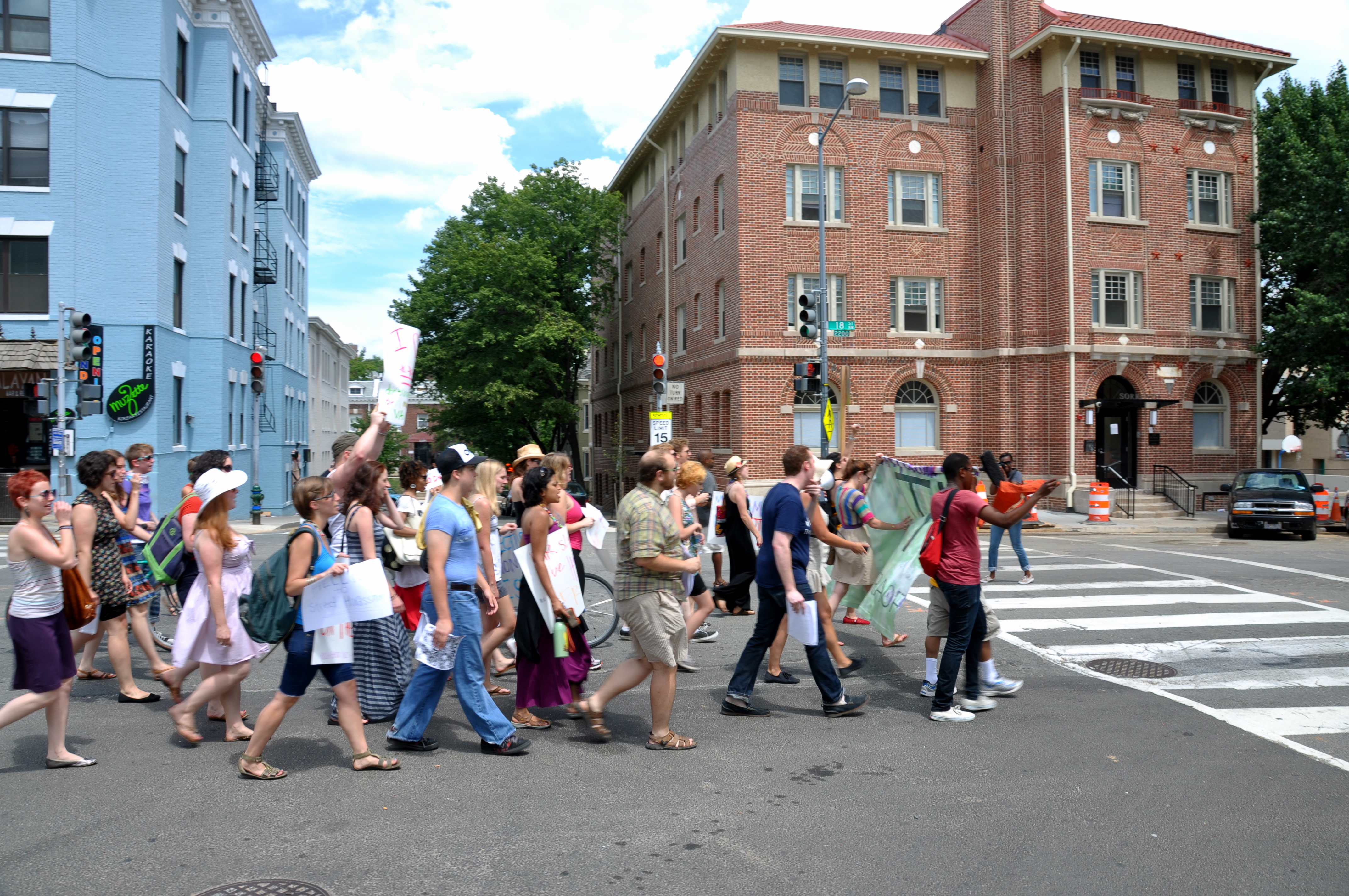
We made a left on U Street and marched up 16th Street towards Malcolm X park. While at Malcolm X park, we had our workshop leaders, Holly from Stop Street Harassment and Board member of Holla Back DC! and Dienna, an activist, talk about ways to address street harassment and share in the collective activism around this issue.
While they were skills sharing with a group of 20 to 25, others were mingling and talking about DC social justice activism, when a Park Police officer came over and told us to cut off the amplified music and asked if we were protesting. We told him that we weren’t, as our protest was done, and we were conducting workshops.  He then walked up a set of stairs towards a group of people who were placing the anti-harassment banner on an over hang. He told them to take it down, and when all individuals left, he followed the two women and started yelling at them to take down the banner. He then proceeded to ask for their IDs, which they gave over, and detained them without telling them what they did wrong.
Because of the Park Police officer’s lack of knowledge around criminal law or lack of wanting to share why he was detaining these women, many rally goers started to get involved and ask the officer what these two women did wrong, since the banner was taken down. He said, “I had to ask them twice.” The officer proceeded to call in his unit, which included five other officers (including the captain/chief, and special ops). It was a sight for sore eyes and a lawyer’s dream.After that 30 minutes of that intense drama, the two women were not papered or arrested. It was all for show. And the irony is that many of our issues around street harassment come from people who abuse their authority. The two women remained calm through out the process, which was just amazing.

Lauren, from Defend Yourself, did a wonderful workshop which concluded the protest and rally. Seeing so many people gather in support of raising awareness on street harassment, stopping traffic, and getting some skills on how to address the harassment was a great way to start the summer.

Many thanks to the supporters and friends of Holla Back DC! who came out to the rally!

If you were at the rally or wanted to be, and feel inspired to get more involved in this issue, please fill out this volunteer form and we’ll get back to you!

Share

Filed Under: Events, hollaback, street harassment Tagged With: our streets too, street harassment

Street Harassment Snapshot – June 26, 2011

June 26, 2011 By HKearl

*** TODAY at 2 p.m., activists in Washington, DC, will be marching to remind people that these are Our Streets, Too, and street harassment should end! ***

Read stories, news articles, blog posts, and tweets about street harassment from the past week and find relevant announcements and upcoming street harassment events.

Street Harassment Stories:

I accept street harassment submissions from anywhere in the world. Share your story! You can read new street harassment stories on the Web from the past week at:

Stop Street Harassment Blog

Hollaback

Hollaback Atlanta

Hollaback Baltimore

Hollaback Berlin

Holla Back DC!

Hollaback France

Hollaback Israel

Hollaback London

Hollaback Mexico DF

Hollaback Mumbai

Hollaback NYC

Hollaback Ottawa

Hollaback Philly

Street Harassment in the News, on the Blogs:

*Women’s E-News, “Time to Count Street Harassment as Hostile Acts“

* Bitch Media, “Takin’ it to the Streets: She Ain’t Me (The Problem of Self-Esteem)”

* Philadelphia Weekly, “Women Take a Stand Against Street Harassment“

* Mumbai Boss, “Holla To Be Heard“

* Daily News & Analysis India, “Eve-teasing could now land you in jail“

*Ahram Online, “International blogging day against sexual harassment ignites in Egypt“

* Christian Science Monitor, “Egyptians fight sexual harassment with June 20 Twitter campaign“

* Percolate Magazine, “Guest Blog: Street Harassment – Why Clothing Doesn’t Matter“

* Sian and Crooked Rib, “I am a hollaback girl“

* The Times of India, “Chennai: Std 10 girl harassed by four youths“

* BBC, “Guatemala estrena sus buses “sólo para mujeres”“

* Americas Quarterly, “Guatemala Debuts ‘Women Only’ Buses“

* Ahram Online, “‘Speak up!’ blogging on sexual harassment in Egypt just a start“

* Bikyamasr, “One reader’s stories of sexual harassment in Egypt“

* Pacific Free Press, “SlutWalk in Honduras“

* Christian Science Monitor, “Egyptian men explain their relentless catcalls“

* Press TV, “Egyptians tweet to end sexual harassment“

Announcements:

New:

* The UN launches a “Safe and Friendly Cities for All” campaign

Reminders/On-Going:

* There’s a new anti-street harassment group in Sri Lanka

*Learn about and help fund Hollaback’s bystander campaign, “I’ve Got Your Back“

* Sign Mend the Gap’s petition to address subway harassment in Delhi, India

* College students, enter the Hollaback essay contest, entries due August 1.

* Are you in Egypt? Use HarassMap to report your street harassers

* Have an iPhone? Download the Hollaback iPhone app that lets you report street harassers

10 Tweets from the Week:

1. CatCall “Ooh baby! I like that. So sexy.” Ave C Thanks. Now I feel gross.

2. RogueDancer Spend the day dancing and fighting #streetharassment at the #thewindowsexproject community workshop

3. PoshBirdGabi @Kiryatraber – I’ve stopped speaking 2 Men I don’t know unless it’s absolutely necessary & unavoidable. #StreetHarassment #VAW #WarOnWomen

4. Kiryatraber Like most women I’ve become hardened to street harassment. I’m generally dismissive or rude to men who approach me… #mysogyny

5. ashcampaign is en route to a meeting with a big production company who want to do a documentary on street harassment!

6. lilyorit Dear Creepy Men: Coming onto me just because my hair is fuchsia? Not cool. Being creepy about it? SO not cool. #streetharassment #notokay

7. FeistyFeminist1 My name is NOT baby! UGH. Screw you, old man in the car. I’m not gonna let you ruin my good day. #streetharassment

8.  WriteAboutIt It’s the #firstdayofsummer, which must be why I got pssted at and cursed out by some ahole in Herald Sq this morning. #streetharassment

9. NadiaE Sexual harassment in #Egypt won’t stop until society as a whole rejects it #endSH

10. maggie87h I am grateful for men in the street, usually older, who intervene when they see harassment. More of them are needed #endSh


Share

Filed Under: Events, News stories, Stories, street harassment, weekly round up

New women-only buses in Guatemala

June 25, 2011 By HKearl

Guatemala, one of the most violent countries in the world, just launched a pilot program of dozens of women-only buses in Guatemala City because of the high rates of sexual harassment and groping that women passengers face.

The buses are identified with signs reading “For Women Only” and pink ribbons (ah yes, as always, pink = female…) and the buses run between the city center and neighbourhoods to the north and south. The buses run from 6 to 7:30 a.m. and 5:30 to 7 p.m., and they allow boys under 12 to ride. Bus drivers are also allowed to be male.

Guatemala joins more than fifteen countries that have women-only public transportation, each instituted as band-aid fixes to address rampant sexual harassment on public transportation and never offered with enough frequency to be of use to all women passengers. The idea for the women-only buses in Guatemala came from seeing Mexico institute them a few years ago.

“Spearheading the initiative was right-wing opposition congresswoman Zury Ríos, who asked the owners of buses to create women-only spaces, to keep them safe from harassment and aggression.

“It’s been a success. I’m really happy that women feel safer and that with this decision, their human rights have begun to be respected,” said the legislator, who is the daughter of former dictator Efraín Ríos Montt (1982-1983).

Congresswoman Ríos, who is known for taking up women’s causes, said the Guatemala City system is based on the Mexico City model. She added that the idea is to also provide a women-only taxi service, with women drivers, similar to a system that is operating in the Mexican capital.”

Americas Quarterly reported on how the first day of the initiative went:

“The first day of service was met with a mix of enthusiasm and confusion. Hundreds of women lined up to board the pink-ribboned buses, but some were made visibly nervous by male riders in nearby lines who appeared to mock the new routine. The system also created difficulties for riders unaccustomed to traveling without their husbands or older sons. Some men, who mistakenly boarded the new buses, were ordered off.”

Like other countries with women-only public transportation, feelings about the women-only buses vary. Some women are simply grateful for any measure that gives them relief from the harassment, while others see it as a surface-level response that doesn’t address or fix the root causes. For my part, I always wonder how people can justify segregating individuals by sex in these instances when it would be unthinkable to do so by race, eye color, or nationality. It may be harder to do, but why not actually address the root causes or focus the attention on men instead of on women?

Here is some of the mixed feedback, via International.to:

“I feel safer here,” Verónica Ortega, holding her two-year-old son, told IPS as she rode home on one of the women-only buses.

“The problem is that off the bus, harassment is still an issue,” Ana María Cofiño, with the La Cuerda feminist collective, told IPS, describing the buses as a “palliative” measure.

“Specific actions like this are taken, but violence in other areas like the workplace or the streets, or the fact that women are at risk of being raped at any time, are not addressed,” she complained.

Cofiño said the Guatemalan state has the obligation to guarantee that women have the same access to opportunities as men, and to carry out awareness-raising campaigns on respect for women. “If the authorities did this, we would believe there was a more serious intention of bringing about change,” she added.

Ana Silvia Monzón at the Latin American Faculty of Social Sciences (FLACSO) told IPS that the initiative makes sense as long as women continue to be harassed on public transport.

“I hope it’s only temporary and that men’s behaviour will improve, but for that to happen, other measures are needed as well,” the expert added…

Evelyn Morales, with Tierra Viva, a women’s group based in Guatemala City, told IPS that it will take a major effort to curb harassment and violence against women. But the women-only buses “are a positive step, because most women experience being groped, harassed and sexually violated on urban and suburban buses,” she said.

But not everyone is happy about the measure. “There aren’t enough buses, and now half-empty buses carrying only women will go by,” complained Víctor Guzmán, a factory employee.”

Thoughts?

Share

Filed Under: News stories Tagged With: Guatemala, women only buses

“That’s the third time he’s driven by and done that.”

June 24, 2011 By HKearl

I’m in Tampa, Florida, for the national NOW conference. This evening, I went for a five mile run near the USF campus. Within the first two miles, I was harassed twice by men going by in their cars.

I also witnessed a man in a car harass a young woman at a bus stop located on the edge of campus. As I approached her, I paused and asked her if he had just harassed her (based on her upset expression, I gathered that he had) and she said, “Yeah, I think so. That’s the third time he’s driven by and done that.”

I offered her a few words of comfort and said if he came by again, she could always tell him to stop harassing her. But she didn’t look too sure about that idea. Probably in part because besides the two of us there were no pedestrians as far as you could see in either direction, just cars, so she may not have felt safe responding. I understand that. I also should have mentioned to her that she could write down his license plate number and try reporting him, but I forgot to in the spur-of-the-moment-ness of the encounter.

A minute after I left her, a bus passed me and when I turned around, I saw it pull over and pick her up, so at least that man couldn’t harass her for a fourth time.

Despite all that I know about responding to street harassers, I tend to be the person who freezes when it happens, including when I see it happen to someone else, so I’m happy that didn’t freeze and I stopped when I saw it happen. Even though I didn’t have a chance to intervene or prevent the harassment, I hope I helped the young woman feel less alone and less upset by talking with her. And honestly, since I faced two of my own harassers, it also made me feel less alone to talk with her. (Very sad, that two out of the two women on the street got harassed, huh?)

If you see someone whose been harassed, even if you can’t do anything to stop or prevent it, consider asking if they are okay and that may make a difference and help them feel less alone.

To help you be a good bystander, here are bystander tips and success stories. And also, consider donating to the Hollaback I’ve Got Your Back bystander campaign.

– Holly

Location: North 50th Street, by USF, Tampa, Florida

Share your street harassment story today and help raise awareness about the problem.
Find suggestions
for what YOU can do about this human rights issue.

Share

Filed Under: Stories, street harassment

New UN initiative focuses on creating safe cities

June 22, 2011 By HKearl

Last fall in Delhi, India, I attended the launch of UNIFEM’s Safe Cities Programme, a five-year program aimed at addressing safety issues particularly faced by women in five major cities. It appears that program, under the new UN Women, has now melded with similar programs run by UNICEF and UN-HABITAT into a program called Safe and Friendly Cities for All. [Update: I just heard from someone at the UN and the two programs are separate, though related]

The following information about it is from the UN Women website. It sounds like the initiatives will take street harassment into serious consideration, which is great. Afterall, we can have all the street lamps and graffiti-less walls we want, but until (primarily) men stop sexually harassing women in the streets, cities will never be safe for half of the population.

UNICEF, UN-HABITAT and UN Women launch “Safe and Friendly Cities for All,” a five-year programme that aims at making women and children feel safer in their local neighbourhoods, while improving their quality of life.

This partnership initiative builds on prior experience that all three organizations have accumulated on preventing gender-based violence, using innovative tools for child and youth engagement in urban settings, and promoting integrated crime prevention strategies in cities.

By working with local municipalities, women’s groups, child and youth advocates, the joint initiative will focus on increasing safety among women, youth and children, and preventing and reducing violence, including sexual harassment and violence against women and girls in public spaces.

More than half of the world’s population — approximately 3.4 billion people — live in cities today. This number is projected to increase to 69 percent by 2050. With this rapid urbanization come increased risks for the citizens of urban areas, especially women and children. Currently, one billion people are living in urban slums and are denied basic human rights, such as access to safe housing and reliable health services.

Global crime rates jumped by about 30 percent between 1980 and 2000, and between 2002 and 2007, approximately 60 percent of urban residents in developing countries reported that they had been the victims of crime. Many of these are women and young girls, facing sexual assault or harassment on streets, public transport or in their own neighbourhoods.

The new partnership will address these challenges by supporting a variety of initiatives in the participating cities. By working with local authorities and organizations on the ground, women and young people will be able to identify those areas in their neighbourhood where they feel most at risk, and find solutions together.

Potential interventions may include:

* Enabling women and young people to have a voice in decisions that affect their lives such as decisions on budgets and local infrastructure

* Establishing female councillor-led committees for effective response to sexual violence and crimes in communities

* Increasing street lights in high-risk areas, including the use of solar lights which are cost-effective and more resilient to damage and vandalism

* Training of community police units to prevent gender-based violence

The five-year initiative will be piloted with municipal leaders. Dushanbe, Greater Beirut, Metro Manila, Marrakesh, Nairobi, Rio de Janeiro, San José and Tegucigalpa are among the cities currently being considered.

See also:

    Speech by UN Women Executive Director Michelle BacheletSafe and Friendly Cities for All Programme Flyer
Share

Filed Under: street harassment Tagged With: gender violence, safe and friendly cities for all, safe cities programme, street harassment, UN women

« Previous Page
Next Page »

Share Your Story

Share your street harassment story for the blog. Donate Now

From the Blog

  • #MeToo 2024 Study Released Today
  • Join International Anti-Street Harassment Week 2022
  • Giving Tuesday – Fund the Hotline
  • Thank You – International Anti-Street Harassment Week 2021
  • Share Your Story – Safecity and Catcalls Collaboration

Buy the Book

  • Contact
  • Events
  • Join Us
  • Donate
  • Facebook
  • Instagram
  • Pinterest
  • Tumblr
  • Twitter
  • YouTube

Copyright © 2026 Stop Street Harassment · Website Design by Sarah Marie Lacy