• About Us
    • What Is Street Harassment?
    • Why Stopping Street Harassment Matters
    • Meet the Team
      • Board of Directors
      • Past Board Members
    • In The Media
  • Our Work
    • National Street Harassment Hotline
    • International Anti-Street Harassment Week
    • Blog Correspondents
      • Past SSH Correspondents
    • Safe Public Spaces Mentoring Program
    • Publications
    • National Studies
    • Campaigns against Companies
    • Washington, D.C. Activism
  • Our Books
  • Donate
  • Store

Stop Street Harassment

Making Public Spaces Safe and Welcoming

  • Facebook
  • Instagram
  • Pinterest
  • Tumblr
  • Twitter
  • YouTube
  • Home
  • Blog
    • Harassment Stories
    • Blog Correspondents
    • Street Respect Stories
  • Help & Advice
    • National Street Harassment Hotline
    • Dealing With Harassers
      • Assertive Responses
      • Reporting Harassers
      • Bystander Responses
      • Creative Responses
    • What to Do Before or After Harassment
    • Street Harassment and the Law
  • Resources
    • Definitions
    • Statistics
    • Articles & Books
    • Anti-Harassment Groups & Campaigns
    • Male Allies
      • Educating Boys & Men
      • How to Talk to Women
      • Bystander Tips
    • Video Clips
    • Images & Flyers
  • Take Community Action
  • Contact

HABITAT 3: Women’s Assembly – Safe Cities Session

October 15, 2016 By HKearl

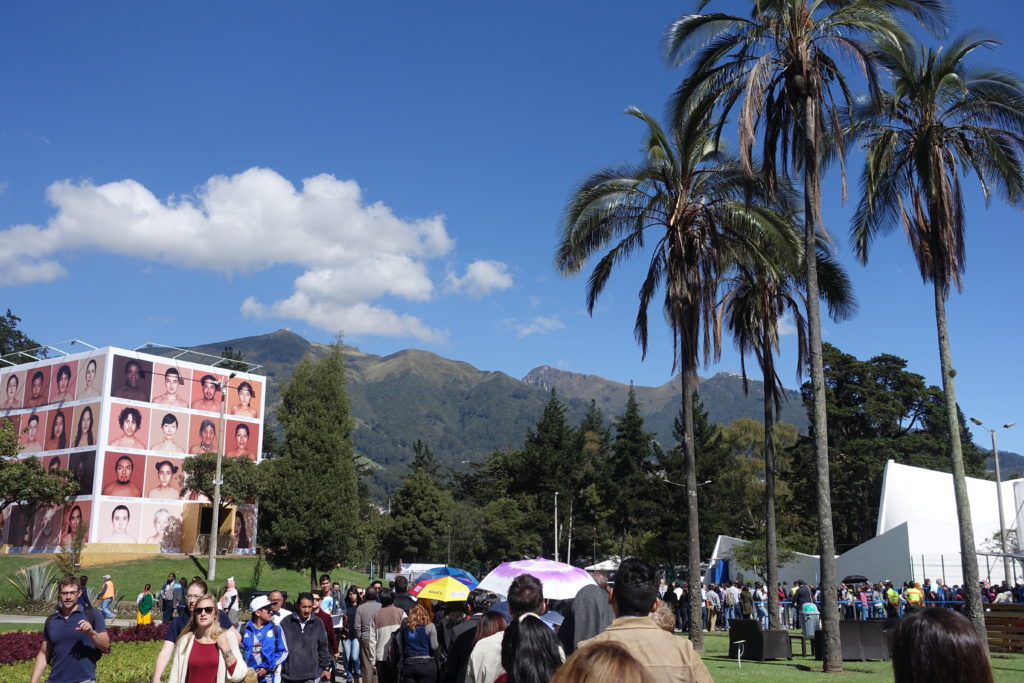
10-15-16-waiting-in-line-to-get-registered-for-habitat-3
Waiting in line to register for HABITAT 3, Quito, Ecuador

I recently started a new consultancy position with UN Women and as part of my job, I am in Quito, Ecuador, for HABITAT 3, the third United Nations Conference on Housing and Sustainable Urban Development. Tens of thousands of people from around the world are convening to discuss cities.

Today was the Women’s Assembly, “designed to celebrate the contributions to and leadership of the Women and Human Settlements’ movement in championing sustainable and women inclusive urban development.”

In the morning, we heard from various UN leaders and grassroots women about the importance of including women in all efforts. In the afternoon, we divided up into 10 sessions to focus on 10 topics (e.g. economic rights, leadership, and safety). In our groups, in addition to discussing our own experiences and ideas, we came up with recommendations for what needs to happen by member states to ensure women’s views and experiences and needs are included and acted upon.
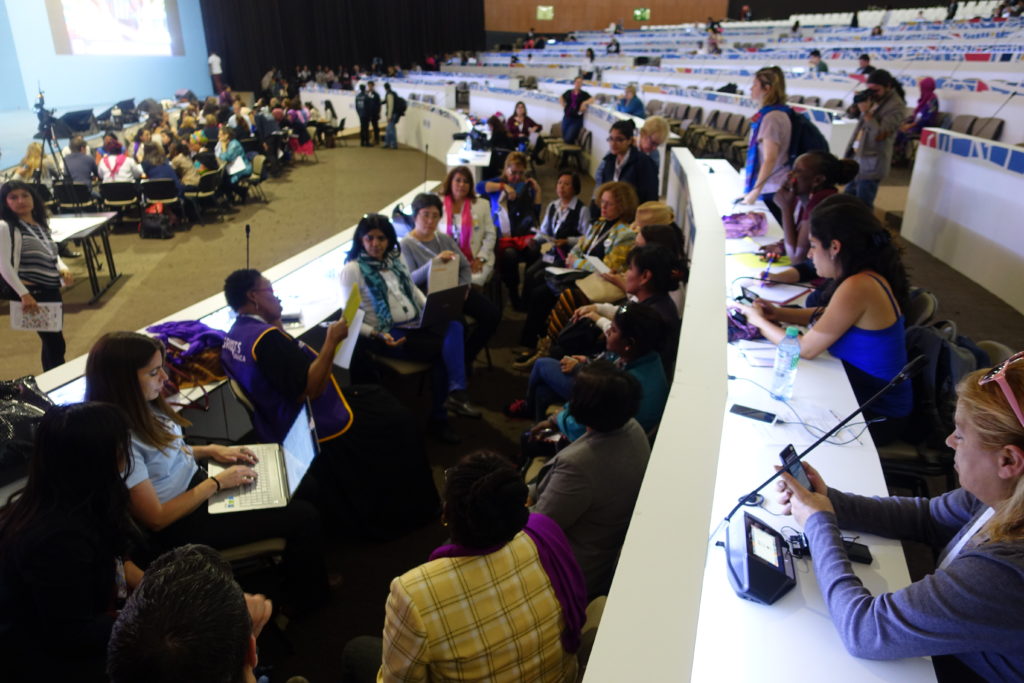
Safe Cities for Women and Girls breakout session

I was the documenter for the Safe Cities for Women and Girls session. Our session coordinator was Kathryn Travers, Executive Director of Women in Cities International, and she shared this to set the stage:

“Safe cities and safe public spaces free of violence against women and girls are increasingly recognized as a priority issue for sustainable development. The fact that safe cities for women figures explicitly as a goal in the Sustainable Development Goals (SDGs), a binding international commitment by Member States, strengthens its position as a key issue for implementation as part of the New Urban Agenda (NUA), a normative non-binding international framework.

SDG 5, on gender equality and empowerment of all women and girls specifically calls for ending violence against women and girls (VAWG) including in public spaces (sub-target 2). This language is mimicked in the NUA and goes on to include mentions of harassment more specifically in (para 13 c). SDG 11 calls on Member States to Make Cities and Human Settlements Inclusive, Safe, resilient and Sustainable, and sub-target 7 specifies “By 2030, provide universal access to safe, inclusive and accessible, green and public spaces, in particular for women and children, older persons and persons with disabilities”…

The NUA Para 100 calls on Member States to “support the provision of well-designed networks of safe, inclusive for all inhabitants, accessible, green, and quality public spaces and streets, free from crime and violence, including sexual harassment and gender-based violence (…) bringing people into the public spaces, promoting walkability and cycling towards improving health and well-being”. Finally, echoing the SDG 5.5, the NUA calls for the empowerment of women and others to participate in urban and territorial development and decision-making (para 155).”

In this context, these were our collective conclusions:
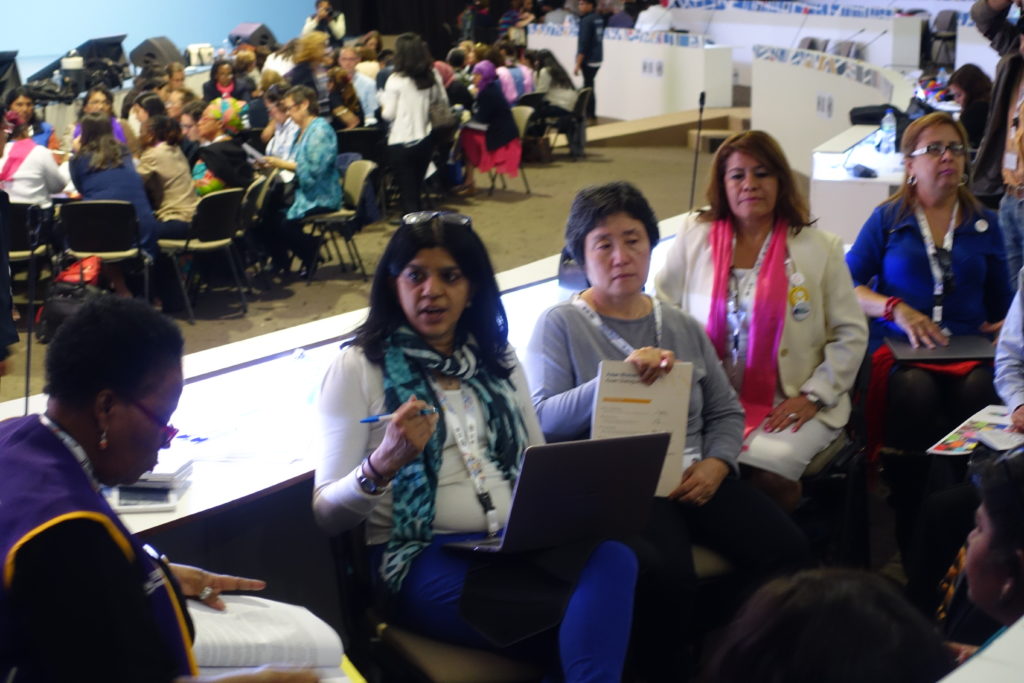
dsc04336We want member states to recognize safety as a right to the city and:

  1. Keep women at the center of efforts including by including women as leaders at all levels;
  2. Collect data at the national level through creative and new methods;
  3. Learn from new practices that are shared in a central place;
  4. Have multi-stake holder and multi-level efforts;
  5. Commit funding to these different initiatives so they can actually happen;
  6. Monitor and report back on efforts and hold governments (local, national) accountable

On our end, we made four commitments for what we’d be do to ensure these outcomes.

  1. We commit to making available the knowledge, tools, successful practices as part of comprehensive rights-based approaches, and key experts (both professional and grassroots women) to national, regional, state and local governments to implement safe cities for women and girls initiatives in cities. Support and capacity building for both grassroots leaders and government stakeholders will be offered as part of this commitment.
  2. Recognizing the special vulnerabilities that girls and young women face, we commit to support girls’ empowerment through processes including intergenerational dialogues to speak for themselves and transform their cities to be safer and more inclusive for all girls and women.
  3. We commit to innovating participatory action research tools, including technology, and approaches for gender transformative and inclusive safe cities for women and girls initiatives and making them available to cities worldwide
  4. We commit to implement safe cities initiatives that recognize women and girls as essential agents of change in a multi-stakeholder, multi-sectoral and multi-level partnership informed by existing global frameworks on safe cities free of violence against women and girls that can be adapted to city and country context.

Share

Filed Under: street harassment, UN events and efforts Tagged With: ecuador, habitat, Habitat 3, safe cities, UN women

“I was devastated by what this harasser did to me and by the way the witnesses reacted”

October 15, 2016 By HKearl

I was visiting Amsterdam for five days and catching up with some friends. I’m from Poland. My friend and I left a cafe after a nice evening spent together talking and laughing. She was taking a tram and I decide to walk as it was just a 20 minute walk from the place where I was staying. When we were saying goodbye, a man appeared around the corner. He followed me and mumbled something, was commenting on my gloves and kept on talking to me. I was seriously threaten as it was 10 p.m. and there were not many people on the street. He was like two steps behind my back stalking me so I told him to leave me alone and stop talking to me as I do not talk to strangers on the street.

Then he got aggressive and started yelling at me, “F**k you, f**k you. I’m not following you.” I asked a person that was witnessing all that to call the police which made him even more aggressive. I had to listen to all that because I was too scared to reply. There were four other men witnessing this and only one said, “Please leave the lady alone”. Two others were smiling. He kept on calling me names and spit on me. Then left. I was too threatened to make a move. The man who was the only one to speak out said that he could walk me to where I lived if I was afraid to walk alone. I made it safe to the apartment but I was devastated by what this harasser did to me and by the way the witnesses reacted.

Optional: What’s one way you think we can make public places safer for everyone?

More campaigns raising awareness that street harassment exists and it should be condemned, girls and women are not things and you cannot do and say whatever you want

– Monika

Location: Amstredam, de Pijp, the Netherlands

Need support? Call the toll-free National Street Harassment hotline: 855-897-5910

Share your street harassment story for the blog.
See the book 50 Stories about Stopping Street Harassers for idea
s.

Share

Filed Under: Stories, street harassment

Michelle Obama’s Speech on Respecting Women!

October 13, 2016 By HKearl

Thank you for this important speech today, Michelle Obama!

“It is cruel. It’s frightening. And the truth is, it hurts. It hurts. It’s like that sick, sinking feeling you get when you’re walking down the street minding your own business and some guy yells out vulgar words about your body. Or when you see that guy at work that stands just a little too close, stares a little too long, and makes you feel uncomfortable in your own skin.
 
It’s that feeling of terror and violation that too many women have felt when someone has grabbed them, or forced himself on them and they’ve said no but he didn’t listen — something that we know happens on college campuses and countless other places every single day. It reminds us of stories we heard from our mothers and grandmothers about how, back in their day, the boss could say and do whatever he pleased to the women in the office, and even though they worked so hard, jumped over every hurdle to prove themselves, it was never enough.
 
We thought all of that was ancient history, didn’t we? And so many have worked for so many years to end this kind of violence and abuse and disrespect, but here we are in 2016 and we’re hearing these exact same things every day on the campaign trail. We are drowning in it. And all of us are doing what women have always done: We’re trying to keep our heads above water, just trying to get through it, trying to pretend like this doesn’t really bother us maybe because we think that admitting how much it hurts makes us as women look weak.”
 
Transcript
I’m also grateful to New York Times op-ed columnist Nicholas Kristoff for his op-ed on this topic today that includes a link to our 2014 study!
Share

Filed Under: News stories, street harassment Tagged With: Hillary Clinton campaign, Michelle Obama, respect women, sexual harassment

Trump’s Locker Room Banter is Our Life

October 11, 2016 By HKearl

A recently released 2005 recording of American presidential nominee Donald J. Trump engaging in what he calls “locker room banter” about forcing himself on women has prompted many people to speak out against his behavior and his excuse of his behavior.

For instance, famed Anita Hill wrote an op-ed in the Boston Globe today saying,

“Trump’s language, which he and others have tried to minimize as “locker room banter,” is predatory and hostile. To excuse it as that or as youthful indiscretion or overzealous romantic interest normalizes male sexual violence….Today’s conversation that must extend far beyond the presidential election. We have made strides in how we think about sexual violence but we’re nowhere close to done.”

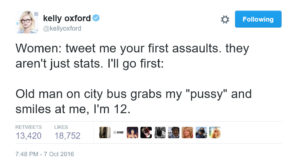
10-7-16-kelly-oxford-trump-tweetThe most visible response is happening over Twitter. On Friday night, author Kelly Oxford tweeted, “Women: tweet me your first assaults. They aren’t just stats. I’ll go first: Old man on city bus grabs my ‘pussy’ and smiles at me, I’m 12.”

By Saturday morning, as many as 50 women tweeted their stories per minute of first-person accounts of sexual violence with the hashtag #notokay. By Monday afternoon, nearly 27 million people had responded or visited Oxford’s Twitter page.

Incredible, but not surprising. A 2014 study we commissioned GfK to conduct nationally in the USA showed that nearly 1 in 4 women had experienced unwanted sexual touching by a stranger while in a public space.

I can add to that number. When I was 18 years old and standing on the sidewalk in front of a cross country teammate’s friend’s house a few blocks from my college campus, a group of men walked past me. A man at least twice my size reached out and grabbed my crotch, then laughed and walked on. You don’t ever forget the humiliation and fear and disgust of something like that happening. And at the same time, I always feel “lucky” that I have never had to live through a more severe violation.

These are the kinds of stories women everywhere have lived through. To us, it is not locker room banter. It is traumatic, upsetting and memorable. We remember. Our bodies remember.

Anyway, I am really glad to see this huge response to the really alarming evidence of what we many of us suspected: Trump is a dangerous, entitled misogynist who does not respect women (nor persons of color, immigrants, etc). Surely now he will never be president. Surely now the American people will put women’s rights and respectability above any other characteristic they deem presidential about him. Surely.

Share

Filed Under: News stories, Resources, street harassment Tagged With: donald trump, kelly oxford, sexual abuse, sexual assault, twitter response

Egyptian Activists Use Eggs to Shame Harassers

October 5, 2016 By HKearl

Well, this is a creative, new and in-your-face (on-your-head?) way to raise awareness that street harassment is not okay!

Via Observers:

“Egyptian activists recently took to the streets of Cairo to crack eggs on the heads of men who bragged about inappropriately touching women … They began by just starting casual conversations with men on the street. They chatted with them for a while, to put them at ease. Then, the activists ask a few targeted questions about street harassment. Often, the men they were talking to actually started bragging about touching women. When this happened, that was the activists’ cue to crack an egg on the person’s head.”

Share

Filed Under: male perspective, News stories, street harassment Tagged With: challenging them, Egypt, harassers

« Previous Page
Next Page »

Share Your Story

Share your street harassment story for the blog. Donate Now

From the Blog

  • #MeToo 2024 Study Released Today
  • Join International Anti-Street Harassment Week 2022
  • Giving Tuesday – Fund the Hotline
  • Thank You – International Anti-Street Harassment Week 2021
  • Share Your Story – Safecity and Catcalls Collaboration

Buy the Book

  • Contact
  • Events
  • Join Us
  • Donate
  • Facebook
  • Instagram
  • Pinterest
  • Tumblr
  • Twitter
  • YouTube

Copyright © 2026 Stop Street Harassment · Website Design by Sarah Marie Lacy