• About Us
    • What Is Street Harassment?
    • Why Stopping Street Harassment Matters
    • Meet the Team
      • Board of Directors
      • Past Board Members
    • In The Media
  • Our Work
    • National Street Harassment Hotline
    • International Anti-Street Harassment Week
    • Blog Correspondents
      • Past SSH Correspondents
    • Safe Public Spaces Mentoring Program
    • Publications
    • National Studies
    • Campaigns against Companies
    • Washington, D.C. Activism
  • Our Books
  • Donate
  • Store

Stop Street Harassment

Making Public Spaces Safe and Welcoming

  • Facebook
  • Instagram
  • Pinterest
  • Tumblr
  • Twitter
  • YouTube
  • Home
  • Blog
    • Harassment Stories
    • Blog Correspondents
    • Street Respect Stories
  • Help & Advice
    • National Street Harassment Hotline
    • Dealing With Harassers
      • Assertive Responses
      • Reporting Harassers
      • Bystander Responses
      • Creative Responses
    • What to Do Before or After Harassment
    • Street Harassment and the Law
  • Resources
    • Definitions
    • Statistics
    • Articles & Books
    • Anti-Harassment Groups & Campaigns
    • Male Allies
      • Educating Boys & Men
      • How to Talk to Women
      • Bystander Tips
    • Video Clips
    • Images & Flyers
  • Take Community Action
  • Contact

Video: Let’s Talk about Street Harassment (Montreal)

April 26, 2016 By HKearl

What is street harassment like in Montreal, Canada? Women in Cities International, in collaboration with Lucie Pagès and Noémie Bourbonnais, took to the streets to find out over International Anti-Street Harassment Week. Here is the video highlighting what they found out, in both French & English!

Parlons du harcèlement de rue//Let’s Talk About Street Harassment from Women in Cities International on Vimeo.

Share

Filed Under: anti-street harassment week, Resources, street harassment Tagged With: montreal, video, women in cities international

Guardian Tackles Online Abuse on Their Site

April 26, 2016 By HKearl

Most people, especially women, who write about feminist topics like street harassment and rape culture have dealt with unpleasant and even harassing comments, tweets and emails in response to their piece/s. I know I have.

Fortunately now there are many efforts underway to address online harassment, and one of the latest is at the Guardian. Earlier this month, they started an initiative to make their comments sections better:

“We need to do more to facilitate respectful discussions and constructive debate everywhere on the site, as well as to protect our staff from the abuse and harassment that has become a routine part of writing for the internet for too many people….

We are going to be implementing policies and procedures to protect our staff from the impact of abuse and harassment online, as well as from the impact of repeatedly being exposed to traumatic images. We are also changing the process for new commenters, so that they see our community guidelines and are welcomed to the Guardian’s commenting community.”

The Guardian also examined their 70 million comments and found that 2%, 1.4 million, have been blocked for violating the Guardian’s community standards. Among the other findings (full info here), they found that articles written by women consistently attracted a higher proportion of blocked comments than articles written by men.

I find their efforts really encouraging and I hope other outlets follow suit. My dream is that one day, we will not have to fear reading the comments section.

Related:

1) How some women are tackling online harassment;

2) Eight things not to say to someone facing online abuse.


Share

Filed Under: online harassment, Resources Tagged With: guardian, online harassment

Late April 2016 News Round-Up

April 25, 2016 By HKearl

Here are relevant news articles from the past few weeks.

Montreal Gazette, “Montreal police urge transit users to report sexual predators, help victims“

“Police in the Montreal region launched a campaign to encourage transit users to report incidents of sexual harassment on the métro, buses and trains. Many victims of sexual touching talk about their experience on social media or report it to transit authorities, but are reluctant to file a police report, said Inspector Carole Lalonde of the Montreal police’s métro division.”

Chicago Reader, “Could woman-only el cars prevent sexual harassment on the CTA?”

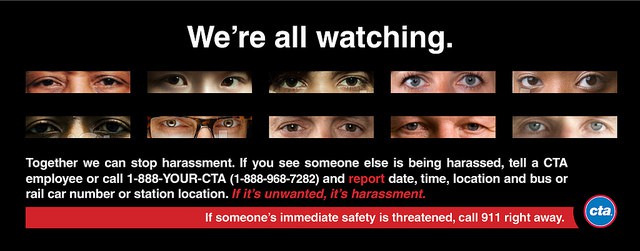
“The agency is addressing the problem through a new informational campaign. ‘If It’s Unwanted, It’s Harassment’ warns would-be offenders that abusive behavior will not be tolerated.

CTA anti-Harassment Ad April 2016

The centerpiece of the campaign is a new line of rail and bus advertisements encouraging riders who see a fellow passenger being hassled to speak up, contact CTA personnel via an onboard intercom, or call 911 if there’s an immediate safety threat.

But some of the credit for the new initiative should go to the Courage Campaign, a grassroots organization launched in 2014 by Uptown resident Kara Crutcher to fight harassment on the CTA. Last year the group successfully lobbied the agency to shift its focus from simply asking victims to report incidents to preventing abusive behavior by raising awareness of the problem.

‘We’re happy to see a couple of CTA ads up regarding harassment,’ Crutcher said. ‘It is definitely a step in the right direction. . . . Personally, I hope that we can work with them to produce more educational ads, but we shall see.’

As for female-only cars, while Crutcher says these could provide a safe space for women suffering from post-harassment PTSD, she argues they’re a Band-Aid solution that doesn’t get to the root of the problem.

‘A cultural shift must occur,’ she says. ‘We must recognize and respect each other everywhere, but especially in these public spaces. . . . Putting men in a train car separate from me will not stop them from harassing me when we exit the train. But education, antistreet harassment advocacy, and courage might.””

Guardian, “‘I cried all the way back’: sexual harassment on public transport“

“How does it feel to be subject to unwanted sexual attention on your morning commute? Or on your way to school? We asked readers to tell us their stories of sexual harassment on public transport … Some told us about being followed off trains. Others told us about men trying to sneak a feel of their breasts between shopping bags. Then there were those who witnessed public masturbation, or were just teenagers when they were first subject to unwanted sexual attention. These experiences were not limited to those living within the jurisdiction of Transport for London.”

Nepal Republic Media, “Public transport is living hell for young women“

“Many young women and girls in Kathmandu Valley don’t like to use public transport because of sexual harassment, which is rife despite several attempts by the authorities to tackle the problem.

Soyana Nyachhon, an 18-year-old student, says she has encountered harassment many times while using public transport vehicles in the city. ‘I was traveling in a micro-bus in the Maitighar area recently and a man of around 25 to 30 came close to my seat deliberately. It made me feel really uncomfortable,’ she said.
‘I asked him to move away a little but he didn’t respond. So I kept quiet and prayed that my stop would come soon,’ she added. She further said it was not the first time she had faced such situations while using public transport.”
Via Liverpool Echo
Via Liverpool Echo

Liverpool Echo, “Women took to the streets of Liverpool to Reclaim the Night“

“It was the fourth year in a row that Liverpool has hosted the event, a campaign to raise awareness of womens’ right to walk free from abuse and assault on the streets.

Around 100 campaigners met outside Liverpool Town Hall and then marched past the bombed out church to the Liverpool Guild of Students for a rally…

Kate Menear, RTN Liverpool communications officer, said: ‘We’re basically just demonstrating that women have the right to walk freely at night without fear of violence. We’re campaigning against street harassment and gender violence in all its forms.’

Reclaim the night began in Leeds in 1977 inspired by Take Back the Night marches which took place in Germany the same year.”

Daily News, “Taxi and Limousine Commission puts sexual harassment rules for cabbies on hold“

“The Taxi and Limousine Commission slammed the brakes on explicit new definitions for sexual harassment on Thursday in the face of outrage from the industry.

The rule would have put specific definitions of sexual contact and sexual harassment on the books, plus a bigger $2,000 penalty for violations.

Under the new definition, hacks would have to steer clear of “any conversation related to sexual acts and sexual contact” and remarks about appearance, gender, sexual conduct or “desire to enter into any type of relationship with another person.”

But commissioners agreed to withdraw the proposed rule in order to fine tune it for next month’s meeting.

Opponents in the taxi industry argued there were too few sexual harassment or assault complaints to justify specific rules telling cabbies to keep creepy conversation to themselves.

They also feared that drivers would fall victim to false allegations.”

The Huffington Post, “14 Perfect Responses To People Who Want Harriet Tubman To Smile“

“It was announced that Harriet Tubman, an iconic “conductor” on the Underground Railroad who helped lead hundreds of other slaves to freedom, would replace former President Andrew Jackson on the front of the $20 bill. Though it’s been reported that the change may not go into effect until 2030, the idea of having a woman, especially a woman of color, on the bill sparked celebration for many people. But others weren’t so happy with — wait for it — the way Tubman’s face looked.

A quick scan on Facebook or Twitter turns up several posts from people who want Tubman to look more cheerful on the $20 bill and to smile (you know, because women should smile all the time).”

The Guardian, “Right to the city: can this growing social movement win over city officials?“

“‘We need a multitude of perspectives in participation to ensure we are building inclusive, resilient cities with social cohesion,’ says Kathryn Travers, director of Women in Cities International, who have partnered with Plan International and UN-Habitat on the programme. Enabling these girls to have a say in shaping better public spaces is critical in a context where women around the world continue to face harassment and violence in the urban realm: of the girls that the programme have worked with, 24% of them said that they never feel safe in public places. ‘It’s crucial that women and girls are consulted,’ Travers adds. ‘Gender gaps in cities lead to exclusion in public spaces. In some cities, upwards of 90% of women experience daily sexual harassment in public space.'”

The Fiji Times, “Street Harassment“

“She said constant sexist remarks such as uro, chrabi, sexy, chalega, and gandu was increasing day by day.

“The callings out from a passing vehicle, the slight passing of men’s hands on your body or the grabbing of the buttocks or breasts were forms of street harassment,” Ms Naidu said.

She said masturbating to women in public spaces, whistling and singing was also common.

“These unsolicited comments, unwanted grabbing, leering and gestures of sexual nature is something that women and girls experience daily.

“These are experienced by some as young as 14 years and boys as young as 12 years carry out such acts of street harassment.”

She said through the One Billion Rising Fiji and Take Back the Streets Fiji, advocacy and awareness campaigns had been carried out targeting this everyday form of violation of women.”

Daily Life, “Where is the line between normal behaviour and harassment?”

“Street harassment begins to look a lot more like a part of the routine objectification, oppression and social exclusion of women, LGBTIQ people, people of colour and people living with disabilities. It’s not a compliment. It is a form of violence and abuse with serious consequences. It has to stop.”

Mashable, “Comedian Jen Kirkman takes on street harassment with powerful retweets“

“Comedian Jen Kirkman turned her Twitter account into a platform for women to share their harrowing stories about street harassment on Tuesday.

Kirkman, who has 175,000 followers, has been performing in Melbourne, Australia, and said she encountered a group of men at 11 p.m. who called her a “bitch” for not answering when they said she was wearing a nice coat.

Melbourne men. When I walk alone &.4 of you yell “nice coat” I’m not a “bitch” not answering.Yell that at a dude. See if he doesn’t beat you

— Jen Kirkman (@JenKirkman) April 3, 2016

Her tweet about the incident garnered sexist responses from some men, but many women shared their sympathy and snippets of past similar experiences. It wasn’t long before Kirkman began retweeting those stories, which collectively demonstrate how street and sexual harassment are pervasive and insidious.

I will now RT every woman who had experienced street harassment even in broad daylight by “normal men”. Dudes. Don’t mute this. Begin!

— Jen Kirkman (@JenKirkman) April 4, 2016″

Share

Filed Under: News stories, public harassment, street harassment

50,000 People Use #WhenIwas to Share Experiences of Sexism, Harassment and Abuse

April 25, 2016 By HKearl

Last week, more than 50,000 people used the Twitter hashtag #WhenIwas to share their first experiences of sexism, harassment and assault. They show how huge the problem is and how young it starts.

Laura Bates, founder of the Everday Sexism Project, started the hashtag and wrote about why in a recent article for The Telegraph:

“I started it because I wanted people to recognise that sexism, harassment, discrimination and abuse can begin from a shockingly young age.

When you talk about women being shouted at in the street, or fielding unwanted sexual advances in the workplace – as we do daily on the Everyday Sexism Project, which I founded – a common response is: ‘It’s just a bit of fun – can’t you take a harmless compliment?’

One of the most effective ways to counter that argument is to reveal the fact that this ‘harmless fun’ starts when girls are under the age of 10-years-old. That we’re talking about schoolgirls in their uniform being groped on public transport, or hearing grown men shout at them in language so sexually explicit they sometimes don’t even understand what it means.

What kind of ‘compliment’ is that? The idea that sexual harassment is just gentle flattery completely fails to acknowledge the fact that it sets up a power dynamic. This is about preying on women, asserting power and control over them. Nothing about that is flattering.”

I agree and always mention the young age that street harassment begins in media interviews and speeches that I give. If we can’t all agree that grown women shouldn’t have to face sexual harassment and abuse, surely we can all agree that girls shouldn’t, right??

Bates concludes her article by saying:

“The #WhenIwas hashtag makes difficult reading, but it is important, especially for those who want to believe that these things are ‘one off’ incidents. While many men have tweeted their shock at the stories being shared, many women remarked that they could identify with almost every single one.

It’s sad that this is what it takes for people to recognise the problem. That an individual woman’s word isn’t enough for people to believe her until 50,000 others come forward and say that the same thing has happened to them, too. That even when we provide reams of examples, people continue to doubt the systemic nature of the problem.

I hope that movements like the one I started last week help those who might have been made to feel ashamed – or even responsible for what happened to them – to realise that it was never their fault, and that they’re not alone.”

Share

Filed Under: News stories, street harassment Tagged With: everyday sexism, laura bates, trending twitter, WhenIwas, young age

Survey about African American Women’s Experiences in Public Spaces

April 24, 2016 By HKearl

4/29/16 UPDATED: Women ages 18-40 may take the survey.

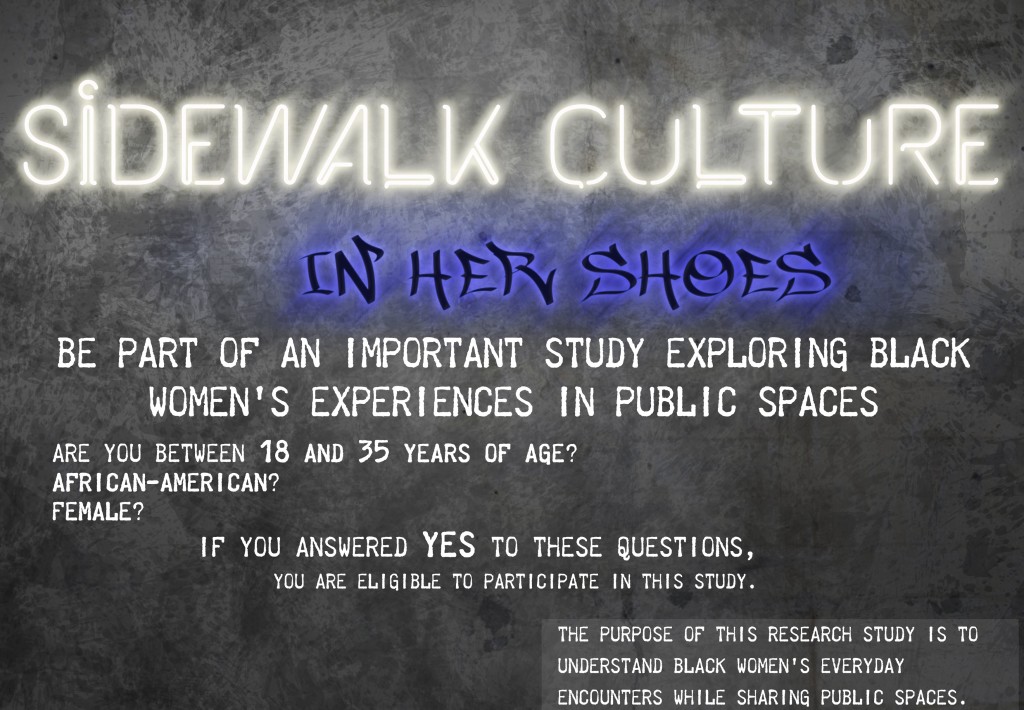
Attention African American women ages 18-35 years old, female African American researchers at Yale University are studying YOUR experiences in public spaces and would love to hear from you.  The survey will take 22-25 minutes of your time. The researchers believe that everyone has a unique story to tell, and they would like to help tell your story. Get updates via the Sidewalk Culture Facebook page.

sidewalkposter

Share

Filed Under: race, Resources, Stories Tagged With: african american women, research, yale

« Previous Page
Next Page »

Share Your Story

Share your street harassment story for the blog. Donate Now

From the Blog

  • #MeToo 2024 Study Released Today
  • Join International Anti-Street Harassment Week 2022
  • Giving Tuesday – Fund the Hotline
  • Thank You – International Anti-Street Harassment Week 2021
  • Share Your Story – Safecity and Catcalls Collaboration

Buy the Book

  • Contact
  • Events
  • Join Us
  • Donate
  • Facebook
  • Instagram
  • Pinterest
  • Tumblr
  • Twitter
  • YouTube

Copyright © 2026 Stop Street Harassment · Website Design by Sarah Marie Lacy