• About Us
    • What Is Street Harassment?
    • Why Stopping Street Harassment Matters
    • Meet the Team
      • Board of Directors
      • Past Board Members
    • In The Media
  • Our Work
    • National Street Harassment Hotline
    • International Anti-Street Harassment Week
    • Blog Correspondents
      • Past SSH Correspondents
    • Safe Public Spaces Mentoring Program
    • Publications
    • National Studies
    • Campaigns against Companies
    • Washington, D.C. Activism
  • Our Books
  • Donate
  • Store

Stop Street Harassment

Making Public Spaces Safe and Welcoming

  • Facebook
  • Instagram
  • Pinterest
  • Tumblr
  • Twitter
  • YouTube
  • Home
  • Blog
    • Harassment Stories
    • Blog Correspondents
    • Street Respect Stories
  • Help & Advice
    • National Street Harassment Hotline
    • Dealing With Harassers
      • Assertive Responses
      • Reporting Harassers
      • Bystander Responses
      • Creative Responses
    • What to Do Before or After Harassment
    • Street Harassment and the Law
  • Resources
    • Definitions
    • Statistics
    • Articles & Books
    • Anti-Harassment Groups & Campaigns
    • Male Allies
      • Educating Boys & Men
      • How to Talk to Women
      • Bystander Tips
    • Video Clips
    • Images & Flyers
  • Take Community Action
  • Contact

Portugal’s Law Against Street Harassment

February 19, 2016 By HKearl

Via Equal Times:
“In 2015 Portugal’s Social Democratic Party made verbal sexual abuse a crime, carrying a prison sentence of up to a year.
 
“Whoever harasses another person, practising before her acts exhibitionist in character, formulating proposals of a sexual tenor or embarrassing her with contact of a sexual nature, is punished with a penalty of imprisonment of a year, or a penalty fine of up to 120 euros if a more serious penalty is not applicable under any other legal provision,” reads the new wording of Article 170 of the penal code.
 
Ferreira Leite co-authored a report after Portugal became the first country to ratify the Istanbul Convention– by which the Council of Europe sets out standards to protect victims of gender-based violence – in 2013. She was also involved in advocating for amendments to Article 170.
 
“Before, sexual contact was included but it was restrictive. You had to touch the victim, so we decided to include threatening and intrusive comments,” says Ferreira Leite.
 
She says she has been surprised by some of the reactions to the amendments.
 
“Some men think that [harassment] means freedom of speech. That it is a compliment and that they shouldn’t have to walk around silent.”
 
But the amended law has its limits, Leite explains. “Not every comment is a crime; it has to have sexual context or a pornographic reference. Saying that someone is pretty doesn’t count….

The necessity for a measure to combat verbal abuse toward women was first proposed by the non-profit organisation UMAR (Union of Women for Alternatives and Answers), which received funding in 2010 from the Dutch government to travel around the country and raise awareness of the issue.

“We found that most women had been verbally assaulted on the street and also that both men and women confused sexual assault with seduction or praise,” says UMAR head Maria Jose Magalhaes. “They didn’t know what assault was. There was an idea that it wasn’t serious because sexism is so ingrained in our culture.”

The radical Left Bloc party – which was founded by four feminists and whose leader, Catarina Martins, is the only woman leader amongst Portugal’s major parties – took the discussion of verbal assault to parliament in 2014.

Left Bloc MP and sociologist Sandra Cunha says the law was necessary to show that sexual assault is unacceptable.”

Share

Filed Under: News stories, Resources, street harassment Tagged With: law, Portugal

NYC Male Focus Group Opportunity

February 19, 2016 By HKearl

4inRinOc_400x400SAFER: NYC is a social enterprise founded by Columbia University School of International and Public Affairs graduate students, dedicated to engaging men in ending street harassment in New York City.

SAFER: NYC is currently working on a large-scale research project within the issue of street harassment in order to deepen our understanding of what solutions will have the most impact in making our streets safer for everyone.

As part of this research, they are conducting focus group conversations with small groups of adult men across NYC’s boroughs. These are 30-minute conversation with you and 5-8 of your male peers. They can provide some compensation to all participants as well as refreshments during the session. Furthermore, all participants will remain completely anonymous.

If you are interested or want more information, contact them at safernewyorkcity@gmail.com.

Share

Filed Under: male perspective, Resources, street harassment Tagged With: focus group, men, NYC, research

Speech Project and Online Harassment

February 16, 2016 By HKearl

There’s a new Speech Project about online harassment at Women’s Media Center, led by our friend, ally and supporter Soraya Chemaly!!

“The prevalence of online harassment toward women leads them to feel limited in their online interactions, and its frequent dismissal leads them not to take their own harassment seriously. By treating online harassment as the crime that it is, we make women less likely to blame themselves — because going online should not be another item on the list of behaviors women are told to avoid to stay safe….

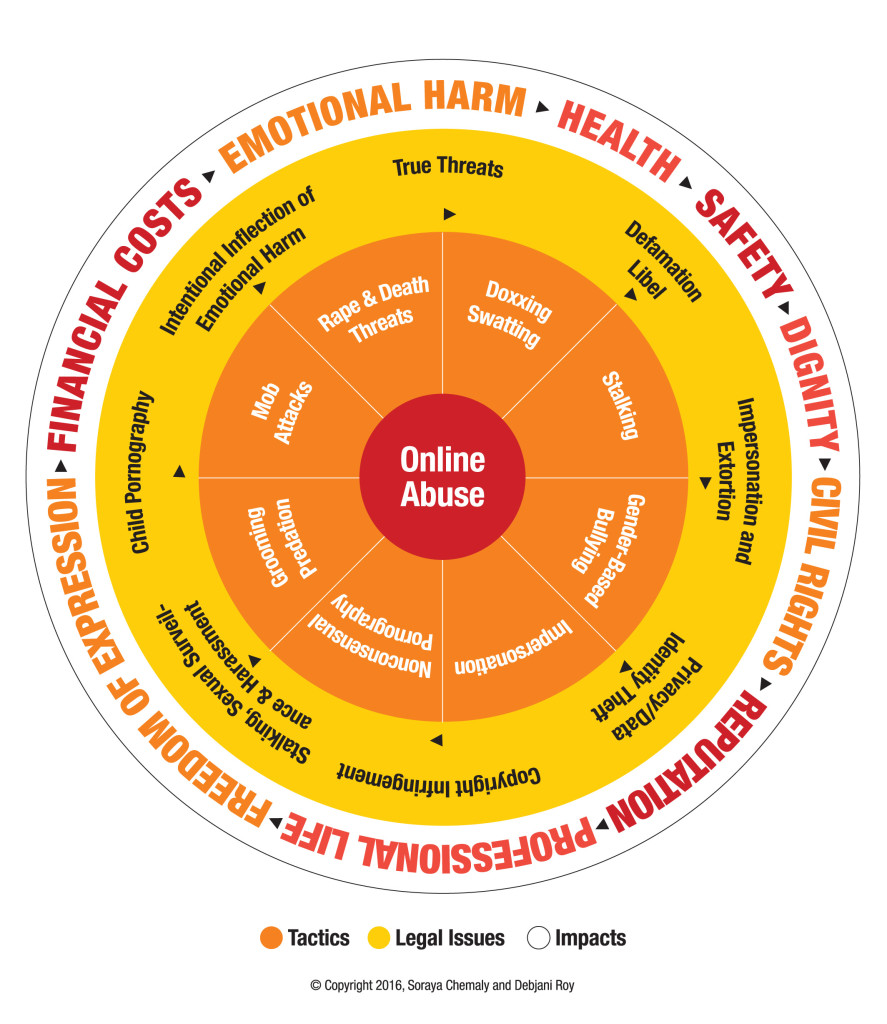
The website contains a glossary of terms related to online harassment, research and statistics about its different forms, and a wheel demonstrating the different types, consequences, and legal classifications of online harassment.”

Print

Share

Filed Under: online harassment, Resources Tagged With: online harassment, Soraya Chemaly, women's media center

Film: “Ovarian Psycos”

February 15, 2016 By HKearl

UPDATE: Support the film’s Kickstarter campaign!

This new filmOvarian Psycos film is premiering at SXSW!

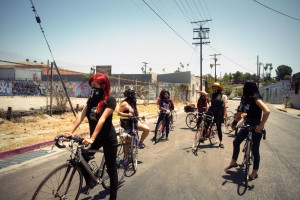
“The Ovarian Psycos gear up and ride out into the night, fanning out in pairs of two, four, and six. In constant motion, cruising up and down the storied streets of Boyle Heights, East Los Angeles, and Lincoln Heights, they call out to new riders to join them in a journey through the neighborhood. “Whose streets? Our streets!”

Since forming in the summer of 2011 by activist, poet M.C., and single mother, Xela de la X, the Ova’s have made it their mission to cycle for the purpose of healing, reclaiming their neighborhoods, and creating safer streets for women on the Eastside. At first only attracting a few local women, over the past few years the Ovarian Psycos have inspired a ferocious and unapologetic crowd of local heroines who are a visible force along the barrios and boulevards of Los Angeles.

Ovarian Psycos rides along with the Ova’s, exploring the impact of the group’s brand of feminism on neighborhood women and communities as they confront the violence in their lives.”

Wonderful!

Share

Filed Under: Resources, street harassment Tagged With: bicycling, documentary, film, los angeles, Ovarian Psycos, violence

Mid-February 2016 News

February 15, 2016 By HKearl

Here’s a sampling of relevant stories from the past two weeks:

BBC, “Iranian youth get app to dodge morality police”

Via BBC
Via BBC

“An anonymous team of Iranian app developers have come up with a solution to help young fashion conscious Iranians avoid the country’s notorious morality police known in Persian as “Ershad” or guidance.

Ershad’s mobile checkpoints which usually consist of a van, a few bearded men and one or two women in black chadors, are deployed in towns across Iran and appear with no notice.

Ershad personnel have a very extensive list of powers ranging from issuing warnings and forcing those they accuse of violating Iran’s Islamic code of conduct, to make a written statement pledging to never do so again, to fines or even prosecuting offenders.

The new phone app which is called “Gershad” (probably meaning get around Ershad instead of facing them) however, will alert users to checkpoints and help them to avoid them by choosing a different route.

The data for the app is crowdsourced. It relies on users to point out the location of the Ershad vans on maps and when a sufficient number of users point out the same point, an alert will show up on the map for other users. When the number decreases, the alert will fade gradually from the map.

In a statement on their web page the app’s developers explain their motives in this way: “Why do we have to be humiliated for our most obvious right which is the right to wear what we want? Social media networks and websites are full of footage and photos of innocent women who have been beaten up and dragged on the ground by the Ershad patrol agents.”

“Police need to provide security for the citizens not to turn into a factor for fear. A while ago, angry with such unreasonable oppressions, we looked for a solution to find a practical way to resist the volume of injustices peacefully with low risk level, to restore part of our freedom.”

The app has rapidly become a hot topic on Iranian social media, with users generally welcoming it as an innovative way to avoid a potentially unpleasant encounter with the guardians of national virtue.”

BuzzFeed News, “Teen Turns Himself In After On-Air Sexual Assault Of Belgian TV Reporter”

“A 17-year-old man has turned himself in to police in Cologne, Germany, after a Belgian journalist covering a city carnival was sexually assaulted during a live television report.

Esmeralda Labye, a reporter for Belgium’s RTBF, had her breast grabbed and neck kissed while reporting from Cologne’s Carnival celebrations.

In a statement released Friday by Cologne police, authorities said the teen, who was accompanied by his mother, told officers he appeared in the images taken of the incident.

Police said the teen denied having approached the journalist with “sexually motivated intentions.”

It is unclear if he has been charged in the incident. Police said the investigation is still ongoing.

According to the BBC, there were 22 incidents of sexual assault on the first night of Carnival.”

Women’s Refugee Commission, “No Safety for Refugee Women on the European Route”

“There is virtually no consideration of gender-based violence along the route to ensure safe environments, identify survivors and ensure that services are provided to them…

There is an urgent need for the Serbian and Slovenian governments, in collaboration and coordination with other countries, the European Union (EU) and the UN refugee agency (UNHCR), to take control of a hastily developed and chaotic humanitarian response and put in place the policies, programs, services and personnel that will protect women and girls from a myriad of risks from the moment they arrive and through the journey to a safe resettlement.”

News, “Woman uses The Force to repel attacker in absurd Finnish anti-rape video”

“Police in Finland have been panned over an absurd anti-rape video which appears to show a woman using ‘The Force’ to repel a would-be attacker….

Some questioned whether the video was a joke or a Saturday Night Live sketch, while others pointed out the obvious Star Wars references.

Many were simply angry. ‘It’s not even funny anymore, but really, really pathetic that it’s come to this,’ wrote Jaana Tuukkanen.”

Independent, “German residents left outraged after mayor says young girls ‘provoke’ sexual harassment”

“Residents of a small German town have been left outraged after its mayor suggested young girls “provoke” sexual harassment.

Jens Müller, Mayor of Bad Schlema, Saxony, made the comments at a council meeting last week, after a grandfather raised concerns young girls were being subject to harassment as they walked home from school, German newspaper FreiePresse reports….

The man, who has not been identified, claimed his granddaughter, who he said was under 10 years old, had been a victim of such behaviour.

In response to the comments Mr Müller said: “That’s easy, just don’t provoke them and don’t walk in these areas.”

“It’s technically not necessary for the girls to walk there,” he added. “There are alternative routes for going to school.”

The comments sparked outrage among residents who accused the mayor of focusing on the victims rather than the perpetrators.”

The Establishment, “Nobody Catcalls the Woman in the Wheelchair”

“Why is my experience so invisible to the feminist community?

When I retreated to online feminist spaces—supposedly safe spaces—looking for community, what I found was endless discussions of the ubiquity of street harassment. Here was a universal consequence of sexism, misogyny, and rape culture. Here was something all women could understand and rally against. Here was our uniting experience.

I found feminism and I thought, Maybe I don’t count here either.

I don’t expect every conversation of street harassment to come with a disclaimer, and I certainly don’t expect to see myself reflected in every essay or article or tweet on the subject. But this admittedly useful assumption that “Women Experience Sexualized Street Harassment” is necessarily exclusionary. That’s not the intent, but as feminists ought to know, intent doesn’t erase harm.”

Broadly, “Big Tits for 600: The Ugly, Sexist Aftermath of Appearing on ‘Jeopardy!‘”

“After my appearance on the theoretically wholesome game show went viral, I received countless lewd and harassing Internet comments. Sadly, my experience is not unique….

when I joined an online group for fellow Jeopardy! alumnae, I discovered that, with the exception of the Turd Ferguson viral thing, my experience had not been all that unique: I began to notice that other women had experienced the same bombardment, and some of them had felt the same crimson-faced confusion about how to react….

Other women—like Amanda Hess, Anita Sarkeesian, and Congresswoman Katherine Clark—have spoken out about the ways women can be the subjects of disproportionate and gendered harassment online. None of the women I spoke to, myself included, had expected their spot in a family-friendly, early-evening trivia show to earn them a toxic mixture of sexualized opprobrium.

And yet, as I set out to better understand my own experience, and those of other women who had sought out America’s most famous trivia gauntlet, I was heartened by the one thing I did not find: regret. Not one of the women I spoke with regretted their decision to appear on Jeopardy!, fulfilling childhood dreams in some cases, paying off student debt in others. Despite the chagrin-inducing—and sometimes downright unsettling—responses we received, each of us had reveled in the change to engage in intellectual competition, to shake Alex Trebek’s hand, and, in my case, to strike a blow for doofuses everywhere.

“Those men don’t own me. I own me and determine how I behave and how I present myself,” said Tiombi Prince. “I refuse to have my accomplishments diminished.”

Oxygen, “Oxygen52: Tatyana Fazlalizadeh Uses Public Art To Fight Street Harassment”

“Her newest portrait series, Women Are Not Seeking Your Validation, is currently on display at the Corridor gallery in Brooklyn. Just as with Stop Telling Women to Smile, it was important for Fazlalizadeh to share the faces as well as the voices of women by incorporating their words into each portrait. Though some text speaks to the viewer and some to the individual woman’s experience and who she is as a person, every piece is an effort to address how women are perceived in public privates spaces – art galleries, school settings, work environments. It’s about reclaiming spaces and raising the voices of women, one portrait at a time.”

Jakarta Post, “Greater Jakarta: Go-Jek driver sacked for sexual harassment“:

“A male motorcycle taxi driver working for smartphone application Go-Jek has been fired for alleged sexual harassment against a young female passenger. The passenger’s sibling posted message about the incident on social media. The now-viral post was initially shared via social media platform Path but has now been shared through other platforms such as Twitter and Facebook. According to the post, the Go-Jek driver, Irwan, picked up the 17-year-old victim at her school. During the ride to the young girl’s home, Irwan told the victim stories of his sex life, causing the latter to be uncomfortable. The young girl reportedly ignored Irwan.

However, upon arriving at the specified destination, Irwan took the victim’s hand and hugged her. When the victim refused his advances, Irwan sexually harassed her.

The post also included text messages Irwan had sent to the victim after the incident. Irwan told the victim not to “misunderstand” and said that she still needed “much learning”. PT Go-Jek Indonesia public relations manager Rindu Ragilia said in an official statement that Go-Jek had cut partnership with Irwan, who has confessed to sexually harassing the victim.”

Slate, “Is Catcalling Ever Ok?”

“Through pop culture depictions and beauty norms, women are socialized to believe that one of their greatest contributions to society is sexual desirability, and that when their youthful beauty fades or never materializes at all, they’re worthless, or at least worth less. Women of any age deserve to feel beautiful, desirable, and of great import to the world. Whether she enjoys catcalls or not, she shouldn’t have to use them to measure her value.”

Share

Filed Under: News stories, street harassment Tagged With: finland, germany, indonesia, iran, usa

« Previous Page
Next Page »

Share Your Story

Share your street harassment story for the blog. Donate Now

From the Blog

  • #MeToo 2024 Study Released Today
  • Join International Anti-Street Harassment Week 2022
  • Giving Tuesday – Fund the Hotline
  • Thank You – International Anti-Street Harassment Week 2021
  • Share Your Story – Safecity and Catcalls Collaboration

Buy the Book

  • Contact
  • Events
  • Join Us
  • Donate
  • Facebook
  • Instagram
  • Pinterest
  • Tumblr
  • Twitter
  • YouTube

Copyright © 2026 Stop Street Harassment · Website Design by Sarah Marie Lacy