• About Us
    • What Is Street Harassment?
    • Why Stopping Street Harassment Matters
    • Meet the Team
      • Board of Directors
      • Past Board Members
    • In The Media
  • Our Work
    • National Street Harassment Hotline
    • International Anti-Street Harassment Week
    • Blog Correspondents
      • Past SSH Correspondents
    • Safe Public Spaces Mentoring Program
    • Publications
    • National Studies
    • Campaigns against Companies
    • Washington, D.C. Activism
  • Our Books
  • Donate
  • Store

Stop Street Harassment

Making Public Spaces Safe and Welcoming

  • Facebook
  • Instagram
  • Pinterest
  • Tumblr
  • Twitter
  • YouTube
  • Home
  • Blog
    • Harassment Stories
    • Blog Correspondents
    • Street Respect Stories
  • Help & Advice
    • National Street Harassment Hotline
    • Dealing With Harassers
      • Assertive Responses
      • Reporting Harassers
      • Bystander Responses
      • Creative Responses
    • What to Do Before or After Harassment
    • Street Harassment and the Law
  • Resources
    • Definitions
    • Statistics
    • Articles & Books
    • Anti-Harassment Groups & Campaigns
    • Male Allies
      • Educating Boys & Men
      • How to Talk to Women
      • Bystander Tips
    • Video Clips
    • Images & Flyers
  • Take Community Action
  • Contact

#16Days of Activism: Marching (Day 7)

December 1, 2015 By HKearl

Nov. 25 – Dec. 10 are the 16 Days of Activism Against Gender-Based Violence. To commemorate the week, we are featuring 1 activism idea per day. This information is excerpted from my new book Stop Global Street Harassment: Growing Activism Around the World (Praeger 2015).

Since the mid-1970s, Take Back the Night and Reclaim the Night marches have occurred annually in many cities worldwide to challenge rape. Starting in 2011, SlutWalk marches spread globally, too, with participants criticizing rape culture and victim blaming. In recent years, there have also been marches in countries like Afghanistan, Colombia, Nepal, Romania, South Africa, and the United States.

Afghanistan. Image via Gender Across Borders

On a hot day in 2011, 50 women and men carrying banners and signs with messages like, “We will not tolerate harassment,” “Islam forbids men from insulting women,” and “I have the right to walk freely in my city” marched together from Kabul University to the Afghanistan Independent Human Rights Commission. Organized by Young Women for Change, marchers handed out fliers to raise awareness about the problem of street harassment in their country. Most of the people they passed on the street stood shocked, staring, since openly supporting women’s rights can be dangerous. Despite the presence of a police escort, some men heckled the marchers and called them names. But others were supportive and took fliers or joined the march. Organizer Noorjahan Akbar, then a 20-year-old college student, told me in an interview at the time: “It was so thrilling to see that none of us are alone in this fight and we are willing to stand up for each other.”

In 2012, between 3,000 and 5,000 women and men joined together to march through Johannesburg, South Africa, outraged by the sexual assault of two women wearing short skirts at a taxi rank and by the daily street harassment most women face. They carried signs with messages like “I will wear my mini-skirt anywhere!” and “Humiliating women is a sin before God.” Lulu Xingwana, the minister of women and children and people with disabilities marched too, and told the local news station: “Through this march, we are reclaiming our streets from those who abuse and terrorize women and children.” She also warned she would close down taxi ranks if harassment and assault against women continued there.

In Bogota, Observatorio Contra el Acoso Callejero Colombia held a march against street harassment in the center of the city in 2014. More than 100 people participated, carrying signs with messages like “Nuestros Cuerpos No Hacen Parte Del Espacio Publico!” (Our bodies are not public space!). The group joined forces with a female percussion group called La tremendarevoltosabatucadafeminista and a performance group called Tulpadanza, which both brought extra energy to the march.

Also in 2014, with the help of volunteers from the feminist organization Filia, Simona-Maria Chirciu organized a 100-person march through Bucharest, Romania. Women and men of all ages held signs that read, “Harassment is violence,” “We don’t need your validation,” and “It is NEVER ok to harass people! So stop doing it.” Numerous women’s rights groups participated. Chirciu wrote for the SSH blog: “People on the streets interacted with us, greeted us, and asked questions about our march: ‘Hey, do you think a march will solve the problem? Boys need to be educated or legally punished for doing this.’ Yes! Maybe a march doesn’t solve the street harassment issue, but it can raise awareness and is empowering for the march participants.”

Help fund our work in 2016, donate to our end-of-year giving campaign!

Share

Filed Under: 16 days Tagged With: Afghanistan, colombia, marches, Romania, south africa

#16Days of Activism: Street Demonstration (Day 6)

November 30, 2015 By HKearl

Nov. 25 – Dec. 10 are the 16 Days of Activism Against Gender-Based Violence. To commemorate the week, we are featuring 1 activism idea per day. This information is excerpted from my new book Stop Global Street Harassment: Growing Activism Around the World (Praeger 2015).

Initiating a street demonstration by holding signs with anti-harassment messages, asking people to write their own messages, and facilitating impromptu conversations are additional tactics growing in popularity among people wishing to challenge street harassment in their community. These types of actions have taken place in many countries, including Jordan, Egypt, Chile, India, and the United States.

Human chain in Jordan. Image via Al Bawaba

In June 2012, more than 200 people in Amman, Jordan, formed a “human chain” from Al Hussein Sports City to the Interior Ministry Circle to protest various gender-based crimes, including street harassment, the practice of forcing rape survivors to marry their rapists, and honor killings. Women and men of all ages stood in a row, each holding signs that condemned these acts and called for behavioral changes and changes to laws. Weeks later in Egypt, the Nefsi (I Hope) anti-sexual harassment campaign also organized scores of people into a human chain along a busy road in Cairo. Some of the participants’ signs read “I wish I could ride a bike without anyone bothering me” and “I wish you would respect me as I respect you.”

Chile

In 2014, Observatorio Contra el Acoso Callejero en Chile held an open outdoor meeting at a plaza where more than two dozen women and men of all ages discussed street harassment, passed out pamphlets to passersby, and wrote anti-street harassment messages on signs like “Mi cuerpo no es un objeto” (“My body is not an object”) and “Yo me visto para mi no para ti” (“I dress for me not for you”). They held the signs for passersby to see and then attached them to strings hung around the plaza. They also attached small ribbons on which they had written their street harassment experiences, and people walking by stopped to read them.

India

In Bangalore, India, members of the volunteer group Jhatkaa spent a day in 2014 walking around the streets of the city with a whiteboard and asking women to write down their experiences with street harassment. People were eager to participate and wrote statements like, “Lots of times men have pinched my breasts and made passes at me on the buses,” “Been whistled and stared at wearing a pair of jeans,” and “The creepy stare.” The organizers wrote in a summary of their event: “Many women thanked us for doing it and told us they felt lighter after speaking about it and participating in fighting against it. On seeing photos of other women and their experiences-they also felt good knowing that they weren’t the only ones. We shared these photos on Facebook and Twitter and received positive comments for the work.”

Philadelphia, USA

Since 2011, Philadelphia-based groups like FAAN Mail and Feminist Public Works have held a demonstration in the spring. It includes drumming, chalking, and posting flyers and signs and discussing street harassment with passersby. In 2014, they framed it as reclaiming public space at LOVE Park and hosted chalking, street theater, music, art making, and double Dutch jump rope. People could write their answers to complete the phrase “A Safe Street is …,” and several chose to publicly share their street harassment stories while standing on a “soap box.” Around 50 people participated. “This year’s action in Philadelphia was our most dynamic action yet,” wrote FAAN Mail co-founder Nuala Cabral in a report of the event. We offered several activities that enabled people to reclaim public space and address this problem in creative ways. Children were a part of the event. Male allies stood with us. It was a beautiful day.”

Help fund our work in 2016, donate to our end-of-year giving campaign!

Share

Filed Under: 16 days, anti-street harassment week, street harassment Tagged With: chile, India, jordan, street demonstration, usa

#16Days of Activism: Painting Murals (Day 5)

November 29, 2015 By HKearl

Nov. 25 – Dec. 10 are the 16 Days of Activism Against Gender-Based Violence. To commemorate the week, we are featuring 1 activism idea per day. This information is excerpted from my new book Stop Global Street Harassment: Growing Activism Around the World (Praeger 2015).

Painting murals and spray-painting graffiti against street harassment is a type of political art and communication that has been used in many cultures since ancient times.

Circle of Hell mural in Egypt. Via the Art Newspaper

During the Egyptian Revolution of 2011, graffiti art and murals were used to voice political opinions. Some women used these to speak out against the sexual harassment and violence many women protesters faced. Artist El Zeft nad Mira Shihadeh, for example, painted a mural called Circle of Hell depicting dozens of leering men surrounding one woman like a pack of wolves surrounding its prey.

One graffiti stencil from that time period was a blue bra accompanied by the caption “No to the stripping of people” and below it was the outline of a foot that said, “Long live the revolution.” It references a 2011 videotaped beating of a female protester by police during which all of her clothes were stripped off, which revealed her blue bra. Some messages were defiant. One graffiti stencil created by Hend Kheera featured a woman with the caption, “Warning! Don’t touch or castration awaits you!” A stencil created by Mira Shihadeh (featured on the book’s cover) showed a woman standing tall and holding a spray can to spray away tiny men. The caption read “No to sexual harassment.”

Egyptian anti-street harassment activists with the group HarassMap have also used graffiti to bring attention to sexual harassment in public spaces. In 2013, for example, a team of mostly male volunteers in Giza wrote messages on walls like “Be a man; protect her from harassment instead of harassing her” and “No to harassment” while a team in Alexandria covered up sexist graffiti that promoted violent harassment by painting a mural that said, “LOVE.”

Anti-street harassment activists in Nepal and the United States painted murals in 2014. In Kathmandu, ten young women and men from the group Astitwa painted a huge mural with a street, a “stop” hand and their logo. The main message in green block lettering was “We Are against Street Harassment,” and each person placed her or his hands in red paint and added their hand-print below it.

Nepal

On their U.S. mural, People’s Justice League (formerly Hollaback! Appalachian Ohio) wrote the messages “Bobcats against cat-calls” and “YOU have the power to end street harassment” (with their logo) and drew a map of uptown Athens with red and green dots showing where people had reported being harassed (red) and where they reported intervening in harassment situations (green).

Help fund our work in 2016, donate to our end-of-year giving campaign!

Share

Filed Under: 16 days, street harassment Tagged With: Egypt, graffiti, murals, Nepal, ohio

Asian American Women Share their Stories

November 29, 2015 By HKearl

Note: Last year, SSH released a national study on street harassment that includes the results of a 2,000 person nationally representative survey and 10 focus groups with under-represented voices. As I have the opportunity and resources to do so, I will continue holding focus groups. Focus group #11 was with Asian American women in Boston, Massachusetts earlier this month. Below is a two-page summary from it, which is also now included in the research report (see pages 59-60). Thank you to the women who participated and to Sarah Chang for inspiring it and hosting it.

11.4.15 Asian American women SSH focus group in Boston, MAAsian American women in the SSH focus group in Boston, MA.

Asian American women’s harassment experiences are often overlooked. Thus, in November 2015, nine women with nations of origin from varying East Asian and Southeast Asian countries came together in Boston, Massachusetts, to document and talk about their experiences.

Participant Pam said, “I appreciate talking about identity and race. I think a lot of times in data and research, the Asian American voice is not included, which unintentionally leaves us silenced and reinforces the stereotype that we are silent.”

In sharing their stories, men following them, blocking their path, or engaging in repeated harassment emerged as common themes.

A man followed Catherine for approximately 45 minutes until she was able to lose him in a grocery store that had a back exit. She talked about her feeling of paranoia and fear. “All you want to do is shut down but you have to somehow keep going or something bad may happen.”

Eight white men harassed Jenn as she entered a subway station, then followed her and sat all around her as she waited for the subway. Then they surrounded her on the subway. “At this point I’m terrified,” she said. “I’m like what if they follow me to the stop? What if they get off at the stop with me?” Finally, before her stop, they got off.

Angela was in her car in an empty grocery store parking lot and as she was getting ready to leave, a man in a black SUV pulled up behind her, blocking her in. He came over and tapped on her window. Thinking he needed directions, she rolled down her window only for him to then tell her she was beautiful and hit on her. She rolled up her window and yelled that she needed to go. Fortunately, he drove away and let her.

A man engaged Cassie and the woman she was dating in conversation outside a club. Then he escalated to harassment, following them inside. He only left them alone once a bouncer ejected him from the club.

A man followed D. from the post office nearly all the way to her office. Finally he got the hint that she was uncomfortable

A man harassed Sarah three different times near her home, including telling her to “suck my dick.” She filed a police report.

Like women in other racial groups, many of their experiences with street harassment are racialized. They all agreed it is common for men to yell “Nǐ hǎo” or “Konichiwa” (“hello” in Chinese and Japanese, respectively) at them. Notably, this happens no matter the woman’s nation of origin.

When Catherine was reading on a park bench, a man repeatedly said “Nǐ hǎo” and “Konichiwa” to her, but then he quickly escalated to sexualized epithets. “Things like, ‘Oh your pussy must be sideways,’ and ‘has anyone ever fucked you?’” she said.

Various men have asked the women what they are. Katie said, “Instead of hello, they say what are you? Are you Chinese?”

Every woman said most, if not all, of her harassers have been non-Asian men, some of whom seem to be fetishizing them. Pam mused this may be because “There is this special race power element of ooh you’re this little Geisha who won’t talk about it.”

Several of them noted that the harassment tends to be worse when they are with another Asian American woman who is either a romantic partner or a friend.

Pam said, “It’s like some sick white man’s fantasy that there are two Asian American women together. It excites them even more.” As an example, she shared this story: “I was on the train with another Asian American female late at night and there were a bunch of white frat dude types and one was like, ‘Oooh who wants to eat Chinese food?’ and they just started getting nasty. You could tell they were so excited to see two Asian American women together.”

Cassie shared that “If I’m out with a woman [I’m dating], especially an Asian American woman, it’s usually like it’s really hard just to be out [because of harassers]…It feels really complicated in terms of race. I want to date people who look like me. But I feel safer with white people because they’re usually the ones I feel the most scared to be around. So if I’m with a white man, I feel like I have this pass… But it feels shitty.”

Many noted that the harassment began around puberty, usually by older men. N., for instance, said, “I have memories of my childhood and being in my teen years when people would harass me.”

Jenn began walking home from the bus stop around age 10 and she was often harassed, including by older Asian men. “That’s when I learned that my body was a sexual object,” she said. “I was a child learning that I would never be safe in my own body.”

When Diana was in middle school, she had to take the subway to the library alone in the afternoon. One day on the platform, a man repeatedly touched her lower back. She’s always tucked in her shirts ever since.

Several women noted that they try to drive or bicycle everywhere as a way to avoid harassment. Most women agreed they are never or rarely harassed when they are with another man, either a romantic partner or friend. N. observed from her experience, “If you don’t use public transportation, if you bike around, if you don’t interact with people, you don’t really get those catcalls.”

A few women shared how they feel they must be rude or stern in public because as soon as they are smiling, pleasant or engage in small talk with men, it escalates into harassment. Katie said, “I feel like any time I’ve just been pleasant out in the public space, I’ve been approached.”

Numerous women shared how their family and friends normalize the experiences or see it as a compliment. Angela said in her family it was seen as “boys being boys.” Now, she shares how she feels scrutinized and unsafe to explain why it’s not okay.

These were their ideas for change:

  1. Changing the normalcy of street harassment and ending the perception that it’s a compliment.
  2. Having boys and men listen to women’s stories so they can understand the effects of street harassment.
  3. Teachers talking to their students. Katie has had success asking her male students if that’s how they’d like their sister or mother treated.
  4. Men who get why it’s not okay talking to young men and boys.


Share

Filed Under: national study, race, SSH programs, street harassment Tagged With: Asian American, focus group, national study

#16Days of Activism: Posting Fliers (Day 4)

November 28, 2015 By HKearl

Nov. 25 – Dec. 10 are the 16 Days of Activism Against Gender-Based Violence. To commemorate the week, we are featuring 1 activism idea per day. This information is excerpted from my new book Stop Global Street Harassment: Growing Activism Around the World (Praeger 2015).

Afghanistan

A simple way to raise awareness about street harassment that one person or a group can do is to hang flyers and posters on bulletin boards, walls, the backs of street signs, and other public places. Take Afghanistan. There, members of the group Young Women for Change, founded by college women, posted flyers about women’s rights and street harassment on the walls of Kabul several times, including a day in 2011 when 25 volunteers glued 700 fliers to walls around the city despite the potential danger involved in publicly calling for women’s rights. Their acts received a mixture of responses, from anger to support.

“I felt like my heart was going to melt down when we posted a poster and a shopkeeper who was there watching us post it couldn’t read it [because he was illiterate],” wrote then 20-year-old co-founder Anita Hadiary in a blog post. “He asked another person to read it. When he learned what the poster said, he started fixing the poster and glued it harder on the wall.”

Zimbabwe
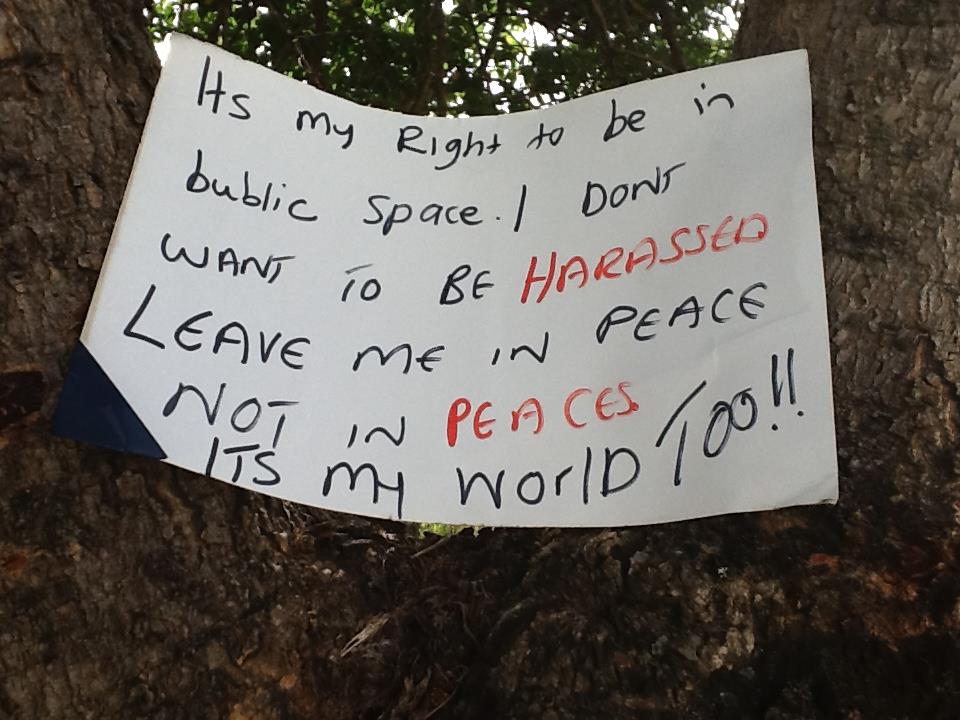
Zimbabwe

In 2013, members of the Zimbabwe Parents of Handicapped Children Association hung signs on trees in their rural community with messages like “It’s my right to be in public space. I don’t want to be harassed. Leave me in peace not in pieces. It’s my world too!” That same year, Ryerson University college students in Toronto, Canada, posted fliers on bulletin boards around their campus. One flier had an image of flat shoes with the words “These shoes do not make me a prude.” Another flier showed high-heeled shoes with the words “These shoes do not make me a slut.” The larger message was “I do not dress for you.”

When a few women in their 20s and 30s formed the STOP Harcèlement de rue in Paris, France, in 2013, one of their first actions was to post 50 fliers against harassment on walls, lamp posts, bar windows, and mailboxes near the Place de la Bastille in Paris, a crowded area well-known for street harassment. The fliers’ messages included “Me siffler n’est pas un compliment” and “Ma mini-jupe ne veut pas dire oui” (“Whistling at me is not a compliment” and “My mini-skirt is not a yes”). Throughout the summer of 2014, the women met every Monday night to put up posters around the city.

Mexico

In the United States, oil painter/illustrator Tatyana Fazlalizadeh launched Stop Telling Women to Smile in 2012. Her own daily experiences with street harassment inspired her to draw her own and other women’s faces and add simple anti-harassment messages. She would then photocopy the illustrations and paste them on walls. The messages included “Stop telling women to smile,” “Women are not outside for your entertainment,” and “Harassing women does not prove your masculinity.” During 2013, Fazlalizadeh held a very successful online fundraising Kickstarter campaign so she could travel to more than 10 cities across the United States to meet with women, hear their stories, create portraits, and then paste their portraits in their communities. In 2014, she also went to Mexico City.

Help fund our work in 2016, donate to our end-of-year giving campaign!

Share

Filed Under: 16 days, Resources, Street Respect Tagged With: 16 days of activism, activism, flyers, gender-based violence, Resources

« Previous Page
Next Page »

Share Your Story

Share your street harassment story for the blog. Donate Now

From the Blog

  • #MeToo 2024 Study Released Today
  • Join International Anti-Street Harassment Week 2022
  • Giving Tuesday – Fund the Hotline
  • Thank You – International Anti-Street Harassment Week 2021
  • Share Your Story – Safecity and Catcalls Collaboration

Buy the Book

  • Contact
  • Events
  • Join Us
  • Donate
  • Facebook
  • Instagram
  • Pinterest
  • Tumblr
  • Twitter
  • YouTube

Copyright © 2026 Stop Street Harassment · Website Design by Sarah Marie Lacy