• About Us
    • What Is Street Harassment?
    • Why Stopping Street Harassment Matters
    • Meet the Team
      • Board of Directors
      • Past Board Members
    • In The Media
  • Our Work
    • National Street Harassment Hotline
    • International Anti-Street Harassment Week
    • Blog Correspondents
      • Past SSH Correspondents
    • Safe Public Spaces Mentoring Program
    • Publications
    • National Studies
    • Campaigns against Companies
    • Washington, D.C. Activism
  • Our Books
  • Donate
  • Store

Stop Street Harassment

Making Public Spaces Safe and Welcoming

  • Facebook
  • Instagram
  • Pinterest
  • Tumblr
  • Twitter
  • YouTube
  • Home
  • Blog
    • Harassment Stories
    • Blog Correspondents
    • Street Respect Stories
  • Help & Advice
    • National Street Harassment Hotline
    • Dealing With Harassers
      • Assertive Responses
      • Reporting Harassers
      • Bystander Responses
      • Creative Responses
    • What to Do Before or After Harassment
    • Street Harassment and the Law
  • Resources
    • Definitions
    • Statistics
    • Articles & Books
    • Anti-Harassment Groups & Campaigns
    • Male Allies
      • Educating Boys & Men
      • How to Talk to Women
      • Bystander Tips
    • Video Clips
    • Images & Flyers
  • Take Community Action
  • Contact

Nicaragua: Surveyed 900 Women

December 29, 2014 By Contributor

This post is from our Safe Public Spaces Team in Nicaragua, with the English translation below the Spanish. The SPSM projects are supported by SSH donors. If you would like to donate to support the 2015 mentees, we would greatly appreciate it!
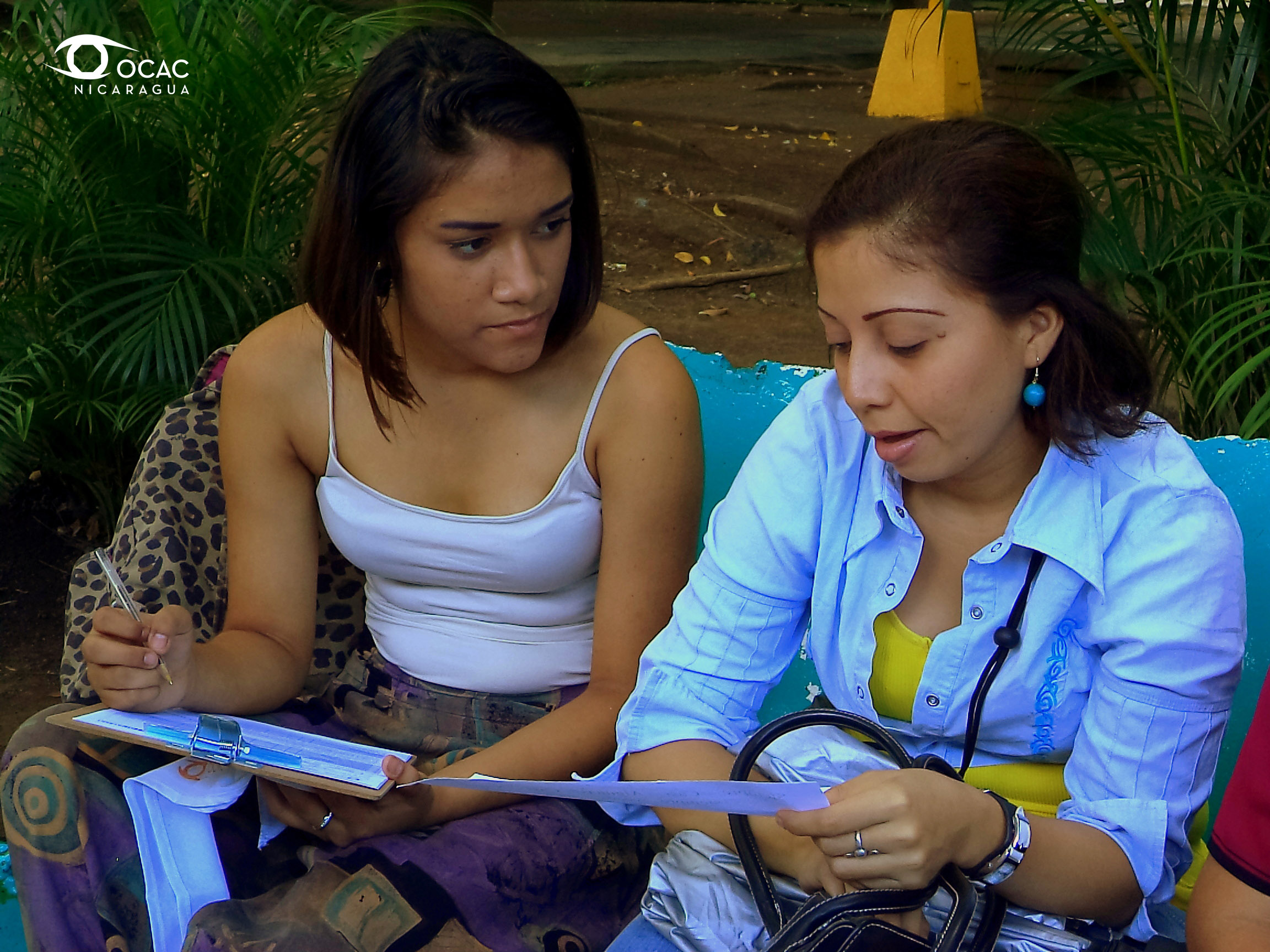
El proyecto de OCAC Nicaragua que dio inicio en Septiembre de 2014 bajo el patrocinio de Stop Street Harassment ha llegado al final de su etapa inicial, por medio de la cual se logró alcanzar a más de novecientas mujeres en la ciudad de Managua, quienes compartieron su tiempo y vivencias con las más de quince encuestadoras voluntarias que apoyaron la iniciativa. Con esta encuesta se alcanzó a conocer testimonios de mujeres de 14 a más de 55 años, quienes experimentan violencia en los espacios que son, en teoría, seguros para todas.

El reconocer los rostros de estas mujeres, con historias que tienen características similares con las del resto, nos ha llevado a la adquisición de un compromiso más sólido y firme con la temática del acoso callejero, ya que no se trata de “piropos”, sino de agresiones que van dañando la integridad de cada una, llenándonos de miedos que limitan nuestro uso pleno de los derechos de libre  circulación.

A través de los resultados que nos generó esta primera encuesta realizada en Nicaragua sobre acoso callejero, constatamos la importancia de dar información sobre el tema, no solamente conociendo en qué consiste, sino la forma en la que podemos contrarrestarlo ya que no se trata de una experiencia agradable y bien aceptada.

Cabe destacar que este compromiso no solo lo adquirimos quienes formamos parte del grupo dirigente, sino de las voluntarias comprometidas que posibilitaron la información al llenar cada una de las encuestas; y es aquí donde reconocemos otro logro, pues muchas de las encuestadoras al escuchar las vivencias, reflexionaron sobre la envergadura de la problemática y reconocieron la importancia que tienen no solo las frecuencias y especificaciones de las incidencias, sino el sentir de aquellas que contando sus historias descargaron sentimientos que tenían reprimidos. Esto transformó en todas nosotras la forma de actuar al sentirnos acosadas en las calles, y desde nuestro actuar incidiendo en el comportamiento de otras.

A partir de los resultados obtenidos, encontramos que más del 90% de las mujeres perciben esta problemática como una forma de violencia de género; sin embargo, -según lo que expresaban algunas de ellas- el responder ya sea con gestos o acusaciones públicas trae consigo respuestas violentas o reiterativas de los agresores, que en algunos casos las inhibían y en otros les hacía exponer más fervientemente su inconformidad.

Del mismo modo, reconocer uno de los focos más vulnerables que son las mujeres con las edades comprendidas entre los 16 a 18 años, nos proporciona mayores insumos en cómo trabajar con estas mujeres. Encontramos también que la masturbación, persecución y exhibicionismo de genitales han sido la base de las experiencias que se han catalogado como más fuertes y las que han hecho sentir más vulnerables ante una sociedad que cosifica el sexo femenino.

Asimismo, los resultados de las encuestas solo fueron el primer paso, ya que seguimos trabajando en el análisis de los resultados, porque consideramos necesario realizar un estudio más amplio para posteriormente darlo a conocer a los medios de comunicación e informar que no se trata de una situación culturalmente aceptada por todas, sino que sus formas de expresión tienen  consecuencias mucho más profundas. Un ejemplo de esto último es que las mujeres expresaron sentirse con miedo al transitar por las calles, otras aseguraban que vestirse de una u otra forma es lo que ocasiona el irrespeto; así como la impotencia que genera el que la sociedad no sea un medio seguro cuando tiene lugar la incidencia de las acciones que el acoso callejero encierra.

Entre las historias que fuimos testigas, nos impactó la de dos mujeres (en lugares y tiempos distintos, pero como antes mencionábamos con características similares en sus circunstancias) que a los ocho años, mientras iban a comprar a la tienda, un hombre en bicicleta les exhibió sus genitales, mientras les gritaba que ya estaban “buenas”, lo que nos reitera que no existe edad establecida para sufrir acoso callejero.

Este sin duda ha sido un proyecto que nos abre las puertas para empezar a trabajar firmemente en contra del acoso callejero, como una de las primeras iniciativas en Nicaragua de esta naturaleza.

Por Estrella Lovo, Vicepresidenta OCAC, Nicaragua.

In English (Using Google Translate)

Under the patronage of Stop Street Harassment, in September Observatorio Contra el Acoso Callejero, Nicaragua began surveying people about street harassment in the city of Managua. We were able to reach more than 900 women who shared their time and experiences with the more than fifteen volunteer interviewers who supported the initiative. This survey was conducted to learn the experiences of women from ages 14 to over 55 who experience violence in the spaces that are theoretically safe for all.

Recognizing the faces of these women, with stories that have similar characteristics with the rest, has led to the acquisition of a more solid and firm commitment to the issue of street harassment. These are not “compliments” but attacks that are damaging the integrity of each, filling each with fears that limit their full use and right to move in public spaces.

Through the results generated by this first survey in Nicaragua on street harassment, we note the importance of providing information about not only knowing what it is, but the way in which we can counter it as there is a experience pleasant and well accepted.

We found that over 90% of women perceive this problem as a form of gender violence; however, they find that responding with either with gestures or public accusations brings violent or repetitive responses from aggressors, which inhibited in some cases and in others made them more earnestly expose their dissatisfaction.

Similarly, recognizing one of the most vulnerable spots are the women aged 16-18 years gives us more input on how to work with these women. We also found that masturbation, exhibitionism persecution and genitals have been the basis of the experiences that have been cataloged as stronger and have made us feel more vulnerable to a society that objectifies the female sex.

Also, the survey results were just the first step as we continue working on the analysis of the results, because we consider necessary to conduct a larger study to subsequently make it known to the media and report that there is a situation culturally accepted by all, but their forms of expression have much deeper consequences. An example of this is that women reported feeling afraid to walk the streets, others claimed that dress in one way or another is causing disrespect; and impotence generated by that society is not a secure medium where the impact of the actions that encloses street harassment occurs.

Among the stories we have reviewed, we were struck that two women in different places and different times both said when they were around eight years, while going to the store, encountered a a man cycling who exhibited his genitals while shouting that they were already “good”, which reiterates to us that street harassment begins at a young age.

Not only did we collect stories but we as volunteers had an opportunity to reflect on the scale of the problem and recognized the importance of not only the frequencies and specifications of incidents, but the feelings of those who tell their stories — for many their feelings were repressed. This helped us all think about how to act when we feel harassed in the streets, and from our actions we realize we can influence the behavior of others.

This has certainly been a project that opens the door to start work firmly against street harassment, as one of the first initiatives of this nature in Nicaragua.

By Star Lovo, Vice OCAC, Nicaragua.

Share

Filed Under: SSH programs, street harassment

Serbia: Street Harassment Survey Has an Impact

December 29, 2014 By Contributor

This post is from our Safe Public Spaces Team in Nis, Serbia. The SPSM projects are supported by SSH donors. If you would like to donate to support the 2015 mentees, we would greatly appreciate it!

“How is that street harassment when everyone does it?”

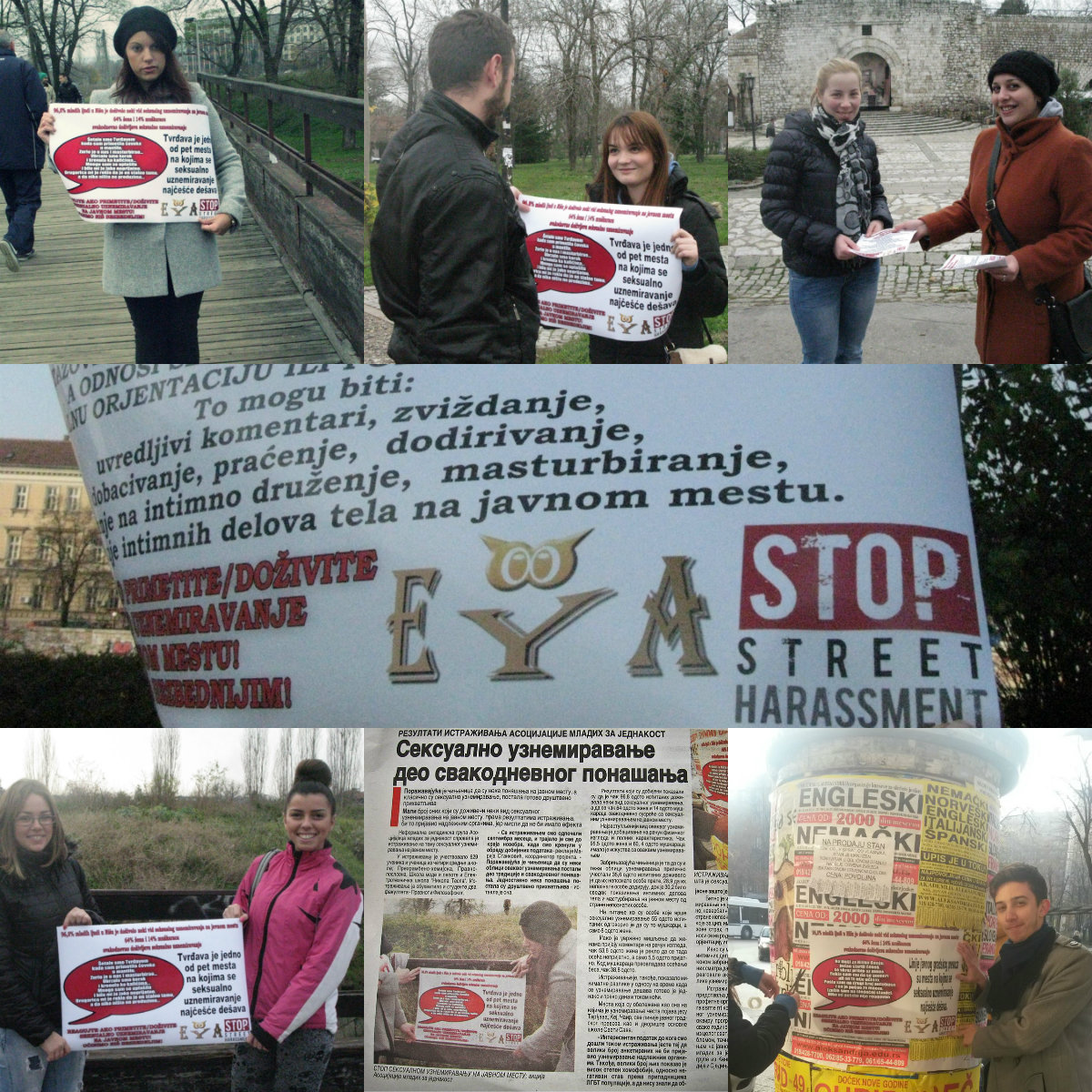
Equity Youth Association conducted a street harassment survey across three months with 629 youth participants from four secondary schools and two Faculties. Psychologist Sanja Cvejić helped us process the data. The findings are below the collage image. We also handed out a flyer with a basic explanation of what street harassment is and the most common forms and through that we were able to educate and raise awareness among even more people.

School psychologist were delighted that this issue is finally being addressed. They were so concerned with our statistics that they encouraged us to start a session of educational workshops on street harassment in the future.

After reading our report in local newspapers, members of the Board Commission for Gender Equality of the City of Nis decided to conduct another survey that will be focused on finding out where women of all ages feel unsafe the most and then developing a strategy for further securing of these parts of the city.

SURVEY FINDINGS:

The statistics were so shocking that we double-checked everything:

* 96.8% of participants experienced some form of sexual harassment at least once in their life.

* 64% of women and 14% of men said they experience harassment on a daily basis.

* The most common form of harassment cited were comments about people’s physical appearance: 84.2% of respondents have experienced this type of behavior, 95.5% of women and 60.4% of men.

* It doesn’t come as surprise that the most common form of harassment is not recognized as harassment at all. Only 18.5 % of respondents said yes that unwanted comments about physical appearance is sexual harassment. 48.9% said no, and furthermore, most of them added that this is compliment.

* What is also worrisome is the fact that 35.5% of girls and 16.6% of boys said they witnessed public masturbation and 33.8 % of girls and 23.1% of boys experienced inappropriate touching by unknown persons.

* We started from a neutral position where we assumed that gender makes no difference when it comes to street harassment. Of course, we were proven wrong. For every type of behavior, women face it more frequently than men.

* 55% of participants said that their harassers were men and only 8% that harassers were women.

* The most common feeling that participants had when they experienced harassment differed a lot between men and women: 53.6% of women feels uncomfortable, while 38.8 % felt angry.

* When it comes to positive feelings, 7.3% of men felt desirable as did only 3.4% of women. 6.2% of men felt flattered as did only 2.6% of women. 4.1% of men said it made them feel phenomenal while no woman selected this.

* Some people admitted to being harassers: 8.8 % of boys and 4.8 % of girls. Of them, 41.3 % of boys said they had made comments about physical appearance as did 18.2 % of girls.  24.5% of the admitted male harassers and only 8.2% of admitted girls harassers said they inappropriately touched (rubbed against) a person they don’t know in public.

* The most common reaction that participant had when they experienced harassment was to just get away from the harasser (37.7%). Only 3.1% of people screamed or asked for help.  It’s worrying that 65.6% of people believe that police wouldn’t react if they would address them. But, what worries even more is that people become so oblivious and used to street harassment that nobody is reacting not even to public masturbation.

 A female participants shared with us: “In the middle of the day in the pedestrian zone, in the city center man was masturbating. No one reacted. Everybody in our country should be ashamed of this.”

* 40.5% of respondent has experienced harassment in public transportation where reaction is lacking as well: “I felt that the older man is rubbing against me. I told him to back off and moved to the back of the bus. He came after me. None of the people in the bus reacted. I came down on the next station.”

* More than half of the harassed people (57.9%) said they first experienced harassment at age 13-17. The story of the girl who was only seven when she first experienced harassment left me speechless. “I was coming home from school when I noticed a car driving very slowly next to me. Inside was a man masturbating and staring at me.”

* What also took me by surprise is the reaction of a fellow law student: “Oh come on, catcalling is street harassment? But, everybody does it.” And indeed they do. According to our survey, harassment is happening everywhere. Elementary school yards, public parks with kids, coffee shops, clubs.

* And, it’s widely believed that women are the one to “blame”: 56.2% of participants believe that women who wear short skirts deserve catcalling on the street.

If there is any silver lining to these dreadful statistics that would be that many people are willing to change. We were pleasantly surprised by the media reaction. Our survey results were published in local newspapers, featured on website and announced on the radio. During our street action many people showed interest in topic and have supported our work. But, what gave us hope the most are school psychologists that have suggested us collaboration.

Hopefully, soon we were be able to come up with form of education on the topic of street harassment that could change the way young people think and act.

Marija Stanković, Equity Youth Association and the lead SSH Safe Public Spaces Mentee in Serbia. 

Share

Filed Under: Resources, SSH programs, street harassment

“My boyfriend didn’t notice what the man said at all”

December 23, 2014 By Contributor

I was eating at a local place with my boyfriend. A woman was just leaving after picking up an order as a man was walking in. He immediately started to make very lewd and objectifying comments about her body to her as she was leaving. I was shocked and disgusted he’d act like that. He then proceeded to go up to the counter and continue to make these comments to the workers at the counter. It made me lose my appetite, and I wanted to leave immediately to avoid receiving the same sort of comments.

Optional: Do you have any suggestions for dealing with harassers and/or ending street harassment in general?

Something interesting about this story is that my boyfriend didn’t notice what the man said at all. I think many men don’t grow up noticing these comments or knowing when harrassment is happening around them.  Men need to be more understanding of why women are afraid or upset after being harassed, and learn how to recognize harassment. Just understanding what it is and what it looks like, even if you cannot intervene can go a long way and it can help those who don’t often experience street harassment provide better support to those who do.

– Anonymous

Location: University Area, Charlotte, NC

Share

Filed Under: Stories, street harassment

“If only I wasn’t in my car right now.”

December 15, 2014 By Contributor

I was fifteen years old and I was walking to work after school across a highway overpass. There weren’t very many cars on the street, and I noticed this car with two men in it driving slower than normal slightly behind me. They looped around the block 3 times so they kept passing me and the third time they started driving the same pace that i was walking, right next to me. One man pulls out a camera and starts taking pictures of me, saying “hello gorgeous,” and “if only I wasn’t in my car right now.” I was in an area where there were no shops and and at the moment, no pedestrians, so I walked as fast as I could and had to call the police, pretending I didn’t even notice. They drove away when they saw the cop car. The people who did pass me as I walked by noticed something was happening, and yet did nothing.

– Anonymous

Location: Santa Monica, CA

Share your street harassment story for the blog.
See the book 50 Stories about Stopping Street Harassers for more idea

Share

Filed Under: Stories, street harassment

“The problem is men’s entitlement.”

December 12, 2014 By Contributor

I’ve had many very uncomfortable encounters when out in public in London. Here are a few that I want to share:

I was taking the bus one time and this man loudly starts asking me to sit next to him and refers to me as “darling”. He did this 3 or 4 times. I didn’t want to engage in conversation with him so I ignored him and left that bus at the next stop. He then loudly said “goodbye darling, have a nice day” as I left the bus. The whole encounter made me feel uncomfortable.

Another time on the tube this man who sat across kept staring at me. I thought at first it was just accidental eye contact but I realised it was full on and the whole time he wouldn’t take his eyes off me. He didn’t look zoned out either – he had a menacing look on his face and creeped the hell out of me. I felt so uncomfortable!

Another time on the tube this man starts talking to me and acting flirtatious and quite sexually aggressive. I began talking to him out of politeness and soon regretted it when he got very forward and I felt very uncomfortable. He then began harassing me for my number and I ended up giving him a fake one so I wouldn’t anger him/to get out of the situation.

In every situation it happened out of the blue, when my mind was very much focused on other things and I felt cheap/objectified each time. It also totally goes against this myth of how you dress affects how men act. Each experience in which I’ve been harassed (apart from club harassment stories) have happened when I have been dressed in long skirts with tights/trousers and wearing normal tops (and most of the time had a coat on). It’s ridiculous for people to still believe that how women dress excuses sexual harassment or to victim blame.

 Optional: What’s one way you think we can make public places safer for everyone?

We need to tackle men’s attitudes to women. The objectification/hypersexualisation and dehumanisation of women is the real problem here. The woman’s body is viewed as a sexual object rather than part of a person. We need to re-educate men to not think this way and to respect women as people. The voyeurism is partly from pornography but also women’s bodies always being hyper-sexualised in the media.

We need to stop victim-blaming. It shouldn’t matter how someone is dressed. If I dress a certain way when I go out it doesn’t excuse sexually aggressive behaviour. I refuse to accept that dressing a certain way will even stop sexual harassment. From my own experiences it wasn’t enough for me to be dressed conservatively (which I was). Because the fact that I was a woman was enough for these men to feel entitled to treat me in such a way. The problem is men’s entitlement.

– Anonymous

Location: London, UK

Share your street harassment story for the blog.
See the book 50 Stories about Stopping Street Harassers for more idea

Share

Filed Under: Stories, street harassment

« Previous Page
Next Page »

Share Your Story

Share your street harassment story for the blog. Donate Now

From the Blog

  • #MeToo 2024 Study Released Today
  • Join International Anti-Street Harassment Week 2022
  • Giving Tuesday – Fund the Hotline
  • Thank You – International Anti-Street Harassment Week 2021
  • Share Your Story – Safecity and Catcalls Collaboration

Buy the Book

  • Contact
  • Events
  • Join Us
  • Donate
  • Facebook
  • Instagram
  • Pinterest
  • Tumblr
  • Twitter
  • YouTube

Copyright © 2026 Stop Street Harassment · Website Design by Sarah Marie Lacy