• About Us
    • What Is Street Harassment?
    • Why Stopping Street Harassment Matters
    • Meet the Team
      • Board of Directors
      • Past Board Members
    • In The Media
  • Our Work
    • National Street Harassment Hotline
    • International Anti-Street Harassment Week
    • Blog Correspondents
      • Past SSH Correspondents
    • Safe Public Spaces Mentoring Program
    • Publications
    • National Studies
    • Campaigns against Companies
    • Washington, D.C. Activism
  • Our Books
  • Donate
  • Store

Stop Street Harassment

Making Public Spaces Safe and Welcoming

  • Facebook
  • Instagram
  • Pinterest
  • Tumblr
  • Twitter
  • YouTube
  • Home
  • Blog
    • Harassment Stories
    • Blog Correspondents
    • Street Respect Stories
  • Help & Advice
    • National Street Harassment Hotline
    • Dealing With Harassers
      • Assertive Responses
      • Reporting Harassers
      • Bystander Responses
      • Creative Responses
    • What to Do Before or After Harassment
    • Street Harassment and the Law
  • Resources
    • Definitions
    • Statistics
    • Articles & Books
    • Anti-Harassment Groups & Campaigns
    • Male Allies
      • Educating Boys & Men
      • How to Talk to Women
      • Bystander Tips
    • Video Clips
    • Images & Flyers
  • Take Community Action
  • Contact

Survivor Activists Call on Campuses to #JustSaySorry

August 11, 2016 By Correspondent

By LB Klein, former SSH Blog Correspondent

Kamilah Willingham, via her Twitter page

There is a joyful moment during which applicants to institutions of higher education turn into admitted students. This moment is perhaps best captured by students sporting newly-acquired campus swag such as a sweatshirt in official colors with the campus name emblazoned on the front or a t-shirt with a mascot. However, for survivors of sexual assault on many campuses who felt their schools did not support them, these coveted items quickly become a tangible reminder of a dream promised and nightmare delivered. To capture the hollowness of institutional betrayal, Wagatwe Wanjuki and Kamilah Willingham, two prominent Black feminist survivor activists and founders of Survivors Eradicating Rape Culture, are literally setting these items on fire.

Willingham and Wanjuki are burning their once-prized possessions and asking for other survivors to do the same until their alma maters do what they see as the bare minimum: acknowledge their experiences by apologizing. Through this #JustSaySorry campaign Survivors Eradicating Rape Culture is asking for “public acknowledgements of past failures” to “restore a sense of trust in the school’s intention and ability to approach campus gendered violence with integrity.” They argue that this action is simple but would have a huge impact on survivors who often feel their campuses see them as numbers in a crime statistics report and not treasured students or alumni who deserve restoration.
saysorryA few years have passed since Wanjuki and Wilingham were sexually assaulted while students at Tufts University and Harvard Law School respectively, they discuss the long-range impact of institutional betrayal. In a recent article she penned for The Establishment, Willingham mentions the “PTSD and a six-figure student debt amount” that linger, while her pride in her Harvard Law School attendance have faded. Much like movements to address street harassment, #JustSaySorry uses a grassroots and community approach to ask institutions to move beyond the often clinical official statements often issued by college and universities. #JustSaySorry is calling for acknowledgment of survivors as people and to consider the human impact of sexual violence and its aftermath when handled poorly.

Survivors Eradicating Rape Culture and the #JustSaySorry campaign come at a time during which there is increased attention to the issue of sexual violence on campuses, but the road to accountability can be a long and fruitless one for survivors. No matter how well we enhance our university systems (and we should) we are in need of more than just more laws and more policies. Our processes for holding institutions accountable for the harm they have caused survivors frequently mirror the failings of systems of perpetrator accountability.
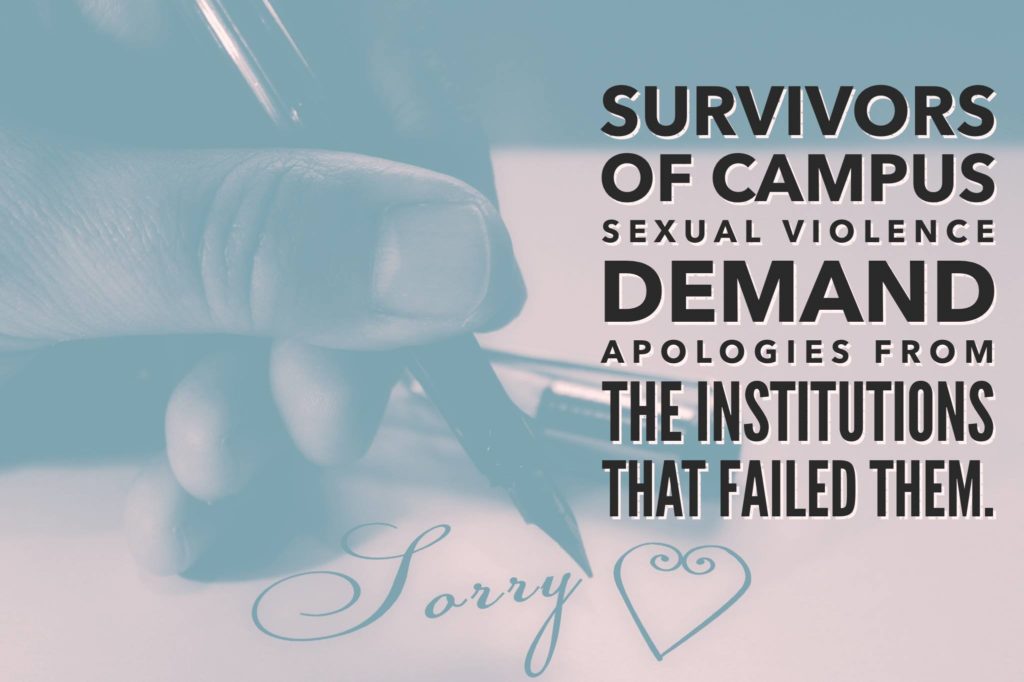
survivorWanjuki and Willingham are reminding us through their deeply personal and cathartic actions that genuine apologizing is a rare, critical, and distressingly radical act for administrators and institutions. Survivors Ending Rape Culture is calling on survivors to send them items from alma maters who failed them or to post videos or photos of themselves withholding their donations to their institutions.

Anyone can show solidarity for their work by using the hashtag #JustSaySorry to call out institutions that have caused survivors harm or by tuning into their live broadcasts of burning protests. To create more survivor supportive cultures, we cannot rely solely on strengthening formal systems. As Willingham and Wanjuki are demonstrating, we must also recognize the powerful role that the people who make up institutions and communities have to help survivors heal.

LB Klein, MSW, MPA has dedicated her professional and academic life to ending gender-based violence, supporting survivors, and advancing social justice. She is a doctoral fellow in the University of North Carolina at Chapel Hill’s School of Social Work and serves a lead trainer and curriculum development specialist for the Prevention Innovations Research Center at the University of New Hampshire.

Share

Filed Under: correspondents Tagged With: activism, campus rape, sexual assault

USA: Make Your Voice Matter

August 10, 2016 By Correspondent

Hope Herten, IL, USA, SSH Blog Correspondent

Warning: This is cheesy! 🙂

If you have been keeping up with my posts throughout the summer, I hope that you were able to relate to my message and learn a little bit about who I am and what it’s like being a young woman in Chicago.  Unfortunately though, my own personal experience and the experiences I have shared from my friends are barely the tip of the iceberg when it comes to street harassment and the other obstacles women, people of color, and trans people face trying to live independently  in the US today.  There are people all over the spectrum of marginalized groups that face different kinds, and an array of severity, of harassment.

Despite my limited experience, it is always my hope that my voice will be heard and will open a door so that those less privileged than me can have a chance to live in a world where their lives are valued more; that their safety and prosperity is prioritized. The topic of street harassment and other feminist movements have helped all kinds of women come together, recognize intersectionalities, and fight for causes that improve the lives of all.

I am using this final post as a platform to call out anyone who reads this and ask them to do one thing this week to make their voice heard and fight back against street harassment. Help out that woman you see on the street or on the bus facing harassment, stop passive aggressively tweeting about sexist colleagues and TAG THEM, say something in your group chat about offensive jokes, anything. The conversation has already been started. Use links to inform your message and utilize hashtags to contribute to the larger conversation. Thanks to social media more than ever voices can be heard. So make yours matter.

Side note: The Slut Walk is a great way to show your support and fight street harassment. Dress however you’d like and bring your friends! If you live in or near Chicago, it’s on August 20th! See you there!

Hope is a full-time undergraduate student studying public health and Spanish in Chicago, IL.  If you want to keep up with Hope you can follow her on Twitter @hope_lucille or check out her public health blog.

Share

Filed Under: correspondents

USA: ‘Hamilton’ and Reflections on Stop Street Harassment

August 8, 2016 By Correspondent

Deborah D’Orazi, LMSW, NY, USA, SSH Blog Correspondent

Image via BuzzFeed
Image via BuzzFeed

Lin-Manuel Miranda’s Hamilton is one of the most popular musicals on Broadway and is continuously gaining accolades the world over for its music and multi-racial and gender inclusive casting. In creating an alternative to the typically white male narrative American history often presents as the norm, Miranda constructs a piece of theater that creates a nuanced critique of who and what is deemed most important in American history and society. Women and people of color not only tell the story of Alexander Hamilton, the American Revolution, and the early American Republic, they tell the story of the very men who often ordered their subordination and inferiority through philosophy, politics, and violence.

More importantly, they represent the stories of the very people and experiences purposefully erased and forgotten in order to create American society. This is a narrative demonstrating the United States’ founding ideals and oppressions on full display through expert storytelling and representation that not only represents a critique of the Founding Fathers and ideals, but of the progress made and still needed for those still experiencing oppression in our society.

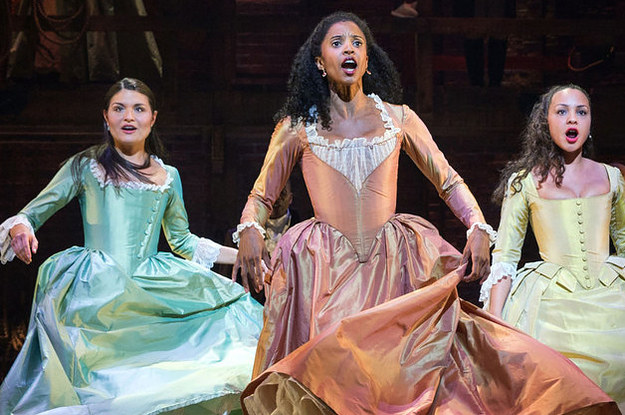
One of the ways in which oppression is explored in Hamilton is through the presence and absence of women in public life due to racial and gender norms. While women of all races are featured in the ensemble, the only prominent female characters are the Schuyler Sisters (Angelica, Eliza, and Peggy—prominent, upper class white women played by women of color). Most of the songs in the play demonstrate the women’s influence in Alexander Hamilton’s life and the frustration that they have such little influence on their own. Father’s must approve marriages and the only political influence they have is through corresponding and talking to men. And, what is most telling, is that the only song where the women are by themselves, and in a public place, is when they are subjected to street harassment.

The Schuyler Sisters is a song introducing the three women exploring Manhattan on the eve of the American Revolution, despite their father’s warnings. While Peggy worries about the inevitable oncoming violence, Eliza and Angelica express enthusiasm for the revolutionary ideals being expressed throughout the city and colonies. The women state they are “looking for a mind at work” and while the male narrator and ensemble seem to suggest they are looking for a suitable male partner, there is a lack of acknowledgement from the men of the times (and in the play) that women and people of color may actually be looking for a say within the narrative of revolutionary politics. This willful ignorance and prejudice comes into full force when Aaron Burr interjects his harassment into the women’s narrative:

[BURR]
Wooh! There’s nothin’ like summer in the city
Someone in a rush next to someone lookin’ pretty
Excuse me, miss, I know it’s not funny
But your perfume smells like your daddy’s got money
Why you slummin’ in the city in your fancy heels
You searchin for an urchin who can give you ideals?

[ANGELICA]
Burr, you disgust me

[BURR]
Ah, so you’ve discussed me
I’m a trust fund, baby, you can trust me!

[ANGELICA]
I’ve been reading Common Sense by Thomas Paine
So men say that I’m intense or I’m insane
You want a revolution? I want a revelation
So listen to my declaration:

[ELIZA/ANGELICA/PEGGY]
“We hold these truths to be self-evident
That all men are created equal”

[ANGELICA]
And when I meet Thomas Jefferson
I’m ‘a compel him to include women in the sequel!

[WOMEN]
Work!

This dialogue represents many things. On one hand, it demonstrates the underrepresented historical narrative that street harassment existed for many centuries before it became noticeable in popular culture and within the Stop Street Harassment movement. As a form of racial, homophobic, and gender violence, street harassment has been used to discourage and harm people fighting for civil rights, suffrage, or any personal or human rights issue. As a woman, LGBTQ individual, or racial minority, etc. even existing in a public place or taking part in a public activity or using a public space becomes an act of resistance when people use harassment to question your right to live and exist within a space near or with them. Thinking of events like the Orlando Club Shooting, the death of Sandra Bland, and the shooting of Malala Yousafzai by the Taliban only highlight even more strongly how existing and living and/or advocating in public for yourself and others can lead to harassment, violence, and death.

The question then becomes, how do we deter attitudes like Aaron Burr’s? How do we change the default where people are willfully ignorant and prejudiced about the many people and voices that exist in this world? That would be willing to use street harassment to quiet those using and existing in public spaces that they wish to use for their own gain or harm?

And I ask the Stop Street Harassment community,

  • How do we create a more inclusive world and environment in our movement to make sure we are advocating for all people and to have a more inclusive discourse?
  • Do you think more historical introspection and education on harassment would be useful to help combat harassment?
  • How does art become an useful tool in combatting harassment and other forms of oppression?

Deborah is a recent MSW graduate who also received certification from American University’s Women and Politics Institute and Rutgers’ Center on Violence Against Women and Children. In addition to social work, Deborah is looking to pursue an MPP/MPA and she is also extremely passionate about the arts (theater, writing, film, television, fine art, poetry, performance art), history, and Hamilton.

Share

Filed Under: correspondents, street harassment Tagged With: broadway, Hamilton, history, normalizing street harassment, play

USA: The Normalization of Street Harassment in Childhood Television

July 15, 2016 By Correspondent

Mariel DiDato, NJ, USA, SSH Blog Correspondent

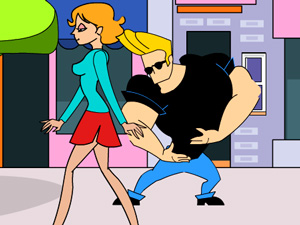
johny-bravo-s-flirts
Johnny Bravo

As a child-turned-adult Pokémon fanatic, I have succumbed to the hype of Pokémon-Go. While basking in my nostalgia, I decided to watch some early episodes of the iconic cartoon. Watching childhood television shows as an adult, I often catch things that I didn’t pick up on as a kid. Certain jokes now make sense, while other things don’t seem as funny. One example of a less-funny aspect of Pokémon is Brock’s persistent advances towards almost every female character besides Misty, and the continued response of female annoyance or rejection. I wouldn’t necessarily claim this show is sexist, as they feature multiple female characters in leadership roles. However, the repeated romantic attempts towards much of these characters, played off with the “boys will be boys” narrative, is something I did not appreciate.

This prompted me to think about the other shows I watched as a child that normalized this kind of behavior. I realized that Pokémon is hardly the worst offender. Johnny Bravo is a show that features catcalling and female rejection as the main source of humor. Even more infamous is Pepe LePew, a male skunk whose storyline involves chasing and grabbing onto a female skunk who, very obviously, does not want to be approached or touched by him.

Although this harassment and female rejection is repeatedly portrayed as comical, the real-life version of this experience is far from laughable. On the Pokémon end of the spectrum, Brock takes rejection with a blushed face, and then moves onto the next woman. Johnny Bravo’s objects of affection sometimes even strike him, leading him to simply move on to his next target, like Brock. However, the reality of female rejection often leads to male escalation, with women receiving a spectrum of responses that can range from insults, threats, and actual violence. Women are aware of this fact; smiling and receiving compliments from harassers is often misconstrued as acceptance and openness, when it is really a method of de-escalation. It is sad to see this portrayed to young children as something to be laughed about. Even while LePew’s victim can be seen struggling to break free from his arms as he kisses her, the whole situation is trivialized to the point of comedy. It is as though harassment is seen as nothing more than a mere annoyance, generally harmless to the women it affects.

More and more data reveal that street harassment is anything but funny or harmless to its victims. Studies show that the continued street harassment most women face before the age of 18 is linked to a multitude of negative effects. One 2008 study found street harassment to be correlated with self-objectification and fear of rape. This, in turn, can lead women to fear travel of any distance, restricting their freedom of movement. In addition, there is evidence that continued and frequent abuse, such as the street harassment women can be subjected to virtually any time they leave their homes, can be more harmful than experiencing one traumatic event.

However, in these cartoons, sexual harassment is shown to be a trivial event that can be laughed off. Young boys are potentially learning that, while ineffective, street harassment is an acceptable way to pick up women. In each of these shows, there is an example of the male “getting the girl.” This might send the message that harassing multiple women is okay. Eventually, one will say “yes” and it will all be worth it. Plus, the women who say no will walk away irritated, but intact. On the other hand, young girls are potentially being taught that objectification and harassment is an appropriate and acceptable part of being female.

Street harassment was a problem prior to the invention of television. Misogynistic cartoon characters did not create the larger problem of sexism in society, but they are instrumental in keeping these messages alive and normalizing them for younger generations. It’s easy to criticize outright sexism on television, but it is also important to pick up on these more discreet messages that people of all ages are receiving. I don’t think I’m going to stop watching shows like Pokémon, but I will definitely be more aware of these indirect messages in the media. I will also be supporting shows that depict healthy relationships, instead of normalizing deeply harmful social interactions. I encourage others to do the same, and hopefully future generations will enjoy cartoons that don’t rely on sexism for their laughs.

Mariel is a recent college graduate, feminist, and women’s rights activist. Currently, she volunteers for a number of different organizations, including the Planned Parenthood Action Fund of New Jersey and the New Jersey Coalition Against Sexual Assault. You can follow her on Twitter at @marieldidato or check out her personal blog, Fully Concentrated Feminism.

Share

Filed Under: correspondents, street harassment Tagged With: cartoons, catcaling, female rejection, kids, messages, objectification, trivialization

USA: What Can I Say? Taking Submissions for Witty Responses to Harassers

July 10, 2016 By Correspondent

Hope Herten, IL, USA, SSH Blog Correspondent

ViaHollabackDesMoinesIf we had a daily post limit for life, I would have to be quiet for the vast majority of my waking minutes. Talking is one of my favorite hobbies; I’m an expert in forming opinions and I’m a speaking-my-mind frequent flier. As a person who always has something to say, why can’t I stand up for myself when faced with unwanted harassment?

A combination of fear and surprise is probably the top contributing factor; rarely am I approached when I am expecting it or by someone less threatening than me. Though I tell myself that maybe not saying anything at all is the high road, I can’t help feeling that an inability to speak reinforces the power structure being exploited by my harassers.

Often we are taught that it is better to say nothing at all than to speak too quickly and let our emotions run away with our words, and though many intelligent men and women have preached this ideal, I have come to struggle with it, particularly in the last few weeks where harassment has become more frequent in my life.

Is it better to say nothing when patriarchal men try to assert dominance over you in public than to say something that may come out wrong? Does it make a bigger impact to ignore a harasser or give him a piece of your mind? Are harassers impacted at all by what you say or don’t say to them? Am I showing my strength by saying nothing or am I admitting defeat? None of these questions seem to have a clear-cut answer; there is no prescription for patriarchy, no magic words to make someone see what they are doing is harmful.

My conclusion comes back to my favorite aspect of feminism: choice. Silence can be a deliberate act of defiance, refusing to let an oppressive voice cause you to lose your cool and say things you don’t mean. Simultaneously, refusing to stay silent is a choice to empower yourself in a different way, vocalizing your refusal to submit. For some, being forced to speak out of anger or fear can help reinforce the power structure that harassers are acting in. For me, silence isn’t a courageous act. I am scared to speak when harassed in public for fear of saying something wrong, I am afraid of angering the harasser, and I worry that what I say won’t matter. I need to remind myself that I am strong and intelligent and that despite what my words mean to an oppressive body, they mean a lot to me and I will not be made silent by a complete stranger.

I want to remind all of you, that no one should make you do something that makes you feel like a lesser person.  Whether you remain silent or speak up, make it your act of protest. Don’t let a single person or moment push you down, because as a collective, feminists are coming together to give you the freedom to go outside and not have to make the choice at all.

P.S. If you are looking for some great suggestions Stop Street Harassment already has some, here and here.

Hope is a full-time undergraduate student studying public health and Spanish in Chicago, IL.  If you want to keep up with Hope you can follow her on Twitter @hope_lucille or check out her public health blog.

Share

Filed Under: street harassment

« Previous Page
Next Page »

Share Your Story

Share your street harassment story for the blog. Donate Now

From the Blog

  • #MeToo 2024 Study Released Today
  • Join International Anti-Street Harassment Week 2022
  • Giving Tuesday – Fund the Hotline
  • Thank You – International Anti-Street Harassment Week 2021
  • Share Your Story – Safecity and Catcalls Collaboration

Buy the Book

  • Contact
  • Events
  • Join Us
  • Donate
  • Facebook
  • Instagram
  • Pinterest
  • Tumblr
  • Twitter
  • YouTube

Copyright © 2026 Stop Street Harassment · Website Design by Sarah Marie Lacy