• About Us
    • What Is Street Harassment?
    • Why Stopping Street Harassment Matters
    • Meet the Team
      • Board of Directors
      • Past Board Members
    • In The Media
  • Our Work
    • National Street Harassment Hotline
    • International Anti-Street Harassment Week
    • Blog Correspondents
      • Past SSH Correspondents
    • Safe Public Spaces Mentoring Program
    • Publications
    • National Studies
    • Campaigns against Companies
    • Washington, D.C. Activism
  • Our Books
  • Donate
  • Store

Stop Street Harassment

Making Public Spaces Safe and Welcoming

  • Facebook
  • Instagram
  • Pinterest
  • Tumblr
  • Twitter
  • YouTube
  • Home
  • Blog
    • Harassment Stories
    • Blog Correspondents
    • Street Respect Stories
  • Help & Advice
    • National Street Harassment Hotline
    • Dealing With Harassers
      • Assertive Responses
      • Reporting Harassers
      • Bystander Responses
      • Creative Responses
    • What to Do Before or After Harassment
    • Street Harassment and the Law
  • Resources
    • Definitions
    • Statistics
    • Articles & Books
    • Anti-Harassment Groups & Campaigns
    • Male Allies
      • Educating Boys & Men
      • How to Talk to Women
      • Bystander Tips
    • Video Clips
    • Images & Flyers
  • Take Community Action
  • Contact

USA: Welcome to Campus: Peer-to-peer sexual harassment

May 16, 2016 By Correspondent

Hope Herten, IL, USA, SSH Blog Correspondent

According to an informal study conducted by the organization Hollaback! in 2015, nearly 67% of female students experienced some sort of sexual harassment on campus.  This figure may seem shocking, but what I find the most disturbing is that despite research and meek attempts to curb catcalling and other forms of sexual harassment, this number has remained stagnant for years.  In 1996, a study was published that looked at two different colleges, reporting the 68% of the women in their study had experienced sexual harassment on campus, not only walking between classes, but many of them experiencing some sort of harassment by male peers while in class (Ivy & Hamlet).  Similarly, an extensive report published in 2005 by AAUW found that that two-thirds of their participants had experienced sexual harassment while at their university (Hill & Silva).  The 2005 study reported that the top three reasons student gave for harassing their peers were (1) “I thought it was funny”, (2) “I thought the person liked it”, and (3) “it is just a part of school life/ a lot of people do it/ it is no big deal”.

As a female college student in Chicago, I expected that I would experience harassment, but I never imagined that my peers would be the ones harassing me or my friends.  During her freshman year, a friend of mine experienced frequent harassment from a random guy in our university’s commons. To avoid that constant harassment, she had to go out of her way to avoid him in ways that made her own life much harder. Now that she’s in her third year, she is still occasionally approached by him on campus, whether he is following her to the bathroom or asking her out. To be faced with this issue not once, not twice, but multiple times from the same person is unacceptable. She says that she rarely feels threatened by him, but the frequent harassment is an additional unnecessary nuisance to her day.  She is not the only one of my friends who faces harassment on campus, whether it is the hallways, the quad, the student union, or even the classroom; many female students at my university face this frequent hurdle in their pursuit of academic success.

The deep-rooted integration of technology has been a blessing and a curse. Though more people have a voice on the internet and information is more readily available, it has opened a new door for sexual harassment on campus. Social media accounts meant for anonymous submissions of confessions and crushes at my university have allowed for a new avenue of harassment. Many women on campus have been publicly shamed and objectified using these platforms, with no repercussions for the men submitting them. One student complained about appearing on these Twitter accounts multiple times; one of the posts was even commenting on the clothes she wore to the gym and calling her a “sexy babe”.  Students should be able to go to public places on campus and feel comfortable walking around or working out without the fear of being talked about publicly, and anonymously, online.

Women have been experiencing harassment on campuses for decades across the country, both at public and private, big and small, and religiously-affiliated or secular institutions.  It seems that no matter how committed an institution is to providing the best education possible, this one issue is constantly put on the back burner.

All students, regardless of gender, sexuality, race, or ability, deserve their right to pursue their education in a place where they are valued and respected parts of the community. From personal experience, I know that it is difficult to focus on school when you are nervous about going to specific places at certain times, if you don’t want to go to class because of that one man who won’t leave you alone, or, now because of technology, fear being called out online for participating in a wide array of activities from going to the gym or drinking at a party.  College is a place to grow as a person intellectually, spiritually, and socially; everyone deserves to feel safe pursuing that education.

What can we do to draw attention to this issue and push administrators to action?  Once we have the critical mass to create change, what concrete strategies do we have to stop harassment?

Hope is a full-time undergraduate student studying public health and Spanish in Chicago, IL. During her time in Chicago, Hope has participated in many protests and events trying to call awareness to women’s issues on campus and in the broader Chicago community. Follow her on Twitter @hope_lucille or check out her public health blog.

Share

Filed Under: correspondents, public harassment Tagged With: campus harassment, chicago

India: The Challenges Reporting Sexual Harassment

May 14, 2016 By Correspondent

Tharunya Balan, Bangalore, India, SSH Blog Correspondent

Trigger Warning

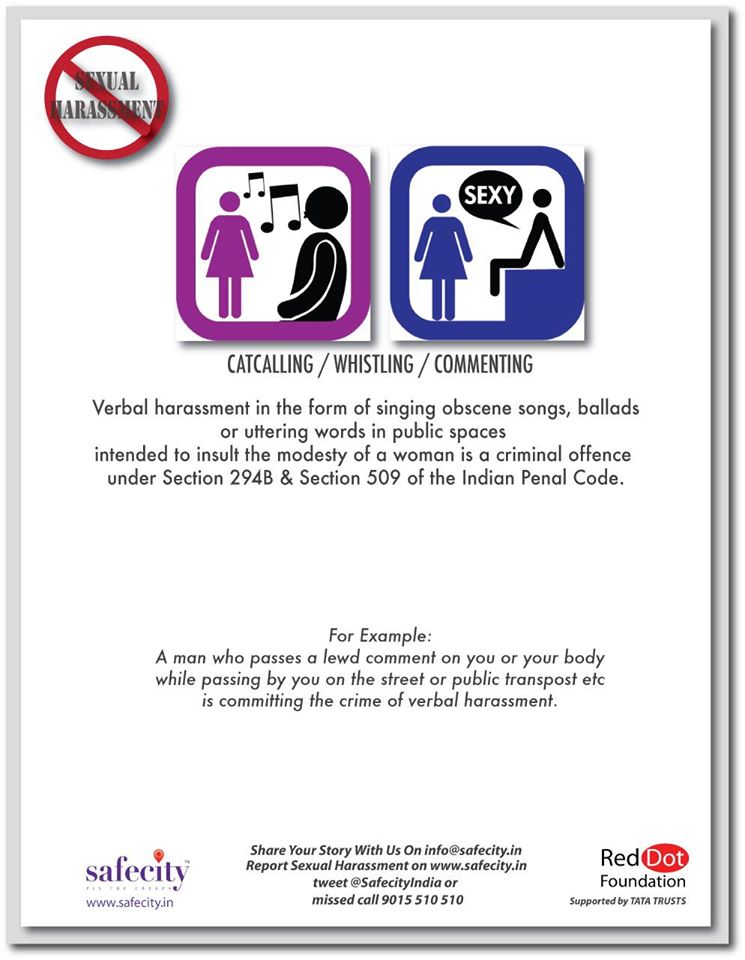
Verbal Harassment - IndiaThe 2012 case of the young woman who was fatally raped and assaulted on a bus in the Indian city of Delhi led to a number of decisions made at the State and Central levels to address violence against women, including several new laws against rape and sexual assault. The new laws include specific mentions of sexual harassment, voyeurism and stalking as punishable offences.

The publicity and international attention around the issue has led to more open conversation on the subject and encouraged more (mostly educated) women to report sexual assault and harassment. Unfortunately, passing laws to criminalize behaviour does little to change the prevalent rape culture and attitudes towards women held by much of the population. Even judges in other countries seem to assume that Indian culture means men simply do not understand boundaries and so cannot be held accountable for their actions.

In May of 2015, Amnesty International India approached the feminist magazine The Ladies Finger about their upcoming Ready to Report initiative, aimed at making it easier for victims of sexual harassment and assault to report incidents to the police. The online magazine then threw their doors open to people who had experienced sexual assault or harassment, and asked if they had tales to tell.

The stories published (a woman assaulted in a car, a woman molested by a friend she was visiting, a woman stalked by an old classmate, a woman molested on the street by a stranger, a team of journalists stalked and harassed by a stranger) include examples of the victims being interviewed in front of their attackers, of them being forced to recount the most intimate details of their assaults in front of a station full of curious policemen, of being browbeaten into recanting or rewriting their stories, and of their being treated as overreactions to minor annoyances, and the police taking it upon themselves to mete out justice as they saw fit.

The campaign also included a twitter hashtag that paints a depressing picture of the narratives that surround victims and stories of sexual assault in the country. Women are hesitant to speak up for a number of reasons, ranging from the fear of reprisals, the social stigma around sexual assault, the fear of being slut shamed for their choices, the stress of filing and following reports while fearing more harassment at the hands of the police force, the fear of negative media attention, and the fear of not being supported by friends and family, and the horror that surrounds medical examinations.

The founder of The Ladies Finger, Nisha Susan writes:

“The variables that affect whether an Indian woman’s claim is taken seriously by the police range considerably, from class, caste, the site of the assault, to the time of day. The more familiar the complainant was with the assaulter/ rapist/ stalker the less likely she was to successfully register a case. Our findings backed up results from the more rigorous studies undertaken by activists: in the legal system, you are likely to fare better if you have been violently assaulted by a working-class stranger in a public place.” (emphasis mine)

This only underscores the fact that marital rape is not a punishable offence, or indeed, a term recognized by the law at all, and it explains why so many reports of stalking are ignored or not taken seriously.

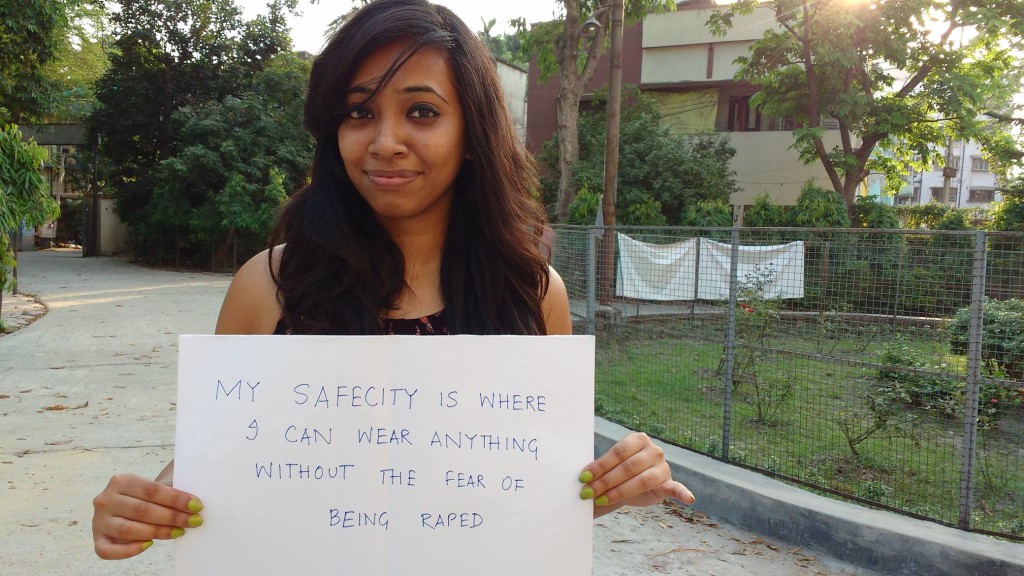
#SafeCity
#SafeCity

There is a lack of genuine discussion around the way women and women’s bodies are perceived in this country. The original text of the law (section 354 of the Indian Penal Code) defines as criminal the “assault or criminal force to woman with intent to outrage her modesty”, and it is this idea of “modesty” in the India context that is still such a sticking point. It is this idea that lies at the heart of the victim blaming, the slut shaming, and the dehumanizing treatment of rape and assault victims when they do come forward.

It is not just female victims who suffer under our archaic ideas of modesty and bodily autonomy. The sections of the Indian Penal Code that refer to rape are not gender neutral, and they do not acknowledge male victims of rape. There is something deeply embarrassing about a country whose leaders and whose laws are the equivalent of an ostrich sticking its head in the sand and pretending that what it sees does not exist. Treating sex as a taboo, refusing to understand the spectrums of gender and sexuality, ignoring the contradictions between what is portrayed in our media and what is taught to our children in schools and homes, and

What we are in dire need of in our country is real sex education: real conversations on consent and real understandings of the ways in which someone’s body and person can be violated by another’s actions.

Tharunya is an urban planner and architect with a passion for issues of social, environmental and spatial justice, including the gendered ways in which urban spaces are designed and function. She has a bachelor’s degree in architecture and a master’s degree in City and Regional Planning from the Georgia Institute of Technology, where she will be returning to obtain a degree in Geographic Infomations Systems Technology later this year. 

Share

Filed Under: correspondents Tagged With: India, reporting

USA: Street Harassment is the “Global” Trigger That Re-Traumatizes Victims

May 11, 2016 By Correspondent

By Shahida Arabi, New York, USA, SSH Blog Correspondent

Image via Flickr
Image via Flickr

I grew up in neighborhoods where street harassment was an all-pervasive part of living, breathing and communicating. This is not to say any area is exempt from the threat of street harassment – this form of harassment takes place all over the world and across all cultures. In my own country of origin, Bangladesh, street harassment is incredibly common, along with sexual harassment, and this form of “eve teasing” has even led to the suicides of young girls. I found that my experiences with street harassment in the USA did not differ as drastically as one might think from my experiences in Bangladesh.

Starting from the age of fifteen, I was routinely objectified by older male strangers on the street as a part of my everyday commute in New York. I have been followed, stalked, harassed, asked whether I was “eighteen yet,” told that putting my earphones on were against the law, cursed at for not being responsive, bashed for being sassy and talking back in a way that was not to their liking, and at one point, almost assaulted on a train by a man who followed me from train car to train car until two other men intervened.

These experiences were triggering enough without any prior history of sexual assault, but after I also experienced my first sexual assault on the streets in Bangladesh and then a later, more severe sexual assault in the U.S., street harassment became something even more darker and foreboding – it became a constant trigger that reminded me that my body was not considered my own in this society. Women are constantly reminded – through lingering stares, covert and overt sexual remarks and even touches – that their bodies are the property of the men who desire them and that their consent does not matter.

It began occurring to me that although street harassment has and always will be incredibly traumatizing for all women navigating public spaces, it will also be incredibly re-traumatizing for women whose spirits, minds and bodies have also been violated by assault, rape or physical and/or emotional violence. Those with histories of chronic trauma, who may have PTSD or Complex PTSD, will be even further debilitated by this form of harassment every day as a barrier to a peaceful, safe commute because their brain is already on high alert, scanning the environment for potential threats. As a result, these victims will are likely to experience even more anxiety, rage and depression after an incident of harassment.

RAINN estimates that there is 1 sexual assault every 107 seconds in America and an average of 293,066 victims (age 12 and older) each year. With numbers like these, along the prevalence of childhood sexual abuse and domestic violence, I can only imagine that there are many survivors of abuse and trauma who are being subjected to a dual traumatization on their daily commutes that are leaving them feeling further revictimized. It doesn’t help that street harassment in itself is in fact a very real threat, and many have experienced sexual assault when encountering this form of harassment regardless of their trauma history.

Street harassment also has a strong verbal component which can be psychologically retriggering for survivors of verbal and emotional abuse who may have suffered childhood abuse or long-term abuse in an intimate relationship. Being name-called on the streets as a form of retaliation after rejection as well as in the private space of your home by a spouse, partner or family member can be incredibly jolting. It can reinforce and instill a pervasive sense of helplessness and worthlessness that already exists in other facets of a victim’s life and his or her trauma history.

That is why I call street harassment the “global” trigger – it not only has the capacity to affect every country, it also has the potential to trigger every other trauma experienced in one’s life. It’s an assault and a violation on a woman’s right to navigate public spaces without having her body being considered public space.

Those who trivialize street harassment as a “compliment” are not only ignorant about the deep-seated issues of this patriarchal entitlement to women’s bodies and rape culture, they are also ignorant about the effects of trauma. According to Dr. Bessel van der Kolk, author of The Body Keeps the Score (2014), trauma lives in our bodies and rewires our brains. Incidents of trauma add onto each other and make the brain more and more hypervigilant to threat. When we are traumatized, we can “regress” back to the original trauma through visual flashbacks or ones that have a high emotional component; these are what therapist Pete Walker calls emotional flashbacks.

The people who leer, touch, degrade, objectify women and later rationalize their heinous boundary-breaking behavior with a narcissistic sense of entitlement are essentially prioritizing their selfish desires over the very real needs, boundaries and desires of the victim. Like many other forms of abuse, street harassment is not about sexual desire or flirting – it is about power, control, coercion, devaluation, objectification and manipulation.

Unfortunately, every incident of street harassment builds upon pre-existing trauma and societal stereotypes about women. This cumulative effect traumatizes and continues to re-traumatize victims in an endless cycle of sexual violence against women, especially for those who reside in neighborhoods where street harassment is a pervasive problem.

It’s time that society heed the wake-up call. Street harassment is a serious issue that is part of the larger problems of gender violence and rape culture. It is this everyday microaggression, this global trigger, that has the potential to traumatize and even re-traumatize victims, all over the world.

Shahida is a summa cum laude graduate of Columbia University graduate school and is the author of four books, including The Smart Girl’s Guide to Self-Care and Becoming the Narcissist’s Nightmare, a #1 Amazon Best Seller. As a passionate advocate for survivors of abuse, sexual assault and trauma, her writing has been featured on many sites. You can follow Shahida on Twitter, her blog Self-Care Haven and join her Facebook community.

Share

Filed Under: correspondents, Stories Tagged With: bangladesh, NYC, ptsd, sexaul assault, trauma, usa

USA: Men’s Experiences with Street Harassment

May 2, 2016 By Correspondent

Kathleen Moyer, Philadelphia, Pennsylvania, USA, SSH Blog Correspondent

4.13.16 La Salle EASV chalking 2When most people hear the term street harassment, they probably picture of a man whistling at a woman walking down the street, or a man catcalling a woman as he drives by in his car. After all, women make up the majority of street harassment victims and men are most commonly the harassers. According to Stop Street Harassment’s 2014 National Report, 65% of women reported that they had experienced street harassment at some point, and 70% of those respondents said that they had been harassed by one man, while 38% reported being harassed by two or more men. Therefore, I’d be willing to bet that most people don’t picture a man harassing another man or a woman harassing a man when they think about street harassment.

Recently, I posed the following question to my male Facebook friends: Have any of you ever experienced street harassment? I received 9 responses from men stating that they have experienced street harassment before. To put that into perspective, that’s about 13.5% of my male Facebook friends. This is a smaller percentage than the 25% of men who reported that they had experienced street harassment in the 2014 National Report on Street Harassment. However, it is possible that some of my friends who experienced harassment didn’t want to share it, or simply hadn’t seen my question.

Because I hear men’s accounts of street harassment far less frequently than women’s, I wanted to learn more about the experiences of those who responded to my questions. In order to do this, I interviewed most of the men who responded to my question. In conducting these interviews I noticed a few trends.


Every man I interviewed reported being harassed on more than one occasion.

One man I talked to told me that he was harassed twice in the same day – first by teenage girls who yelled, “Hey we wanna suck your dick!” out of their car as he was walking down the street, and later by a man who yelled, “Nice hair, faggot!” at him.

The second experience is also notable because my friend is gay, and the 2014 National Report found that homosexual men are more likely to experience street harassment than heterosexual men, and homophobic slurs were reported to be the most common form of harassment that they experienced.

When I asked another man how often he experiences street harassment, he responded, “A lot. It’s almost commonplace for me so I’ve honestly lost count.”

Therefore, not only do many men experience street harassment, but some experience it on a regular basis.


Many of the men I talked to experienced harassment under circumstances that prevented them from responding sternly, if they had the chance to respond at all.

As I mentioned earlier, one man was harassed twice by people speeding by in cars. Another man, said that he experiences the same thing about once a month when he is outside walking with his girlfriend.

“We’ll be waiting for the light to change and a car will pull up and some teenagers will shout something…a lot of times though, we can’t really tell what they’re saying.”

That same man works in a public place, and described two times that he was harassed while at work. One time, he was bent down sweeping, and a woman walking behind him flirtatiously said, “You can sweep the floor at my house any day.” Because this took place at work, it would be difficult for him to respond assertively.

I believe that people who harass men may choose opportunities like this either because they are more afraid of how a man may respond to harassment, or simply because they enjoy the dominant feeling of being able to harass someone when they are unable to respond.


They experienced both verbal and physical harassment, almost equally.

Although most of the experiences I’ve mentioned so far have been verbal, the men I talked to did share quite a few experiences with physical harassment. One person told me about when he was groped at a restaurant.

“I was at the entrance to a restaurant…and I just felt someone grab my right butt cheek and I thought it was one of my friends messing around, so when I turned around to say stop messing with me right now, I found this girl laughing and asking me if I wanted to dance with her.”

Although he said no, the girl insisted that he dance with her, calling him cute. He walked away from her, but a few minutes later, while he was at an ATM, she approached him again.

“She was like ‘Hey, can I get you a drink?’ and added ‘if you know what I mean…’.”

When he again refused, she called him a “snobby person.”

Another person I talked to shared an experience in which a girl fondled him.

“I was sitting having lunch with a co-worker…one of the girls that works at the ice cream parlor at the local food court stops by to chit chat…Then, I noticed how she began eyeing me up. Next were the comments about me like ‘Damn, boy…,’ followed by her rubbing on my arms and back.”

Fortunately, the girl immediately stopped when he glared at her, but the experience made him very uncomfortable. Which brings me to my final, somewhat obvious, conclusion from the interviews.


Street harassment can make anyone feel violated or annoyed, regardless of their gender or the gender of their harasser.

After each person shared his experiences with me, I asked him how it made him feel. Below are some of the responses.

“Well, confused for sure…it’s just like…why would people say these types of things?”

“It’s more annoying than anything else.”

“Well surprised at the beginning, and she was cute, but she was still a stranger and the whole touching thing was just weird and uncalled for.”

“Awkward and annoyed.”

“Like a piece of eye candy that someone thought they could enjoy. It’s strange being objectified.”

“Highly annoyed.”

“Angry. I wish he got out of his car so he could say that to my face.”

“Grossed out.”

Although women are statistically more often the targets of street harassment, these responses make it clear that the harassment of men is also a serious problem. It is never okay to leer at, verbally objectify, fondle, or otherwise disrespect others, no matter what gender they are. In order to bring more attention to the experiences of both male and female victims, I want to encourage everyone to share their stories on the Stop Street Harassment blog via this Google Form. I believe that discussing these experiences, and listening to all victims, can help the issue of street harassment become more widely acknowledged and hopefully encourage a culture of mutual respect among all.

Kathleen is a full-time graduate student studying professional and business communication. She plans initiatives to increase awareness of sexual assault, domestic violence, and other related issues through her university’s anti-sexual violence group, Explorers Against Sexual Violence.

Share

Filed Under: male perspective, Stories, street harassment

USA: Harmful Oklahoma Court Ruling

April 29, 2016 By Correspondent

Rupande Mehta, New Jersey, USA SSH Blog Correspondent

It was a good and bad week for victims of sexual assault and rape. While former House Speaker Hastert was being sentenced to 15 months (yup, only 15 months after the judge declared him a “serial child molester”) for molesting young boys when he coached as a wrestler, the Oklahoma court shocked everyone with the declaration that state law does not criminalize oral sex with a victim who is completely unconscious.

Right, why didn’t we think of that? An unconscious person is completely capable of giving consent so why prosecute someone who took advantage of the VERY fact that the victim was unconscious and orally sodomized her?

I have to be brutally honest here: some days the fight to make folks understand what constitutes violation of a person’s body seems so hopeless. On days like these, I feel I am transported to the hell holes of Pakistan, India and other countries where rape and other forms of violence against women is a daily fact of life. My mind cannot accept the fact that a verdict of that magnitude was issued by a court in the United States. It seems like the work of moron village elders and other local leaders, who need five witnesses to prove a rape, not that of a judicial body in the United States.

I can’t even comprehend the idiocy of this court. And I don’t even know where to begin.

This is not the court’s fault…not ONLY their fault. This is a system-wide issue that takes pride in victim-blaming. Every day we hear about assault, rape and other forms of violence like street harassment, but the question that takes center stage is “what was she doing” instead of “why did he abuse”?

We as a society have culturally evolved to the point where violence is acceptable if we can shift the onus on the victim. We look for loopholes in her story – why was she there? Who did she go with? What was she wearing? Or as John Kasich famously said, don’t drink at parties so you don’t get raped. I can’t wait for his 16 –year-old twin girls to get to college and avoid parties because their father warned them they could get raped.

We live in a society that victim blames and no one is a better example of this than our judicial system. We let lawyers question victims about abuse in a manner that befits no living being in this world. We sit back and enjoy every tiny detail re-lived by the victim over and over again and then turn around and tell her that her story has holes in it because she cannot remember every single ghastliness that happened to her. We sit back and let lawyers badger victims, not considering their emotional abuse and high levels of trauma that prevent them from being consistent in their narration. We live in a society where it is acceptable to yell and scream at people who have been abused but not okay for someone to falter in their responses. We have made our society into a mockery of human values devoid of empathy, understanding and respect of one’s experiences; instead delving into painful details where even accurate chronicles result into justice failing them at the end of the day.

Our focus is on the victim and what they did or didn’t do right. Did you say no? Did you scream? Why not? If not, how can we believe you were being raped? Or in this Oklahoma case, you were passed out so you could not have said no. But what about her not saying yes either?

This level of victim blaming is nauseating. Besides a severe gap between ideas of rape and consent and appropriate laws, there is a lack of basic understanding of what consent is. And asinine rulings such as the Oklahoma case further propagate a society where such behavior becomes the norm.

We are all responsible for this hideous culture – a social order where women are constantly assessed on how well they defended themselves against harm, how deftly they handled a street harassment situation or whether they made a big deal of the assault at the time it was happening. As far as the abuser is concerned, we are waiting to give them a free pass or sympathize and excuse him the moment a woman cannot fill all holes in her story.

Consent is simple: Yes means yes and No means no. If a person is too drunk, they CANNOT give consent. Consequently, if they are passed out; the question of consent does not even arise. This is a very simple concept but many of us, including the learned individuals on the Oklahoma court, cannot grasp it. Whichever way we look at it, it is time to change the way the rules are written; ones which do not look to place the blame on the victim but on the one who committed the crime. It is time the law takes into account emotional abuse, trauma and, of course, the unequivocal definition of consent.

Rupande grew up in Mumbai, India, and now resides in the U.S. She has an MBA and is currently working towards her MPA, looking to specialize in Non Profit Management. You can find her writing on her blog at Rupande-mehta.tumblr.com or follow her on Twitter @rupandemehta.

Share

Filed Under: correspondents Tagged With: oklahoma victim blaming, rape, unconscious

« Previous Page
Next Page »

Share Your Story

Share your street harassment story for the blog. Donate Now

From the Blog

  • #MeToo 2024 Study Released Today
  • Join International Anti-Street Harassment Week 2022
  • Giving Tuesday – Fund the Hotline
  • Thank You – International Anti-Street Harassment Week 2021
  • Share Your Story – Safecity and Catcalls Collaboration

Buy the Book

  • Contact
  • Events
  • Join Us
  • Donate
  • Facebook
  • Instagram
  • Pinterest
  • Tumblr
  • Twitter
  • YouTube

Copyright © 2026 Stop Street Harassment · Website Design by Sarah Marie Lacy