• About Us
    • What Is Street Harassment?
    • Why Stopping Street Harassment Matters
    • Meet the Team
      • Board of Directors
      • Past Board Members
    • In The Media
  • Our Work
    • National Street Harassment Hotline
    • International Anti-Street Harassment Week
    • Blog Correspondents
      • Past SSH Correspondents
    • Safe Public Spaces Mentoring Program
    • Publications
    • National Studies
    • Campaigns against Companies
    • Washington, D.C. Activism
  • Our Books
  • Donate
  • Store

Stop Street Harassment

Making Public Spaces Safe and Welcoming

  • Facebook
  • Instagram
  • Pinterest
  • Tumblr
  • Twitter
  • YouTube
  • Home
  • Blog
    • Harassment Stories
    • Blog Correspondents
    • Street Respect Stories
  • Help & Advice
    • National Street Harassment Hotline
    • Dealing With Harassers
      • Assertive Responses
      • Reporting Harassers
      • Bystander Responses
      • Creative Responses
    • What to Do Before or After Harassment
    • Street Harassment and the Law
  • Resources
    • Definitions
    • Statistics
    • Articles & Books
    • Anti-Harassment Groups & Campaigns
    • Male Allies
      • Educating Boys & Men
      • How to Talk to Women
      • Bystander Tips
    • Video Clips
    • Images & Flyers
  • Take Community Action
  • Contact

USA: Maya Young and Transgender Homicides

February 25, 2016 By Correspondent

Kathleen Moyer, Philadelphia, Pennsylvania, USA, SSH Blog Correspondent

Maya Young. Image via Philly.com

Maya Young, a 25-year-old transgender woman of color, was stabbed to death in the Frankford section of Philadelphia late Saturday night. According to police, she was found lying in the street with multiple stab wounds to her chest and neck before being rushed to a nearby hospital, where she died 20 minutes later.

No arrests have been made in the case yet. The city is offering a $20,000 reward for information leading to the arrest and conviction of her killer. People with tips can call 215-686-3334.

While investigators are still searching for a motive, the brutal murder of Young seems to reflect the murders of Keisha Jenkins and London Chanel – two transgender women of who were killed in Philadelphia last year. These murders are part of a pattern of increased transgender homicides across the United States. Statistics indicate that transgender homicide is becoming an epidemic, especially among women of color like Young, Jenkins, and Chanel.

In 2015, 23 transgender people were killed – the highest annual total since advocacy groups began keeping a record of transgender murder rates. Nineteen of those victims were transgender women of color. According to a 2013 report on LGBT hate violence by the National Coalition of Anti-Violence Programs, transgender women are the victims of 72% of LGBT homicides, and 89% of LGBT homicide victims are people of color.

Statistics also show that violence against transgender people is not limited to physical violence; over half of transgender individuals experience verbal street harassment. A report by SAVE Dade, an LGBT advocacy group, showed that 53% of transgender people surveyed experienced harassment and disrespect in public areas. These numbers show that transgender violence is a serious problem and it’s progressively getting worse.

We have to take a stand now more than ever. The motive in the case of Maya Young may still be unclear, but it is clear that this pattern of transgender violence is not coincidental. As the LGBT community and allies mourn the loss of Young, we need to remind society that no one’s gender is up for debate. An individual is whatever he/she identifies as and it’s no one’s place to object to that, because nobody knows how that individual thinks and feels.

No one deserves to be put through hell, verbally, mentally, or physically for simply being who they are. The transgender community deserves better; it’s our responsibility, as a society, to ensure that they receive better and to bring those who harm transgender individuals to justice. For Maya. For Keisha. For London. For every transgender person who has been victimized in the past, and those who will be victimized throughout this year.

Kathleen is a full-time graduate student studying professional and business communication. She plans initiatives to increase awareness of sexual assault, domestic violence, and other related issues through her university’s anti-sexual violence group, Explorers Against Sexual Violence.

Share

Filed Under: correspondents, News stories Tagged With: homicide, justice, killing, LGBT, maya young, philadelphia, transgender, women of color

USA: Believing Kesha and Other Survivors

February 24, 2016 By Correspondent

Rupande Mehta, New Jersey, USA SSH Blog Correspondent

Free Kesha Rally. Image via Mic

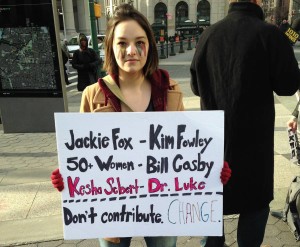
If there was any doubt how hard it is to prove rape, assault or any other violence against women just look at Kesha. The singer filed a lawsuit against her producer, Dr. Luke, who she claims “sexually, physically, verbally, and emotionally abused Ms. Sebert to the point where Ms. Sebert nearly lost her life.”

Unfortunately despite 10 years of rigorous abuse, the court dismissed her complaint ruling she has to continue to work with her abuser and the record company (Sony) who allowed and tolerated the abuse. (Don’t kid me that they did not know).

Am I surprised? Nope. Saddened? Incredibly.

I am sad because there is yet another victim of abuse who has to live through the travesties of the legal system who has sided against her and with the guys in the fancy suits who claim to have spent a lot of money on her career and rightfully deserve their share of returns. Heartbroken that yet again a corporation is put ahead of human lives that endure incredible pain and anguish to have to continue to survive with such a dismal reality. Distraught that despite her tribulation, Kesha failed to get the approval of the justice system and has to continue working with the man who vehemently abused her.

Such injustice, though, happens every day, everywhere. Every day an abuser walks free and the victim is put through the ringer. Every day a victim sobs uncontrollably as the judge delivers a verdict that makes her worst nightmares come true. Every day another victim repeats her story millions of times and no one believes her.

Courts need evidence and when victims fail to provide any proof, they are deemed erratic. When victims change their narrative they are described unreliable or unworthy of stating the truth. But tell me, after you’ve been raped are you thinking about gathering evidence? Are you thinking about being so glib that your narrative never changes? Or are you dealing with the trauma that someone just handed down to you? Ask those who have been raped and they will tell you they never get their story straight the first time because their memory is not linear and comes back only in patches.

So what can we do?

Well for once, the justice system needs to realize the trauma resulting from rape and other assaults and consider it. In Kesha’s case, the judge saw it simply as a contract dispute and ruled in favor of Sony but the truth is more than that. Sony’s lawyers must have done an exceptional job of ruining Kesha’s reputation in the court room and making her sound like a vindictive woman out for blood. Her previous testimony denying that Dr. Luke never put a hand on her, I am sure, was wittingly used against her. For many this may raise the question whether Kesha was lying then or now. Unfortunately only Kesha knows the answer but having been through trauma and assault, I will stand by her side.

Kesha lost a big battle with the Supreme Court. Thankfully she had the means to do so and garner incredible support afterwards from the public who are demanding Sony #FreeKesha.

Celebrities like Taylor Swift are contributing money so Sony would let Kesha out of her contract. Although my heart goes out to her and her suffering, I cannot help but wonder how many don’t have what Kesha does. How many women, on a daily basis, are unable to access services or support with their story untold or not believed?

How many of us are harassed on a daily basis be at work or home or even in the streets? I often look at women passing me and wonder what, if any, trauma do they suffer from and why? Who called them unjustified names and put labels on them that forced them to have weight issues or eating disorders or anger or rage?

Why do the courts not look past this and understand that the issues of the psyche stem from the issues of harassment and if someone is experiencing them it is likely due to a deeper, more profound reason?

We live in a society where those who tell their story are not believed. Is it a surprise then that most of these cases go unreported? And how do you think cases like Kesha’s impact those abused women? The Supreme Court may have ruled for Sony but in the process it did an immense disservice to millions of women out there who were contemplating speaking up.

Rupande grew up in Mumbai, India, and now resides in the U.S. She has an MBA and is currently working towards her MPA, looking to specialize in Non Profit Management. You can find her writing on her blog at Rupande-mehta.tumblr.com or follow her on Twitter @rupandemehta.

Share

Filed Under: correspondents, News stories Tagged With: justice, Kesha, rape survivor, supreme court

USA: Shine Squad Confronts Violence in Activist Organizations

February 22, 2016 By Correspondent

LB Klein, Georgia, USA, SSH Blog Correspondent

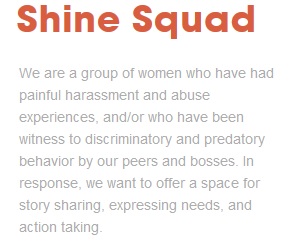
ShineSquadGender-based violence is currently ingrained in our society, and only true culture change will eradicate it. While we want to believe that organizations and groups working to end this violence and advance social justice are immune, abuse happens in these spaces as well. What happens when though when spaces that have a mission to end violence are actually perpetuating it? What happens when the perpetrators are our colleagues, our fellow activists, our leaders?

Enter Shine Squad, a tumblr space by and for folks who have experienced harassment and abuse while they’re working within these movements. As Shine Squad’s first video mentions, we often expect that abuse will be “overt and straight out of Mad Men.” However abusers, particularly those who know the language and values of our movement-building spaces, use more subversive strategies. Shine Squad’s tumblr is full of stories from women and trans folks whose colleagues and supervisors used these spaces against them in overt and covert ways.

It can be challenging to “rationalize [perpetrators’] work in the movement with their abusive behavior.” Because it is so disarming and surreal to experience violence in these spaces that are supposed to be safe, survivors can feel “on an island.” This cognitive dissonance leads to isolation, silencing, and self-blame that shifts the focus from what the perpetrator did wrong to blaming the survivor.

The painful consequences of violence in these spaces can be overwhelming to face alone, so Shine Squad provides a platform for “story sharing, expressing needs, and action taking.” Through their online form, anyone can submit anonymous stories of the harms they have experienced in activist communities and social justice organizations. These reports encompass a wide range of behaviors from subtle workplace discrimination that was “gross but you can’t quite put your finger on it” to intimidation to financial threats to digital harassment to sexual assault and abuse.

Shine Squad is not stopping with story sharing, however, they are also providing connections. They’re introducing survivors to others who have also survived abuse, even connecting those who might name the same perpetrator. They’re offering emotional support, connections with journalists, legal referrals, and opportunities for activist and organizing opportunities around addressing the “systematic problems of discrimination, harassment, and abuse in social justice movements.” They also give opportunities for members to help others through hosting conversations, sharing skills including legal and HR, or offering opportunities to advance the public conversation.

By building networks and sharing stories, Shine Squad is addressing a valuable need. This activist space provides a powerful reminder that for our movements to be successful, we must start at home, by fostering organizational environments that support survivors, prevent violence, and hold perpetrators accountable.

LB is an Atlanta-based researcher, advocate, and educator dedicated to ending gender-based violence, supporting survivors, and advancing social justice.  You can follow her on twitter @LB_Klein.

Share

Filed Under: correspondents, Resources Tagged With: abuse, sexual violence, share story, shine squad

USA: Addressing “Revenge Porn” Beyond the Criminal Legal System

February 11, 2016 By Correspondent

LB Klein, Georgia, USA, SSH Blog Correspondent

“Revenge porn” is a euphemism for a form of sexual violence that can also involve harassment, intimate partner violence, and stalking. It involves the non-consensual sharing of sexually explicit still or moving images. These images may have originally been taken with or without consent and may have originally been consensually shared with a partner or stolen via hacking of a personal computer or phone. This “revenge porn” is then often posted on websites, sometimes with the victim’s contact information, social media sites, or address, so that they can be further harassed and humiliated.

There are two commonly proposed solutions for “revenge porn.” The first is the idea that people should just stop taking nude photos of themselves. This solution blames victims and shames people, usually women, for their sexuality. The issue with “revenge porn” is the lack of consent in distributing the images, not in the existence of the images themselves. The root cause is not the existence of bodies or people seeing them but in who has consent to see them and how perpetrators, typically men, leverage patriarchy to shame their women partners to gain “revenge.”

The second proposed solution, while less victim-blaming, is also often quite ineffective: turning to the criminal legal system. While 23 states currently have laws against “revenge porn” and seventeen more are drafting legislation, “revenge porn” is a psychologically and sexually abusive form of violence that relies on community shaming. Like many other forms of gender-based violence, “revenge porn” is rarely addressed in a timely or fulfilling manner by the criminal legal system and victims are often left without recourse and with increased stigma. There are people who will never feel safe turning to the police or the courts for help, even if those avenues are improved. Simply making “revenge porn” illegal is but one step toward true prevention and intervention.

There are six key areas outside of introducing new legislation or advocating for risk reduction can be leveraged to address “revenge porn.”

  1. Increase capacity of sexual and domestic violence service providers.

It is vital that advocates and counselors learn more about the nature and dynamics of “revenge porn” so that they can identify the behavior and possible remedies. As these providers are already working these issues, they can also raise awareness that “revenge porn” is a form of gender-based violence and that its victims deserve support.

  1. Increase public education and awareness without shaming victims.

Due to recent media attention, there is increased awareness that “revenge porn” is happening, but the sensationalism and emphasis on legal intervention does not inspire the public to take responsibility. Educational efforts should focus on what community members can do to aid in prevention by not going to websites, shaming websites that host nonconsensually-shared images, and providing support to friends who are targeted through “revenge porn.” This will give perpetrators less power to leverage shame and survivors more community support.

  1. Include discussion of “revenge porn” in bystander intervention programs.

Bystander intervention is a powerful prevention strategy that centers on seeing all members of the community as a part of the solution for ending violence. These programs should include examples of “revenge porn” alongside other forms of interpersonal violence. These programs can emphasize the need for perpetrator accountability and the power of active bystanders to shift the culture that emboldens “revenge porn” perpetrators.

  1. Engage with leaders in the technology field to develop innovation solutions.

While “revenge porn” is simply a form of gender-based violence facilitated using new technology, social media and the idea are relevant points of consideration when uncovering solutions. By marrying violence prevention expertise and technological prowess, we can design new solutions that can adapt to changing times. Technological interventions might make it harder for abusers to disseminate “revenge porn” or might help survivors quickly get images taken down.

  1. Fund further research on the impact of revenge porn and the effectiveness of current legislation.

As legislation is so commonly proposed as the solution for “revenge porn,” the effectiveness of said legislation should be evaluated over time. This research should include both the number of cases that are successfully prosecuted versus those that are not as well as interviews with survivors on how the processes are or are not serving them.

  1. Explore restorative and healing models for accountability.

As we continue to assess the efficacy of criminal legal models of accountability for “revenge porn,” it is also critical to explore restorative and transformative justice models that emphasize healing. It is also important to consider how to change the attitudes and beliefs of men who facilitate violence on the internet by shaming and harassing victims, even though there are rarely laws that address their behavior. It is vital to consider what the survivor wants from accountability processes and to build their restoration into our measures of success.

“Revenge porn” is a new manifestation of a pervasive endemic public health issue: gender-based violence. It relies on a patriarchal culture in which even well-meaning individuals abdicate responsibility. This leads to the perpetuation of a myth that criminal and civil legal systems work to provide justice and restoration to victims or that further shaming and limiting the sexualities of women is prevention. Because these are false promises, we must consider new solutions that are rooted in communities, address power and privilege, promote education, empower bystanders, and use innovative technological practices. Only through leveraging interdisciplinary expertise and listening to what survivors really want will we see a shift in a culture that enables “revenge porn” and excuses those who host and post it.

LB is an Atlanta-based researcher, advocate, and educator dedicated to ending gender-based violence, supporting survivors, and advancing social justice.  You can follow her on twitter @LB_Klein.

Share

Filed Under: correspondents Tagged With: laws, revenge porn

USA: When Women Refuse

January 30, 2016 By Correspondent

Kayla Parker, Washington, D.C., USA, SSH Blog Correspondent

The debate goes on and on about what a woman should do should a stranger in a public space approach her. Some people say that a simple, “No thank you,” or an “I’m not interested” will do the trick. Other people argue that it’s entirely too dangerous to decline and a woman should just give a fake number in an attempt to get the man to leave her alone. Both are compelling arguments and there are very plausible reasons for why a woman would be afraid to decline.

A week ago, a woman in Pittsburg, Janese Talton-Jackson was fatally shot after rejecting advances from a man in a bar. Janese was the mother of twin girls and a 1 year-old baby boy. When discussing street harassment, we often talk about what “could” happen and brainstorm ways to prevent an outcome like this. Many people scoff at the idea of street harassment being dangerous but what happened to Janese could easily happen to anyone.

I initially read the story of what happened to Janese on Facebook and upon further research, I was absolutely disgusted by the viewpoints left via comments.

“What was she doing at a bar at night when she has young kids at home anyway?” one comment read. Another user insisted that she probably “led him on” or “was being a tease.”

We have been conditioned to a culture of victim blaming. We live in a world where a mother of three is murdered for declining an offer, yet people assassinate her character and defend the culprit. I challenge you to test this theory for yourself.

In your free time go to Google and enter the search terms, “woman killed after rejecting man” and see for yourself how many cases exist. Next scroll down to the “comments” section of the article and I can almost guarantee you will find a victim blamer who chooses to ignore the brutality the victim was forced to endure. Pittsburg, Detroit, and New York City are only few of the places this has happened.

Women of all different ages and racial backgrounds have had to suffer for simply declining an offer. Meanwhile in the comments sections of these articles, Facebook stories, blog posts and otherwise, there is always one (if not many) heckler who insist upon blaming the victim. There is a blog that collects stories of things that have happened to women who reject men’s advances called, “When Women Refuse.”

As for Charles McKinney, the 41-year-old man who took Janese Talton-Jackson’s life, he has been arrested and stands to face charges for homicide as well as “two counts of aggravated assault, firearms without a license, fleeing or attempting to elude police, two counts of possession with intent to deliver, two counts of recklessly endangering another person and reckless driving.”

Kayla Parker is a sophomore acting major at Howard University and is a native of Birmingham, Alabama. In addition to focusing on school, she spends her time working on her web-series, “Black Girls R Us” that aims to uplift black women of all different shapes, sizes, and shades. For updates on episode releases, you can follow her on twitter at @TheTimidLioness.

Share

Filed Under: correspondents Tagged With: janese talton-jackson, killed, women refuse

« Previous Page
Next Page »

Share Your Story

Share your street harassment story for the blog. Donate Now

From the Blog

  • #MeToo 2024 Study Released Today
  • Join International Anti-Street Harassment Week 2022
  • Giving Tuesday – Fund the Hotline
  • Thank You – International Anti-Street Harassment Week 2021
  • Share Your Story – Safecity and Catcalls Collaboration

Buy the Book

  • Contact
  • Events
  • Join Us
  • Donate
  • Facebook
  • Instagram
  • Pinterest
  • Tumblr
  • Twitter
  • YouTube

Copyright © 2026 Stop Street Harassment · Website Design by Sarah Marie Lacy