• About Us
    • What Is Street Harassment?
    • Why Stopping Street Harassment Matters
    • Meet the Team
      • Board of Directors
      • Past Board Members
    • In The Media
  • Our Work
    • National Street Harassment Hotline
    • International Anti-Street Harassment Week
    • Blog Correspondents
      • Past SSH Correspondents
    • Safe Public Spaces Mentoring Program
    • Publications
    • National Studies
    • Campaigns against Companies
    • Washington, D.C. Activism
  • Our Books
  • Donate
  • Store

Stop Street Harassment

Making Public Spaces Safe and Welcoming

  • Facebook
  • Instagram
  • Pinterest
  • Tumblr
  • Twitter
  • YouTube
  • Home
  • Blog
    • Harassment Stories
    • Blog Correspondents
    • Street Respect Stories
  • Help & Advice
    • National Street Harassment Hotline
    • Dealing With Harassers
      • Assertive Responses
      • Reporting Harassers
      • Bystander Responses
      • Creative Responses
    • What to Do Before or After Harassment
    • Street Harassment and the Law
  • Resources
    • Definitions
    • Statistics
    • Articles & Books
    • Anti-Harassment Groups & Campaigns
    • Male Allies
      • Educating Boys & Men
      • How to Talk to Women
      • Bystander Tips
    • Video Clips
    • Images & Flyers
  • Take Community Action
  • Contact

Romania: When We’re Taught that Women are Not Equal to Men

September 29, 2015 By Correspondent

Roxana Geru, București, Romania, SSH Blog Correspondent
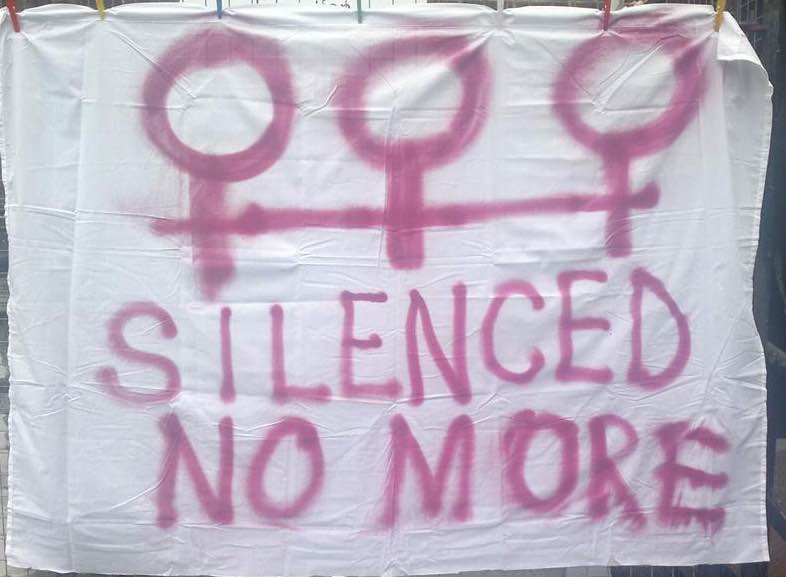
Silenced no more bannerAs a woman raised in Romania, I have been taught that I am not equal with a man. It is not necessarily my family who taught me, but my school, my friends, the church, and the SOCIETY. For a long time, I really believed it. I believed that I cannot do or I am not supposed to do some things, just because I am a woman. Like if a woman wears short pants she is considered a sexual worker, who “asks for it.” Or if a woman dares to drink a beer with a man she is an alcoholic. Or it a horrible thing to see a girl eating in McDonald’s.

Instead, it is believed that all a woman is supposed to do is be pretty, cook and give birth.

During my teens I felt upset. I did not understood why it was forbidden for me to do some things that were not for my best friend, who was a guy. And I cried. But after a few years I accepted that people have different points of view. I started to see equality as a thing which involves rights and obligations as well. And to accept that men can naturally be more physical strong than women, but that does not mean that all guys have to be strong or all the girls have be less strong. That maybe we are not born equal, but we should all have an equal chance to get where we want.

A few months ago I was at a university helping students who wanted to join the Psychology Faculty. At the beginning, we had to explain to them that they had to pay a fee and then come back. Everything seemed to be okay until one guy came back in this public institution and started to yell at us that he did wrong because of us. This “us” refers to a group of six women and a guy. Some of us tried to calm him down and explain to him that he was wrong and he misunderstood. We even came to him with some solutions for his problem. When a woman, a friend of mine, tried to speak to him, he yelled at her, “I do not speak to you. You are a woman. You are a woman and you do not have statute.”

My friend and I did not have any idea how we should reply because he became very verbally aggressive toward us.

I was shocked to see a guy around my age say that women do not have any statute. That women are nothing but objects who have to be pretty and produce kids. I wonder how that guy acts at home with his mother, his sister, his girlfriend. How will he act with his daughter? What he will teach his daughter? How will he react when his daughter comes home and says that another guy punched her. Will he defend her? Or he will congratulate the other guy?

I know my story is not exactly about street harassment, but it shows what it is like to be a woman in Romanian society. It is about how some of us are educated. It is one of the reasons why women in Romania are street harassed. It can be an answer to the question of “Why, as a woman in Romania, can someone touch my back?” or “Why, as a woman, in Romania, do some guys whistle after me?” and “Why does no one do something when someone rapes a girl?”

We have to see our culture change if we want to see street harassment and other forms of sexual violence end.

Roxana is a 21-year-old who is studying psychology and plans to do a master’s program in Sexuality and Gender Studies. She hopes to one day work within the LGBT community, with sexual workers and/or with people who are suffering from sexuality disorders.

Share

Filed Under: correspondents

Nepal: She ‘Almost’ Lives

September 27, 2015 By Correspondent

Smriti RDN Neupane, Nepal, SSH Blog Correspondent

She almost runs, in the drizzling rain,
towards the last bus of the evening, or so they said
Up the road
She almost runs under the drizzling rain
Her body putting in all the strength she has onto the ‘almost’ running,
crying out silently, for some rest, for peace,
Her body aching to be not- groped, on her way

Her body has a Saree
Draped around it like a vine creeping up
the only thing that covers her ‘dignity’,
A whisk of strong wind would blow the shield away,
She ought to hold it with her hands,
her hands, she can’t put it free, cannot fling it while she walks,
Her coarse, broad hands trying to grip to the hope that she is safe

Her hands have a bag
and bangles that jingle with her every step,
She gropes to them; the saree and the bag,
as if her life depends on it,
She walks hastily, almost running, her feet trying hard to move fast
but the vines around her not giving them enough space
Her feet trying so hard,
Hoping the path she travelled was as dry and clean as she would like

Her feet have slippers,
They keep slipping on the slippery slope
Sometimes plunges in the puddle
while her feet desperately trying to stay steady
She cannot miss the bus
when it’s already getting dark,
Not when she has probably five eager, hungry adult stomachs to cook for, at a place called home

Other adults around her,
they look, keep looking, at her vines,
and the lines beneath those vines,
The lines that peek through the vines when a gust of wind blows it,
The lines, she is desperately trying to shield
with those vines from the prying eyes,
Her eyes, mapping those eyes
She almost runs to the bus,
The bus isn’t still, keeps rolling away slowly,
slow enough to jump in

The bus has a small door
and it’s open, yet jammed,
Seven of them trying to get in, twelve trying to get out
at the same time
She can’t leave now,
not after the second bus just got missed, not when it’s turning dark
On her attempt to get in
She feels a hand pushing on her behind
Pushing her to go inside and that hand is not trying to be discreet

That hand also has a mouth
Tells her to get in fast if she wants to go
She recognizes the tone,
and the way those hands push her every time
She manages to get inside.
manages to grab the handle- too high for her
Her hands high up towards the handles,
Her lines exposed, the vines would not protect her
No

There are bodies all around her
Bodies have hands
and other parts
There is an occasional pull and push, occasional tug
Her vines and her lines
also her hair,
all exposed
There is frequent touch,
and pokes she doesn’t want to talk about
She dissociates herself from the present
Becomes numb to the happenings around her,
To her.
She thinks about work
She thinks about the struggle to prove herself every day, every time, every where
The bus rides along, oblivious of what is going on its inside and her inside.

She gets down on her stop
And the bus with a small door swirls along the road,
Away
With her
Dignity,
Self-confidence,
Happiness
Few parts of her

She thinks about tomorrow
“Tomorrow is going to be a better day”
She dreams while she walks towards the place she calls home,
The roads, rides and respect she deserves
She will get
because
She has hope!

Smriti coordinated Safe cities campaign in Nepal with a team of feminist activists of various organisations, networks and community groups from 2011 to 2014 and is still voluntarily engaged with it. She is currently engaged in an action research and advocacy on women’s leadership in climate change adaptation focusing on women’s time use.

Share

Filed Under: correspondents

USA: NO, girls, don’t loiter on the streets! Gendered access to public spaces in India

September 25, 2015 By Correspondent

Meghna Bhat, Chicago, USA, SSH Blog Correspondent

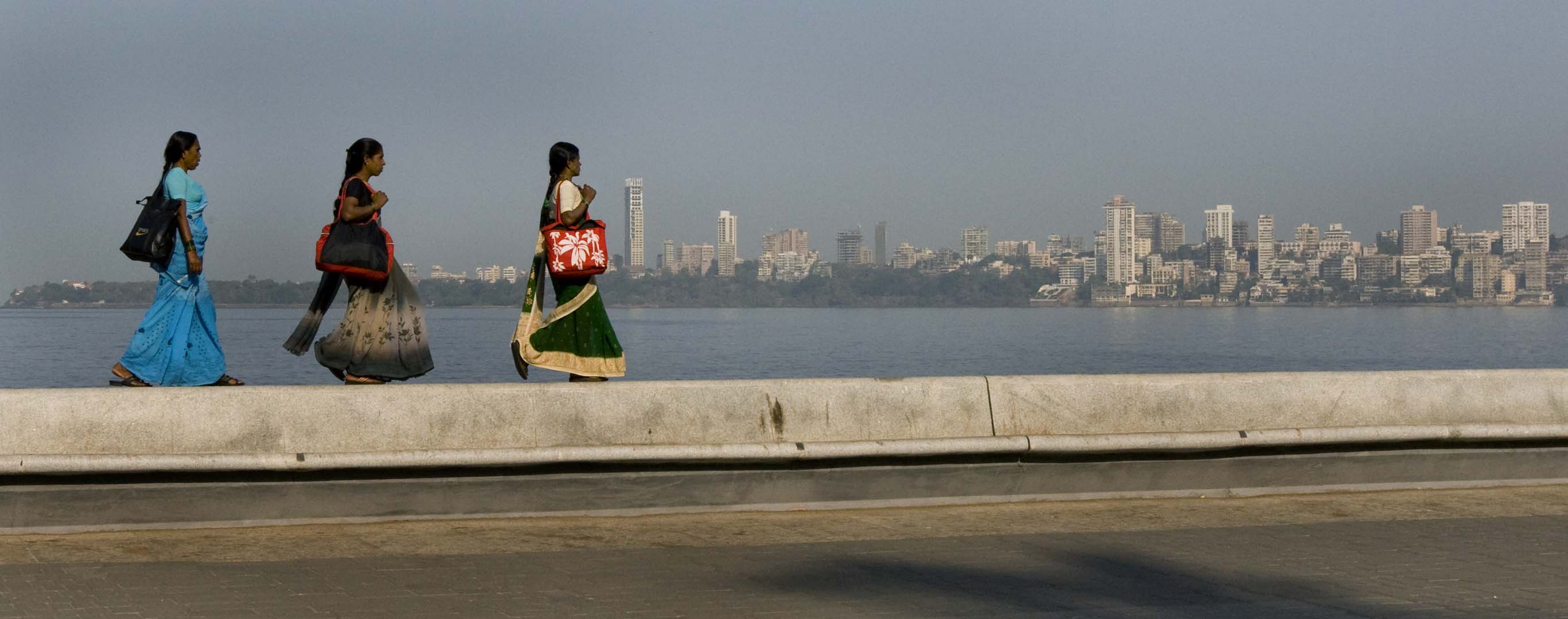
Three women in Mumbia | Wikipedia

As I got into the car last week, my husband told me a segment on women’s rights in India that was going to start on NPR radio. As I tuned in, the correspondent spoke about how a group of young women in Mumbai started cultivating a movement called Why Loiter?

These young women believe that we (as women) should be able to hang out with friends or be alone in public spaces, just because we want to and feel like. We don’t need to give a possible reason to anyone! Women are often excluded from claiming public spaces in India on the pretext of keeping them safe. They are warned not to ‘loiter’ or ‘hang out’ in public spaces and if they are, a man or family should accompany them.

That’s when I remembered how many times I was told the same thing during my school and college days and when I worked at different places. “Don’t go out or stay late in the dark,” “That road is very deserted so take the alternate road where it’s brighter”, “Don’t loiter around- wait closer to a bus-stop so it looks like you are waiting for a bus”, “Talk to a friend on your cell phone if there’s a potential pervert walking around so he doesn’t approach you”, “Wear appropriate clothes if you are going out at this time”, “Avoid standing alone or with your girlfriends at this paan-shop (tobacco shop) or dhaaba (street diner)…people shouldn’t misunderstand you” and “don’t take the late night train home on this route as there are barely any commuters, so take the bus”. “Hanging out or loitering in public spaces just for fun, absolutely NOT!”

Did years of blindly and sincerely following these warnings and messages make us less exposed to sexual harassment — or what India calls ‘eve-teasing’? Did these measures lessen our experiences of being catcalled, groped or pinched, or being sexually assaulted and attacked by some men? The answer is NO.

I wonder how much time, mental stamina and efforts I and many other women have sub-consciously and unintentionally invested in avoiding being a target of harassment or unwanted unpleasant attention. Examples of changes include planning my daily schedule, deciding what public transport to take, figuring out what time to leave and return home, and what clothes to wear depending on what time of the day and which neighborhood. There is an underlying implication that we are likely to be at risk for sexual harassment or assault if we wander outside our homes and we need to stop loitering out in public spaces to keep ourselves safe.

My parents never necessarily gave this advice to us (my younger sister and me) but these were the very obvious strong messages that we as Indian girls and women have been conditioned to hear from our society and popular culture such as films and TV serials. Don’t get me wrong- the advice is well intentioned from a parents’ perspective and it is overall good to take precautions, but these messages are mostly pelted to girls than boys. What messages are we giving to our young girls and boys? Who are likely to be ‘victims’? In India, the gender-biased advice, policing and curfew for the safety of girls and women is likely to stem from deeply embedded cultural norms and practices of raising daughters in the past.

The Why Loiter? movement was drawn from the book written by Shilpa Phadke, Sameera Khan and Shilpa Ranade (2011). This powerful book, based on the research between 2003 and 2006 in the City of Mumbai, highlights how the 21st century Indian society deals with women’s safety. The authors argue how women from different castes, social classes, neighborhoods and communities in Mumbai have been excluded from many public avenues and additionally, have to plan and negotiate their lifestyle, daily schedule, transport and work to prevent from being at risk everyday. Grounded in feminist perspectives, the authors further suggests that “loitering should be celebrated, not reviled, as an act that offers possibilities for a more inclusive city where all people have a right to city public spaces.”

Even though I have been living away from my hometown for the past 11 years, I wish I had come across a similar movement that encouraged young girls and women in Mumbai to claim public spaces without negotiating, hangout with girl friends just for fun, take a nap in the park, to chit chat until late night, and to enjoy food at street diners. So, after I read the book Why Loiter? in 2013, I started researching if there were similar social movements. One particular fascinating example that I came across is the #GirlsAtDhabas that young girls and women in Karachi, Pakistan, are promoting. I say, more power to these girls and women!

By focusing on young girls and women’s rights in India, this blog does not intend to trivialize the daily sexual harassment and structural violence our transgender and LGBTQI friends in our cities encounter in these same public spaces. Is it not possible to share these public spaces for everyone to hang out, loiter or just enjoy a late night ice cream at the neighborhood stall, without being stared at, questioned, judged, or harassed and policed?

Meghna is a doctoral candidate in the Criminology, Law, and Justice program at the University of Illinois at Chicago, with a specialization in Gender and Women Studies. She is currently working on her dissertation, which focuses on representations of violence against women in a widely viewed form of Indian popular culture, Bollywood cinema.

Share

Filed Under: correspondents, street harassment

USA: Keep Running Outside

September 24, 2015 By Correspondent

Chelsea Cloud, Michigan, USA, SSH Blog Correspondent

Run!
Image via Flickr

Every day that I suit up for running I am mentally preparing myself for what I am going to encounter out on the streets. No, I’m not worried about my route or the looming danger of shin splints. I am concerned about what street harassment I am going to face. As a solo runner, I often ask myself, “How am I going to respond?” or, “What if it turns physical?” Over the past year I have added pepper spray to the plethora of accessories I wear during a jog, just in case. Thankfully, it’s only served as a safety blanket, but how do I protect myself mentally and emotionally from the attacks that come in the form of honking, yelling and sexually explicit comments? I started running three years ago in response to major life changes. I quickly realized that running made me feel alive and in control of my life. I felt strong. Resilient.

Then I moved to a slightly more urban locale and began running in downtown Kalamazoo, Michigan. The harassment amped up considerably. My internal responses range from disgust to rage. On a good day, I am fueled by the harassers. I go faster, farther even. If the main source of street harassment comes from the harassers need to dominate and take the power away from women, than I will show them how powerful I can be. But on the bad days, I feel defeated. By the third honk or heckle I am ready to burst into flames from anger. I’m left wondering how other women do it. Especially women in a considerably larger city, with packed streets and sidewalks. There are horror stories all over the internet and in message boards about the harassment that is subjected upon runners in large cities. I am reminded of an article that went viral earlier this year by Katie Prout for The Toast.com in which she describes her worst experience with street harassment while running in Chicago, when a group of pre-teen boys threw debris at her head while telling her to suck their dicks.

Running in the city, Chinatown, San Francisco
Image via Flickr

So what advice are runners being given to combat street harassment? Women who run solo are often told to run in groups. But what if they don’t like to run in groups? And why should a runner have to change their routine? Victims of street harassment are often naively asked, “What were you wearing?” and the same goes for female runners. Personally, I’ve been harassed in the dead of winter, completely bundled up with a mask covering most of my face. The tumblr page But What Was She Wearing? is a place where women are submitting their actual outfits that they were wearing when they were catcalled. It’s become glaringly obvious that choice of outfit does not make or break whether or not you are harassed. I’ve read blog posts by women and members of the LGBT community that don’t want to wear bright colors for fear of harassment. Runners are told to wear bright colors so drivers can see them, but many may be opting to wear drab colors so they don’t stick out to potential harassers.

Women may also be choosing to run more trails to get off the streets, but this comes with another set of dangers. Just last month, a young woman in my community was dragged off of the Bicentennial Trail in Portage, Michigan and into the woods by a male attacker. Thankfully, she escaped and got help (runners are a tough bunch). This incidence just adds to the growing list of worries that come with the decision to run outdoors.

There is also much debate over HOW to respond to catcalls. If you read the comment section in most articles about street harassment you will see that there are many conflicting views on not only how to respond, but how we should feel about being harassed. I am shocked when people say, “Just ignore it”, “It’s just life” and “You’re too sensitive.” While I can physically ignore verbal harassment, and usually do, I cannot forget the man who pulls over to honk at me or the young boy who comments on my body as I run past him. These little everyday harassment incidents are insidious. We cannot ignore the fact that we are being treated like public property.

So what is a runner to do?

Remind your friends and family that you are dealing with harassment on your runs and you need some support and solidarity. Download a safety app, or buy a TigerLady. But maybe most importantly, keep running outside. You are in control of your own run and every time that you lace up your shoes you’re running with countless others that won’t let street harassment put them on a treadmill.

Chelsea is a full-time sales assistant for an advertising company in West Michigan and a part-time Graphic Design student. She is proud to call herself a feminist and feels passionately about speaking up for women’s rights. You can find her on twitter @LitSmitten.

Share

Filed Under: correspondents

The Netherlands – Amsterdam: Haven of Sex, Drugs and Rrr…Catcalls?

September 24, 2015 By Correspondent

Eve Aronson, Amsterdam, the Netherlands, SSH Blog Correspondent

When people think about Amsterdam, what usually comes to mind is a fantastical world of marijuana, Red Light Districts and lots of gorgeous canals running through the city.

The Netherlands is not really an obvious place to look at street harassment. Ranked fourth in Europe by the European Institute for Gender Equality, and ranked 14th in the world according to the World Economic Forum’s Global Gender Gap Index, the Netherlands at first glance appears to be doing fairly satisfactorily in terms of promoting gender equality.

But there’s also a lot of people here and, consequently, a lot of room for mischief. There’s over 4,000 people per square kilometer in Amsterdam to be precise, which is about twice the amount of people in the same amount of space in New York and London.

So many humans sharing so little space doesn’t only lead to horrendously clogged roads (and bike paths) during rush hour, but also inevitably to more catcalls, more groping and to more instances of harassment in these overcrowded public spaces.

In January and February, I conducted a detailed survey of people’s experiences with street harassment in this ‘great small city’.

In just two weeks, I received a flood of over 150 responses from women, men, LGBTQ-identified folks and people of color. What their experiences underlined was that street harassment was happening in Amsterdam and that people were itching to talk about it.

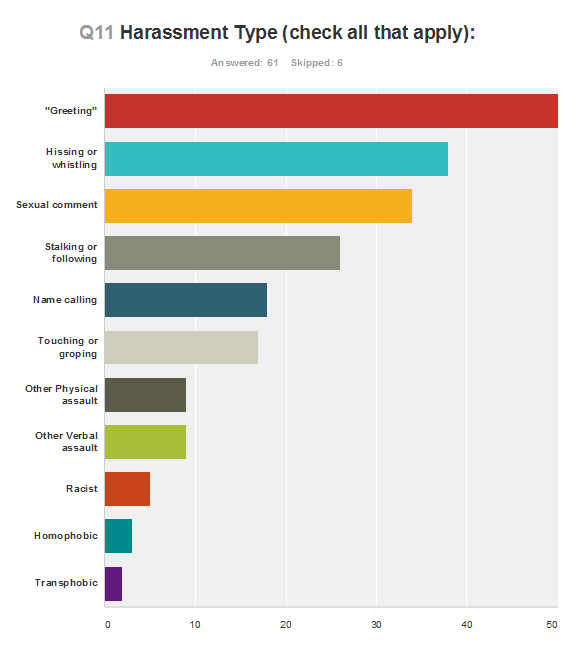
The three most popular types of harassment reported were ‘Greetings’ like Hey baby and Hi sexy, Hissing or Whistling and Sexual Comments. Below is a chart of all reported types of harassment by the survey respondents in Amsterdam:

hollaback! amsterdam street harassment surveyAlong with the types of harassment listed above, a significant number of people also reported experiencing non-verbal forms of harassment like leering, or smirking. One respondent described their harasser(s) as, “Looking at me with their eyes like they are already ripping my clothes off and raping me very violently. Looking at me like me fighting back would only turn them on more”.

What do these and other forms of street harassment do to those who experience it? What are the effects and long-term consequences, if any? To some survey respondents, the answer to these questions was that there were none, and described their experiences as ‘benign’ or ‘normal’.

Some respondents described their experiences as complimentary. Last year, New York Post writer Doree Lewark spoke to such interpretations, pointing to the euphoric nature of catcalls: “[W]hen a total stranger notices you, it’s validating…What’s so wrong about a ‘You are sexy!’ comment from any observant man?… For me, it’s nothing short of exhilarating, yielding an unmatched level of euphoria”.

But for many people in Amsterdam, what they experienced was far from euphoric. One respondent explained that she has been diagnosed with PTSD (post traumatic stress disorder) as a result of years of street harassment in Amsterdam, a recent encounter of which left her with a broken nose after she called her harassers out.

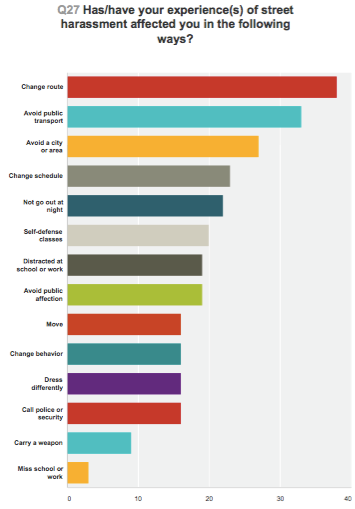
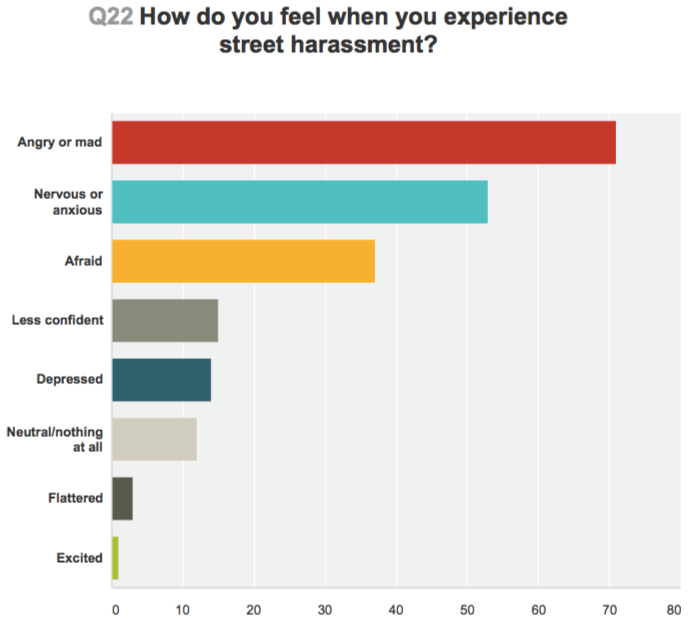
Below are two figures illustrating the extent of the effects of street harassment on the folks like the respondent above. The first shows 14 different effects that street harassment has had on people’s day-to-day lives in Amsterdam. The second gives a glimpse into some of the emotional effects that street harassment has on people who experience it:

Hollaback Amsterdam street harassment surveyhollaback! amsterdam street harassment survey finding
Survey respondents used words like “suspecting”, “fearful”, “frustrated”, “depressed” and “angry” to describe how they felt after being harassed in the streets or on public transport in Amsterdam. The experiences of these respondents were far from euphoric—rather, they are red flags that what is understood as ‘harmless’ or ‘playful’ to some is in actuality having a huge impact on how people move through public spaces and interact with others.

In April, I launched a local Hollaback! chapter in Amsterdam to provide an outlet to folks who have experienced street harassment to post their stories, get resources and mobilize on-the-ground actions. A local partner, StraatIntimidatie, is also currently running an online petition, vying for a nationwide law against street harassment.

One story told and one signature at a time, street harassment is being named and fought here in Amsterdam and around the world. Next time, I’ll talk about some cool new ways that online and digital technologies are being brought into the fold to really shed light on the pervasiveness of street harassment in Amsterdam and beyond. I’ll also talk about some important challenges that come with using these newer forms of activism and how they risk perpetuating certain racial and ethnic stereotypes about who harasses, who is harassed and why. See you next month!

You can find the full analysis of the Amsterdam survey results here or by contacting Eve at evearonson@gmail.com. Follow Eve and Hollaback! Amsterdam on Twitter at @evearonson and @iHollaback_AMS and show your support by liking Hollaback! Amsterdam’s Facebook page here.

Share

Filed Under: Activist Interviews, correspondents, hollaback, street harassment

« Previous Page
Next Page »

Share Your Story

Share your street harassment story for the blog. Donate Now

From the Blog

  • #MeToo 2024 Study Released Today
  • Join International Anti-Street Harassment Week 2022
  • Giving Tuesday – Fund the Hotline
  • Thank You – International Anti-Street Harassment Week 2021
  • Share Your Story – Safecity and Catcalls Collaboration

Buy the Book

  • Contact
  • Events
  • Join Us
  • Donate
  • Facebook
  • Instagram
  • Pinterest
  • Tumblr
  • Twitter
  • YouTube

Copyright © 2026 Stop Street Harassment · Website Design by Sarah Marie Lacy