• About Us
    • What Is Street Harassment?
    • Why Stopping Street Harassment Matters
    • Meet the Team
      • Board of Directors
      • Past Board Members
    • In The Media
  • Our Work
    • National Street Harassment Hotline
    • International Anti-Street Harassment Week
    • Blog Correspondents
      • Past SSH Correspondents
    • Safe Public Spaces Mentoring Program
    • Publications
    • National Studies
    • Campaigns against Companies
    • Washington, D.C. Activism
  • Our Books
  • Donate
  • Store

Stop Street Harassment

Making Public Spaces Safe and Welcoming

  • Facebook
  • Instagram
  • Pinterest
  • Tumblr
  • Twitter
  • YouTube
  • Home
  • Blog
    • Harassment Stories
    • Blog Correspondents
    • Street Respect Stories
  • Help & Advice
    • National Street Harassment Hotline
    • Dealing With Harassers
      • Assertive Responses
      • Reporting Harassers
      • Bystander Responses
      • Creative Responses
    • What to Do Before or After Harassment
    • Street Harassment and the Law
  • Resources
    • Definitions
    • Statistics
    • Articles & Books
    • Anti-Harassment Groups & Campaigns
    • Male Allies
      • Educating Boys & Men
      • How to Talk to Women
      • Bystander Tips
    • Video Clips
    • Images & Flyers
  • Take Community Action
  • Contact

UK: Making Gigs Safer!

September 22, 2015 By Correspondent

Tracey Wise, London, UK, SSH Blog Correspondent
Safe Gigs for Women logoIt’s 1991, and Courtney Love, performing with ‘Hole,’ stage dives in Glasgow.  It’s 1991 and Love stage dives and is violated by the crowd. It’s 1991 and I am 10.

It’s 2015 and Iggy Azalea gives an interview saying she had to stop crowd surfing because “Fans think it’s funny to finger her.” It’s 2015 and I am 34. In 24 years it appears nothing has changed.

Fandom, proper, all consuming fandom that devours your being and speaks to your soul, whether that be sport, cult TV or music, takes effort. My friends and I have repeatedly travelled the British Isles to see “one more gig” by that special artist – the ones that make life complete. Safe to say I don’t just like music, I am obsessed with it. So when the thing I love comes to represent something seedy, it breaks my heart.

Over the years I have been doing that “one more gig” or spending some of the best days of my life in a muddy field, at a festival. I have more than my fair share of harassment stories. I have been groped on more than one occasion, cornered, cat called, told by a male security guard – someone employed with the purpose of keeping festival goers safe – that the theft of my tent was nothing to worry about because “I could always sleep in his tent”. So fast forward to June 2015, I’m watching my favourite band play a career-defining gig and I‘m groped again by a complete stranger, no small talk first or even an introduction. A two handed full on grab, passed off as acceptable because “it’s the last song.” I’ve now finally had enough.

A blog written in haste the next day provokes a huge response – women telling me similar stories, and worse. Stories telling of how worryingly common harassment is happening in the background of dark, sweaty, packed-in music crowds. Some women tell of multiple experiences. Some tell of how this has impacted their own behaviour, like choosing to not go on their own to gigs or even not going at all. The music obsessive in me hates this. How can the thing I love be reduced to this?

In response, I established the ‘Safe Gigs for Women’ Twitter account, as a way for women to share their stories in an anonymous way, in order to highlight the harassment being experienced by women at gigs. This has been picked up on by a local authority in London that is well known for its music scene. Together we will be looking at improving the gig going experience with venues, gig goers and bands, in order to ensure all people, male and female get to enjoy live music, for the enjoyable, beautiful thing that it is.

You can join us! Please find us at www.sgfw.org.uk.

Born and raised in London, Tracey is a graduate of City University. She has spent the best part of her life at gigs and festivals and obsessing about music and created the “Safe Gigs for Women” project.

Share

Filed Under: correspondents, public harassment, Stories

Italy: When Playing it Safe is Your Only Option

September 17, 2015 By Correspondent

Sara Rigon, Italy, SSH Blog Correspondent

SSH_Rigon_Pic1For the past two years I lived the life of an expat. I left my hometown in northern Italy to live and work in New Zealand first and then Denmark. It was an incredible adventure personally and professionally, with unexpected side effects.

Usually, the first question people generally ask when they learn I’ve lived in Aotearoa, the land of the long white cloud, all by myself for more than one year, is: “Why New Zealand?”

I can perfectly understand the puzzled tone of voice and curiosity, Oceania is so far away and Kiwi land is not the most popular destination in the South Pacific. I wonder if people would ask me: “Why Australia?” I’ll never know, but I doubt it.

I have a standard reply. I’ve been saying this so many times, that at one point I didn’t have to think about it and I started listening to what I was saying, it was a revelation.

So, why NZ? “Well, I was looking for an English-speaking country, nice sunny weather most of the year and beautiful landscapes (I was leaving Italy, after all), and most important I needed a safe place for a single woman to travel and move around.”

A safe place. In the life of a woman, safety is an everyday concern, one that pervades your existence in almost every aspect and in the end regulates the course of your life. On top of that, you know, safety is YOUR problem, as in the unfortunate case something happen, people will kindly remind you that “you should have known better.” Meaning that you shouldn’t have worn such a short skirt, walked home at such late hour or taken that lonely walk on the beach at night. Victim-blaming is so incredibly common, almost expected, sometime I wonder if women change their behavior for safety reasons or simply to avoid the humiliating and shaming reprimand.

As a woman, you are well aware that safety needs to be taken into account, it will always be part of the equations, a fundamental component of most of the choices you’ll make through out your life.

Safety will determine your outfit, it doesn’t matter the occasion, it could be work, a party or the gym, you just want to keep the wolf whistles at the minimum (as if you could control them). For safety reasons you will leave the pub at a “decent hour” (I wish I could tell you what time is that) on a Friday night and you will not have “too many” drinks at a party. You know you always need to be aware of your surroundings and you shouldn’t lose control. Safety will also help you choose your travel destination for that trip you want to take on your own or with your girlfriends and which country you are moving to as a professional medical doctor. You might have one of the most powerful passports in the world, but as a woman you still can’t go everywhere you want, not without consequences.

You know all that, it’s normal, it’s the way the world turns. Moreover people say equality is already a reality so this must be it, it can’t get better than this: catcalling is a complement and victim-blaming is a useful reproach to suggest you the appropriate behavior. You might get used to this, it is your life, after all. Nevertheless, it is not okay; in fact, this is structural violence.

Structural violence, has described by the Norwegian sociologist and mathematicians Johan Goltgun who first used it in the article “Violence, Peace and peace research” (1969), is “avoidable impairment of fundamental human needs or.. the impairment of human life which lower the actual degree to which someone is able to reach their needs below that which would otherwise be possible”. In other words, systemic ways in which social structures harm or disadvantage individuals or groups by preventing them from reaching their full potential.

Embedded in longstanding “ubiquitous” social structures – economics, political, religious and cultural – as well as normalized by stable institutions and regular experience, structural violence is often invisible at our own eyes. This is how we all perpetrate and be subjected to adultism, ageism, classism, ethnocentrism, nationalism, racism, sexism without even knowing it. This is the odious power of structural violence.

When I first realized I was a victim of such violence and discrimination in a society that proudly proclaims itself fair and egalitarian, I felt deceived and helpless. With a wolf whistle after another I started thinking it was better in the old days, when men were gentlemen and you just knew you were not allowed certain behaviors or privileges. It was the rule and everybody knew it and lived accordingly. Yet this is can be the answer. Violence and injustice may apparently hurt less if they are institutionalized and regulated by law, but in fact they don’t.

I feel privileged to live in a world where I have civil rights that other men and women fought injustices to secure. It is my turn now and I want to do my part to create a future where women will be able to walk down the street with no risk of being shouted or whistled at or assaulted.

What to do then? The shocking murder of Mary Spears reminds us that safety is still an issue, standing up for your rights, speaking up and saying no have a price and it can be very high. I wish I could be brave enough to ignore conventions, shaming and victim-blaming everyday to be myself and live my life at its full potential. Instead, at times I play it safe and choose to move to New Zealand over other possible destinations. Nonetheless I’m not giving up, today I wrote this post.

Sara is a registered General Practitioner in Italy and New Zealand. She is the founder and current lead of the newly established Equally Different group within the European Junior General Practitioners Organization, the Vasco da Gama Movement, branch of the World Organization of Family Doctors. Follow her on Twitter @rgn_sr.

Share

Filed Under: correspondents

Croatia: “Raise Your Voice!”

September 14, 2015 By Correspondent

Marinella Matejcic, Croatia, SSH Blog Correspondent

One time I was going home from a club in Zagreb, a capital of Croatia, with a couple of friends. Two guys stopped us, asked us for directions, and when we continued our way, one of them slapped me on my behind. As I was the unfortunate one to be addressed in such an obnoxious way, I returned to them and asked them politely who did it, told the perpetrator to take off his motorcycle helmet – and slapped his face pretty hard. Sure, there is no need to answer violence by perpetuating violence, but something just snapped and I was beyond irritated. And I was lucky: nothing serious happened after this incident. That guy just asked us out, we, naturally, declined and that’s it.

But I’ve rejected being the object and the victim.

Downtown Zagreb, image via enviropau.wordpress

According to the research conducted by Hollaback Croatia in 2012, as much as 70 – 90% of women have experienced some form of a verbal encounter from a stranger in public space at least once in their lifetime. The harassment ranged from swearing to comments about their appearance. A fair percentage of women have been flashed, have seen public masturbation, been groped or followed. Every third woman was physically attacked at least once in her lifetime. Every second woman in Croatia will experience some form of street harassment by the age of 18.

Since street harassment is so hard to itemize, there are no official data, just this research done by the Hollaback Croatia initiative. The thing with this research is that most of the women who participated in it are living in the biggest city in Croatia, where is it somehow expected for this to happen. It’s not justified, it’s just expected. If there was any research conducted on the national level, the results would provide a better picture.

Just to be sure about the lack of institutional statistics on the subject, for the sole purpose of this blog post, I contacted the Croatian Ministry of the Interior, asking them if there are any data that could be used. They responded surprisingly quickly, asking me for the clarification of the query. They didn’t know what I meant by the term “street harassment”. The whole situation gets even more absurd when you realise that Croatia basically has the legal frame that puts (sexual) harassment in the penalty code.

When being harassed, most women just stay passive, ignore it or try to move away. It is this society that we’re brought up in, that’s something we learn to do: if you’re a woman (or any member of the LGBTIQ community) you’re not allowed to raise your voice, to fight back. If you’re witnessing that kind of event and not doing anything about it, you’re helping the perpetrator. That’s something most of us are very aware of while debating or chitchatting but have you ever actually stood up and stopped the harasser from harassing?

The fact that in most cases street harassment does not include “more” than “just words” is just not enough to justify it. Not in any community. That’s not the matter of culture, but patriarchy and male domination. We shouldn’t just let it be. We have to act. Stand up. As with any other form of violence, it is never the victim’s fault. Don’t judge, act (but think on your own safety). Raise your voice!

Marinella is a freelance journalist/writer, feminist activist, and soon-to-be administrative law student. She writes for Croatian portal on gender, sex and democracy called Libela.org and covers CEE stories for globalvoicesonline.org. Follow her on Twitter @mmatejci.

Share

Filed Under: correspondents, Stories, street harassment

USA: Hey Baby! Unhinged

September 11, 2015 By Correspondent

Hannah Rose Johnson, Tucson, AZ, USA, SSH Blog Correspondent

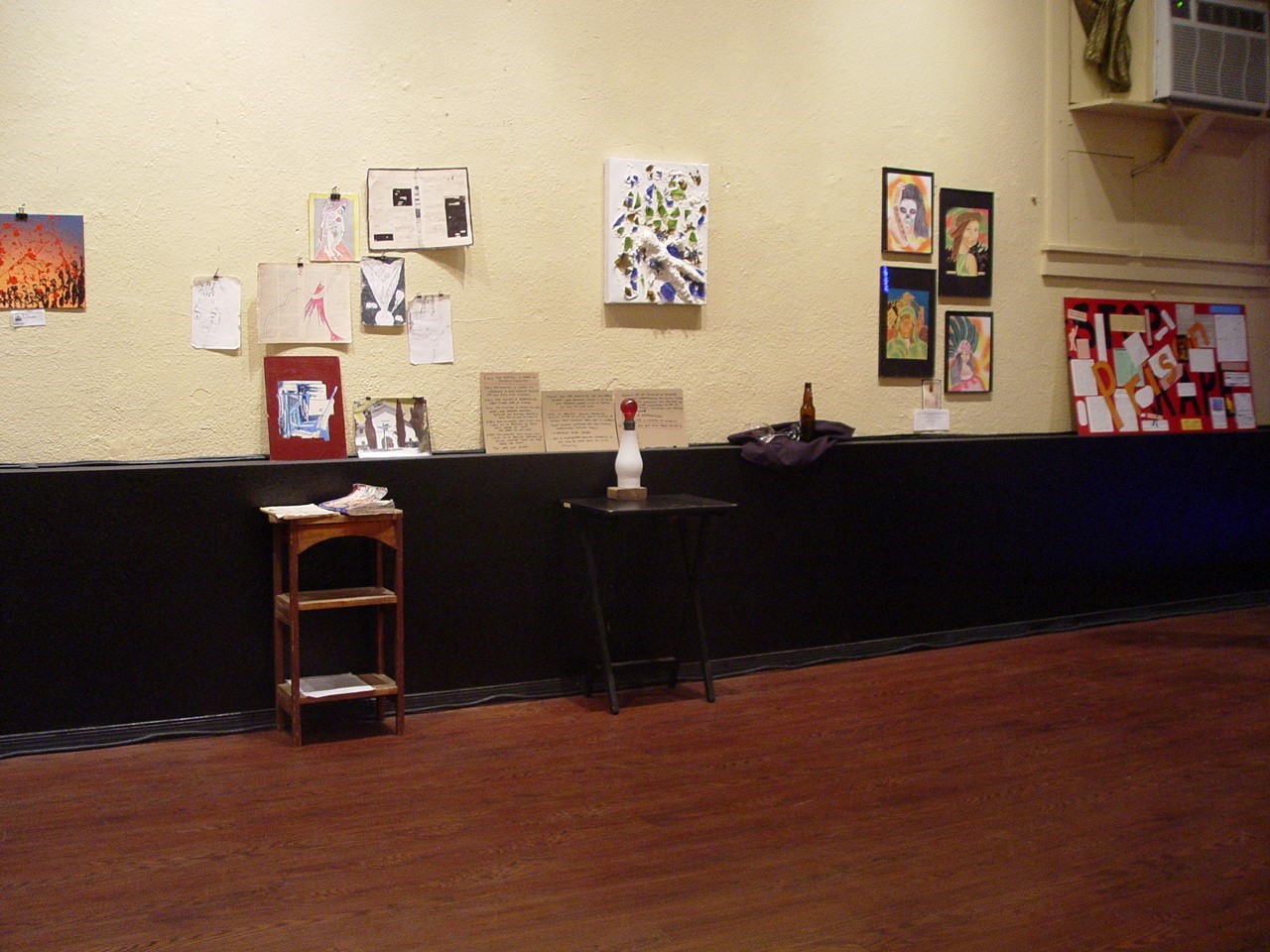
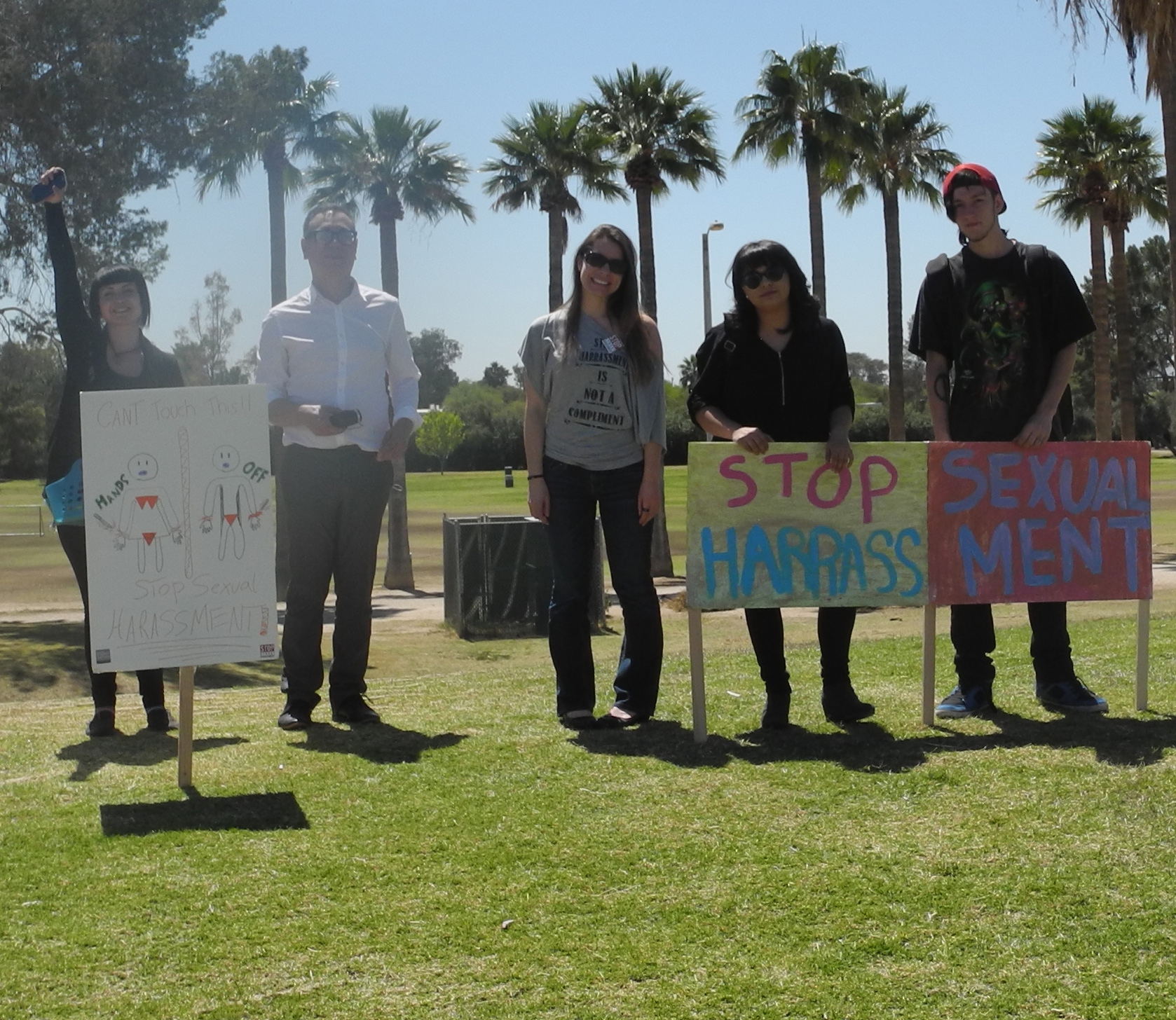
Hey Baby! Art Against Sexual Violence is an exhibition series that uses art as a vehicle and tool to end street harassment and sexual violence. After participating in this year’s shows, in April and May, I wanted to know more about this art movement. I wanted to know more about the people I passed in my office hallway, who I breezed by on 4th Avenue, who were doing this work. I wanted to piece together a genealogy. So I sat down with Wendy Sampson, an organizer who originally brought Hey Baby! to Tucson, and Manuel Abril, a current Hey Baby! organizer (and SSH board member).

Hey Baby! Art Against Sexual Violence show 2015.

This is what I learned: (it’s not linear and it’s not a history).

Rewind to 2010. Hey Baby! was a copycat of an event that happened in North Carolina, which Sampson’s friend suggested they organize in Tucson. Sampson said, “The one in North Carolina was a one-time event and we just planned a one-time event as well. We were like oh, this was a good idea, we should do it here.”

Sampson presented a really interesting analysis on the relationship between street harassment and intimate partner violence. She said that complacency with a culture of street harassment infiltrates our relationships with each other. That if we are willing to treat one another like shit on the street, we are willing to behave like that in intimate settings. But she also said people can more easily rally around street harassment; that “people have a tangible reaction [to street harassment] and are steady in that reaction than intimate partner violence, which is messier and complicated and drains you in a different way.”

Putting on Hey Baby! provided a break amidst the emotional exhaustion of the intimate partner violence work that she was doing. Sampson said, “I remember being excited about the art we had. I remember feeling that ANGER, that can get drown out through exhaustion, and to share it with other people was really rejuvenating.”

No one knew that it would get taken up again by other activists or be institutionally grant funded for a while, and eventually come out again on its own, unhinged. After Wendy organized the event she left Arizona. For four years. She admitted that she didn’t remember much about the actual event because she was so exhausted from the accountability processes. Though she did say, “I remember putting art up…I remember someone doing poetry…there was a lot of art being laid out and a lot of things people could take home, like posters…”

2014 Hey Baby art in Tucson
2014 Hey Baby art in Tucson (Abril is two in from the left)

I asked Abril to fill in the gaps. What he said about the ebb and flow of transitions actually isn’t the most relevant. We’re talking about a genealogy here, a series of connections that produces something that may mean something else depending on the timing and environment. And Hey Baby! got taken up with organizers, non-profits, and sexual violence prevention educators at different times and places.

What he did say that I thought was interesting was about the show this year: “We wanted to recapture the feeling of connecting with a kind of playfulness where we didn’t feel suffocated by everything that could go wrong.” The kind of wrong that comes from building a complex analysis that isn’t easily palatable.

Messiness.

Abril said that before inviting people to participate this year, “We told ourselves that we are going to f**k up and that’s going to be a part of our process…we wanted stuff that was messy and that didn’t have a predictable outcome in terms of how people were going to receive it…. And a lot of came from that…[artists and organizers] felt relieved not having to tell people what we already knew. Like depart from the place where we know rape culture exists, and pull in the other things, conditions that we live in that are socially or institutionally imposed. And try to make connections to those.”

Organizing against street-harassment is complex because when we examine the conditions of sexual violence we enter a multi-dimensional zone. Hey Baby! Art Against Sexual Violence brought together art as resistance, art as distance, and as a creative strategizing tool. We wrote, painted, collaged, sculpted and performed new narratives that exposed the intricacies from where sexual violence departs from and seeps into. Pieces that examined street harassment, catcalling, rape, date-rape, partner violence, state-violence, mental illness, incarceration, abuse within activist communities, victim-blaming, and challenging perfect-victim narratives.

After talking with Sampson and Abril, I had more questions. Curiosities about anti-street harassment movements, art as activism, and where are these people in North Carolina who organized the first event? [Editor’s note: My 2010 book on street harassment features the North Carolina event!]

I had some more tracking down to do.

For more information about Hey Baby! Check out www.facebook.com/HeyBaby.Art or www.heybabyart.tumblr.com

Hannah Rose is writing from Tucson, Arizona and Lewiston, Maine (US) as she transitions from the Southwest to the Northeast for a career in sexual violence prevention and advocacy at the college level.  You can check her out on the collaborative artistic poetic sound project HotBox Utopia.

Share

Filed Under: Activist Interviews, correspondents, street harassment

USA: “It’s Okay To Be Angry”

September 10, 2015 By Correspondent

Maryah Converse, New York, USA, SSH Blog Correspondent

“Do you think that women can be their own worst enemies? When they act as if the harassment were a compliment, or don’t speak up. Aren’t you your own worst enemies?” asked a man in the audience after a performance of #SpeakUp: The Street Harassment Play.

I did not just assume his good intentions, as Flux Theater Ensemble’s “Rules of Engagement” asked us to do in the facilitated discussion after the performance. I felt his good intentions, saw it in the dismay on his face at the reactions of all the women in the circle.

I thought, how many times have I said this to myself? “You shouldn’t have walked away. You should have stood up to that man. You’re your own worst enemy, woman!”

Then I remind myself that it is a psychological defense mechanism. I cannot confront or even take seriously every incident of street harassment in my life. I would have no time or energy for anything else. And sometimes—no, often it is physically dangerous. On my computer, I have a quote by the writer Margaret Atwood: “Men are afraid that women will laugh at them. Women are afraid that men will kill them.” I hate that she is right.

Some of the others in our circle have responded to his well-intentioned but jarring question. Then Shaun Bennet Fauntleroy said, “The worst enemy is the one who makes us feel small.” It felt like the perfect note to end our discussion.

*     *     *

Bennet Fauntleroy was not just the facilitator of our discussion group. She is also the woman behind the event, #SpeakUp: The Street Harassment Plays, and wrote one of the seven short monologues in the project.

#SpeakUp, photo via Flux Theatre Ensemble's Facebook Page
#SpeakUp, photo by Isaiah Tanenbaum. Via Flux Theatre Ensemble’s Facebook Page

Each of the monologues approached harassment from the many ways that women respond, all different, all equally valid. The second piece, “Just the Way It Is” by Nicole Pandolfo, was the only male voice, and it provoked that too-common fear response. There is the trauma response of the seventh voice, “What I Would Do to You” by Maria Alexandria Beech.

The third voice, “God Bless You Mama: A Woman’s Guide to the World” by Sol Crespo, was by far the funniest. The text dripped with sarcasm, on the verge of farce, but was played absolutely straight by Holly Chou. With heartfelt innocent sincerity, she declares, “If he hadn’t reminded me to smile, I would never have known I had the ability … or the permission!” She keeps declaring with a bright smile, “Men are SO HELPFUL!”

I could not help but notice that the loudest laughter in the room came from the men. Every time I laughed, I felt guilty, because under the humor, this can be deadly serious.

The fifth voice was like a punch in the gut. I knew from the first sentence that this was the work of Lauren Ferebee, titled “Rogue Agent.” It was no surprise that my friend Lauren would want to write a theater short for a production of this kind. Another full-length play of hers, “Somewhere Safer,” is a nuanced reflection on terrorism and the wars in Afghanistan and Syria, gender, and the choices we have to make between morality and making a living.

Here in “Rogue Agent” was the anger response to harassment, raging against the machine. “I never wanted to be a woman writer,” the narrator spits out, played with the perfect low, gravelly voice by Hanna Cheek.

I asked Lauren about her piece, and she described the lack of women’s voices in the standard literary canon, saying, “To me, the silence of women artists across history is, on a structural level, related to the silence of a woman who has been called out over and over again in public. On a societal and personal level, women who live, write and work in the public space are told over and over again ‘you don’t belong here.’ I struggle with having internalized that voice telling me that I don’t belong here, and I struggle with having internalized that larger dynamic that my work doesn’t belong here.”

When I asked Lauren why she chose theater as the medium for her message, she said she wanted to tell audiences “that it’s ok to be impacted by those experiences. It’s ok to be angry. And that we should be angry, whether anyone tells us it’s ok or not.”

That is exactly what I heard in her piece in the lines, “All I ever learned about anger was to turn it into a secret … so I talk.”

Maryah works for the Unitarian Church of All Souls in New York City where she has provided particular leadership in the Racial Justice Initiative. She has an MA in Near Eastern Languages and Cultures, and was a Fellow at the Center for Arabic Study Abroad in Cairo.  Read her blog “Arabs I’ve Known.”

Share

Filed Under: correspondents, street harassment

« Previous Page
Next Page »

Share Your Story

Share your street harassment story for the blog. Donate Now

From the Blog

  • #MeToo 2024 Study Released Today
  • Join International Anti-Street Harassment Week 2022
  • Giving Tuesday – Fund the Hotline
  • Thank You – International Anti-Street Harassment Week 2021
  • Share Your Story – Safecity and Catcalls Collaboration

Buy the Book

  • Contact
  • Events
  • Join Us
  • Donate
  • Facebook
  • Instagram
  • Pinterest
  • Tumblr
  • Twitter
  • YouTube

Copyright © 2026 Stop Street Harassment · Website Design by Sarah Marie Lacy