• About Us
    • What Is Street Harassment?
    • Why Stopping Street Harassment Matters
    • Meet the Team
      • Board of Directors
      • Past Board Members
    • In The Media
  • Our Work
    • National Street Harassment Hotline
    • International Anti-Street Harassment Week
    • Blog Correspondents
      • Past SSH Correspondents
    • Safe Public Spaces Mentoring Program
    • Publications
    • National Studies
    • Campaigns against Companies
    • Washington, D.C. Activism
  • Our Books
  • Donate
  • Store

Stop Street Harassment

Making Public Spaces Safe and Welcoming

  • Facebook
  • Instagram
  • Pinterest
  • Tumblr
  • Twitter
  • YouTube
  • Home
  • Blog
    • Harassment Stories
    • Blog Correspondents
    • Street Respect Stories
  • Help & Advice
    • National Street Harassment Hotline
    • Dealing With Harassers
      • Assertive Responses
      • Reporting Harassers
      • Bystander Responses
      • Creative Responses
    • What to Do Before or After Harassment
    • Street Harassment and the Law
  • Resources
    • Definitions
    • Statistics
    • Articles & Books
    • Anti-Harassment Groups & Campaigns
    • Male Allies
      • Educating Boys & Men
      • How to Talk to Women
      • Bystander Tips
    • Video Clips
    • Images & Flyers
  • Take Community Action
  • Contact

USA: Street Harassment as Body Shaming

September 8, 2015 By Correspondent

Sara Conklin, Washington, DC, USA, SSH Blog Correspondent

“Blondie” — Photo from Haley Morris-Cafiero’s The Watcher series

This weekend I was feeling particularly enraged about a viral video called Dear Fat People by YouTube comic, Nicole Arbour. In this video of self-proclaimed satire, “fat shaming” is heralded as something of a favor to people; if you can shame people enough, they might just lose weight.

I don’t know what universe Nicole Arbour lives in where shaming any person in any matter is considered a service to society, but I am proud to say I don’t live in the same one.

Unfortunately, the internet isn’t the only place where body image harassment exists. My first blog post was about an incident of street harassment I experienced where the line between objectification and sexism was blurred with a spewed statement of body hate.

This is a scenario that happens all too often – sexualized hecklings with specific references to one’s appearance and particularly, a woman’s curves.

I should be clear that it is neither my goal nor do I have enough time to discuss the myriad of ways in which people of all sizes and genders experience harassment in public spaces. But what I can begin to consider are the ways in which women of a certain body type experience public harassment differently, and I can do so by reflecting on my own experiences.

As Nicole Arbour so unabashedly points out in her gruesome video, plus-size women (or as I will start referring to as women) can be treated like public property, as if our bodies incentivize more of an invitation than others. A harassment perpetrator might feel like it is their privilege to point out a descriptive observation that they just don’t like, i.e. “move that fat ass along.” Melissa A. Fabello the Managing Editor of Everyday Feminism, points out that, “So long as people believe that ‘concern trolling’—harassing and threatening people under the guise of being concerned for their health;—is acceptable, attitudes like this one will not only exist, but also thrive.” Perhaps even to the extent of a “well-intentioned” blonde on YouTube projecting hate to hundreds of thousands of viewers.

In the words of another YouTube comic, Meghan Tonjes, that video was “lazy comedy wrapped in health concern trolling tied in a f***ing privilege bow.”

The sad truth: the street harassment I have experienced is most often directly related to the size of some part of my body or the way an outfit fits on it. So, what is the difference between being harassed by a comedian’s video online and being told to move my fat ass on the street? Not a lot. Both perpetuate and let flourish the notion that “calling out” people who don’t fit a certain qualifying personal descriptor makes them less than and makes them a target for words used to demean people. If you don’t believe that’s even possible, check out the brilliant photographer Haley Morris-Cafiero who captured reactions to her body in public.

We need to shake up the idea that all harassment is the same stereotype: a come-on from the guy in the hard hat to the girl in the short skirt. Truthfully, harassment in public spaces comes in more varieties than we have words to describe it. But, what is lacking in variety are the tools to combat harassment that is guised as body shaming.

I’m always reading articles about women who have witty and poignant comebacks to street harassers. I’d like to think of myself as one of those women. On most days I have an allegorical potluck of shutdowns in my head. But why, when I am directly insulted about the size of my body, do I fall silent? I feel powerless. Perhaps more of our empowering messages to women don’t always require literal references to situational street harassment. It might start at a place deeper-rooted and intrinsically engrained — It might start with body acceptance. It’s worth thinking that if I loved my whole self a little more and was aided in this self-actualization by the world around me, the allegorical potluck could be reeling with comebacks of body positive statements instead of contrived defense mechanisms.

Truthfully, my body does not occupy nearly enough space to be of such a mental occupation to you. Yet, every time you make a comment in regards to it, there is a power dynamic shift. I won’t stand by and let anyone feel powerless because of the way someone sees them. I’m worth more than your lazy and privileged comments in any public space, online or otherwise.

Sara works in fundraising events at an organization that empowers women who face homelessness through recovery, wellness training, and housing. She runs her own photography company (saraconklinphotography.com) and a popular website that seeks to connect the world through pictures, sarapose.com.


Share

Filed Under: correspondents, street harassment

USA: Dealing with Street Harassment is Emotional Labor — And I Quit

September 1, 2015 By Correspondent

Michelle Marie Ryder, USA, SSH Blog Correspondent

A sex-obsessed Harry Block in the film Deconstructing Harry asks the prostitute he’s just slept with if she likes her job. Still under the sheets, she replies “It’s okay, it beats the hell out of waitressing.”

“That’s funny,” Harry laughs, “every hooker I ever speak to tells me that it beats the hell out of waitressing. Waitressing’s gotta be the worst fucking job in the world!”

Perhaps not THE worst job, waitressing is without a doubt ONE of the worst jobs. I’ve toiled away, overworked and underpaid, in a number of unenviable trades, including as a janitor hauling trash and scrubbing toilets, but what made waitressing so unbearable was that thing that often separates men’s work from women’s work: emotional labor.

In her book, The Managed Heart: The Commercialization of Human Feeling, noted sociologist Arlie Hochschild defined emotional labor in the workplace as “the management of feeling to create a publicly observable facial and bodily display… sold for a wage.”

Emotional labor is a kind of mandatory fakeness, a display of affected emotion, usually warmth and enthusiasm, in order to manage the expectations of the customer. It commonly entails displays of deference from those who “occupy disadvantaged structural positions within society,” and as a result, is strongly associated with occupations dismissed as women’s work, such as waitressing, nursing, teaching, childcare, social work and sex work. Not surprisingly, emotional labor contributes to occupational segregation and the gender pay gap.

In highly sexualized industries like the restaurant business, emotional labor makes substantial psychological demands on the individual. Attesting to this, after just a few months on the job I had to make a promise to myself daily not to burn the place down.

The power differential between customer and server meant male customers felt entitled to my company, my time and even my body. My hospitality was often mistaken for flirtation, and in a culture of sexism and male entitlement, this “mandatory fakeness” served as justification for sexual objectification and harassment.

The last straw for me was when a male patron asked if he could take professional photographs of me. He was puzzled when I declined his offer, confident I desired nothing more than to be the privileged object of his gaze. He was double my age and it was hard to miss his “Lolita Complex.” I could see Nabokovian fantasies flowering between his eyes every time I looked at him.

The thought of being fetish fuel for this man’s erotic preoccupations – and to have it all captured on film – pushed me to my breaking point. That night I walked out with no intention of returning.

I felt liberated. The air never tasted so sweet and I managed a few lungfuls of it before a stranger at the bus stop demanding my attention and asking me questions like what I did for a living (oh the irony!) tried to grope me. That’s when I realized a woman’s work is never done, only now there was no paycheck or Title VII protections.

Freshly unemployed, I couldn’t escape the burden of emotional labor. It was still my job to make creeps feel at home. Either I defer to the male ego on the street or I reject its advances and disrupt a sense of entitlement so draconian I risk my own safety. The threat of violence is always there, ominous, circling, ready to unleash its attacking power because gender-based street harassment is nothing less than an expression of power in a society heavily invested in minimizing and normalizing violence against women.

The type of emotional labor women are expected to perform in public is exhausting and requires split-second decision making that is shaped by our socialization to be open, kind, friendly and forgiving.

This means that despite years of calling out harassers, I still struggle to break the logic of this system. Often, before my sympathetic nervous system can determine “fight or flight,” an even deeper level of social programming kicks into gear and pulls the “polite” lever instinctively. It’s an opening harassers exploit to escalate the situation because anything other than unapologetic hostility is interpreted as an invitation. This is what happened at the bus stop.

Women are raised from birth to please others. It’s why over half of the female workforce ends up in jobs that require them to display friendliness and defer to the emotional demands of others. It’s why a woman walking down the street (or waiting tables) is viewed as sexually available and existing solely to satisfy men.

It’s why we are told to smile wherever we go.

Emotional labor is a double standard that makes public space a playground for men and a battleground for women. And it is work I am increasingly refusing to do. Consider slam poet Venessa Marco’s masterful poem “Patriarchy” my long overdue resignation speech.

Because I quit.

Michelle is a freelance writer and community activist. She has written for Infita7.com, Bluestockings Magazine, and The New Verse News on a range of social justice issues, and shares her poetry regularly at poetrywho.blogspot.com.

Share

Filed Under: correspondents, Stories, street harassment

Spain/Ireland: In praise of (feminist) festes majors

August 28, 2015 By Correspondent

Rebecca Smyth, Spain, SSH Blog Correspondent

Oh how time flies. This time last year I was wandering about what was then my new Barcelona neighbourhood. Today I’m back home in Ireland wondering where summer is.

And oh what I could be doing in Barcelona if I were still there. It’s festa major season you see, and what a season that is.

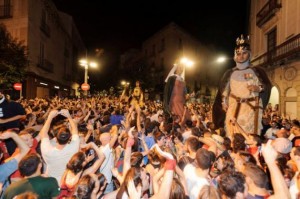
(Maria di Mario, tefl-iberia.com)  And yes, that is a bunch of people dancing under fireworks.
(Maria di Mario, tefl-iberia.com) And yes, that is a bunch of people dancing under fireworks.

From the 24th of June (Sant Joan, for those of you taking notes) until, as far as I can tell, the 24th of June of the following year, every other day sees the celebration of a festa in one corner of Catalonia or another.

Festes Majors de Mataró, 2015 (Dani Ros)

Festes are great. I want to import them here. For want of a better translation, they’re local, traditional festivals. They can be a one-day event or a two-week long blowout. What I like best about them is that there’s more to them than just the Degenerate Youth vomiting and brawling in the streets. You get kind of sick of seeing that if you grow up in Ireland. In point of fact, I witnessed no Degenerate Youth vomiting or brawling. Instead I saw people of all ages out until the wee hours of the morning taking part in processions and dances, watching open-air concerts, having water fights, having cook-outs in the street and generally just enjoying summer fun with family and friends. There may be some firework-related mayhem here and there, but what’s a lost finger or two among friends?

When I first arrived in Barcelona last year, the Festa Major de Sants was already in full swing. It’s not everyday that the new city you’ve just moved to throws a party for you, so I felt we were already off to a good start.

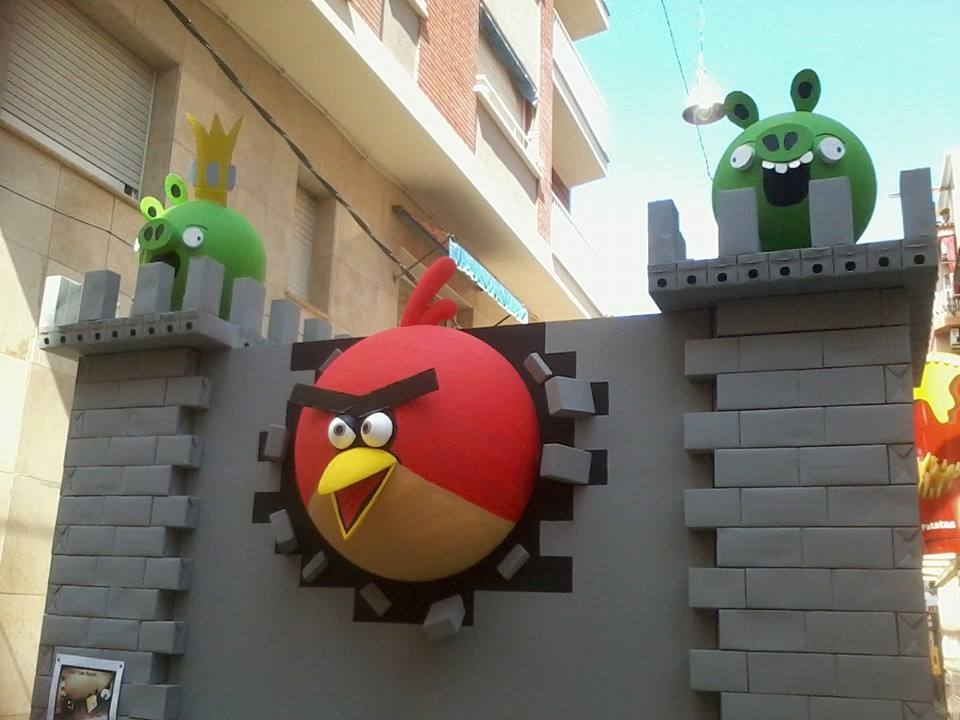
Festa de Sants street decorations 2014

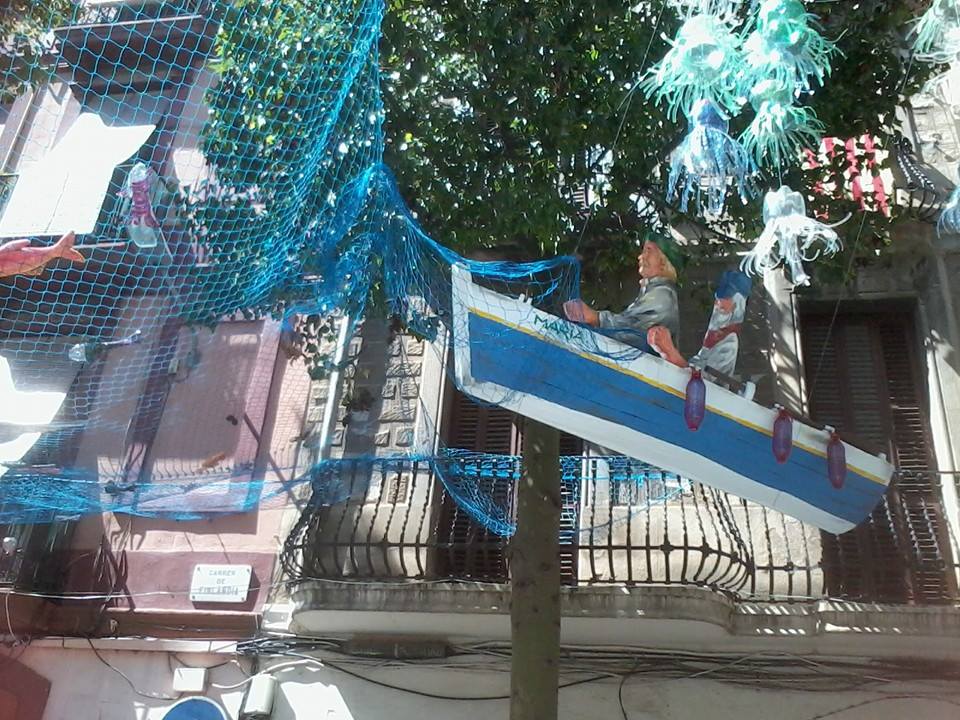
As part of the Festa Major de Sants many streets participate in a competition to see which one can come up with the best themed street design. I’m not entirely sure how or by whom it’s judged or whether anything more substantial than the honour and the glory is won, but that is irrelevant to this blog post (what is relevant will be revealed shortly, honest.) I wandered around for a couple of hours marvelling at the creativity, humour and effort that went into the street decorations, and marvelling all the more at the fact that groups of people get together and pick a theme and gather old bottles and clothes and scraps and cut and glue and stick and transform it all into Under the Sea or Pokémon or Angry Birds or Important Event in Catalan History or Witty Commentary on International News Events every single year because this is their neighbourhood and they love it and are proud of it.   And then they turn around and plan a bunch of events suitable for all ages to take place in the now-decorated street.

Festa de Sants Under The Sea, Boat in a Tree

And this is just one neighbourhood. It happens all over Barcelona, in El Raval and Poble Sec and, most famously, in Gràcia. Apparently the street decorations there are a whole other level, but Muggins here can’t say for sure because Muggins here couldn’t really afford to stay in Barcelona until the Festa de Gràcia kicked off on the 15th.

All sounds peachy, doesn’t it? But there’s a but. There’s always a darn but, isn’t there?

Fortunately I didn’t experience any nastiness first hand, but this is patriarchy and that’s why we can’t have nice things. Assaults, harassment and general perviness ruin something that should be fun for far too many women and other Others.

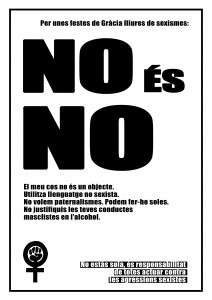
Asamblea de Dones Feministes de Gracia 2014 campaign poster (No means No; my body is not an object.  Use non-sexist language.  We don't want paternalism.  We can do it alone.  Don't justify your machista behaviour by blaming alcohol.  You are not alone, it is the responsibility of all to act against sexual harrasment)
Asamblea de Dones Feministes de Gracia 2014 campaign poster (No means No; my body is not an object. Use non-sexist language. We don’t want paternalism. We can do it alone. Don’t justify your machista behaviour by blaming alcohol. You are not alone, it is the responsibility of all to act against sexual harassment)

In response to this, numerous feminist collectives based in different Barcelona barrios and beyond have drawn up anti-harassment protocols in recent years. In 2012 the Asamblea de Dones Feministes de Gràcia (Assembly of Feminist Women of Gràcia) started the ball rolling with a poster campaign. The following year, they launched an awareness campaign featuring leaflets, posters and even radio advertisements. That summer also saw them draw up a proposed protocol against sexual harassment during festes majors. Primarily focused on their own ‘catchment area’, Plaça del Raspall, their activities and the protocol inspired other collectives involved in the Festa de Gràcia to take similar action. In both 2014 and 2015 the Asamblea and other collectives continued to campaign against sexual harassment and to provide support services to those who experienced it. It also inspired the barrio of Poble Sec’s les dones de La Base to draw up a campaign and protocol of their own this summer, to which many important groups involved in organising the Festes Majors de Poble Sec signed up.

La Asemblea de Dones Feministes de Gràcia’s 2015 protocol outlines how best to respond to different types of sexual harassment: non-physical harassment, physical harassment without force and physical harassment with force. In the case of the first two, the perpetrator is first warned that their behaviour will not be tolerated and, that if they continue, they will have to leave. If they continue, they are expelled from the festivities. In the case of violent physical harassment, they are immediately expelled.

Significantly, the Asamblea states in its protocol that it’s the person on the receiving end of any form of harassment to call the shots. If they feel like it’s harassment, then it’s frickin’ harassment. Organisers should only do what the person who has been harassed would like them to do. It also emphasises the importance of everyone being on the lookout for anti-social, sexist behaviour. Finally, and perhaps most importantly, the Asamblea also makes the point that those involved in organising the festivities should look to prevent harassment before it happens. This gives a whole new dimension to what ‘inclusivity’ can and should mean. For members of La Trama, a Sants-based feminist organisation, their anti-harassment campaigns in recent years aim “to show the rejection of sexist or homophobic violence by the organisers and the barrio.” Safe spaces can be fun spaces and fun spaces can be safe spaces, one hopes.

Writing this as my last blog was very much a deliberate thing: obviously it ties in nicely because the festes are currently ongoing, but most of all I wanted to write about something positive and something that reflected on the impressive grassroots activism that informs everyday life in Barcelona. Groups like La Trama, La Base, La Asamblea de Dones Feministes de Gràcia and many, many more have drawn upon and, to my mind, updated what can seem like fuddy-duddy concepts of community spirit and civic duty by giving them an intersectional feminist twist. It’s something I think we can all aspire to replicating in our own neighbourhoods, towns, university campuses and other communities. Failing that, we can all just move to Barcelona. Lovely weather you know.

The following article was a most helpful starting point and point of reference in writing this post.

For more information on the organisations mentioned, visit their websites:

* Asamblea de Dones Feministes de Gràcia

* La Base

* La Trama Feminista de Sants

Rebecca is currently living, working and stumbling through ballet classes in Barcelona. Originally from Kilkenny, she has a degree in European Studies and a Master’s in Gender and Women’s Studies from Trinity College Dublin, and will be doing an LLM in Human Rights Law in Edinburgh this fall.

Share

Filed Under: correspondents

USA: When Does Street Harassment Begin?

August 22, 2015 By Correspondent

Liz Merino, Massachusetts, USA, SSH Blog Correspondent

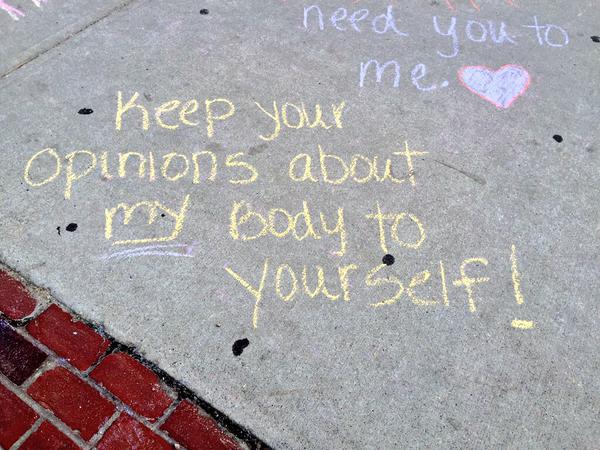
Boston chalking for International Anti-Street Harassment Week 2015

When does street harassment begin? I asked myself this the other day. When can I remember instances throughout my life that someone has sexualized my body without my consent?

There are really too many too count.

The news does capture some of it. Blips and glances, reels of one rape case or harassment of another, slowly turning, always changing, lighting up the television screen until something more repulsing replaces it.

Between sexist school dress codes, elite school rape cases and the systematic rape-based theology of Yazidi women carried out by of ISIS soldiers; I can’t help but feel helpless.

When does the sexualization of a woman begin? When does it really end?

Street harassment occurs every day. It happens on busy sidewalk streets during the morning hours when the sun is just slinking over the horizon. It happens on poorly lit streets after a night out with friends, causing some women to wonder if they will even make it home to see their loved ones again.

It happens on public transportation, city sidewalks and country back roads. Sexual harassment happens in the hallways of our schools and in the corners of our office spaces.

Sexual harassment doesn’t need an actual street to happen. It just needs a man with a sense of entitlement that reaches far beyond a normal scope of perception.

Don’t draw attention to yourself, but be sure people know you are there and carry your keys for protection, but don’t let them jingle or they will hear that too. Pull the top of your shirt up if you don’t want the attention, but stop, not every man is looking, not everyone is a predator. But cover your drink and watch your back just in case, because if they get you it’s always your fault. But you’re probably lying anyways, right?

Street harassment hurts. It creates a world in which men believe that a woman is their property simply for being in a public space.

If men can call you a slut on the street, take upskirt pictures of you in a grocery store or ask you to suck their dick from behind a car window, what will they really do to you when they get you all alone?

Priyanka, 23, a resident of New York City recounted her first experience of street harassment:

“The first place that I can truly remember it occurring was in the Middle East in one of the nicer malls. There would always be guys standing in a row near the theatre, just staring at you walking by and whistling or following you eventually. It was creepy and I didn’t appreciate the attention. I didn’t like feeling like a piece of meat.”

Having a vagina and a set of breasts is not a welcome mat upon which to lay your comments or your opinion or your crass approval of my body.

Street harassment is not a compliment. The oversexualization of women has never been “something nice” or “just something to do.” Funny how a woman can go from “sexy “and “honey” to stark raving mad, like a feral dog, when she rebuffs a man’s advances responds with how she really feels.

A woman is not a prude, stuck up cunt just because she doesn’t want you to grope her on the subway.

Jade, 21, a California resident echoed the same sentiment as Priyanka:

“I remember driving with an older guy friend, who was like my brother. He thought it was so funny to catcall women and he said, ‘If I see something I like I want to tell them.’ I tried to explain how uncomfortable it makes girls feel and he just didn’t understand that women are not here for his viewing pleasure. I don’t understand what men think they will get out of it. I am not going to hop in your car and I’m definitely not going to give you my number because you honked at me and said I have a nice ass. You are someone that I would make sure to stay far away from.”

Compared to a lot of other things I wrote in this article, the following incident isn’t that big of a deal. Or maybe in comparison, there are other bigger, more important things happening that people should care more about.

The one incident that has been popping into my mind happened during my freshman year of high school. I was wearing a tank top and a cardigan with a pair of sweatpants. I was 15.

As I was walking to class a teacher pulled me aside, a woman at that, and told me to pull up my shirt because it was “too low” and “I shouldn’t have worn it to school.”

I was embarrassed, mortified, I wanted to crawl into a hole and die. So I pulled up my shirt and hid my barely there boobs as a 15-year-old because I was “distracting,” “improper” “not appropriate.”

I hid my body because it was not deemed to be appropriate.

That line of thinking followed me into my sophomore year of college. During a sociology class discussion of street harassment, I finally realized that my body, my visible breasts and butt, thighs and flesh, the rough patches on my elbows and the bits of my baby toes were mine. Mine.

My body was not improper, but the way people view it and think about it is.

During this class I recounted a story of how my roommate and I were spending the day in NYC. It was hot, and my roommate had worn a beautiful sequin skirt, shiny and incandescent in the sunshine. We walked along laughing and smiling, taking in the city sights on our way to the Metropolitan Museum.

Street by street though, men called out to her. “Motherf***ing gorgeous,” “legs for days,” “hey sexy, come over here.” I watched as my roommate, a tall brunette with a wide smile and a contagious kindness folded into herself, hunching over and staring at the sidewalk, embarrassed by the attention she had drawn.

Before we got to the museum, she changed into a pair of pants she had in her bag. She covered herself to shield us both from the men old enough to be her father lusting after her.

She too felt her body was inappropriate, too much, asking for it. It killed me to watch it happen, and it kills me to see it now.

The only person a body belongs to is the one who can feel its heart beating from the inside. A woman is not a walking vagina, here for your pleasure only. She has two eyes, a nose and lungs, she breathes and loves and walks and thinks just like you.

And she feels.

Street harassment is not a compliment. Sexualizing women constantly is not acceptable. We know better. We can do better.

If you don’t believe street harassment, or the plight women suffer every day is actually an issue please educate yourself. If after reading and researching the topic you still don’t see the problem, rest assured we all do for you, because you are a part of it.

Liz is a recent graduate of Hofstra University with a Bachelor of Arts Journalism degree. She is currently a staff writer for a marketing agency in Boston. Follow her on Twitter @slizmerino and Instagram @elizabethmerino93.

Share

Filed Under: correspondents, Stories, street harassment

UK: Harassment and Technology – Legislation Is Not Growing Fast Enough

August 19, 2015 By Correspondent

Emma Rachel Deane, UK, SSH Blog Correspondent

PAY-Gemma-NewittLast month 20-year-old Gemma Newitt was left enraged after no charges could be brought against a man who took inappropriate photos of her in a supermarket. CCTV footage from a Co-op store in St Austell, Cornwall shows Karl Leggatt holding his mobile phone inches away from Newitt’s bottom as she browsed the shelves of the store. After the incident was reported to the Store Manager the police were called and Newitt was told that no arrests could be made because Leggatt had not broken any laws.

After celebrities including Katy Perry, Paris Hilton and Lindsay Lohan fell victim to an invasive lens, the “upskirt photo” became an all too familiar phrase. Although generally used to refer to an unauthorised photograph under a woman’s skirt, the term is also used in relation to more general voyeuristic photography depicting, almost exclusively, women. Despite the relatively recent phrasing, the interest in creating such images is not a recent occurrence and references in art can be found as early as the 1700s as well as a plethora of pictures created during the pin-up era. The difference between then and now, of course, is the development of technology. Smartphones now make it possible for non-consensual images to be uploaded to the internet and viewed by millions within minutes. There are entire websites dedicated to photographs of women sitting on benches, relaxing in parks and stepping out of cars completely unaware that they are being intimately photographed and posted on an erotica site.

Screenshot 2015-08-16 at 22Last year, despite complaints, crowdfunding site Indiegogo continued raising funds for a smartphone accessory, pitching itself on the ability to take stealthy photos of a woman’s body without her knowledge. The text on the webpage advertised the accessory’s ability to “take pictures round corners” while images used in the marketing focused on discreetly photographed breasts and legs.

Australia, New Zealand and India are countries that have specific legislation in place to tackle the issue based on a reasonable expectation of privacy but the UK is yet to follow suit. The Sexual Offences Act of 2003 criminalises ‘voyeurism’ in the UK and defines it as recording someone engaging in a private act or installing surveillance equipment in private areas without the knowledge or consent of the victim. This means that because Newitt was shopping in a public place, her body was considered available for public recording. Few countries have tackled the issue head on and created specific legislation for the protection of a woman’s privacy in this modern world of ever developing technology.

The attitude that women’s bodies are publicly owned is ingrained deeply in our society. We see this exhibited in a myriad of ways which each boil down to denying women agency over their own bodies. Restriction to abortion access, slut-shaming, sexual assault and the endless barrage of judgmental appearance based media representation are all displays of entitlement to the female form which promulgate a culture in which Leggatt could think of his actions as reasonable behaviour and stand vindicated by the law.

Emma Rachel Deane is a London-based retail manager for a fast growing women’s lifestyle brand and an outspoken advocate for women’s social justice issues. She can be found blogging on Raging Hag or tweeting @emmaracheldeane.

Share

Filed Under: correspondents, News stories, public harassment

« Previous Page
Next Page »

Share Your Story

Share your street harassment story for the blog. Donate Now

From the Blog

  • #MeToo 2024 Study Released Today
  • Join International Anti-Street Harassment Week 2022
  • Giving Tuesday – Fund the Hotline
  • Thank You – International Anti-Street Harassment Week 2021
  • Share Your Story – Safecity and Catcalls Collaboration

Buy the Book

  • Contact
  • Events
  • Join Us
  • Donate
  • Facebook
  • Instagram
  • Pinterest
  • Tumblr
  • Twitter
  • YouTube

Copyright © 2026 Stop Street Harassment · Website Design by Sarah Marie Lacy