• About Us
    • What Is Street Harassment?
    • Why Stopping Street Harassment Matters
    • Meet the Team
      • Board of Directors
      • Past Board Members
    • In The Media
  • Our Work
    • National Street Harassment Hotline
    • International Anti-Street Harassment Week
    • Blog Correspondents
      • Past SSH Correspondents
    • Safe Public Spaces Mentoring Program
    • Publications
    • National Studies
    • Campaigns against Companies
    • Washington, D.C. Activism
  • Our Books
  • Donate
  • Store

Stop Street Harassment

Making Public Spaces Safe and Welcoming

  • Facebook
  • Instagram
  • Pinterest
  • Tumblr
  • Twitter
  • YouTube
  • Home
  • Blog
    • Harassment Stories
    • Blog Correspondents
    • Street Respect Stories
  • Help & Advice
    • National Street Harassment Hotline
    • Dealing With Harassers
      • Assertive Responses
      • Reporting Harassers
      • Bystander Responses
      • Creative Responses
    • What to Do Before or After Harassment
    • Street Harassment and the Law
  • Resources
    • Definitions
    • Statistics
    • Articles & Books
    • Anti-Harassment Groups & Campaigns
    • Male Allies
      • Educating Boys & Men
      • How to Talk to Women
      • Bystander Tips
    • Video Clips
    • Images & Flyers
  • Take Community Action
  • Contact

UK: Page 3 – a shameless contributor to street harassment

May 6, 2015 By Correspondent

Emma Rachel Deane, UK, SSH Blog Correspondent

Britain is an odd place. We have an international reputation for stiff upper lips and conservatism, when in fact, much of our politics and our stance on many human rights issues are really rather liberal compared to the US and other western countries. And yet, there are still examples within our culture of mainstream British institutions hell bent on dragging us back to the dark ages. Like the third page of tabloid newspapers (including The Sun – Britain’s biggest selling newspaper) that show a girl in her late teens or early twenties posing in underwear or with her breasts exposed. This serves no purpose except for sexual entertainment. To be clear, this isn’t a “lad’s mag” or one of the top shelf publications your Dad might have had a secret stash of when he was a teenager. This is Britain’s biggest. selling. newspaper. What does that say about women today and how we should see them?

When a young woman’s maturing body is presented to us as news, particularly in such a powerful way as this, is it any wonder that street harassment, and the social acceptance of it, is so widespread? By putting a semi-naked woman on such a prominent page within a publication among news of foreign conflicts, natural disasters and welfare cuts, The Sun and other newspapers like it, are sending the very clear message that women’s bodies are just as attention-worthy and deserve to receive just as much public discussion as any other news story.

Sarah Faulkner is one of the women at the forefront of “No More Page 3”, a grassroots activist campaign calling for the voluntary removal of Page 3 by the tabloids. She had this to say about her earliest memories of Page 3. “My first experience of Page 3 was at school, when one of the boys would bring a copy of The Sun onto the bus. He and his friends would use the images in it to tease female classmates whose bodies had developed a little earlier than others. For the girls that were picked on it affected their confidence as they grew up. We are taught to enjoy male attention, if it makes us popular it must be a good thing, but if a woman’s sense of self-worth comes solely from men enjoying how she looks, then then that confidence is meaningless.”

It’s worth noting that prior to the Sexual Offences Act of 2003 (which outlawed the practice) many Page 3 models were just 16 years old when they posed topless for The Sun, wearing school ties and hats. The sexualisation of schoolgirls is a widespread problem, for which The Sun is not solely responsible, but as Faulkner went on to say, “The influence that a feature like Page 3 has on our society can’t ever be measured to reach a firm conclusion, but what we must accept is that it provides validation for people who already have negative ideas about the role of women and girls within our culture and certainly allows space for casual public discussion of women as objects.”

I agree with her. The attitudes that cause instances of street harassment are held together and even perpetuated by countless forms of embedded cultural validations. The tabloids are not accountable for the misdeeds of the advertising industry, or the tired gender stereotypes we see in film or TV, but when we’re discussing the content of newspapers we must do so while remembering Allen Ginsberg’s famous quote, “Whoever controls the media, the images, controls the culture.” These tabloids have a social responsibility to us all and they must be held accountable.

The debates surrounding Page 3 have received more press than usual recently when, in January, The Sun appeared to remove the feature without explanation. Its sister paper, The Times, broke the news that Page 3 had been ditched for good. This turned out to be no more than a school-boy prank and sure enough, Page 3 returned a few days later under the headline “We’ve had a mammary lapse.” How witty. I have to say, the timing was impeccable.

The Sun managed to draw attention to the “No More Page 3” campaign and the debates surrounding it in the wake of the Charlie Hebdo attacks at a time when discussions around freedom of press are very much at the forefront of our cultural zeitgeist. Faulkner’s views on press freedoms are very clear and are reflected in the No More Page 3 campaign strategy. “I would not support a government imposed ban on Page 3.” She said. “I’m not a fan of slippery slope arguments by a long shot, but that way danger lies. If the images are removed by force its far less meaningful than if the tabloids accepted that they have been at fault, which would propel a real shift in societal attitudes.”

The debates surrounding Page 3 are about as complex as it gets in relation to modern feminism. Many would suggest that these images are a result of second wave sexual liberation and so it falls to us as individuals to decide what female sexuality truthfully looks like and how to represent it in our media. I for one think that if Page 3 was, as its supporters claim, a beacon of female empowerment and a shrine to the female form, we would see much more of a variety of women “enshrined”.

The oldest model ever featured on Page 3 was 29. Considering the fact that the average life expectancy of women in the UK is 83, that’s already 65% of the adult female population ousted. We must then take into account that only four black women have ever been represented in Page 3 and only women with a size 6-10 dress size have ever been featured.

If we’re going to talk about Page 3 in terms of female empowerment, let’s bear the Page 3 criteria in mind and remember how few women we are actually representing in that empowerment. Comparisons have also been drawn from No More Page 3 and the Free The Nipple movement, a campaign that seeks to address sexist nudity censorship. Faulkner was quick to point out that No More Page 3 is not about nudity. “This was never about the exposure of breasts to the public. We have no problem with female nudity at all, this is about media representation.”

She went on to describe the complex relationship between the two campaigns. “I can see where they’re coming from, and I agree with what they’re saying. Female nudity is over-sexualised and therefore over-censored. When women sunbathe topless on the beach or breastfeed their babies, people see sex where there isn’t any, it’s just a body part. It would be great if women could do those things without the usual controversy or fear of harassment that accompanies them. Normalising female nudity is very important, but in order to do that we first have to desexualise it.”

That, in essence is what No More Page 3 is about. It’s about reclaiming our bodies and reclaiming our sexuality which does not exist purely for male entertainment. If we can stop turning women’s bodies into news, we can stop people responding to them as if they were newsworthy.

Sign the No More Page 3 petition here and stay up to date with the campaign at nomorepage3.org. You can also tweet your support @NoMorePage3

Emma Rachel Deane is a London-based retail manager for a fast growing women’s lifestyle brand and an outspoken advocate for women’s social justice issues. She can be found blogging on Raging Hag or tweeting @emmaracheldeane.

Share

Filed Under: Activist Interviews, correspondents, street harassment Tagged With: page 3, sexualization

Kenya: Is public transport a nightmare for you?

May 4, 2015 By Correspondent

Linnet Nyawira Mwangi, Kisumu, Kenya, SSH Blog Correspondent

Via Travel Blog

There have not been any cases of street harassment in Kenya in the media since last year. I would like to say we are heading in the right direction, men are learning to respect our women, but that is not really the case. There are quite a few isolated cases that you will experience as you transverse the country even as you shift from the urban areas to the rural areas.

Last week I traveled to Nairobi (Kenya’s capital city) and I had two bags with me since I had just left school for holiday. On arrival I had to wait for my friend to pick me up so I moved to a less crowded spot at the station. A lady walked past me obviously in a hurry by the strides she was making and as she tried to make her way out of the station, a man asked her where she was going and grabbed her hand. This is one behavior that is rampant in this place where you just alight from a vehicle and the conductors are all around you asking you where you are going and some will even seize your luggage in attempt to get you in their vehicle. For me it is always a nightmare if I have to travel with too much luggage.

Back to the lady, she started shouting angrily at the man and this brought the attention of the people around her as some moved towards the scene. I could not move any closer because I risked losing my belongings if left untended but I could hear the people as they all aired their opinions. A man appeared from the ticketing office and the conductors and the other men responsible to ensure the vehicles are fully packed tried to find their way out but the man called them back and everybody else fell silent.

When the man found his way to the lady, he introduced himself as the manager of the Sacco (company) and asked her to explain what had transpired and she told him how the man had followed her insisting she get in the vehicle and even grabbed her hand when she said she was going somewhere else. The conductor on the other hand said the lady had insulted him. An old woman from the crowd raised her voice and said that it was untrue because the conductor was the one who had insulted the lady and other voices agreed with her.

The lady told the manager that such behavior was unacceptable since everybody knew where they were going and if they did not they would ask for help and she told him she was going to sue the Sacco and the people around nodded in agreement. They would be glad to support her because harassing passengers was unacceptable some even started saying that they had lost their goods in that manner. The manager asked the conductor to apologize, which he did and then asked the lady to accept the apology and promised everyone around that the situation would not be repeated. He then asked the conductor to follow him and everybody watched, with some suggesting that he should be fired. I did not exactly wish that he was fired but if that would teach others a lesson or two…

Linnet is a student at Maseno University in Kisumu, Kenya pursuing a bachelor’s degree in sociology with IT. Follow her on Twitter @Shantel_lyn and Facebook @lynnette Shantellah.

Share

Filed Under: correspondents, street harassment

USA: YouTube Trolling and Street Harassment

April 30, 2015 By Correspondent

Dylan Jane Manderlink, Arkansas, USA, SSH Blog Correspondent

Via Mother Jones

I recently watched a few anti-street harassment videos made by nonprofit organizations and I was so elated and proud to see the anti-street harassment movement get traction and attention. But then I read the comments below and my mood drastically changed.

I could write a rant on every single misogynistic comment I saw and feel better about getting it off my chest. But I’m not sure how much good that would actually do at the end of the day. I don’t think there will ever be a feminist article or blog post to end all misogyny and hateful trolling, but I am tired of waiting for my turn to speak and I am getting impatient with feeling punished for my feminism. Above all, the anti-feminist and misogynistic discourse is precisely why we need feminism in the first place.

Online misogynistic trolling is a form of harassment and violence – just like street harassment. The two serve to promote a harmful and pejorative notion that women are fundamentally subordinate, invalid, incapable and solely exist to be ineffective and powerless. So when I was scrolling through the deluge of vulgar and demeaning comments on YouTube, one troll particularly fired me up by saying “People are free to hit on you” in response to a video about catcalling. Of course all of the trolling and misogynistic comments were derogatory and slandering, but this comment just represented the distance that exists in society from shared humanity.

This comment wasn’t even a disguised attempt at male supremacy, misogyny, and self-satisfaction – it was brazenly there for all to see with every lack of care, decency, and respect as possible. Allowing men to have a “free pass” at hitting on and catcalling us is a denial and complete neglect of  my rights and personhood. No one is free to hit on me. I should be free to walk through a public space without falling victim to harassment, unwanted comments and glares, public sexualization, and unsafe circumstances.

With this being my last post through the Blog Correspondent’s Program, I’ve been searching for a particular aspect of social activism and advocacy surrounding street harassment to write passionately about. I’m certainly passionate about ending and raising awareness of street harassment but I think what I’m most fired up about right now is in reaction to the dejection I often feel when advocacy efforts are severely ridiculed, trivialized, and damaged by online trolls.

I know activists and advocates often recommend not reading the comments posted by trolls on feminist articles, videos, and social media but it’s difficult to ignore the blatant disregard for an important fight against the mistreatment, inequality, and marginalization of others. The misogynistic online trolling I’ve seen on YouTube, Facebook, and Twitter has not only made me feel stunningly uncomfortable and uneasy, but it has showed me how comfortable people are with defaming, dehumanizing, and attacking others. Although reading the comments posted on feminist and female activist videos and articles upsets and offends me, it’s also what motivates me to keep fighting this fight. And if the trolls want me to give up and throw in the towel, they couldn’t be more wrong. If anything, the anti-feminist trolling has given me more ardor in my commitment and involvement in women’s rights, feminism, and social activism.

I want this post to not just serve as a strong grievance and indignation with misogyny and trolling against feminism and anti-street harassment activism. I want to put this hateful act of misogynistic trolling on display so that it’s no longer thinly disguised and permissible. It’s harrowing to admit how normalized anti-feminist online trolling has become and I want to call attention to how much of an anomaly it should be (or how non-existent it should be).

Don’t get me wrong, I think free speech is a basic right we all deserve and should be entitled to, however, when this form of free speech serves the sole purpose of “putting women back in their place”, making women feel even more unsafe and inferior, objectifying women through abhorrent commentary, and invalidating women’s existence in society, then I cannot and will not support it. I will no longer stand for an online narrative that is incredibly short-sighted, unjustified, offensive, and inglorious. As advocates and activists, I understand that the idea of changing this narrative and pushing back on the trolls is a lot easier said than done. Not only can responding to the trolling make women feel unsafe (because people who speak up against trolls are often threatened), but sometimes it can seem like a lost battle because it doesn’t end. I’m not fully recommending we respond to every anti-feminist and misogynistic trolling instance, but I am certainly fired up to out them and put their inflammatory and insolent behavior on display.

So that’s what my last post is about. I will no longer allow women to fall victim to a false belief system and disempowering narrative due to the pervasiveness and poisonous impact of online trolling and public misogyny. Although standing up to the trolls or raising public awareness of the harms of trolling are difficult and disheartening, if you are creating change you believe in, then don’t feel discouraged.

For anyone looking to improve the quality of social media and virtual spaces for women, let’s start now. Who’s with me?

Dylan is a recent graduate of Emerson College and currently teaches 8th, 10th, and 11th grade Digital Communications and Audio/Visual Technology in an Arkansas high school. You can visit her personal blog and follow her on Twitter @DylanManderlink.

Share

Filed Under: correspondents, online harassment, street harassment

USA: No, Anti-Harassment Laws and Policies Don’t Violate Your Constitutional Rights

April 24, 2015 By Correspondent

Emily Gillingham, Washington, DC, USA, Blog Correspondent

DSCN4790Every now and again, someone in a newspaper editorial, blog post, or conversation will argue that a law or policy restricting street harassment violates Americans’ First Amendment right to free speech. Though these people’s dedication to their desire to hurl sexual remarks at strangers or defend those who do so is admirable, here’s why that assertion is way off-base.

The First Amendment to the United States Constitution reads in pertinent part, “Congress shall make no law . . . abridging the freedom of speech . . . ” This is about things that Congress does; an easy way to think about it is whether the government is restricting the speech.

The First Amendment protection against government abridgement of free speech is not absolute. While the First Amendment has been found to protect rights to things like the speech of protestors outside of abortion clinics, it has been found to not protect “speech” like public school students holding a banner at a school event that reads “BONG HITS 4 JESUS” and unsolicited mailing of graphic brochures advertising pornographic books. For how often the old adage that the First Amendment doesn’t protect falsely shouting “fire” in a crowded theater is brought up in free speech arguments, no such set of facts was ever before the US Supreme Court, and in fact the case from which the concept sprung has since been overruled. But the basic premise remains: First Amendment rights are not absolute.

The U.S. Supreme Court has upheld laws restricting public place speech before. For example, in Chaplinsky v. State of New Hampshire, a man was convicted of violating a state law that read, “No person shall address any offensive, derisive or annoying word to any other person who is lawfully in any street or other public place, nor call him by any offensive or derisive name, nor make any noise or exclamation in his presence and hearing with intent to deride, offend or annoy him, or to prevent him from pursuing his lawful business or occupation” for standing outside City Hall in Rochester, New Hampshire and saying things like, “[y]ou are a God damned racketeer” and “a damned Fascist and the whole government of Rochester are Fascists or agents of Fascists.”

The Supreme Court upheld the constitutionality of the state law over Chaplinsky’s argument that the law violated his First Amendment rights because the law was limited in scope, Chaplinsky’s words lacked social value, and the law did not “unduly impair liberty of expression.” The Court wrote that Chaplinsky’s words “by their very utterance inflict injury or tend to incite an immediate breach of the peace.”

First Amendment cases use several different rules and rationales because they are so heavily fact-dependent. And we don’t have a Supreme Court case directly on this issue to compare. But one line of cases focuses on whether the restriction focuses on the content of the speech, or instead the “time, place, or manner” of the speech, which is scrutinized under a less stringent standard. This line is drawn in several Supreme Court cases.

An anti-street harassment law which regulated the content of speech, like a law that prevented shouting “compliments” at strangers in public, might fail. But a law that prohibited a certain manner of speech, like unwanted verbal contact with another person on public transportation, should pass constitutional muster. Not to mention, street harassment can sometimes be prosecuted criminally or civilly as hate speech, sexual assault, threats, defamation, intentional infliction of emotional distress, “fighting words,” intimidation, or obscenity, which receive limited or no First Amendment protection.

Street harassment is about exerting power over others who dare to enter a public space to go to work or the grocery store. The man who rode his bike dangerously close to me to force me to make eye contact and then hissed “I WANT TO TASTE YOUR PUSSY” was not trying to pay me a compliment. He was not trying to make friendly conversation. He was not informing me about a political issue he’s concerned about. He was not asking the time. He was not letting me know that I dropped a glove a half block back. He was not wishing me a good morning or remarking on the weather. His speech was not designed to convey an idea; it was intended to intimidate, dehumanize, and subjugate me.

Street harassment impacts what I wear, how I travel to work, how late I stay out, and whether or not I feel safe outside. Would educating and persuading street harassers to change their ways be a preferable course of action to legislating against that type of behavior? I think so. But that isn’t going to change attitudes overnight, and frankly, certain people, like “TASTE YOUR PUSSY” guy, probably aren’t going to change short of a criminal or civil statute giving him a reason to change that he cares about (because intimidating strangers is clearly not enough).

So while it’s an easy cop-out to blurt “BUT MAH ‘MERICAN FREEDOMS” when the government acts to prevent people from making others feel unsafe, the First Amendment argument falls flat. If this topic interests you, I’d strongly suggest reading Cynthia Grant Bowman’s wonderful Harvard Law Review article on the subject and articles and a book by Dr. Laura Beth Nielsen.

Disclaimer: this article is an opinion and is not intended to be used as legal advice.

Emily is a 3L at Michigan State University College of Law, and the president of her school’s chapter of LSRJ. Follow her on Twitter @emgillingham.

Share

Filed Under: correspondents, Resources, street harassment

Romania: Anti-Street Harassment Week in Bucharest

April 21, 2015 By Correspondent

Simona-Maria Chirciu, Bucharest, Romania, SSH Blog Correspondent
11167666_879511048761694_6696537207933721063_n
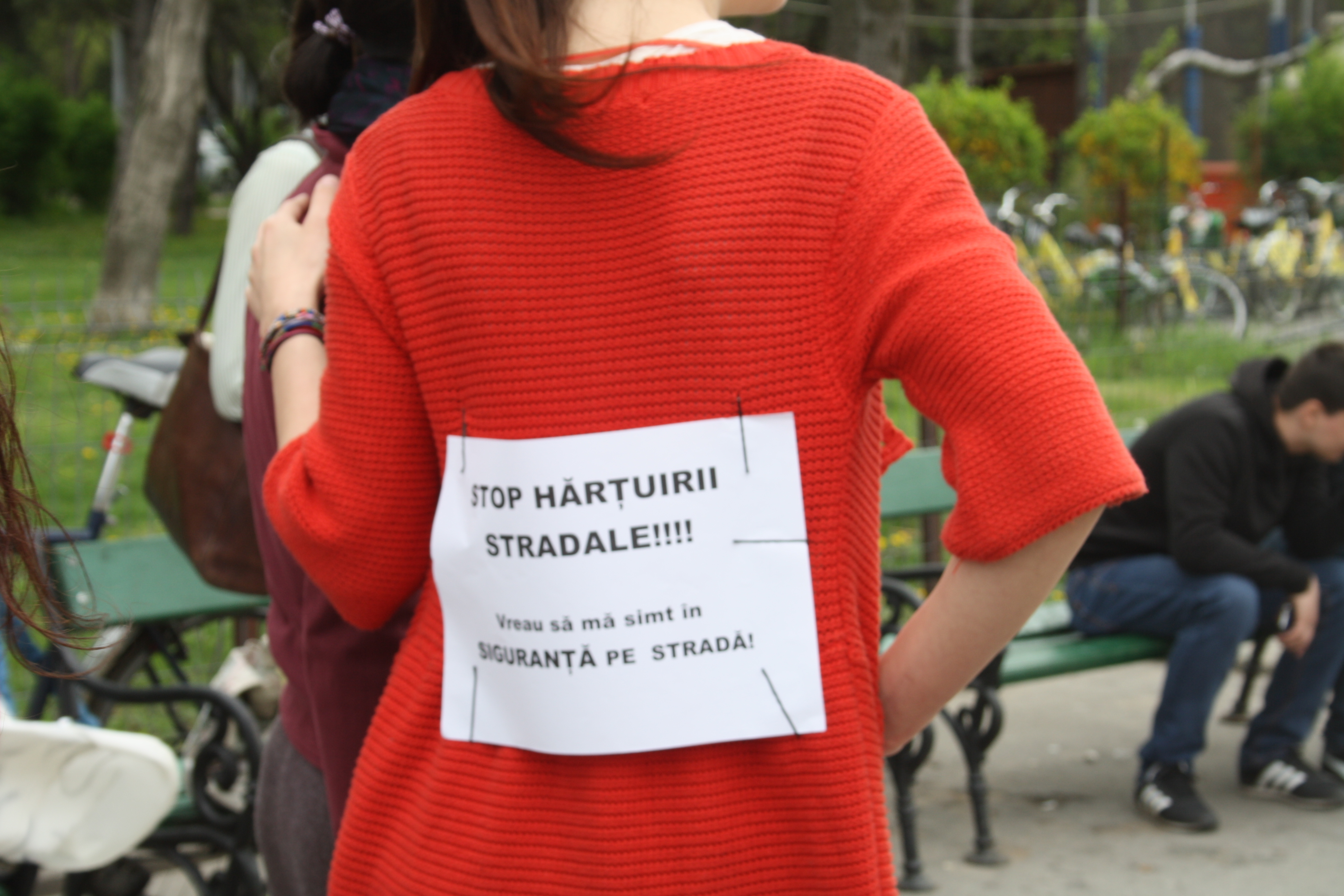
We had a week full of events for International Anti-Street Harassment Week in Romania. Activists and feminists were very active in raising awareness about this problem by posting online testimonials about street harassment experiences, sharing international events, participating in flashmobs and distributing fliers.

FILIA NGO and volunteers posted testimonials all week on Facebook and other activists Tweeted about street harassment. These kinds of online posting and discussions with people about street harassment is important. For example, some young women commented on our testimonials, opening up about their own experiences. Is vital for us to start talking more and more about this problem, in online but also in public spaces.

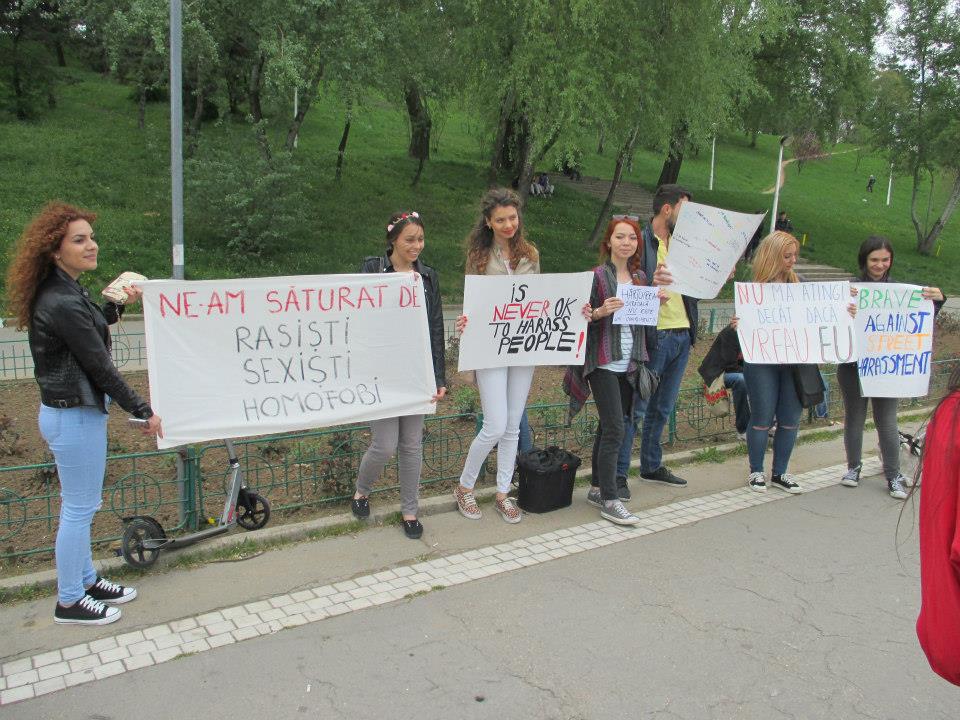
IMG_4730When it comes to street harassment in Romania, people tend to ignore it, to minimize the gravity of it. They excuse the harassers and blame the victims, so for this year’s International Anti-Street Harassment Week, three feminist NGOs from Bucharest — FILIA, FRONT and AnA: Society for Feminist Analyses — organized a public action in a park in Bucharest.

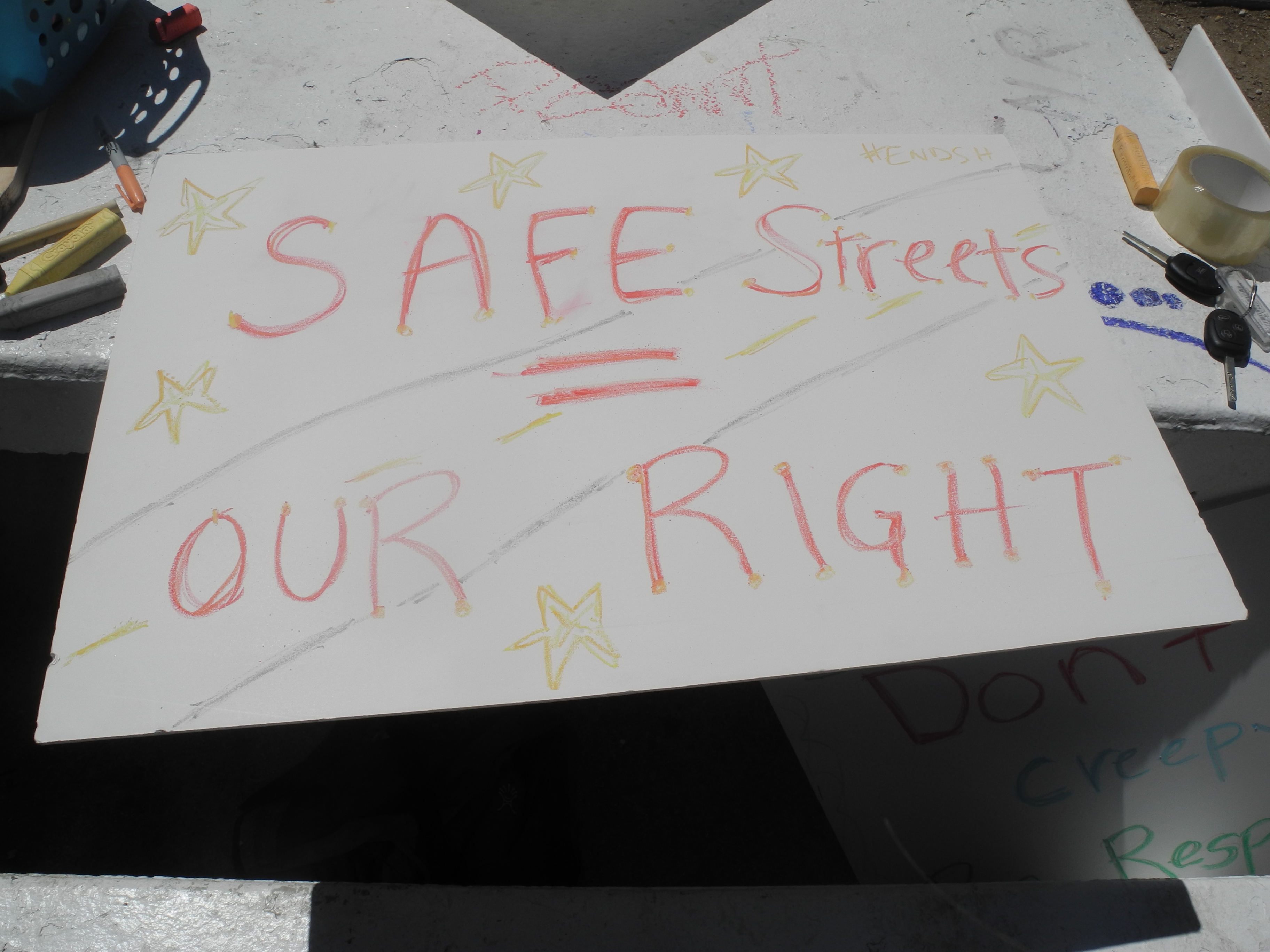
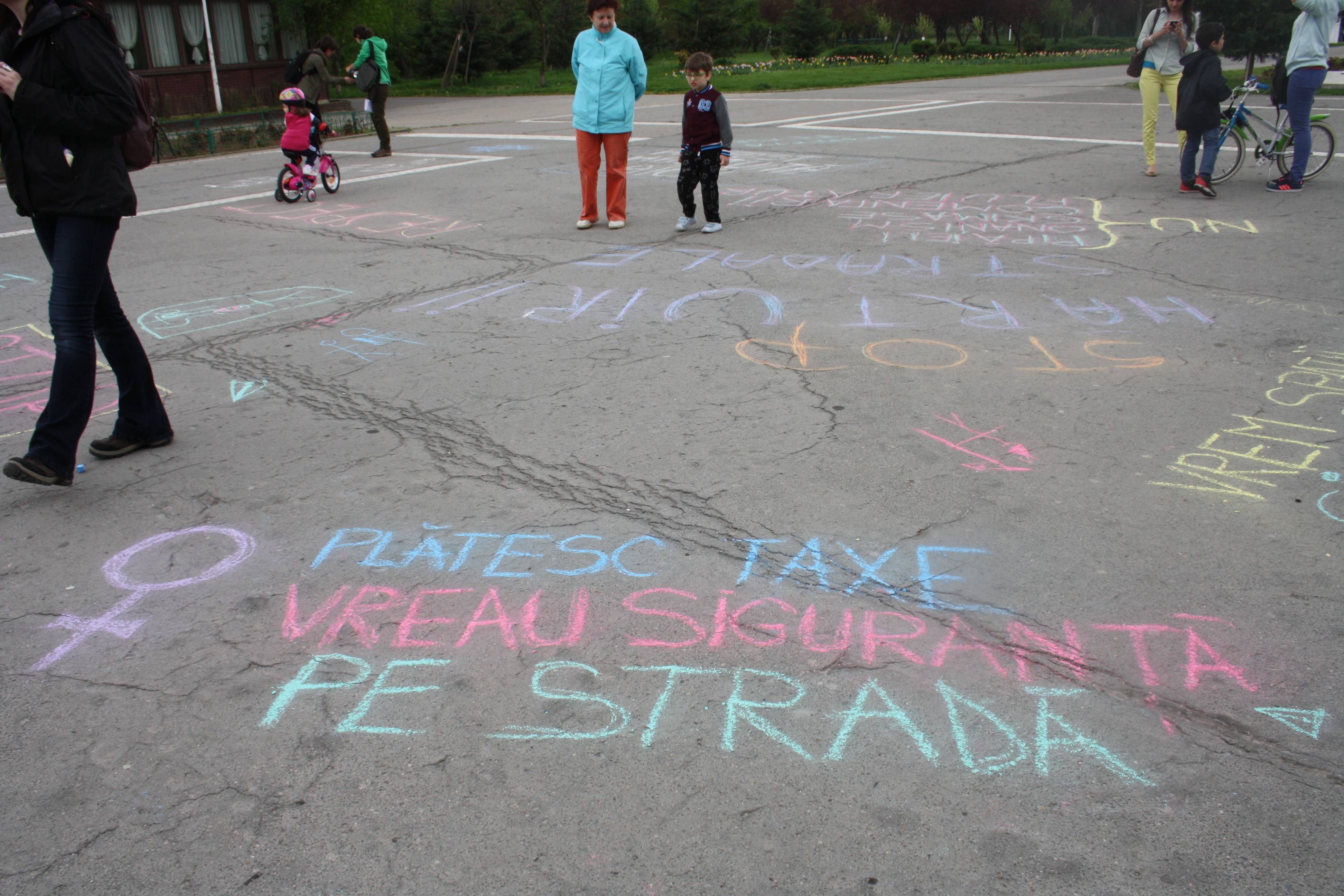
We gathered in a large park on Saturday, 18 April, to raise awareness about victim-blaming and the importance of bystanders intervention. How did we do that? We begun with writing chalk messages against street harassment like: “My skirt doesn’t concerns you!”, “I was harassed HERE”, “I don’t harass women”, “The public space must be safe for all of us”, “Take action against street harassment”, “Brave against street harassment”, “STOP street harassment”, “Harassment is violence”, “Respect women”.

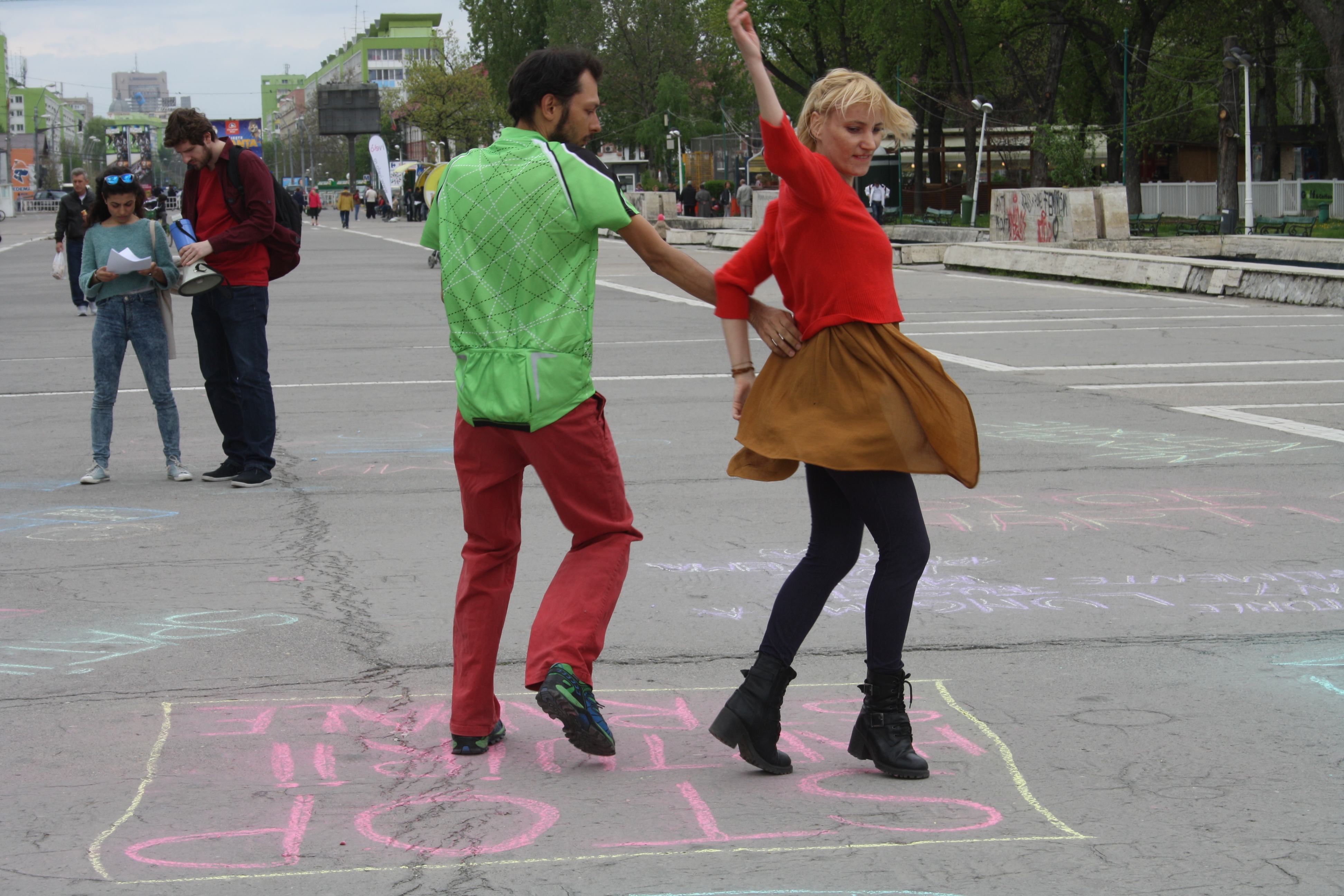
IMG_4766 Many people in the park took a moment to stop and read or asked us what are we doing, what is street harassment or just stopped to congratulate us on our work. After the chalking, we made a flashmob – an artistic dance to symbolize the “relation” between the aggressor and the harassed woman, a relation of dominance and submission, a power relation. A powerful woman, an actress and activist on Roma rights – Mihaela Dragan – recited testimonials about street harassment to go with the dance. It was great! Then, the other participants made a circle, surrounding the dancers with banners and placards with messages against street harassment, for the people to see them.

IMG_4667 At the end of the activity we shared fliers with this simple message:

“When was it the last time you saw a girl or a woman catcalled, whistled, groped on the street, bus or park? What was your reaction? Street harassment is a daily problem for girls and women worldwide. Whistles, honking, leers, groping, sexual commentaries about women’s body, stalking, flashing, masturbation in public, threats with rape or physical aggression and other behaviours of street harassment in public space are making girls and women to feel unsafe. Street harassment has nothing to do with sexual attraction or what a woman is wearing. Is about the need of the harassers to demonstrate their power on their targets, the women who are seen just like sexual objects, walking down the street to please the men. Is time to get over stereotypes and stop blaming the women, but their aggressors. Say STOP to street harassment! Women have the right to a safe space too! Take attitude if you see a harassed women on the street!”

I was very glad that so many women and men in Bucharest got involved in this amazing week and I hope will be that way and something more in 2016 too!

Simona is the Vice President of a feminist NGO – FILIA Center and a PhD student in Political Sciences, working on a thesis on street harassment in Bucharest. You can follow her on Facebook.

Photos by Ana-Maria Popa.

Share

Filed Under: anti-street harassment week, correspondents, street harassment

« Previous Page
Next Page »

Share Your Story

Share your street harassment story for the blog. Donate Now

From the Blog

  • #MeToo 2024 Study Released Today
  • Join International Anti-Street Harassment Week 2022
  • Giving Tuesday – Fund the Hotline
  • Thank You – International Anti-Street Harassment Week 2021
  • Share Your Story – Safecity and Catcalls Collaboration

Buy the Book

  • Contact
  • Events
  • Join Us
  • Donate
  • Facebook
  • Instagram
  • Pinterest
  • Tumblr
  • Twitter
  • YouTube

Copyright © 2026 Stop Street Harassment · Website Design by Sarah Marie Lacy