• About Us
    • What Is Street Harassment?
    • Why Stopping Street Harassment Matters
    • Meet the Team
      • Board of Directors
      • Past Board Members
    • In The Media
  • Our Work
    • National Street Harassment Hotline
    • International Anti-Street Harassment Week
    • Blog Correspondents
      • Past SSH Correspondents
    • Safe Public Spaces Mentoring Program
    • Publications
    • National Studies
    • Campaigns against Companies
    • Washington, D.C. Activism
  • Our Books
  • Donate
  • Store

Stop Street Harassment

Making Public Spaces Safe and Welcoming

  • Facebook
  • Instagram
  • Pinterest
  • Tumblr
  • Twitter
  • YouTube
  • Home
  • Blog
    • Harassment Stories
    • Blog Correspondents
    • Street Respect Stories
  • Help & Advice
    • National Street Harassment Hotline
    • Dealing With Harassers
      • Assertive Responses
      • Reporting Harassers
      • Bystander Responses
      • Creative Responses
    • What to Do Before or After Harassment
    • Street Harassment and the Law
  • Resources
    • Definitions
    • Statistics
    • Articles & Books
    • Anti-Harassment Groups & Campaigns
    • Male Allies
      • Educating Boys & Men
      • How to Talk to Women
      • Bystander Tips
    • Video Clips
    • Images & Flyers
  • Take Community Action
  • Contact

USA: YouTube Trolling and Street Harassment

April 30, 2015 By Correspondent

Dylan Jane Manderlink, Arkansas, USA, SSH Blog Correspondent

Via Mother Jones

I recently watched a few anti-street harassment videos made by nonprofit organizations and I was so elated and proud to see the anti-street harassment movement get traction and attention. But then I read the comments below and my mood drastically changed.

I could write a rant on every single misogynistic comment I saw and feel better about getting it off my chest. But I’m not sure how much good that would actually do at the end of the day. I don’t think there will ever be a feminist article or blog post to end all misogyny and hateful trolling, but I am tired of waiting for my turn to speak and I am getting impatient with feeling punished for my feminism. Above all, the anti-feminist and misogynistic discourse is precisely why we need feminism in the first place.

Online misogynistic trolling is a form of harassment and violence – just like street harassment. The two serve to promote a harmful and pejorative notion that women are fundamentally subordinate, invalid, incapable and solely exist to be ineffective and powerless. So when I was scrolling through the deluge of vulgar and demeaning comments on YouTube, one troll particularly fired me up by saying “People are free to hit on you” in response to a video about catcalling. Of course all of the trolling and misogynistic comments were derogatory and slandering, but this comment just represented the distance that exists in society from shared humanity.

This comment wasn’t even a disguised attempt at male supremacy, misogyny, and self-satisfaction – it was brazenly there for all to see with every lack of care, decency, and respect as possible. Allowing men to have a “free pass” at hitting on and catcalling us is a denial and complete neglect of  my rights and personhood. No one is free to hit on me. I should be free to walk through a public space without falling victim to harassment, unwanted comments and glares, public sexualization, and unsafe circumstances.

With this being my last post through the Blog Correspondent’s Program, I’ve been searching for a particular aspect of social activism and advocacy surrounding street harassment to write passionately about. I’m certainly passionate about ending and raising awareness of street harassment but I think what I’m most fired up about right now is in reaction to the dejection I often feel when advocacy efforts are severely ridiculed, trivialized, and damaged by online trolls.

I know activists and advocates often recommend not reading the comments posted by trolls on feminist articles, videos, and social media but it’s difficult to ignore the blatant disregard for an important fight against the mistreatment, inequality, and marginalization of others. The misogynistic online trolling I’ve seen on YouTube, Facebook, and Twitter has not only made me feel stunningly uncomfortable and uneasy, but it has showed me how comfortable people are with defaming, dehumanizing, and attacking others. Although reading the comments posted on feminist and female activist videos and articles upsets and offends me, it’s also what motivates me to keep fighting this fight. And if the trolls want me to give up and throw in the towel, they couldn’t be more wrong. If anything, the anti-feminist trolling has given me more ardor in my commitment and involvement in women’s rights, feminism, and social activism.

I want this post to not just serve as a strong grievance and indignation with misogyny and trolling against feminism and anti-street harassment activism. I want to put this hateful act of misogynistic trolling on display so that it’s no longer thinly disguised and permissible. It’s harrowing to admit how normalized anti-feminist online trolling has become and I want to call attention to how much of an anomaly it should be (or how non-existent it should be).

Don’t get me wrong, I think free speech is a basic right we all deserve and should be entitled to, however, when this form of free speech serves the sole purpose of “putting women back in their place”, making women feel even more unsafe and inferior, objectifying women through abhorrent commentary, and invalidating women’s existence in society, then I cannot and will not support it. I will no longer stand for an online narrative that is incredibly short-sighted, unjustified, offensive, and inglorious. As advocates and activists, I understand that the idea of changing this narrative and pushing back on the trolls is a lot easier said than done. Not only can responding to the trolling make women feel unsafe (because people who speak up against trolls are often threatened), but sometimes it can seem like a lost battle because it doesn’t end. I’m not fully recommending we respond to every anti-feminist and misogynistic trolling instance, but I am certainly fired up to out them and put their inflammatory and insolent behavior on display.

So that’s what my last post is about. I will no longer allow women to fall victim to a false belief system and disempowering narrative due to the pervasiveness and poisonous impact of online trolling and public misogyny. Although standing up to the trolls or raising public awareness of the harms of trolling are difficult and disheartening, if you are creating change you believe in, then don’t feel discouraged.

For anyone looking to improve the quality of social media and virtual spaces for women, let’s start now. Who’s with me?

Dylan is a recent graduate of Emerson College and currently teaches 8th, 10th, and 11th grade Digital Communications and Audio/Visual Technology in an Arkansas high school. You can visit her personal blog and follow her on Twitter @DylanManderlink.

Share

Filed Under: correspondents, online harassment, street harassment

USA: No, Anti-Harassment Laws and Policies Don’t Violate Your Constitutional Rights

April 24, 2015 By Correspondent

Emily Gillingham, Washington, DC, USA, Blog Correspondent

DSCN4790Every now and again, someone in a newspaper editorial, blog post, or conversation will argue that a law or policy restricting street harassment violates Americans’ First Amendment right to free speech. Though these people’s dedication to their desire to hurl sexual remarks at strangers or defend those who do so is admirable, here’s why that assertion is way off-base.

The First Amendment to the United States Constitution reads in pertinent part, “Congress shall make no law . . . abridging the freedom of speech . . . ” This is about things that Congress does; an easy way to think about it is whether the government is restricting the speech.

The First Amendment protection against government abridgement of free speech is not absolute. While the First Amendment has been found to protect rights to things like the speech of protestors outside of abortion clinics, it has been found to not protect “speech” like public school students holding a banner at a school event that reads “BONG HITS 4 JESUS” and unsolicited mailing of graphic brochures advertising pornographic books. For how often the old adage that the First Amendment doesn’t protect falsely shouting “fire” in a crowded theater is brought up in free speech arguments, no such set of facts was ever before the US Supreme Court, and in fact the case from which the concept sprung has since been overruled. But the basic premise remains: First Amendment rights are not absolute.

The U.S. Supreme Court has upheld laws restricting public place speech before. For example, in Chaplinsky v. State of New Hampshire, a man was convicted of violating a state law that read, “No person shall address any offensive, derisive or annoying word to any other person who is lawfully in any street or other public place, nor call him by any offensive or derisive name, nor make any noise or exclamation in his presence and hearing with intent to deride, offend or annoy him, or to prevent him from pursuing his lawful business or occupation” for standing outside City Hall in Rochester, New Hampshire and saying things like, “[y]ou are a God damned racketeer” and “a damned Fascist and the whole government of Rochester are Fascists or agents of Fascists.”

The Supreme Court upheld the constitutionality of the state law over Chaplinsky’s argument that the law violated his First Amendment rights because the law was limited in scope, Chaplinsky’s words lacked social value, and the law did not “unduly impair liberty of expression.” The Court wrote that Chaplinsky’s words “by their very utterance inflict injury or tend to incite an immediate breach of the peace.”

First Amendment cases use several different rules and rationales because they are so heavily fact-dependent. And we don’t have a Supreme Court case directly on this issue to compare. But one line of cases focuses on whether the restriction focuses on the content of the speech, or instead the “time, place, or manner” of the speech, which is scrutinized under a less stringent standard. This line is drawn in several Supreme Court cases.

An anti-street harassment law which regulated the content of speech, like a law that prevented shouting “compliments” at strangers in public, might fail. But a law that prohibited a certain manner of speech, like unwanted verbal contact with another person on public transportation, should pass constitutional muster. Not to mention, street harassment can sometimes be prosecuted criminally or civilly as hate speech, sexual assault, threats, defamation, intentional infliction of emotional distress, “fighting words,” intimidation, or obscenity, which receive limited or no First Amendment protection.

Street harassment is about exerting power over others who dare to enter a public space to go to work or the grocery store. The man who rode his bike dangerously close to me to force me to make eye contact and then hissed “I WANT TO TASTE YOUR PUSSY” was not trying to pay me a compliment. He was not trying to make friendly conversation. He was not informing me about a political issue he’s concerned about. He was not asking the time. He was not letting me know that I dropped a glove a half block back. He was not wishing me a good morning or remarking on the weather. His speech was not designed to convey an idea; it was intended to intimidate, dehumanize, and subjugate me.

Street harassment impacts what I wear, how I travel to work, how late I stay out, and whether or not I feel safe outside. Would educating and persuading street harassers to change their ways be a preferable course of action to legislating against that type of behavior? I think so. But that isn’t going to change attitudes overnight, and frankly, certain people, like “TASTE YOUR PUSSY” guy, probably aren’t going to change short of a criminal or civil statute giving him a reason to change that he cares about (because intimidating strangers is clearly not enough).

So while it’s an easy cop-out to blurt “BUT MAH ‘MERICAN FREEDOMS” when the government acts to prevent people from making others feel unsafe, the First Amendment argument falls flat. If this topic interests you, I’d strongly suggest reading Cynthia Grant Bowman’s wonderful Harvard Law Review article on the subject and articles and a book by Dr. Laura Beth Nielsen.

Disclaimer: this article is an opinion and is not intended to be used as legal advice.

Emily is a 3L at Michigan State University College of Law, and the president of her school’s chapter of LSRJ. Follow her on Twitter @emgillingham.

Share

Filed Under: correspondents, Resources, street harassment

Romania: Anti-Street Harassment Week in Bucharest

April 21, 2015 By Correspondent

Simona-Maria Chirciu, Bucharest, Romania, SSH Blog Correspondent
11167666_879511048761694_6696537207933721063_n
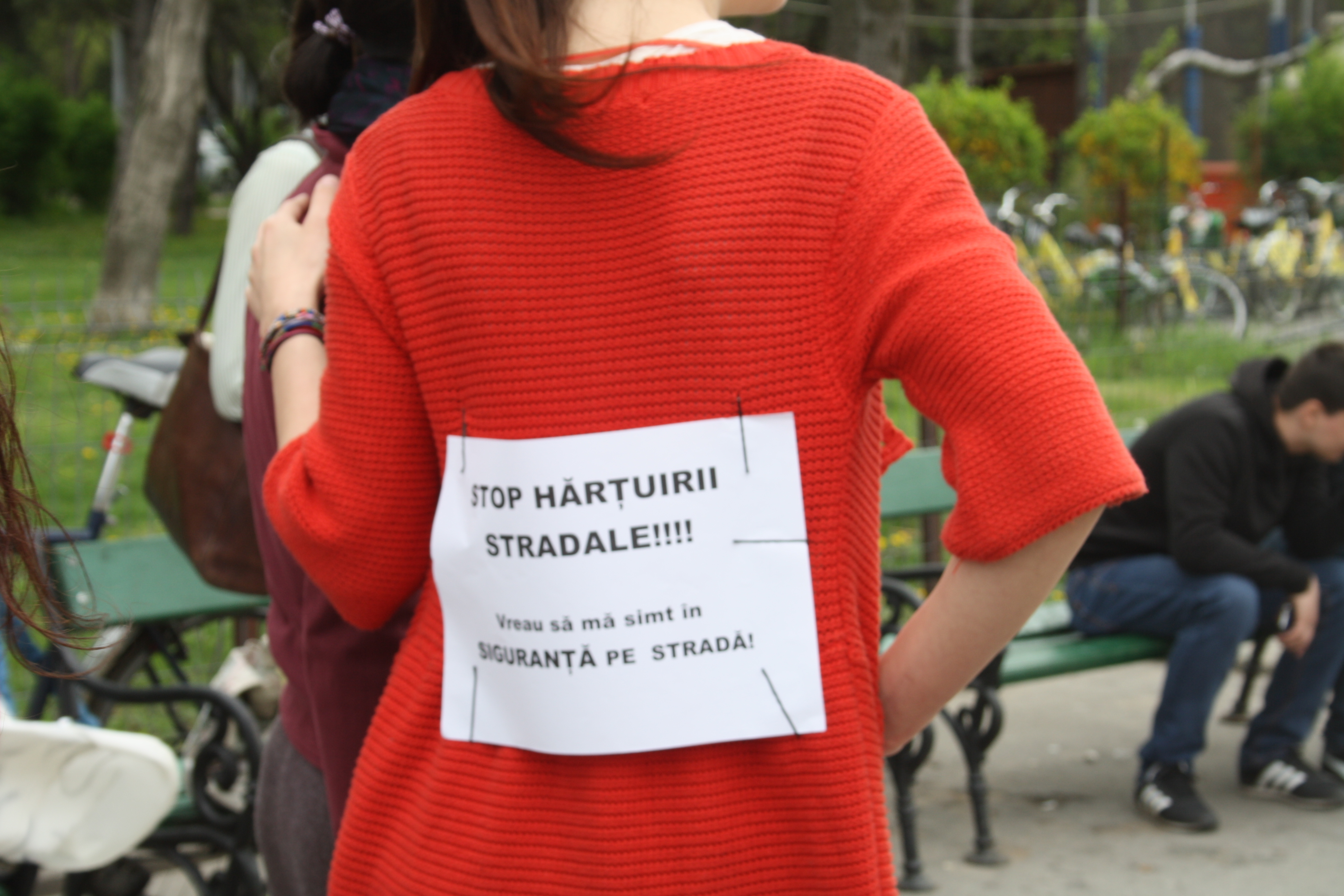
We had a week full of events for International Anti-Street Harassment Week in Romania. Activists and feminists were very active in raising awareness about this problem by posting online testimonials about street harassment experiences, sharing international events, participating in flashmobs and distributing fliers.

FILIA NGO and volunteers posted testimonials all week on Facebook and other activists Tweeted about street harassment. These kinds of online posting and discussions with people about street harassment is important. For example, some young women commented on our testimonials, opening up about their own experiences. Is vital for us to start talking more and more about this problem, in online but also in public spaces.

IMG_4730When it comes to street harassment in Romania, people tend to ignore it, to minimize the gravity of it. They excuse the harassers and blame the victims, so for this year’s International Anti-Street Harassment Week, three feminist NGOs from Bucharest — FILIA, FRONT and AnA: Society for Feminist Analyses — organized a public action in a park in Bucharest.

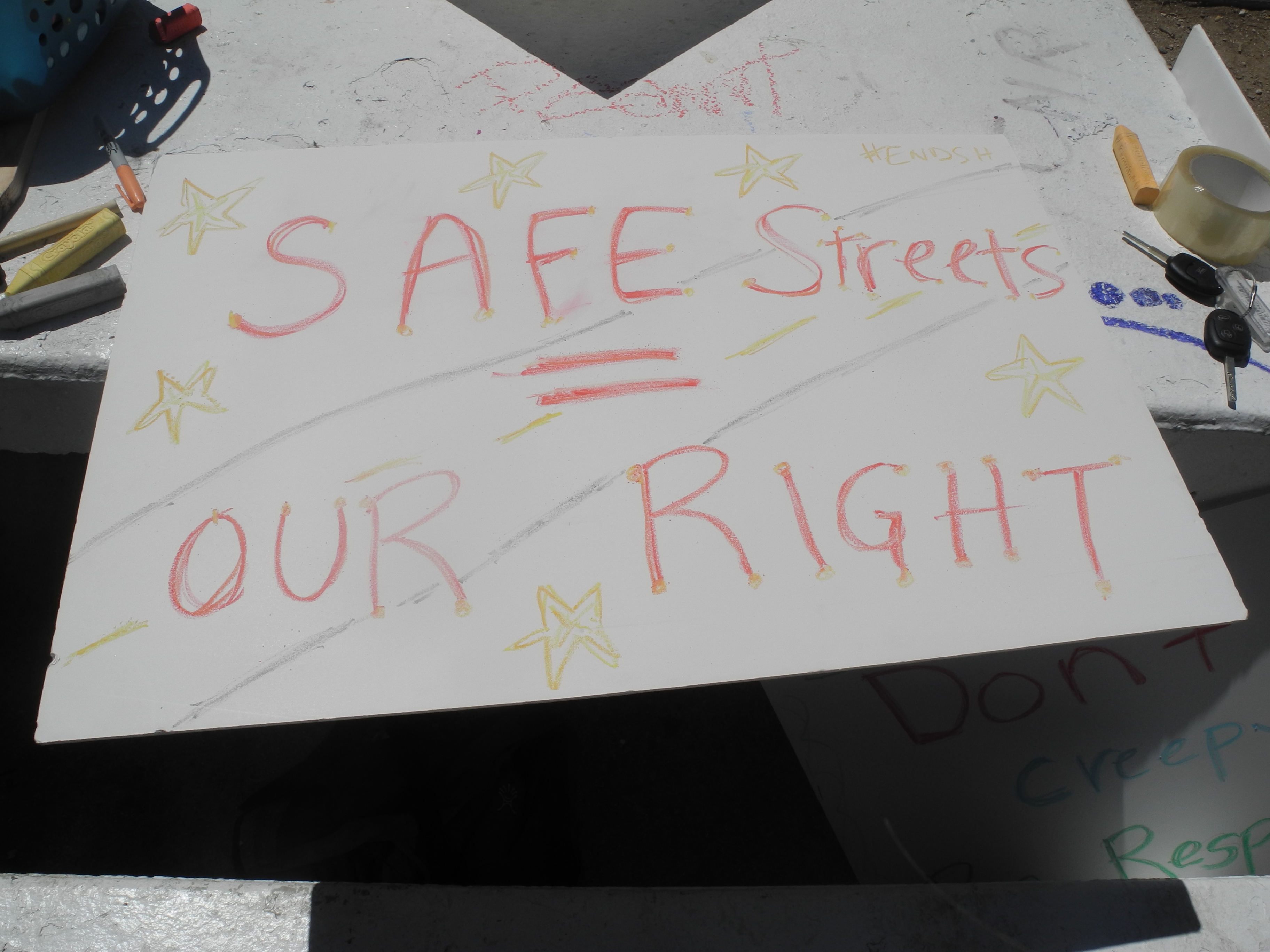
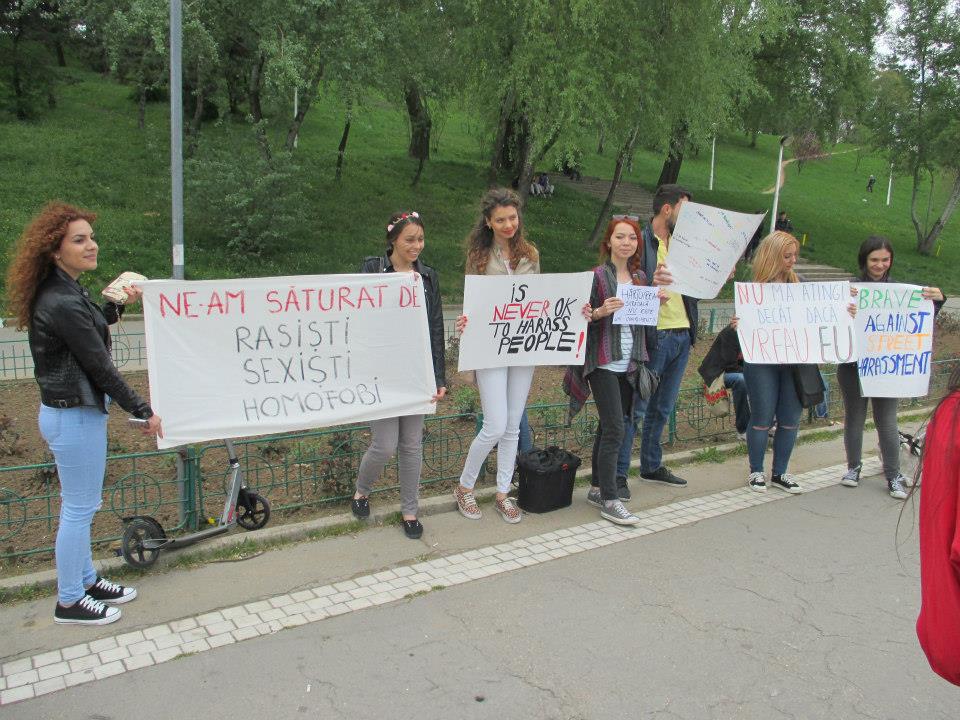
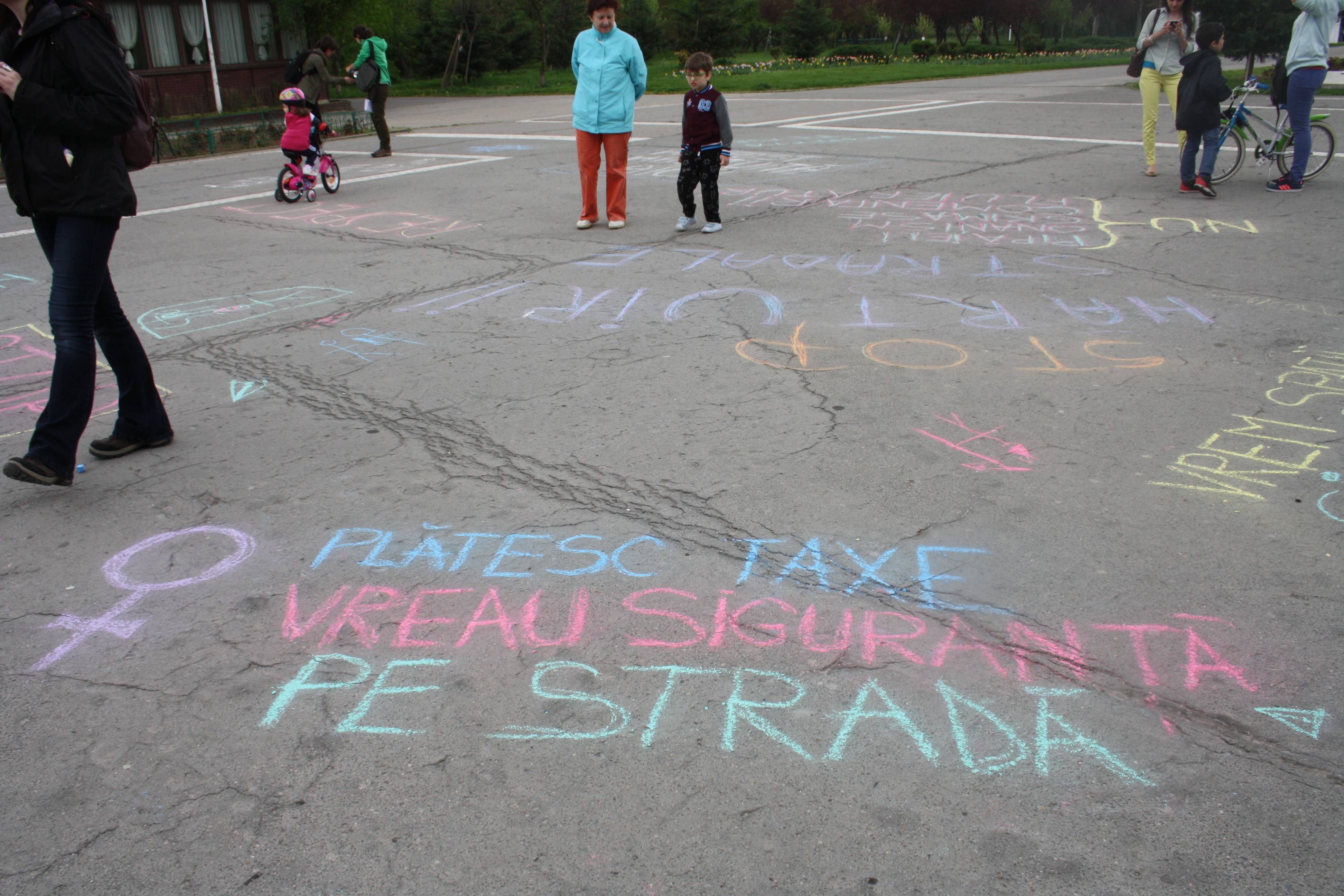
We gathered in a large park on Saturday, 18 April, to raise awareness about victim-blaming and the importance of bystanders intervention. How did we do that? We begun with writing chalk messages against street harassment like: “My skirt doesn’t concerns you!”, “I was harassed HERE”, “I don’t harass women”, “The public space must be safe for all of us”, “Take action against street harassment”, “Brave against street harassment”, “STOP street harassment”, “Harassment is violence”, “Respect women”.

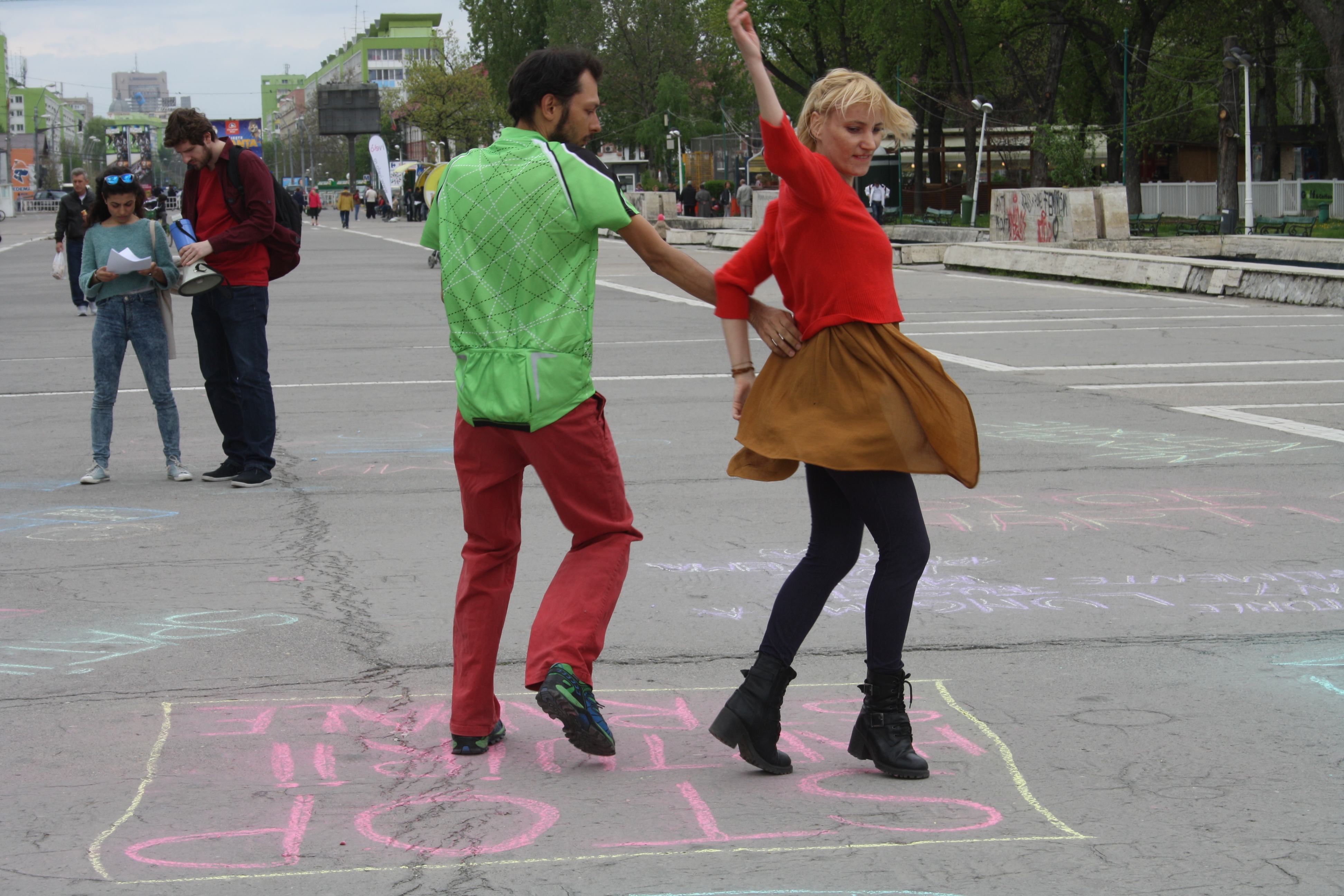
IMG_4766 Many people in the park took a moment to stop and read or asked us what are we doing, what is street harassment or just stopped to congratulate us on our work. After the chalking, we made a flashmob – an artistic dance to symbolize the “relation” between the aggressor and the harassed woman, a relation of dominance and submission, a power relation. A powerful woman, an actress and activist on Roma rights – Mihaela Dragan – recited testimonials about street harassment to go with the dance. It was great! Then, the other participants made a circle, surrounding the dancers with banners and placards with messages against street harassment, for the people to see them.

IMG_4667 At the end of the activity we shared fliers with this simple message:

“When was it the last time you saw a girl or a woman catcalled, whistled, groped on the street, bus or park? What was your reaction? Street harassment is a daily problem for girls and women worldwide. Whistles, honking, leers, groping, sexual commentaries about women’s body, stalking, flashing, masturbation in public, threats with rape or physical aggression and other behaviours of street harassment in public space are making girls and women to feel unsafe. Street harassment has nothing to do with sexual attraction or what a woman is wearing. Is about the need of the harassers to demonstrate their power on their targets, the women who are seen just like sexual objects, walking down the street to please the men. Is time to get over stereotypes and stop blaming the women, but their aggressors. Say STOP to street harassment! Women have the right to a safe space too! Take attitude if you see a harassed women on the street!”

I was very glad that so many women and men in Bucharest got involved in this amazing week and I hope will be that way and something more in 2016 too!

Simona is the Vice President of a feminist NGO – FILIA Center and a PhD student in Political Sciences, working on a thesis on street harassment in Bucharest. You can follow her on Facebook.

Photos by Ana-Maria Popa.

Share

Filed Under: anti-street harassment week, correspondents, street harassment

Germany: Women-Only Transit Options

April 21, 2015 By Correspondent

Lea Goelnitz, Berlin, Germany, Blog Correspondent

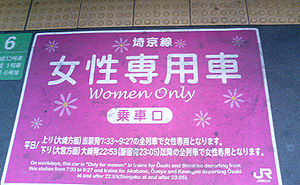
women_only_public_transportIn more than one dozen countries, women-only public transportation is chosen as a short-term (or mid-term!) solution to street harassment. These countries are as diverse as Japan, India, Brazil, the Philippines and UAE, and offer sex segregated compartments in their trains or subways. In India public buses have benches reserved for women, entire trains for women and a women-only carriage in the Delhi metro. On the platform of the metro stop, the pink sign marks the “safe” area.

As the latest example of women-only transit, in the beginning of April the Guardian reported that there would be a new women-only rickshaw- service in Pakistan. The founder was fed up with facing daily harassment and now offers safe rides in pink rickshaws. I disagree with celebrating this business idea too much if the reason for the need of such women-only services is not sufficiently seen as a problem. We have to address the root causes.

Although I used to ride in the women-only carriage in Delhi and I guess it created a certain feeling of safety, I always felt like I was being put on display. Having all the women gathered in one space surrounded by men felt awkward. It is frustrating to know that these women-only spaces are a big move away from a gender equal society and from achieving real safety. Through sex-segregation, men do not need to adjust to a society in which women are equal and have the right to be in public spaces. The onus is on women to change.

In addition to women-only trains there are taxi services for women, which are even more widespread. There is SheRides in New York, Cab for Women by Women in Delhi and the Women´s Night Taxi in Hannover, Germany. In Germany there are also women-only parking lots, which are the ones closest to the building.

These interventions and businesses run by women create a safe option for women who otherwise might not go out or who will feel uncomfortable when they are out. As long as politics and culture fail women, this might be the only way to go. On the upside, in most cases it even provides women with economic empowerment. But of course even that is not perfect; the few female drivers may face safety issues as long as they are in the male-dominated space of taxi waiting lanes and rest areas.

Since January one of the major taxi companies in Delhi incorporated women drivers, catering to female passengers as well. This might be a small step forward. At least the men driving for this company will have to get used to having female colleagues.

In order for women to be safe, more women need to be out in public, as passengers and drivers.

Lea works in journalism and women´s rights and is involved in the women´s rights NGO Discover Football, which uses football as a tool for empowerment and gender equality. Follow her on Twitter, @LeaGoelnitz.

Share

Filed Under: correspondents, News stories, public harassment Tagged With: public transit, women-only

USA: Researching Street Harassment in Texas

April 21, 2015 By Correspondent

Madison Ford, Texas, USA, Blog Correspondent

My neighborhood in Texas is relatively safe. I know since I’ve jogged through its streets three times a week since I moved here in June. I know where I can run freely, eyes closed, blood pumping, without being startled by a car horn and a smug smile. I walk my dog every day before dark. And every morning, I check my email for a little summary of all the crimes that took place within a two-mile radius of my address. I know that my neighborhood is safe. But despite the fact that the only crimes anyone is committing around here are almost always nonviolent, I can’t leave my house at night without one of my male roommates coming with me.

I’ve been fortunate enough to be conducting research on street harassment through the honors program in the Sociology department at the University of Texas at Austin; I had a unique experience in designing my survey in that I was basically asking people if they had been harassed in the same places I was getting harassed. Their anecdotes in the free-response portions rang true with some of my own experiences and while it was nice to know I wasn’t alone, it made me angry that so many people are experiencing the same frustrations. It was interesting to see other places in Austin where I may not visit frequently be listed as street harassment hotspots. Mostly Central Austin, where there’s lots of foot traffic and everyone is out in the open.

The most difficult thing about conducting my survey was attempting to gather responses. What I had anticipated as being one of the simpler parts of my project quickly became the most challenging aspect of it, but I think there’s a good reason I had trouble getting participants. Female students in our university have been receiving many survey research opportunities regarding their experiences with sexual violence, sexual harassment, and their experiences on the college campus and mine was just one of them. Although much work remains to be done in the fight against sexual violence and sexual harassment, the national conversation is taking a turn in the right direction. It was almost a year ago that the list of colleges under Title IX investigations for mishandling sexual assault and sexual harassment was released, and the dialogue has only grown since then. Research is not only being conducted by concerned undergraduates like me, but by universities themselves in order to make sure they make a serious effort to create safe and welcoming environments for everyone. Although female students may be undergoing survey fatigue, it’s nice to know that so many people are taking the concerns of college students about their campus climate seriously.

Conducting my own research has been an academically challenging but ultimately fulfilling experience and I feel much more comfortable talking to people I know and people I don’t know about the issue of street harassment and its wider implications for addressing sexual violence across the world. I’ll have to spend the next few weeks hunched over my computer during the data analysis process, but maybe one day the research I’ve done will inspire a young researcher as I was inspired by so many studies before me.

Madison is a soon-to-be graduate of the University of Texas at Austin studying literature and sociology. Follow her on Twitter, @madiford222.

Share

Filed Under: correspondents

« Previous Page
Next Page »

Share Your Story

Share your street harassment story for the blog. Donate Now

From the Blog

  • #MeToo 2024 Study Released Today
  • Join International Anti-Street Harassment Week 2022
  • Giving Tuesday – Fund the Hotline
  • Thank You – International Anti-Street Harassment Week 2021
  • Share Your Story – Safecity and Catcalls Collaboration

Buy the Book

  • Contact
  • Events
  • Join Us
  • Donate
  • Facebook
  • Instagram
  • Pinterest
  • Tumblr
  • Twitter
  • YouTube

Copyright © 2026 Stop Street Harassment · Website Design by Sarah Marie Lacy