• About Us
    • What Is Street Harassment?
    • Why Stopping Street Harassment Matters
    • Meet the Team
      • Board of Directors
      • Past Board Members
    • In The Media
  • Our Work
    • National Street Harassment Hotline
    • International Anti-Street Harassment Week
    • Blog Correspondents
      • Past SSH Correspondents
    • Safe Public Spaces Mentoring Program
    • Publications
    • National Studies
    • Campaigns against Companies
    • Washington, D.C. Activism
  • Our Books
  • Donate
  • Store

Stop Street Harassment

Making Public Spaces Safe and Welcoming

  • Facebook
  • Instagram
  • Pinterest
  • Tumblr
  • Twitter
  • YouTube
  • Home
  • Blog
    • Harassment Stories
    • Blog Correspondents
    • Street Respect Stories
  • Help & Advice
    • National Street Harassment Hotline
    • Dealing With Harassers
      • Assertive Responses
      • Reporting Harassers
      • Bystander Responses
      • Creative Responses
    • What to Do Before or After Harassment
    • Street Harassment and the Law
  • Resources
    • Definitions
    • Statistics
    • Articles & Books
    • Anti-Harassment Groups & Campaigns
    • Male Allies
      • Educating Boys & Men
      • How to Talk to Women
      • Bystander Tips
    • Video Clips
    • Images & Flyers
  • Take Community Action
  • Contact

USA: From Harassment at School to the Streets

March 31, 2015 By Correspondent

Dr. Dena Simmons, New York City, USA, Blog Correspondent
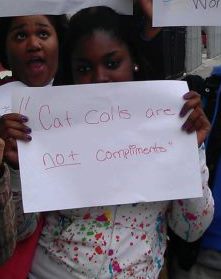
Girls working with The Women Worldwide Initiative in Brooklyn

“Leave me alone,” I screamed.  Stop it! Stop!

But he kept inserting himself into my space no matter how hard I pushed him away.

I was in sixth grade when one of the boys from seventh grade cornered me so that he could grope me. After taking what he wanted, he left me in a corner, violated.

This inappropriate touching was an unwelcomed part of my middle school years. During class trips, during transitions in the hallways, at lunch, and at recess, the boys would sneak free-feels of the girls’ butts for fun. Many of us girls disliked the sexual harassment, but back then, no one did anything to protect us.  We did not even have the vocabulary to describe what was happening to us.

Worse, one of my male English teachers would gently pinch my ears and stomach and rub my shoulders intimately, which made his class an unwelcomed part of my middle school years.  I had no power to tell him to stop. I felt paralyzed by his actions.  He touched other girls inappropriately too—without any shame. Fed up, I organized a movement against his casual touching, which included having our parents come into school to complain about his behavior.  The principal reprimanded him, but he kept his job.

I never felt justice from reporting my teacher’s unwanted touches or the harassment from my male classmates—and still today, I walk the streets of New York City, subject to harassment that, for me, began between the walls of my school.  Too often, young feminine bodies are sexually objectified in the very school buildings that should keep them safe.  As a teacher, I would walk through the hallways and hear adolescent boys throwing their bravado around through derogatory comments about their female-bodied peers.

I can’t wait to hit that!

Did you see her ass?

I like her boobs.”

I hear she’s easy. You should go for her.

I want to fuck her.

I would hear stories from my female students who complained about the ways their male peers touched them when no one was looking, the way it bothered and distracted them from learning.  Similar to when I was a middle schooler, many teachers did little to address the unwanted touching and the verbal harassment about which our students complained. Often times, these events happened when we were not looking. Most teachers and school leaders never learn how to handle the inappropriate touching that happens between students at school.

How are we supposed to have safer streets if we have not prepared adults at school to keep our school communities safe from harassment, safe from victimization and bullying?

Our pedagogy as a nation has been so watered down with test preparation that there are so few opportunities to teach students to be respectful and kind to people regardless of their differences, to have conversations about feminism, sexism, and gender with students and colleagues, and to teach lessons about power and privilege among other topics.  There is so much work to do.

As adults, parents, school leaders, big brothers, uncles, teachers, and fathers, let’s do more for our youth. Let’s call out street harassment and other forms of victimization when we see it.  Let’s build our youth’s problem-solving skills, empathy, self- and social awareness, and conflict resolution abilities. And, let’s model the type of respectful, thoughtful, and loving behavior we want to see in our youth.

Dr. Dena Simmons serves as the Associate Director of Education and Training at Yale’s Center for Emotional Intelligence. She is a recent graduate of Teachers College, Columbia University, where her research focused on teacher preparedness to address bullying in the middle school setting.


Share

Filed Under: correspondents, Stories, street harassment

Kenya: I Confronted Street Harassers Today

March 30, 2015 By Correspondent

Linnet Nyawira Mwangi, Kisumu, Kenya, SSH Blog Correspondent

Over the weekend I attended a friend’s birthday party in town but I had to leave early because I had a busy day the following day. After saying goodbye to my friends I decided to go get a cab outside and declined the offer to be walked out by some friends since everyone was having fun and after all, I would get one outside…or so I thought. After waiting for a few minutes I decide to walk to the next block which is usually more open so that I could get a cab with ease. Three men appeared from the direction I was heading to and from the noise they were making and their sluggish walk, you could easily tell (assume) they were drunk.  The path was well lit so I had no fear and I continued walking towards them.

As I got closer to them, one shouted, “Hey sexy lady where are you cat walking to at this time of the night?”

A second voice asked, “Business is not good today, ha?” By now they were right in front of me.

Another voice crept in “Come with us we can pay you handsomely.”

By now, one of them had blocked my way and as he stepped close to me I shoved him angrily with my purse. This angered his counterparts who in turn started shouting at me in a language I could not understand. I had walked through this street many times during the day and evenings as I left work and I knew there were guards on duty in these business premises and if it got any worse I would scream and draw their attention. But I was not ready to let these men have their way. Harassing every woman they saw walking at night and misjudging us felt totally unacceptable!

By this time I was so angry and I quickly raised my voice at them and told them to treat women with respect and dignity and respect themselves too. One of them asked me why I was talking back at them and whether my mother did not teach me to listen to men talking as he took a step towards me and I told them it was my right to defend myself against harassment. They all burst out laughing asking me what right I was talking about. I then told one of the men to excuse me and if he touched me I would scream loud enough to attract the soldiers who were guarding a bank a few yards away and they would all end up in prison.

This worked and as I walked past them I could hear them shouting after me that I would never get married like other feminists with that kind of attitude. So they actually knew what they were doing if they referred to women who stood up for themselves as feminists? Luckily a cab appeared and I got in and I could not help but feel good that I had actually stood for myself and stopped some men from taking advantage of me. I realised that street harassers know what they are doing they are just preying on scared and fearful women to take advantage of.

Linnet is a student at Maseno University in Kisumu, Kenya pursuing a bachelor’s degree in sociology with IT. Follow her on Twitter @Shantel_lyn and Facebook @lynnette Shantellah.

Share

Filed Under: correspondents, Stories, street harassment

Australia: Car Culture and Street Harassment

March 23, 2015 By Correspondent

Tara Willoughby, Canberra, Australia, SSH Blog Correspondent

Image via Clipsal website

For many Australians, cars are a huge part of their lives. Around the country, you’ll find ‘Ford families’ and ‘Holden families’.  And like many other pursuits in our society, being ‘into cars’ is a strongly gendered affair – cars are for men. Car culture is perhaps most visible during large public events centred around cars. It is also at these events that more insidious aspects of car culture can be seen, including street harassment. While there is debate about whether there are increased rates of harassment around these events, I will look at two events in particular: the Clipsal 500 in Adelaide and Summernats in Canberra.

The Clipsal 500

The Clipsal 500 is a round of the V8 Supercar Championship Series and takes place over 4 days at the start of March in Adelaide. As well as the race itself, there are a large number of other ‘attractions’ during the event, and it forms part of Adelaide’s ‘Mad March’ celebrations.

In 2009 and 2014, YWCA Adelaide ran the ‘Women’s Safety Survey’ after hearing from young women members that they felt unsafe in the city while the race was in town.  Of the almost 400 respondents in 2014, 90% said they felt unsafe at the Clipsal, and 60% said they had experienced an incident around the race that made them feel unsafe.

It has however been questioned whether there truly is an issue of harassment at the Clipsal. Critics point to the lack of a spike in reports to police of harassment and assault during the event, the participants from other Mad March events being in the city at the same time, and the theory that increased numbers of people in the city would actually make it safer (although there is no evidence proposed to support this theory). It is also notable that much street harassment is not of the type people feel the need/ability to report to the police.

Summernats

Summernats is a car festival held over three and a half days in Canberra each year. Like with the Clipsal 500, many women feel unsafe during this event. A colleague of mine described her friend’s experience of being continuously harassed and yelled at to ‘take your top off’ – a shout that has been noted at the event for many years. This year alone many women used social media to complain of sexual harassment around the event.

Police regularly report low or no arrests and reports during Summernats. A further example of the shortfalls of police reports as a metric for measuring street harassment at Summernats comes from 2008, when a mob of 400 men aggressively surrounded and harassed a number of women over several hours and yet police were not involved. That year’s Summernats was described by Police as quieter than the year before. Another mobbing incident was alleged in 2011.

What can we do?

Even assuming that street harassment is no worse in and around car-specific events than in the rest of Australia, there is still an onus on organisers to make their events safe for women. Not only is it good for business, but preventing violence against women is everyone’s responsibility.

So what steps can be taken? To start with, we know that messages from society at large matter. Messages that are disrespectful towards women, messages that support inequality between men and women, messages that have strong distinctions between men’s role and women’s roles, all lead to the perpetration of violence and unhelpful responses from people who witness violence. This is a well-established fact [pdf – see especially page 18]. It’s high time that car event organisers think carefully about the messages they are sending to participants.

Activities solely devoted to appraising women’s appearance are present at both the Clipsal 500 (the bikini parade) and Summernats (the Miss Summernats Beauty Pageant). Likewise both events feature various promotional (female) models and ‘grid girls’. Meanwhile, in 2015, the vast majority of winners at Summernats and all drivers lined up at the Clipsal 500 were men. There’s so much that could be done to change this one-dimensional image of women as inactive sexualised objects and men as serious participants. Welcoming women into traditionally male-dominated arenas is a goal that has received a huge amount of support in Australia, including creation of fantastic research and practical tools. It is also important not to disregard the important place of ‘inactive’ elements like models. There is absolutely no reason why men should not also be welcomed into these areas. Indeed, they can add talent in this area just as women add talent as ‘active’ participants.

Most importantly, street harassment (and sexism and violence more broadly) is an issue that needs to be talked about inside car culture, not just by feminists and academics. These behaviours are simply unacceptable, and there is so much that can be done to change the social structures that allow them to happen. Even just starting the conversation makes a difference.

Tara works with AWAVA (the Australian Women Against Violence Alliance) indulging her love of social media. You can find her on Twitter as @angelbird72 or @Tash_Because or being silly as one half of the ‘slice-of-life’ podcast Heaps Funny But.

Share

Filed Under: correspondents, street harassment

Romania: Call for Submissions for Book Chapter

March 23, 2015 By Correspondent

Simona-Maria Chirciu, Bucharest, Romania, SSH Blog Correspondent

This is a call for book chapter submissions. The topic: Sexual Harassment – Lived Histories & Street Harassment as a Urban Discrimination

Remembering and writing about personal experiences of sexual harassment is sometimes easy and maybe other times it is very hard. But either way, it is good to speak up for yourself and make your experiences matter!

I want to present to you two interesting projects in Romania that aim to tackle sexual harassment and urban discrimination against women.

1. One of them is an editorial project and before the 1st May 2015, you can send your contributions, regardless of your origin country or your gender.

We all have a sexual harassment history (unpleasant, of course!) so I want to share with you some important information about a call for book chapters. I’m very pleased with this project and I’ve already submitted my contribution. I really think there is importance in sharing with others the hard and heartful experiences of sexual harassment so we can raise awareness about this problem.  As most of us know, sexual harassment comes in many forms (street harassment, workplace harassment, school harassment) and happens all the time. We are not its victims, but its survivors and need to act as such!

So, “Sexual Harassment. Lived Histories” is an editorial project that aims to gather and uncover sexual harassment experiences for women and men in Romania and the world over. The purpose of this collective volume is to enhance the visibility of sexual harassment stories and experiences worldwide and to offer a framework of its causes, effects, need for proper and viable solutions.

I really think that sexual harassment in general and street harassment in particular are invisible problems, so we need to put some light on it!  I invite you to read the call for book chapters and write down, if you want, one or some of your stories! Let your own voice be heard. Your voice matters! This is more than a reflection exercise and is emotionally healing as well.

Let’s raise awareness on sexual harassment together, despite the distances and differences between us!  Deadline for this call is 1st May 2015.  For more important information, you can find information here.

2. The other project is “Urban Discrimination” and it was created by two feminist NGOs from Romania, Bucharest – FRONT Association and Society of Feminist Analyses AnA. The project is open to people who want to participate actively and it aims to respond problems such as “Is the Capital of Romania an European city who pays attention to gender equality problems, inclusion, diversity? Is Bucharest a sexist, homophobic or transphobic city? Is it a city safe for girls and women of all ages? Are women represented in the public-urban space? Are they finded in the collective memory of Bucharest?”

We all know urban spaces are not safe places! The Urban Discrimination site has a map where women can pin the places where they were sexually harassed and share their experiences for raising awareness and to make this problem more visible.

I only can say I am glad that in Romania feminists are present and working hard in addressing and stopping sexual harassment! We must work and fight for our right to be safe and free!

Simona is the Vice President of a feminist NGO – FILIA Center and a PhD student in Political Sciences, working on a thesis on street harassment in Bucharest. You can follow her on Facebook.

Share

Filed Under: correspondents, street harassment

USA: How to Talk with Someone who Disagrees with You

March 19, 2015 By Correspondent

Madison Ford, Texas, USA, Blog Correspondent

Street harassment awareness is spreading. A year ago, when I talked about my research on the subject with casual acquaintances I had to explain what exactly street harassment is almost every single time. Nowadays, street harassment shows up in the media often enough that people have at least some conception of what it is.

Every once in a while, I end up having these conversations with people who have actively participated in street harassment. Most of the time these conversations end very well: we have an engaging discussion about masculinity or gender inequality and my acquaintance will express regret for ever participating in harassing behaviors. But this isn’t always how it goes down. Sometimes the people I speak with will admit they have harassed women on the street, and despite the public outcry against the act they continue to do so because they don’t see it as a problem. It’s only a game, women need to just get over it, the same old story.

Now no two people’s opinions can ever be exactly alike, but I abide by these four tips when I’m speaking with somebody who not only disagrees with my opinions on street harassment – but actively participates in harassing behaviors as well. In your discussions with friends, acquaintances, and colleagues – I hope these tips help you keep things civil and on topic.

1) Stay calm. Believe me, if anyone has ever wanted to spit fire during a conversation about street harassment – it’s me. If you let your emotions overwhelm you it will be much more difficult to word a convincing argument on the spot. Whenever your conversation partner says something frustrating, take a deep breath and move on to step two.

2) Remember the facts. Many websites have abundant research with scientific conclusions about street harassment. If somebody tells you that women are overreacting, point them to statistics on sexual assault. We live in a culture that blames the victims for the actions of perpetrators. It’s hard to walk through life as a woman not knowing that, but often it’s a fact that men overlook since sexual assault so overwhelmingly affects women. If these logical tactics still don’t sway the opinion of your acquaintance, it’s time to move on to an emotional argument.

3) Empathy. Everyone who has harassed somebody else has women in their life in some form: a mother, a sister, an aunt, a cousin, or a girlfriend. Ask the harasser how they would feel knowing someone said something sexually violent to the women in their lives. Ask them if they know the alternate routes their family members take to avoid certain men on certain streets or if their family members carry weapons to protect themselves from the threat of sexual violence. Most importantly, remember that this empathy needs to go both ways. Empathize with the harasser. Ask him why he harasses, why he thinks it’s okay, and even ask his opinion on the street harassment research you may have presented earlier in the conversation. By asking someone to truly evaluate their actions, they may realize their impact. But not everyone will – some will resist no matter what you do or say, and that’s where the last step comes in handy.

4) Recognize a lost cause. People are stubborn, especially when they’re feeling defensive. Maybe he’ll change his mind later, maybe he’ll never change his mind. Point is, some people won’t listen to what you have to say. Some people are stubborn enough they’ll wait to change their minds until after you’re gone. If the conversation has gone on for a while and you’re both just parroting the same things back to one another, realize that this conversation will probably not end with changing the other person’s mind. Never look back at conversations like this as if they’re a waste of time – think of it as your own training for future conversations. You’ll learn how to more eloquently word your arguments and you may even learn more about why you feel the way you feel about certain issues. For a while, almost nobody was even having a conversation about street harassment; so now, every conversation is integral to the fight against it.

Madison is a soon-to-be graduate of the University of Texas at Austin studying literature and sociology. Follow her on Twitter, @madiford222.

Share

Filed Under: correspondents, street harassment

« Previous Page
Next Page »

Share Your Story

Share your street harassment story for the blog. Donate Now

From the Blog

  • #MeToo 2024 Study Released Today
  • Join International Anti-Street Harassment Week 2022
  • Giving Tuesday – Fund the Hotline
  • Thank You – International Anti-Street Harassment Week 2021
  • Share Your Story – Safecity and Catcalls Collaboration

Buy the Book

  • Contact
  • Events
  • Join Us
  • Donate
  • Facebook
  • Instagram
  • Pinterest
  • Tumblr
  • Twitter
  • YouTube

Copyright © 2026 Stop Street Harassment · Website Design by Sarah Marie Lacy