• About Us
    • What Is Street Harassment?
    • Why Stopping Street Harassment Matters
    • Meet the Team
      • Board of Directors
      • Past Board Members
    • In The Media
  • Our Work
    • National Street Harassment Hotline
    • International Anti-Street Harassment Week
    • Blog Correspondents
      • Past SSH Correspondents
    • Safe Public Spaces Mentoring Program
    • Publications
    • National Studies
    • Campaigns against Companies
    • Washington, D.C. Activism
  • Our Books
  • Donate
  • Store

Stop Street Harassment

Making Public Spaces Safe and Welcoming

  • Facebook
  • Instagram
  • Pinterest
  • Tumblr
  • Twitter
  • YouTube
  • Home
  • Blog
    • Harassment Stories
    • Blog Correspondents
    • Street Respect Stories
  • Help & Advice
    • National Street Harassment Hotline
    • Dealing With Harassers
      • Assertive Responses
      • Reporting Harassers
      • Bystander Responses
      • Creative Responses
    • What to Do Before or After Harassment
    • Street Harassment and the Law
  • Resources
    • Definitions
    • Statistics
    • Articles & Books
    • Anti-Harassment Groups & Campaigns
    • Male Allies
      • Educating Boys & Men
      • How to Talk to Women
      • Bystander Tips
    • Video Clips
    • Images & Flyers
  • Take Community Action
  • Contact

Australia: Mental Health and Street Harassment

February 26, 2015 By Correspondent

Tara Willoughby, Canberra, Australia, SSH Blog Correspondent
Like street harassment, mental illness is a subject that does not get enough serious discussion. In 2007, the Australian Bureau of Statistics (ABS) estimated that almost half of all Australians would experience a mental illness in their lifetime, and 1 in 5 Australians will experience mental illness in any 12 month period. And yet there’s still a huge level of stigma around talking about mental illness in our community – three quarters of Australians with mental illnesses reported experiencing stigma.

Also like street harassment, mental illness often has disproportionately difficult effects on more marginalised members of our community like LGBTIQ people, Aboriginal and Torres Strait Islander people, and people from culturally and linguistically diverse backgrounds, among others. As a queer woman who has struggled with mental illness, I am quite familiar with some of the ways that street harassment fits into the larger puzzle of prejudice, violence and mental ill-health in our communities.

There are two areas of intersection between street harassment and mental health that I’d like to talk about here: the effects that street harassment can have on people dealing with mental illness, and the possibility that street harassment could contribute to people developing mental health problems in the first place (spoiler alert: it does).

Effects of Street Harassment on People with Mental Illness

We often talk about the way that street harassment makes public spaces unsafe and unwelcoming, especially for women. The way that harassment impacts on mental illness is a key way that this takes place.

In Australia, women experience higher rates of mental illness in a given 12 month period, and in particular they experience much higher rates of anxiety disorders. Street harassment can play into the narratives and fears that run around in our heads. It can keep us cooped up on our houses, debating whether to go out and do the things that would otherwise be good for us (exercising, seeing friends and maintaining social connections, being in nature) and risk having our whole day or week crushed by a stranger, or stay inside where at least we know the people who demand we smile.

Street Harassment as a Cause of Mental Illness?

Street harassment is part of the larger spectrum of violence that’s present in our society. It sits in the same group as other more acknowledged violence against women, with homophobic and transphobic violence, with racist violence. We know that violence against women is more damaging to the health of Victorian (Australian) women aged 15–44 years than any other well-known risk factors. And when we look at that health damage, the majority of it manifests as mental ill-health.

Many people have written about the impacts that street harassment has on them, and the way that it has affected their own mental health, through to the development of PTSD symptoms or other negative mental health outcomes.

The Moral Responsibility to Consider Mental Illness

The world over, it is not surprising for a street harasser to change in a second from giving so-called ‘compliments’ to declaring their targeted woman a ‘crazy b*tch’. People who look to deny our experiences also occasionally find it convenient to question our mental health – to suggest that ‘only a crazy person would find a simple hello to be harassment.’

My response to all of these suggestions and allegations and shouts is: so what?

So what if your behaviour would only hurt someone who is experiencing mental illness? So what if I’m crazy? I’m also hurt. There are a whole bunch of people in Australia who are dealing with mental illness at any one time. And it is entirely well publicised that street harassment behaviours hurt people with mental illness. So if you choose to engage in street harassment, you choose to risk exposing someone with mental illness to increased harm.

I find this discussion reminiscent of the massive arguments that are periodically had online about trigger warnings. People often say that we just don’t know what may trigger someone – should we give trigger warnings for the sound of rustling papers and the smell of peanut butter? But on the other side of the coin, there are a whole bunch of things that we write about that we know can often negatively affect people. And we know that, because the people who are affected keep telling us.

We need to listen to the voices of the people who are hurt by street harassment on a daily basis. If we don’t listen, then the hurt is on us.

Tara works with AWAVA (the Australian Women Against Violence Alliance) indulging her love of social media. You can find her on Twitter as @angelbird72 or @Tash_Because or being silly as one half of the ‘slice-of-life’ podcast Heaps Funny But.

Share

Filed Under: correspondents, street harassment

Romania: Street harassment in rural Romania

February 25, 2015 By Correspondent

Simona-Maria Chirciu, Bucharest, Romania, SSH Blog Correspondent

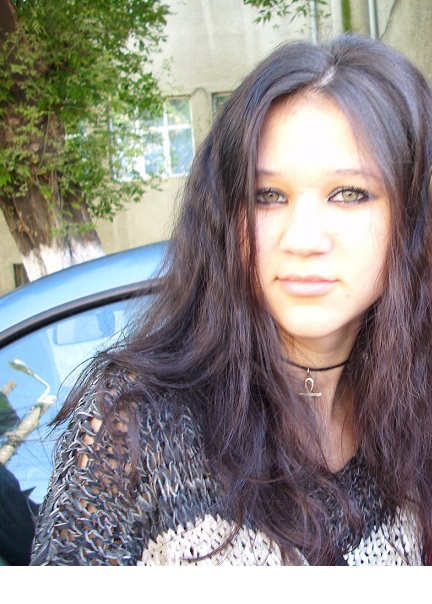
Photo by the author

I want to share with you all one of my experiences of street harassment. It was so awful and terrifying. I was in the village where I grew up and where I used to go and relax in the summer. Is a small village with a predominantly older population. There are some teenager and people in their 20’s and only about 12 children.

I was walking down the rural road on my way to my grandma’s house. It was dark, because in some Romanian villages the light goes on after 10 p.m. Four boys where following me that night but I didn’t see them and I didn’t care about that. I was in a bad mood that night and I did not respond to their catcalling me and leering at me when I was passing by.

When I got back from my grandma’s house and I was going to my uncle’s house, not so far from her house, those guys started to throw rocks at me. It was very dark, I had my hands full with apples, a big bottle of honey and my mobile phone as I was on the phone with my boyfriend. I managed to avoid being hit, but I yelled at them that I’m not scared of them. Then they started to walk behind me, so I stopped and let them pass, to let them be in front of me because  then I felt safer. But I was wrong! They laughed and tried to intimidate me. I was so nervous; a feminist and activist feeling unsafe and vulnerable in front of those guys!

Most of the time when I get catcalled I respond and I wanted to do that then too! My boy friend heard all of the discussion and tried to calm me down, demanding me to let them be and to stay quiet. But I was furious! This wasn’t the first time I was harassed in my village. I didn’t even know them so why were they acting like this toward me? I felt the urge to respond back! So I started acting fiercely, saying that I don’t fear them and that they are just some dumb harassers. One of them got nervous and started threating me, saying to shut up. I didn’t want to shut up. Why for?

He approach me and threatened me again. So I screamed out in his face that I’m not afraid. So immediately he punched me very hard in the face. Twice! I tried to fight back, but my hands were full. So he pulled my hair in a very brutal manner that I felt my cervical spine snapped. Then he put me on the ground and punched me in the face and the head. Then he and his friends left… while I was laying there, in acute pain. But I didn’t want to feel a victim so I managed to get up, to grab my telephone and other things and I faked that I was calling the Police. They heard and started running. Nobody heard my scream even though people from rural Romania are so curious and always behind the fences, looking on the street to see what’s happening and the next day to gossip about it. But when it comes to violence against women, they do not care!

After a short time, Police came and said to me: “Come on miss, stop crying, it’s not so bad, you’re overreacting!”

I had a swollen cheek and blood came out of my mouth, my hair was damaged. I was in shock! They blamed me for that incident. The officers heard all of my declarations and the guy that hit me, fled. When I confronted the Policeman he said and did nothing about it. Moreover he said the one that hit me me has mental disabilities and he can’t be punished and that he beats his mother and harasses other women too. And because I am not from that village, the Policeman said the declaration has no value if I want to press charges and I can’t come back here every month. For one week my cervical spine was all swollen and sore. I didn’t manage to move my head even an inch. Everybody in my family said to me that was my fault, a girl must never argue with a guy and why I was wandering in the village after dark? Why couldn’t I just mind my own business? Ohhh! All this discourse discouraged me so I didn’t continue with the Police complaint.

Even now, two years after the incident, sometimes my head hurts in those places where I was hit and once more I get terrified when I remember the hate in his eyes towards me. The very cherry on top was that a few weeks from that incident an unknown mobile phone number sent me messages like “I know you! How are you, you sweet girl” and then called me.. It was a familiar voice: it was that Policeman from my village, the one that took my declaration and said to me that I was overreacting! I threatened to report him and he stopped, but still I was petrified that he did this!

This experience gave me the motivation to fight harder against street harassment. Harassers don’t stop easily, so we keep on fighting!!

Simona is the Vice President of a feminist NGO – FILIA Center and a PhD student in Political Sciences, working on a thesis on street harassment in Bucharest. You can follow her on Facebook.

Share

Filed Under: correspondents, Stories, street harassment

USA: Wednesday Addams and Street Harassment

February 24, 2015 By Correspondent

Tyler Bradley, Michigan, USA Blog Correspondent

YouTube star Melissa Hunter is an online sensation, with 186,000 subscribers, and her biggest hit video reached the digital viewing screens of more than 2.25 million, just last week. This video hits the point home on catcalling by examining what an adult Wednesday Addams would do.

This series features many comedic videos, several hinting at women’s issues, tackling reproductive rights, one night stands, and internet dating, but nothing has been so direct in terms of activism as the street harassment video.

This sketch demonstrates how Hunter visualizes Addams Family character Wednesday would respond to street harassment.

In this video, two stereotypical dudebros call at her, “You’d look a lot prettier if you smile,” and obscene phrases.

Then Wednesday Addams appears at the home of the two catcallers to confront them. At first, the two are convinced she has come to repay the compliment in a consensual way, but she has something else up her black Victorian-age sleeves.

Wednesday brings in three of her most masculine and muscular friends — not to physically harm them, but to compliment the harassers all day long.

The men engage in ironic conversation, twisting their actions against them. “They’re not welcome in our house,” they rant, expressing their concern that the compliments are unwanted and a form of harassment.

After the harassers threaten to call the cops, Wednesday tells them, “Most forms of verbal assault on public property are perfectly legal – isn’t that just twisted?”

She nails the coffin with her last quote, “Cheer up. You’d be prettier if you smiled.”

Similar to social experiments like “When did you choose to be straight?”,  Adult Wednesday Addams reverses their argument by using their excuses against them.

Fighting fire with fire against sexual harassment by gender role reversion usually results in reinforcing gender stereotypes, like Buzzfeed’s “If Women Catcalled Men” or Funface’s “Women Catcalling Guys.” Hunter avoids this by not showing the different unwanted compliments her three friends would have said, with the exception of the heavy breathing by Bob.

It may alienate the male audience by depicting such a stereotypical hyper-masculine duo, making them less relatable to those participating in the institutional harassing culture. But, I don’t think Hunter should be too concerned. Creating parodies of fictional characters with strong cult followings can push the extremes of how viral a message can go, and this is just what Hunter has done.

Buzzfeed Video recently proved this is successful after releasing a strong feminist piece by creating a social justice parody of Harry Potter from Hermione’s perspective. They also address catcalling in this video, by the way. This video, much like Hunter’s, increases the viral state of a video, just by incorporating fictional figures with cult followings.

The lesson we’ve learned from Hunter is that popular culture is an excellent venue of advocacy and activism. They offer relatability in terms of massive followings, they’re comedic, and they help advance under-recognized causes.

Thank you, Melissa Hunter, and let’s hope you bring more of your third wave feminism to your future uploads!

Tyler is a senior majoring in graphic design at Saginaw Valley State University and plans to undertake a graduate program in higher education in the fall. Follow Tyler on Twitter, @MysteriousLuigi.

Share

Filed Under: correspondents, street harassment

Brazil: “The ‘Forced Kiss’ Incident”

February 23, 2015 By Correspondent

Juliana Guarany, Brazil, Blog Correspondent

(In Portuguese)

So this happened: I was enjoying Carnaval in São Paulo, following a nice bloco down the street when I saw him stop and force a girl to kiss him. She was uncomfortably laughing, in an attempt to get rid of him without spoiling the fun of the party. He grabbed her and kissed her for less than 30 seconds and then he was gone, and she was back with her friends, probably telling herself that this is normal during this time of the year and she should just let it go. I had the same reaction as her. It was too fast and I knew that, if I intervened, things could get uglier, so I didn’t do anything at that time even though it upset me.

French kisses during Carnaval are a tradition. Even singer Claudia Leitte wrote a song about it and broke the record of couples kissing at one of her concerts. Unfortunately, forced kisses are also very common. I have heard stories from friends being kissed against their will on micaretas (out-of-season Carnaval parties) since I was 15 years old. I also heard stories of men’s tactics, like this guy who used to take a tube of lança-perfume (an illegal mixture of ethyl chloride that gives a quick sense of euphoria, but can cause arrhythmia) and hold the girls, forcing them to inhale it until they passed out so he could kiss them. I guess every stupid action has its extreme.

Right before Carnaval started this year, a man was charged with seven years in prison for forcing a kiss on a girl in Salvador, Bahia, in 2008, which was considered rape. He was arrested at the scene and spent one year in jail before getting the right to appeal.

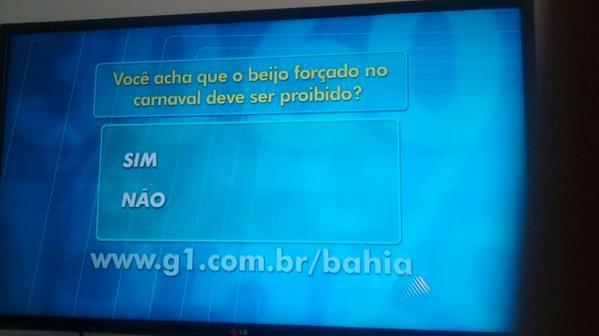
The main TV channel in the region used the story to give us a great “why we need feminism” moment when they released a poll for their Internet users, asking if “the forced kiss during Carnaval should be prohibited” (SEE PHOTO).

Unlike me and the bloco I saw, people on social media did not let this go. They even remembered the famous forced kiss after the end of World War II and the glamour behind a scene of violence (the girl says she hates that image.)

This year is no different from 30 years of Carnaval… forced kisses are common. But at least the debate about forced kisses and harassment in general is rising. Let’s hope next year brings us an even better party, in which we will not hesitate to intervene when a forced kiss happens in front of us.

Juliana is a fellow from Alexander von Humboldt Foundation and, together with Hamburg University, in Germany, is creating a digital campaign to connect all feminist initiatives around the globe. Read her blog Whistleblower and follow her on Twitter, @juguarany.

Share

Filed Under: correspondents, Stories, street harassment

USA: Dear Men of New York

February 19, 2015 By Correspondent

Dr. Dena Simmons, New York City, USA, Blog Correspondent

Dear Men of New York City,

Please let me walk the streets without your sweet-nothings, your unwanted advances. I don’t care for the elaborate details of what you’d like to do to my body.

No, you cannot take a picture of my badankadonk,
lick my thighs,
suck my toes,
ravage me with your hard cock,
join me on my run,
have my number,
bang me silly.
No, no, no!

I am more than my body. I don’t owe you a smile, a thank you, or a hello. I am not a bitch for ignoring you. I don’t deserve your street-abuse just because I don’t give you my attention or affection.

Please, please, please let me walk down the streets without having to map out a route to avoid your verbal daggers. I don’t like the way you devour me with your eyes, the way you make me feel unsafe, the way you strip me of my humanity.

Your disrespect massacres me.

Please leave me alone. Please don’t touch me. Please let me walk in peace.

My body is not yours. I do not exist for your pleasure.  I exist for me.

Respectfully,
Dena

Dr. Dena Simmons serves as the Associate Director of Education and Training at Yale’s Center for Emotional Intelligence. She is a recent graduate of Teachers College, Columbia University, where her research focused on teacher preparedness to address bullying in the middle school setting.

Share

Filed Under: correspondents, Stories, street harassment

« Previous Page
Next Page »

Share Your Story

Share your street harassment story for the blog. Donate Now

From the Blog

  • #MeToo 2024 Study Released Today
  • Join International Anti-Street Harassment Week 2022
  • Giving Tuesday – Fund the Hotline
  • Thank You – International Anti-Street Harassment Week 2021
  • Share Your Story – Safecity and Catcalls Collaboration

Buy the Book

  • Contact
  • Events
  • Join Us
  • Donate
  • Facebook
  • Instagram
  • Pinterest
  • Tumblr
  • Twitter
  • YouTube

Copyright © 2026 Stop Street Harassment · Website Design by Sarah Marie Lacy