• About Us
    • What Is Street Harassment?
    • Why Stopping Street Harassment Matters
    • Meet the Team
      • Board of Directors
      • Past Board Members
    • In The Media
  • Our Work
    • National Street Harassment Hotline
    • International Anti-Street Harassment Week
    • Blog Correspondents
      • Past SSH Correspondents
    • Safe Public Spaces Mentoring Program
    • Publications
    • National Studies
    • Campaigns against Companies
    • Washington, D.C. Activism
  • Our Books
  • Donate
  • Store

Stop Street Harassment

Making Public Spaces Safe and Welcoming

  • Facebook
  • Instagram
  • Pinterest
  • Tumblr
  • Twitter
  • YouTube
  • Home
  • Blog
    • Harassment Stories
    • Blog Correspondents
    • Street Respect Stories
  • Help & Advice
    • National Street Harassment Hotline
    • Dealing With Harassers
      • Assertive Responses
      • Reporting Harassers
      • Bystander Responses
      • Creative Responses
    • What to Do Before or After Harassment
    • Street Harassment and the Law
  • Resources
    • Definitions
    • Statistics
    • Articles & Books
    • Anti-Harassment Groups & Campaigns
    • Male Allies
      • Educating Boys & Men
      • How to Talk to Women
      • Bystander Tips
    • Video Clips
    • Images & Flyers
  • Take Community Action
  • Contact

USA: Turning to the Research

February 18, 2015 By Correspondent

Madison Ford, Texas, USA, Blog Correspondent

By Amy Mastrine

Talking about street harassment with people who aren’t familiar with the issue can often be frustrating, especially when not knowing leads to not believing that it’s a serious problem.  Writing my honors thesis on street harassment has led to this type of interaction more times than I can count. When I speak with somebody who believes street harassment isn’t a big problem, my imperfect solution is to turn to the research.

Why is this imperfect? Well, studies all have some flaws and limitations. Science can never be 100% certain, and social science is often beneath the proverbial microscope rather than looking through it. Some people don’t trust statistics and cling to anecdotes that support their own worldview. I believe everyone is guilty of this, even the researchers who try very hard to avoid it. The point is, nothing is ever perfect or certain. That’s why continuing to study street harassment is integral to the fight against it: the more research we have about its prevalence, how it affects victims, and the mechanisms involved in changing the way women navigate public space, the more scientific evidence illuminates the realities of harassment.

Here are some of the things we know about street harassment, in addition to its prevalence, thanks to the blood, sweat, and tears of researchers.

1. All kinds of street harassment have negative effects on women.

In Dr. Harmon B. Sullivan’s 2011 study, women were separated into two groups. One group watched a video of a woman being harassed on the street and the other watched a scene on a street with no harassment. In the experimental group, women who had experienced more street harassment themselves reported more negative feelings than those who experienced less harassment. This held true for women who mostly experienced hostile or threatening harassment and for women who experienced mostly “benign” harassment. This goes to show that “compliments” or “just saying hi” are not as innocent as they seem to be.

Rachel H. Pain’s 1997 study shows how different types of harassment may lead to fear of sexual attack. More than 20% of respondents reported that unwanted sexual comments or being leered at made them fear sexual attack. Forty-two percent of respondents indicated that being touched up made them fear sexual attack and almost 50% reported that being flashed at incited that fear. Finally, a whopping 85% of women who report being followed in public say that this makes them fear sexual attack. Less intense types of street harassment show corresponding lower levels of fear, but fear remains nonetheless.

A study released in late 2014 conducted by researchers at the University of Mary Washington found that sexual harassment is traumatizing for women, especially for those who have experienced sexual abuse.

2. Street harassment and fear of rape are highly correlated across multiple studies.

Street harassment is an active factor in preventing women from going out in public on their own. Cynthia Grant Bowman refers to this pattern as the informal ghettoization of women in her legal article “Street Harassment and the Informal Ghettoization of Women,” and that if women are going to continue fighting for social equality, they must be able to leave their homes without crippling fear. In her book Back Off! How to Confront and Stop Sexual Harassment and Harassers Martha Langelan wrote that for women, an underlying tension is always wondering how far the harasser will go, if he will become violent.

More recently, in early 2015 researchers at the University of Missouri-Kansas City released a study showing that the treatment of women as sexual objects – including through street harassment – contribute to increased feelings of anxiety about their physical safety, causing them to fear both physical and sexual harm.

3. Stranger harassment can be more damaging than harassment from people the victim knows, and the consequences could be dangerous.

In a 2000 study of Canadian women, findings suggested that women’s perceptions of safety were vastly influenced by their experiences of stranger harassment. While non-stranger harassment had very little effect on perceptions of safety, for each additional type of stranger harassment experienced, the odds of feeling safe decreased by 17-23%.

Knowing this, it makes sense that Pain’s 1997 study also discovered that women are almost twice as fearful of sexual attack from strangers than non-strangers despite the fact that “86.1% of women who have experienced rape, physical violence, and/or stalking during their lifetime reported that the perpetrator was a current intimate partner at the time when the violence first occurred.” Street harassment directs women’s fear of rape towards people who may very well not assault them and confuses an already messy discussion about sexual assault.

This is by no means an exhaustive list of all the things we know about street harassment. Social scientists continue to search for answers and anti-street harassment organizations are conducting surveys of their own. If you’re committed to the fight against street harassment, take a look at these studies – or even better, start your own research project! Distribute a survey to your peers, coworkers, or friends and find out how street harassment affects the people around you. Then in your discussions about street harassment, you’ll have the tools to keep everyone informed.

Madison is a soon-to-be graduate of the University of Texas at Austin studying literature and sociology. Follow her on Twitter, @madiford222.

Share

Filed Under: correspondents, Resources, street harassment

USA: Street Harassment Disrupts Private Space

February 17, 2015 By Correspondent

Dylan Jane Manderlink, Arkansas, USA, SSH Blog Correspondent

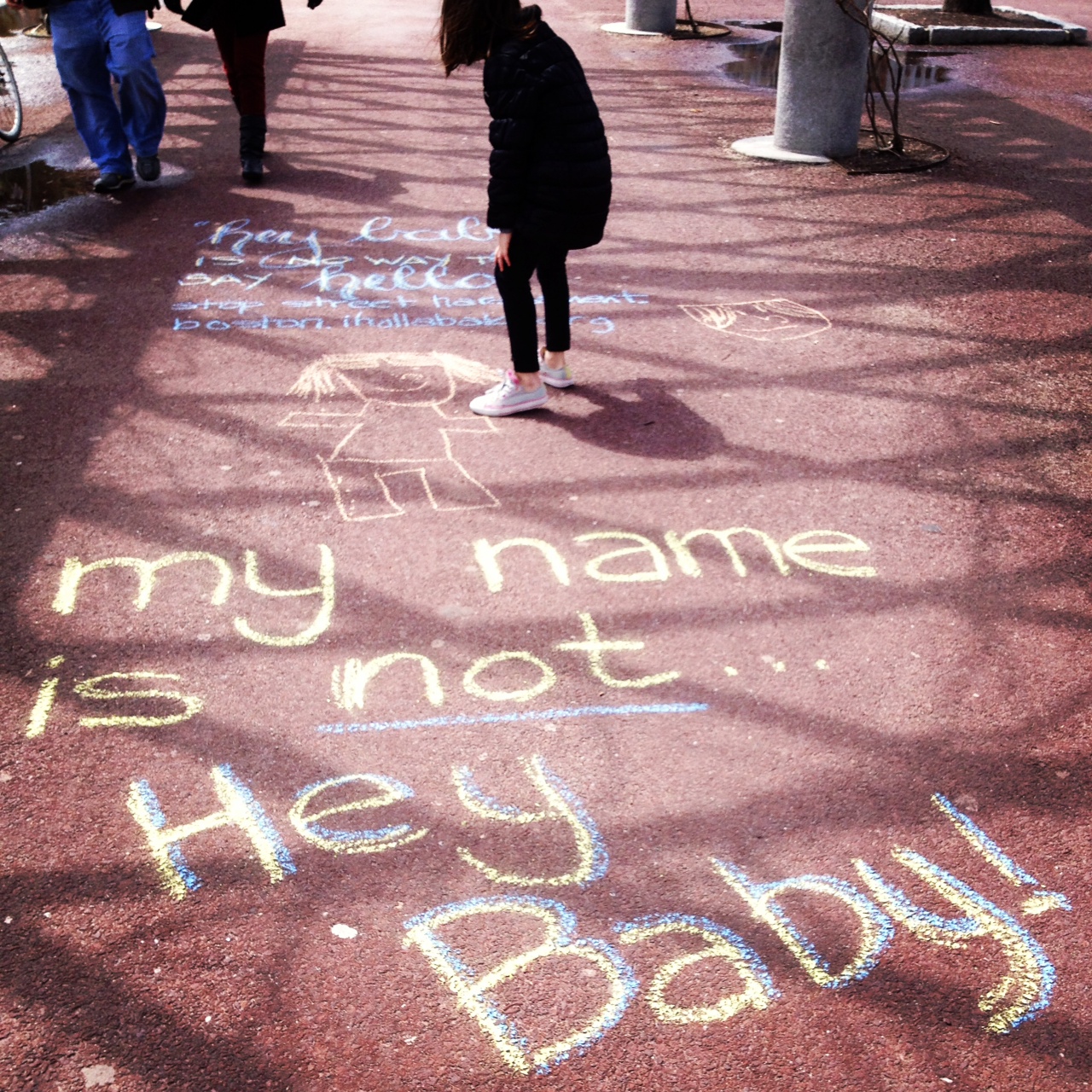
Anti-Street Harassment Week 2013 in Boston

A few nights ago, after being approached by a man on the street in Boston as she walked with a friend, Ellen R. replied, “Not tonight, thank you,” but the the man continued to follow her. She then turned around and said, “Please don’t follow us” and he yelled, “I’m not following you, bitch.”

Ellen told me, “This interaction upset me for so many reasons. Not only did I feel uncomfortable with the man’s initial comment, but when my friend and I tried to defend ourselves in the most polite way possible, the man only got more interested and more angry. I am already scared to walk down the street, so it’s even more frightening to know that even when I try to handle the situation in a calm manner, the man doing the harassing can go from 0 to 10 in a split second.”

Unfortunately Ellen’s street harassment experience is not uncommon. Despite responding with a polite remark, her street harasser met her with petulance, callousness, and an unforeseen temper. In many street harassment awareness and prevention blogs and articles I’ve read, I see the same message being revisited: Street harassment endangers the public space of individuals and disempowers their ability to walk through a public space safely, positively, and healthily. I certainly agree with that because I too, have felt that way when experiencing street harassment. But I would add that street harassment also communicates the message that your private space is no longer yours or never belonged to you.

As you navigate through a public space (a sidewalk, a city, a park, etc.), you also have your own private space within that. The way we personally view the environment we’re in is our private world…our thoughts, our bodies, the space between us and the people we pass on the street in close proximity…those all inform our private world. And when street harassers interfere with that personal, private, and intimate domain of ours, we can feel a different type of violation and discomfort. By understanding the threat we experience on both a private and public level, I believe we can better inform our awareness and advocacy efforts and the dialogues we promote through those modes.

Street harassment tells people that wherever they’re walking, wherever they’re living, whatever space they’re occupying – it’s not theirs. When we are catcalled, groped, eyed, followed, and yelled at the street harasser is claiming that space as theirs and communicating to us that we don’t belong in it. This needs to stop. This is not okay and people are really starting to take notice of how much street harassment is a detriment to our society and to people’s lives. We deserve better. Respecting our public and private space should not be optional, it should be the accepted and expected norm. As activists, the more we make noise and the more we create productive and cooperative pathways to empowerment and awareness, the more we can effect change.

As we approach International Anti-Street Harassment Week (#EndSHWeek) from April 12-18, let’s construct and promote a vigilant and sustainable conversation surrounding street harassment and the private and public spaces that are too often taken advantage of and threatened. I will no longer stand for our space being jeopardized, devalued, and disregarded. In the next couple months leading up to #EndSHWeek, let’s affirm the positive and inspiring efforts of fellow activists, bloggers, feminists, and community members. In doing so, I encourage you to open up meaningful channels of dialogue, spread awareness, and get involved with advocacy that helps make people’s private worlds a better place. Reclaim your space because it was yours to begin with and will always be. No one should be able to take that away from you.

Dylan is a recent graduate of Emerson College and currently teaches 8th, 10th, and 11th grade Digital Communications and Audio/Visual Technology in an Arkansas high school. You can visit her personal blog and follow her on Twitter @DylanManderlink.

Share

Filed Under: correspondents, Stories, street harassment

Germany: One Billion Rising and Documenting Murder

February 13, 2015 By Correspondent

Lea Goelnitz, Berlin, Germany, Blog Correspondent

TRIGGER WARNING

“Men are afraid that women will laugh at them. Women are afraid that men will kill them.”

UK Women killed through suspected male violence in 2014, via Smith’s website

This quote by Margaret Atwood might seem extreme, but there is some truth to it. For example, in the U.S., at least one-third of all female homicide victims were killed by male loved ones, and nationally, one woman per 100,000 is killed by a man.

In the UK, two women per week are killed by a current or former intimate male partner. Ingala Smith started counting Britain´s murdered women three years ago to make the government pay attention. February 12 was the official launch of the Femicide Census in London, a database of every woman who is killed by a man. The project is designed to “force a recognition of the scale and significance of male violence against women.” Smith told the Guardian, “I want us to stop seeing the killings of women by men as isolated incidents: to put them together and to see the connections and patterns; to highlight what a big issue it is; and to make it feel real for people.”

Of course, homicide is relatively rare, but men’s violence against women and girls is quite prevalent. It differs from violence against men because it is based in the structural inequality between men and women. A recent European Union-wide study revealed that one in three women has experienced physical and/or sexual violence since the age of 15 and 75% of women experienced sexual harassment in the work place. The UN notes that at least 35% of women worldwide have experienced physical and/or sexual violence and some national studies place this at 70% of women.

Although there is increased awareness of gender-based violence (GBV) as a public health concern and an obstacle to development, there is still a lack of data to explain it and document it. This leads to a lack of awareness among the general public and an overall lack of visibility of violence against women. Further, some forms of GBV are considered normal or are even institutionalized as cultural practices, such as female genital mutilation. Street harassment is another example and is usually seen as acceptable, or at least not bad enough to be recognized as a form of violence.

But a recent article published in the Guardian reports that a new study found “that some of the sexism women face – from catcalling and sexual harassment to sexual objectification and violence – makes women generally more fearful and anxious. The researchers from the University of Missouri-Kansas and Georgia State University found a substantive ‘link between physical safety concerns and psychological distress”.”

It does matter.

This year´s Valentine´s Day marks the 4th time Eve Ensler’s One Billion Rising raises awareness about violence against women and GBV. We can join in by striving to call out every incident of street harassment, collect stories and explain to people that street harassment is a form of GVB too. As street harassment is sometimes a gateway crime to other forms of VAW like sexual assault and even murder, it is worth it and very necessary to do so.

Lea works in journalism and women´s rights and is involved in the women´s rights NGO Discover Football, which uses football as a tool for empowerment and gender equality. Follow her on Twitter, @LeaGoelnitz.

Share

Filed Under: correspondents, News stories, street harassment

USA: Street Harassment- Not Just for City Slickers

February 13, 2015 By Correspondent

Emily Gillingham, Washington, DC, USA, Blog Correspondent

A lot of the conversation around street harassment focuses on harassment in cities. But this post is about street harassment in rural America, from three people who grew up there.

I grew up in a rural, conservative Michigan town. When I say “rural,” I mean that my township’s claim to fame is that it is the self-proclaimed “Kohlrabi Capital of the World.” And when I say “conservative,” I mean that when I knocked doors for Obama in 2008, a guy showed me his gun to emphasize that 1) he supported gun rights, and 2) I needed to get off his property immediately.

I remember the first time I experienced street harassment. I was fourteen years old. My mother and I had just moved closer to my high school. It was the first time I had lived in a place with sidewalks in my neighborhood, and I got in the habit of taking a bike ride downtown after school. “Downtown” consisted of a dozen or so shops, offices, and restaurants and a park. One day, I was biking home and a pickup truck headed towards me suddenly gunned it. Instinctively, I looked up- just in time to see the boy a few years my senior in the passenger seat lean out the window, make a ring with the fingers of his right hand, and vigorously stab his left index finger through it, screaming wildly.

I asked two young men who grew up in rural America, Chris and Tyler, what that was all about. Chris, who is originally from rural southeastern North Carolina, said, “Either he was crudely trying to hit on you, or he was mocking you with a douchey high school boy gesture.”

Why would someone take their time to do something like that? Chris pointed out that in the middle of nowhere, there’s nothing better to do. He told me about the form that street harassment took where he grew up- cruising. Chris said, “You take your pimped out car, and you cruise through town at slow speeds, just circling around. If you see an attractive female, you say something to her, like ‘hey, baby.’” I asked Chris if this something people do with friends, and he said, “Yeah, it would be creepy if someone was alone.”

I asked Chris if he had ever catcalled anyone or gone cruising. He said no, since he’s scared to talk to women in general. He also said it’s “disrespectful” and “weird” to talk to strangers on the street.

Tyler grew up in rural Maryland. I asked him what sort of catcalling he saw growing up. He explained that he never saw any, and when I pressed him as to why, he said that a lot of the places he went growing up were nicer, “family kinds of places where you didn’t do that kind of stuff.” I asked Tyler if he had ever catcalled someone, and he said, “I don’t even like people when I talk to them normally. I think you need to have a bit of an ego to think you’re the star and everyone needs to be looking at you.”

So what are the lessons here? First of all, I think it’s worth saying, explicitly, that street harassment isn’t just a city problem. It’s something that happens everywhere, between all kinds of people. But it definitely takes different forms in different places. I think that Chris was on to something when he said street harassment in rural America is just a way to pass the time. And after spending a few weeks asking my friends if they’ve ever catcalled someone and not getting a single “yes,” I think that there is a social element to it, too. People who catcall, particularly in rural areas, hang out with other people who catcall. And there seems to be a different social group that doesn’t catcall. And somehow, having a bachelor’s degree in Women’s and Gender Studies, I’m not surprised that I would up with a bunch of friends who say they’ve never catcalled anyone.

Emily is a 3L at Michigan State University College of Law, and the president of her school’s chapter of LSRJ. Follow her on Twitter @emgillingham.

Share

Filed Under: correspondents, Stories, street harassment

USA: What To Do When What We’re Doing Isn’t Working

January 31, 2015 By Correspondent

Emily Gillingham, Washington, DC, USA, Blog Correspondent

If you’re reading this, we’re probably on the same page that street harassment is awful. You’ve probably read about the toll that street harassment has on victims. If you study street harassment in the United States, you understand that there are a slew of laws covering every inch of the country designed to protect people from things like threatening language, upskirt photos, unwanted touching, being followed, obscene language, indecent exposure, and more. Penalties for violating those laws can include large fines or jail or prison time. But you also know that street harassment persists. It is pervasive. It directs where we go, what we do, the company we keep, and the clothes we wear.

As a law student hoping to spend my career advocating for women, I think often about what public policy changes could address street harassment. Clearly, there are laws meant to protect victims of street harassment on the books. But I can say that I have no confidence that those laws would protect me from the run-of-the-mill sexual and harassing remarks hurled at me as I commute to and from work, even if a man hissed “hey baby” at me in earshot of a police officer. If I were to videotape an incident of street harassment I’d put my physical safety, personal property, and others around me at risk, with little expectation that the police would take my report seriously or bring the harasser to justice. If I were groped on the Metro, I would not expect bystanders to assist me and logistically could not fathom how I would ensure the perpetrator’s arrest and prosecution short of taping the incident and then cold-cocking him. Make no mistake: this is why these things continue to happen.

I don’t think that stopping street harassment can be solved by legislating against harassing behaviors. But I do think that progress lies in stressing the importance and attainability of street harassment reform to policymakers. If politicians, public health advocates, and nonprofits were to zealously pursue the following package of reforms, real progress will be made in eradicating street harassment.

Legislative, Legal, and Judicial Reforms

Laws should be comprehensive designed to keep up with new technology. Legislatures should pass well-drafted laws barring upskirt photos and other harassment with technology. State and federal evidentiary rules should be updated to ensure that electronic evidence of stalking and recordings made with digital recorders and cell phones are admissible into evidence when vetted properly. State bar associations should continue to expand training offered to attorneys and judges about how to obtain and preserve electronic evidence of stalking and street harassment in an admissible format.

Education

Education about street harassment is crucial; it can prevent people from becoming street harassers, better equip stakeholders to respond effectively to street harassment incidents, and change cultural attitudes that treat street harassment as a minor problem or no problem at all. School curricula should include age-appropriate education about respect for others, scientifically-rooted information about how being harassed is harmful to mental health, and safe means of responding to street harassment incidents they witness. School honor codes should explicitly state the school’s opposition to street harassment and describe penalties for students who engage in street harassment. College and university honor codes should reflect the same, and new student orientation should emphasize why street harassment is unacceptable and that harassment on-campus will not be tolerated.

Police officers and transit employees should be trained about street harassment laws and encouraged to take incidents reported to them seriously. Efforts should be made to teach the public how to report officials who fail to respond effectively to reports of street harassment.

Most importantly, nationwide movements encouraging bystander awareness in other areas should be built upon in the street harassment context. PSAs and other means of educating the public should be engaged to encourage bystanders to intervene when they witness street harassment incidents. They should stress why bystander intervention is important and describe effective strategies that bystanders can employ.

Funding

This is the most critical piece. Funding is why many reports of street harassment cannot be properly addressed and why public education about street harassment is so lacking. Funds should be allocated to build cybercrime units to take seriously the taking and distribution of upskirt photos- both to remove the content and to identify perpetrators and hold them accountable. Lawmakers need to earmark funds for street harassment prevention and prosecution, and tie funding for public safety, public health, and public transit to meeting benchmarks for street harassment training, education, and enforcement efforts. These proposals aren’t costly, but they won’t work without clearly defined benchmarks and penalties for failure to meet them.

Street harassment is a cultural problem and public health issue worthy of being prioritized in our public policy in these ways. Let’s hope that our policymakers start to see it this way too, to make our streets and public transportation safe and welcoming for everyone.

Emily is a 3L at Michigan State University College of Law, and the president of her school’s chapter of LSRJ. Follow her on Twitter @emgillingham.

Share

Filed Under: correspondents, street harassment

« Previous Page
Next Page »

Share Your Story

Share your street harassment story for the blog. Donate Now

From the Blog

  • #MeToo 2024 Study Released Today
  • Join International Anti-Street Harassment Week 2022
  • Giving Tuesday – Fund the Hotline
  • Thank You – International Anti-Street Harassment Week 2021
  • Share Your Story – Safecity and Catcalls Collaboration

Buy the Book

  • Contact
  • Events
  • Join Us
  • Donate
  • Facebook
  • Instagram
  • Pinterest
  • Tumblr
  • Twitter
  • YouTube

Copyright © 2026 Stop Street Harassment · Website Design by Sarah Marie Lacy