• About Us
    • What Is Street Harassment?
    • Why Stopping Street Harassment Matters
    • Meet the Team
      • Board of Directors
      • Past Board Members
    • In The Media
  • Our Work
    • National Street Harassment Hotline
    • International Anti-Street Harassment Week
    • Blog Correspondents
      • Past SSH Correspondents
    • Safe Public Spaces Mentoring Program
    • Publications
    • National Studies
    • Campaigns against Companies
    • Washington, D.C. Activism
  • Our Books
  • Donate
  • Store

Stop Street Harassment

Making Public Spaces Safe and Welcoming

  • Facebook
  • Instagram
  • Pinterest
  • Tumblr
  • Twitter
  • YouTube
  • Home
  • Blog
    • Harassment Stories
    • Blog Correspondents
    • Street Respect Stories
  • Help & Advice
    • National Street Harassment Hotline
    • Dealing With Harassers
      • Assertive Responses
      • Reporting Harassers
      • Bystander Responses
      • Creative Responses
    • What to Do Before or After Harassment
    • Street Harassment and the Law
  • Resources
    • Definitions
    • Statistics
    • Articles & Books
    • Anti-Harassment Groups & Campaigns
    • Male Allies
      • Educating Boys & Men
      • How to Talk to Women
      • Bystander Tips
    • Video Clips
    • Images & Flyers
  • Take Community Action
  • Contact

USA: “Stop Telling Women To Smile” Comes To Baltimore

April 30, 2014 By Correspondent

Brittany Oliver, Baltimore, MD, USA, SSH Blog Correspondent
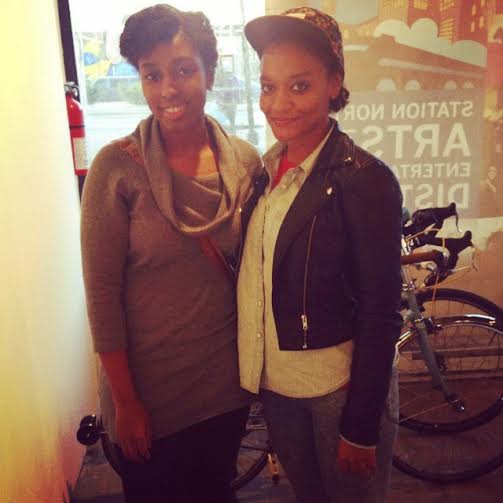
Brittany and Tatyana

During the week of April 21st – 27th, Tatyana Fazlalizadeh traveled to Baltimore to introduce Stop Telling Women To Smile (STWTS), which is an on-going traveling public art series that attempts to address gender based street harassment.

Tatyana Fazlalizadeh is an illustrator and painter based in Brooklyn, NY who is mostly known for her oil paintings, but recently branched out into public art as a muralist. STWTS started in the fall of 2012 and was born out of the idea that street art can make a difference.

On two different days, Hollaback! Baltimore co-sponsored an open discussion and artist talk at Station North Chicken Box in Baltimore City. The process of STWTS consists of shooting photographs of local women, using them as references for drawing, and composing them into a design with captions that speak directly to offenders of street harassment. The large black and white prints that feature local women are then wheat pasted throughout cities all over the country and aims at raising awareness of the unwanted, unwelcomed, and dangerous treatment of women in the public.

The open discussion was held on Monday, April 21st and allowed women share how street harassment affected them in different areas and what was so specific about it. The more I listened to other people’s stories, the more comfortable I became to share my own. It has never been easy to discuss my experiences with street harassment, but this discussion provided me with a safe space to vent and connect with others who felt the same.
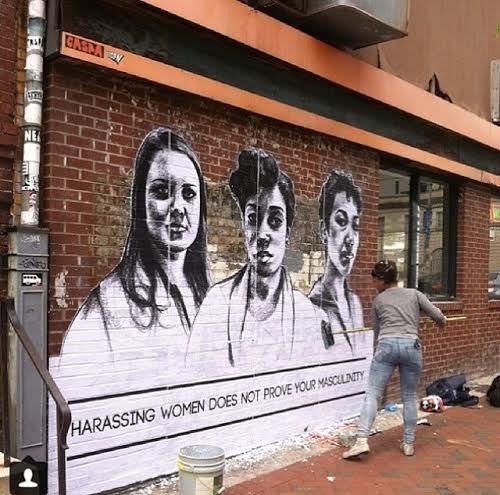
Afterwards, I met with Tatyana to tell her what I wanted to say to my harassers and to have my photo taken. After discussing a few ideas, we both decided to use “Men do not own the streets,” which would be the quote used if she did my portrait.

The artist talk held on Thursday, April 24th involved Tatyana discussing her background in visual art and how STWTS was created along with questions from the audience. This session was specifically interesting to me because I too have a background in the arts and have recently decided to incorporate feminist art into my work as an activist.

A couple days after while browsing through Instagram, I discovered a photo of Tatyana wheat pasting her very first piece at Station North and noticed that the mural included my portrait. I had no idea I would be featured in the first mural and was overwhelmed with empowerment and emotion when I saw it.

STWTS coming to Baltimore is one of the most memorable experiences I’ll ever have. This powerful campaign allows women to stand up to their harassers and it sends a strong message that street harassment is a serious issue that affects women worldwide.

The message is clear: Stop Telling Women To Smile.

Brittany Oliver is a recent graduate of Towson University and works in the non-profit communications sector and supports local anti-street harassment advocacy through Hollaback! Baltimore. She blogs at brittuniverse.wordpress.com and publicly rants on Twitter, @btiara3.

Share

Filed Under: correspondents, street harassment

USA: Don’t Let Their Sexism Fuel Your Racism

April 30, 2014 By Correspondent

Heather Frederick, USA, SSH Blog Correspondent

Race has always been an issue in the United States, and even now everyone from Supreme Court Justice Sonia Sotomayor to basketball legend LeBron James are talking about its impact. From how we speak to how we’re educated to what job opportunities are afforded to us (or not) our race is one of the most impactful pieces of our identity. Feminism has recently learned the importance of examining intersectionality–how the intersection of each facet of one’s identity comes together to create an individual who is simultaneously privileged and oppressed by life in America.

Much as it can be difficult for someone who is oppressed in many ways to see their privilege(s), when someone is harassed, or worse attacked, it can be difficult to recognize the humanity of the person being violent. While I believe in nonviolence, especially strategic nonviolent action in the form of civil resistance, to create change, I am not nonviolent on principle like Gandhi or King. I believe that I have the right to use violence to defend myself from physical harm, however, if the violence coming at me is not physically damaging but emotional, how do you defend against that?

One thing I make every effort to do is to see a street harasser as an individual. Period. This one person, or perhaps carload of people, is acting alone, not in cahoots with the Universe to make my day worse or make me feel unsafe. As a feminist I recognize that this one individual acting out sexism and misogyny is in cahoots with the Patriarchy to continue to oppress women/LGBTQ folk, but, this individual does not speak for all men, nor does he speak for all people of his race, or class, or education level. He speaks for himself alone.

Because America is still so segregated, it’s common for people to live in communities where they don’t often interact with people of other races. The fewer interactions one has with members of any given race, the more likely the negative interactions they do have will stand out. And because rape culture still encourages the idea that “real rape” is a black man jumping out of the bushes to rape a white woman, the reality that most sexual assaults are committed against someone of the same race as the perpetrator is ignored. While it can be difficult to be logical after being harassed, reminding yourself that not all people of the harasser’s race are “like that” can help you keep an open heart to the rest of your community.

The other tactic that has been therapeutic for me lately has been to remind myself, after I am harassed, of how many men, how many cars have passed me up until that point that have *not* harassed me. For those men are the example we want others to follow. We are surrounded by men all the time who treat us with respect, and we should remind ourselves of these men when we are harassed. We should point them out to the guy at the bus stop who won’t leave us alone. We should enlist their help in re-educating men about what masculinity and being a man mean. We should not let their sexism fuel our racism.

Heather Frederick works a Supervisor for The National Dating Abuse Helpline, www.loveisrespect.org. Her passions include intersectional feminism, reproductive justice, languages, travel, blogging at www.FeministActivism.com (@FeministSNVA) and bringing an end to human rights abuses.

Share

Filed Under: correspondents, Stories, street harassment

Scotland: Understanding the Male Harassers

April 28, 2014 By Correspondent

Rocío Andrés, Spain, SSH Blog Correspondent

Every time I have to write about a male harasser, a stalker, a molester, I would like to see just a neat crystal point to make it easier. Often, black over white – cross over tick, no over yes. But, instead, I see moiré.

I would like to be firm and forceful. And sure. I would like to be not contaminated by the whys. I strictly repeat “unjustifiable, inexcusable”, as if the human being couldn’t allow himself to spare any empathy for the violence and its acts, as if the violence were not human. However, after the impromptu furiosity and fuss, there is sadness and powerlessness and I, deep in me, see a sack of pretexts that a harasser might find to legimitate his actions, the long ache. Pretexts that, as in many other cases, turn into motives, like when you are in the middle of a sky dark black and, after a while, your blind eyes start to see tenuous lights.

Trying to be in another´s mind is often hardly difficult, but the work is far more complicated when we talk about being in a man´s who inferiorises your economic, social or living status because you are a woman, subordinates your rights to his self-interested understanding of your rights, doesn´t respect your body and your person, violentizes your mind, insults your human dignity, humiliates or mocks at your corporal strength, looks at you in the eyes and doesn’t see a woman, but a bitch or doesn’t find a connection in the fact that “excuse me, you and me – naked-, have arrived here at the same time”.

1) “What does your cunt like?”, a man in his sixties, maybe seventies, asked me recently just at the moment I took my seat during a flight from Spain to Scotland (obviously, no matter the age to be offensive, and however it provides with information to show the variety of harassers around the world). As I don´t like to turn everything into a drama, I threw to his nose a ball of paper that I always keep in my pocket just in case, which, somehow due to Murphy´s law, ended up landing back on my hair (how to predict a rubbery nose!) and so, I went straight to Facebook, where I updated my status as “critical”.

Minutes before, in the queue to enter the plain, another man at the same age, while his (I believe) wife was naively entertained reading a magazine, had obscenely been sticking his tongue out at me, as if he were eating an ice-cream of air.

2) “Hundreds of rapists and sex offenders are roaming the streets of Cairo, according to a leading human rights claims. The shocking International Federation for Human Rights (FIDH) report found that 250 reported cases of sexual assault and rape took place against female protestors during political demonstrations. None of the cases were ever prosecuted sparking fears than hundreds of sexual predators are still roaming Egyptian streets.” According to www.scoopempire.com, Egyptian street children is one of the most vulnerable groups exposed to sexual violence. “A study conducted by Lipincott Williams & Wilkins Inc. rounded up 857 homeless children in Cairo and found that 93% were sexually assaulted or raped (mostly by police officers and other homeless children) – 50% of whom were females”. In order to reduce the chances of being harassed or assaulted, girls stop showering or cover their bodies to hide their gender. http://scoopempire.com/violence-street-children-egypt/#.U1uYfxarPIf

3) “Dear Harvard: I am writing to let you know I give up. My assailant will remain unpunished, and life on this campus will continue its course as if nothing had happened. Today, Harvard, I am writing to let you know that you have won”. This was the beginning of an anonymous open letter sent to Harvard Crimson by a woman who had been sexually assaulted by “a friend.”

After all this, point at which the amount of violence traumatises the mind and your mouth becomes mute of adjectives, how can I possibly understand harassers? or, how can I possibly want to understand them? (Not to mention today, laws, measures or tools to eradicate these crimes).

Well, presuming that I am a common-sense person, I do. Here there are a few reasons why I think women should try to understand a harasser (not the same as to agree on the violence):

  1. because they are human beings. And that includes dads, granpas, brothers, cousins, uncles, boyfriends, neighbours, sons…
  2. because they have ability of thinking, which technically works in the same way as mine – not inferior, not superior-, and that raises hope for Indentification-Acceptation-Remorse-Change?
  3. I know a respectable amount of men who look for women´s equality (if you are one, click here https://stopstreetharassment.org/resources/male-allies/). Thus, equal gender is possible.
  4. Just by being acknowledged of the causes, I can help to solve them.
  5. I really yearn for our rights to be given and respected by men. And, whether I want it or not, that involves my effort in understanding harassers.
  6. We are partly responsible for education and the culture we live in. It is worthwhile to watch these videos of boys and girls giving their reasons why they think harassment happens in Egypt.


Of course, there is a huge exercise in wanting to understand a harasser, especially when you get used to suffering from harassment in the first place or even if you just read the deplorable news on the papers. On many occassions, I have to stop my readings, not before saying Objection! in order to calm down and start again.

Harassers, however, aren’t normally the focus of the news or academic studies, where, contrarily, the informative weight mostly falls on the woman´s presence, sensationalizing and highlighting her victim status and where, consequently, the harasser´s figure is pushed into the background, almost forgotten, deleted, or just presented as if it were lack of social or human roots.

Indeed, harasser´s representation is mainly characterised by de-humanization – the monster´s myth-, and depicted by the litres of blood shed – gory, pure predators (see the article I mentioned before referring to harassers/rapists as sexual predators). I wish it were that plain, so then we could just limit ourselves to call them animals and we  didn´t need to ask: what are we doing wrong?. But, as far as I know, being a man and lacking humanity (understood as part of the human race and not positive human attributes) cannot be separated. And here it is where I consider the bulk, the impact rests, in our acceptation of them as people, as men.

Once this is assumed, the writings of violent/harassing behaviours can go deep and spread, prioritising the social, economic and political components in which the harasser cohabitates over the innate ones, prioritising the man over the monster and understanding that behind such behaviours, it resides a greed of power, traditions, miseducation, a macho parade – in fact, all plastic, a fake.

Rocío Andrés holds a Bachelor´s degree in Audiovisual Communication, History of Art (both Universidad Complutense de Madrid, Spain) and a Master´s in Education (Universidad Rey Juan Carlos, Spain, 2010). She has six years experience as a TV and advertising producer.


Share

Filed Under: correspondents, street harassment

USA: Self-Care after Street Harassment

March 31, 2014 By Correspondent

Heather Frederick, USA, SSH Blog Correspondent

Violence exists in a continuum. From one child yelling at another to nations going to war, violence takes many forms. Street harassment is one form of sexual violence that is still overlooked, under-reported and in general, ignored.

As we know many times people who are subjected to street harassment are told “it’s no big deal” and to “just get over it,” but having your physical safety threatened in public is a big deal. And how you get over it is very personal; some people feel best when they ignore harassment–turn the music up and move on with the day, and some people feel best when they combat their harasser–giving the middle finger or yelling back.

No matter what you do in the moment to keep yourself safe, it’s important to take care of yourself later too, when you’re in a place that you feel safe reflecting on what happened.

While it has taken decades for the legal system to recognize that sexual violence is, in fact, a crime, the varying natures of some sexualized crimes are still not yet protected by law. Finally in the US rape, sexual assault, marital rape and sexual abuse are considered criminal, but when it comes to being honked at the laws can be less useful. Because protections against street harassment vary from state to state, and even from town to town, knowing whether or not you can or should contact the police can be tricky. And if you’re in public because you’re on your way somewhere, taking the time to report what happened may not be an option. If you think you may want to report it later writing down what happened in a text to a good friend, or taking a voice note on your phone can help you recall the details. And if you’re the type to Hollaback! having a picture of your harasser is likely to make it a lot easier for the police to find them.

A lot has been written on how to respond to street harassment when it’s happening, and we’re beginning to have conversations about how to prevent/combat street harassment in the first place, but so far there hasn’t been a lot of focus on dealing with how it makes you feel. Personally when I am harassed I go through a range of emotions: fear, embarrassment, anger, sadness and numbness.

The negativity surrounding my experiences is what lead me to become involved with Stop Street Harassment, and I encourage you, especially if harassment is something that affects you regularly too, to get involved in your community, because you are not alone. Also, take care of yourself. We live in a culture that moves at lightning speed all the time, where doing something for yourself is seen as selfish and weak, but sometimes slowing down, caring for your emotional self, is about survival.

Self-care can be as simple as doing some deep breathing when you get to a safe place, or as elaborate as getting a massage on a weekly basis, whether you’ve been harassed or not. Some people throw themselves into their work, if they truly enjoy it, and others spend hours debriefing with friends. Whatever you like to do, whatever helps you relax and take your mind off what happened, that’s what you need to do. Physical stuff like yoga, sports or running can be a great way to release negative energy, while anything creative like baking, music or art can be a great way to express yourself. Volunteering for something in your local community not only lets you give back, it can help you meet people who have similar interests and lifestyles. Journaling is also a helpful tool, not just for dealing with street harassment, but for sorting out your feelings in general.

So no matter what anyone says to you during your commute, know that you deserve to feel safe in public, and have a right to take care of yourself in whatever way works best for you. Now go do something to take your mind off street harassment!

Heather Frederick works a Supervisor for The National Dating Abuse Helpline, www.loveisrespect.org. Her passions include intersectional feminism, reproductive justice, languages, travel, blogging at www.FeministActivism.com (@FeministSNVA) and bringing an end to human rights abuses.

Share

Filed Under: street harassment

USA: 29 Things Men Can Do (and Not Do) to Challenge Street Harassment

March 28, 2014 By Correspondent

Joe Samalin, New York City, NY, USA, SSH Blog Correspondent

March 30th – April 5th is Anti-Street Harassment Week so come out and Meet Us On The Street!

Can’t make it? Don’t know anything about street harassment? Don’t know what to do? Not sure how to make a difference?  There are limitless ways to make a difference. Here are just a few to start us off…

1. Learn how often street harassment actually happens (spoiler alert: it happens a lot. Informal studies and more formal research show that the overwhelming majority of girls and women experience it often.)

2. If research and numbers are not your thing, try this. Ask three women in your life (three women you trust and who trust you) about their experiences being harassed in public. If they don’t mind sharing you can ask where it happens and how often, what is said or done, how they react (if they do), and how the harassers react back. Ask them how this affects them, and how they feel about it. But don’t forget to…

3. Listen to their answers, without judging, disagreeing, or arguing. Just listen.

4. If you do not get harassed regularly, think about what that means for you. Recognize that as a privilege we have. And then choose something else on this list and do something about it.

5. Challenge myths about street harassment.

6. For example, don’t bring up your one female friend who likes street harassment to show that it is ok to harass women. It is a slap in the face to the millions of women who don’t like it. And you can’t tell who might like it by looking at them anyway, so it’s kind of a moot point to begin with.

7. And ask that friend who likes it if they always like it, or if it depends on context.

8. Talk to (male) friends who don’t harass women. Ask them if they ever notice it, and what they think about it. Ask them what they do or can do to challenge it. And what you can all do together! Remember to challenge myths (see #5 above) and don’t defend it (#27 below).

9. Understand that street harassment and other forms of violence in public are common against gay, lesbian, bisexual and transgendered people and people of color, as well as women and girls. And understand too that all those categories are not mutually exclusive.

10. Support organizations like Girls For Gender Equity, Incite! Women of Color Against Violence, Stop Street Harassment, Hollaback, Center for Anti-Violence Education, Anti-Violence Project, RightRides, and others working to support those affected by street harassment and other related forms of violence.

11. Safely and respectfully intervene when you see harassment in public. Be creative!

12. Practice practice practice what you can say to friends, co-workers, teammates, classmates, and family members when they harass women:
“Cut that out, it really makes me uncomfortable.”
“Don’t do that in front of me….or at all. It’s not right.”
“You really shouldn’t do that. It’s disrespectful and it is called harassment.”
“(Insert witty line here.)”

13. Practice what you can say to strangers when they harass women
“Hey man I heard what you said to those women and it’s really not ok.”
“Don’t do that around here.”
“Can you please cut that out? People are just trying to get through their day and you are bothering them.”
“It’s not a compliment.”
“Don’t tell women to smile – they can feel however they want to feel.”
“(Insert another witty line here.)”

14. Print up tee-shirts with messages like ‘her name isn’t baby’, ‘it isn’t a compliment, it’s harassment’, ‘respect women and girls in public’, and more. Give them to men you know. Or sell them and give the profit to organizations addressing violence against women.

15. Join/support/get trained by agencies promoting healthy non-violent masculinity – Men Can Stop Rape, A Call To Men, Men Stopping Violence, Coach For America, White Ribbon Campaign, and others.

16. Contact men in leadership positions (coaches, politicians, business owners, teachers, etc.) and get them to make public statements against street harassment.

17. Figure out fun creative ways to interrupt street harassment on your block and in your neighborhood.

18. Practice your ‘hell no’ look for when other men turn to you in public and try and get you to harass women and girls with them, or to have your back when they get called out for it.

19. Film and release your own hometown video about men challenging street harassment to try and match the coolness of NYC, California, Northern Azerbaijan, and Egypt.

20. Use art, theater, music, or whatever else you are good at and enjoy doing to raise a little awareness about men challenging street harassment.

21. Join us for anti-street harassment week this year and every year.

22. Actually, make every week anti-street harassment week.

23. Think of one thing you can do today that would challenge street harassment, and then…

24. Do that thing, and then…

25. Share that thing you did with others, so they can try it too.

26. Add to this list and share it with others – at home, at work, at school, at church, at practice, everywhere.

27. Don’t defend it.

28. Don’t ignore it

29. Don’t do it.
 

Copyright: Joseph Samalin. All rights reserved. Reprints or reposts with the permission of the author and Stop Street Harassment.

Joe Samalin has been addressing gender-based violence for over 15 years, including as the Training and Technical Assistance Coordinator for Men Can Stop Rape. He is currently the Outreach and Training Manager for the Disaster Distress Helpline and is examining among other things gender-based violence in the aftermath of disasters. Follow him on Twitter, @joesamalin.

Share

Filed Under: street harassment

« Previous Page
Next Page »

Share Your Story

Share your street harassment story for the blog. Donate Now

From the Blog

  • #MeToo 2024 Study Released Today
  • Join International Anti-Street Harassment Week 2022
  • Giving Tuesday – Fund the Hotline
  • Thank You – International Anti-Street Harassment Week 2021
  • Share Your Story – Safecity and Catcalls Collaboration

Buy the Book

  • Contact
  • Events
  • Join Us
  • Donate
  • Facebook
  • Instagram
  • Pinterest
  • Tumblr
  • Twitter
  • YouTube

Copyright © 2026 Stop Street Harassment · Website Design by Sarah Marie Lacy