• About Us
    • What Is Street Harassment?
    • Why Stopping Street Harassment Matters
    • Meet the Team
      • Board of Directors
      • Past Board Members
    • In The Media
  • Our Work
    • National Street Harassment Hotline
    • International Anti-Street Harassment Week
    • Blog Correspondents
      • Past SSH Correspondents
    • Safe Public Spaces Mentoring Program
    • Publications
    • National Studies
    • Campaigns against Companies
    • Washington, D.C. Activism
  • Our Books
  • Donate
  • Store

Stop Street Harassment

Making Public Spaces Safe and Welcoming

  • Facebook
  • Instagram
  • Pinterest
  • Tumblr
  • Twitter
  • YouTube
  • Home
  • Blog
    • Harassment Stories
    • Blog Correspondents
    • Street Respect Stories
  • Help & Advice
    • National Street Harassment Hotline
    • Dealing With Harassers
      • Assertive Responses
      • Reporting Harassers
      • Bystander Responses
      • Creative Responses
    • What to Do Before or After Harassment
    • Street Harassment and the Law
  • Resources
    • Definitions
    • Statistics
    • Articles & Books
    • Anti-Harassment Groups & Campaigns
    • Male Allies
      • Educating Boys & Men
      • How to Talk to Women
      • Bystander Tips
    • Video Clips
    • Images & Flyers
  • Take Community Action
  • Contact

South Africa: Perspectives on How Men Should Approach Women in the Street

October 28, 2013 By Correspondent

By: Gcobani Qambela, South Africa, SSH Correspondent
Via The Huffington Post

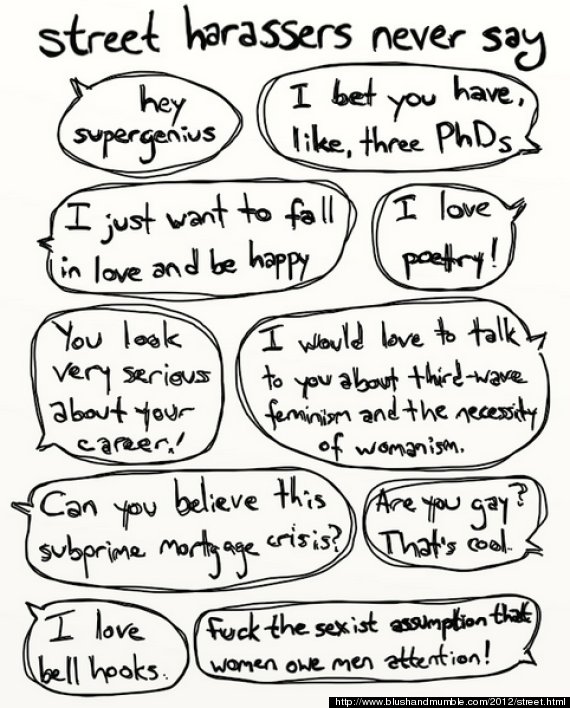
I recently read an interesting article in The Huffington Post titled “What We Wish People Would Say To Us On The Street”. The article covers the illustration by Norma Krautmeyer “which observes what people never say to women on the street.” This month I decided to talk to a small number of South Africans from across genders in various provinces in South Africa about the different ways they would like people to approach them in the street.

I believe street harassment in any form is unacceptable, but where necessary, how can men be better prepared to approach women in respectful and dignified ways in the street? What are the best ways to start a conversation with strangers across genders in a non-threatening way in the streets?

I spoke to gender activist and researcher, Rethabile Mashale, in Cape Town, in the Western Cape province of South Africa. She tells me that she has had her fair share of being subject to “catcalling and harassment” in the street. So what approach does she prefer when strangers, especially men approach her in the street? She says she has devised five basic alternatives. “The first is that a decent and genuine ‘hello’ and ‘how are you?’ which are followed by a genuine concern for whatever happens next” always work she says. Secondly she says “never lick your lips, or do a once over, over my body.

The person, thirdly, must look me in the eye instead of my tits” she continues. Fourthly she says while a clever joke can work, pick up lines are generally also unacceptable. She says lastly and mostly importantly “lead with getting my PERMISSION to engage in conversation, in fact, I would say that is the most important one” to get permission to talk and engage a person and quietly accept should she decline.

I also spoke to Amanda* in the province of KwaZulu-Natal. She told me she feels like street harassment is very degrading and that there is always a very “thin-line” between a stranger cracking a conversation and also at the same time harassing you. However the important distinction she made is that “Harassment is when I say ‘no’ and he doesn’t stop or if he feels the need to touch or say derogatory things to me.”

Tandokazi Mbopa, a university student in Port Elizabeth, in the Eastern Cape province, told me that she just does not want strangers approaching her in the street at all. This, she said, was born out of a horrible experience of being persistently harassed in the street. She told me that last year, she was walking and running late to school and a guy in a car kept hooting at her even though she ignored him. “He really didn’t get the hint ‘because he was driving next to me saying: ‘Oh, where are you going? Do you want a lift?’ as if I was going to get into that car after that hooting” she tells me.

Despite her declination to get into the car she says he refused to take a hint and kept driving slowly next to her saying, “Ooh, baby you’re hot. Baby you’re hot.”

“I felt like meat. The way he was looking at me. I was wearing track pants and a vest down to cover my butt… I wanted to change whatever was making him look at me like that and call me ‘sexy’” she tells me. “I don’t respect any guy approaching me on the street. I never will, unless if I’ve met you before – just not in the streets,” she concludes.

While these are only three interviews that I have included here, what emerged clearly from all the women I spoke to is that the key is consent and permission to approach and talk to women or anyone else in the street should be garnered clearly from the person who is being approached. If the women do not want to speak or engage then one should politely accept that. While Krautmeye’s illustration is encouraging, it is also important to remember that there are people with painful experiences like Tandokazi of dealing with harassers in the street even though the harassers probably thought they were saying something ‘nice’ to her. It is important therefore to treat even what appears to be ‘nice’ harassment with caution for it can also be traumatic for those on the receiving end. Consent and acceptance of a woman’s choice is thus critical in all cases, even if it appears that the guy is saying something that the woman would appreciate.

*The interviewee wished to remain anonymous.

Gcobani is completing his Masters in Medical Anthropology through Rhodes University, Grahamstown, South Africa. His research centres around issues of risk, responsibility and vulnerability amongst Xhosa men (and women) in a rural town in South Africa living in the context of HIV/AIDS. Follow him on Twitter, @GcobaniQambela.

Share

Filed Under: correspondents, Stories, street harassment

USA: Halloween costumes can be clever, not just “sexy”

October 25, 2013 By Correspondent

By: Taylor Kuether, Minnesota, USA, SSH Blog Correspondent

“Sexy” Hamburger, Image via Yandy.com

While it is one of my favorite holidays, Halloween is also hard. As a feminist against street harassment, I think women should be able to wear whatever they want and not be harassed for it, but as a feminist against cultural appropriation and heteronormativity, I think there are some costumes that are hurtful, degrading, and demeaning.

Consider the popular skeleton costume with a tape measure around the waist, “playfully” called “Anna Rexia.” Such a costume trivializes a real disease that hurts thousands of people. Or what about dressing up as sexualized Disney princesses, which both infantilizes women by dressing them up in costumes traditionally reserved for very young girls and hurts said young girls by showing them highly sexualized versions of otherwise innocent children’s characters. And how many countless costumes are there that – literally – objectify women by turning them into objects? Sexy USB Port (with matching USB Stick for your boyfriend…)? Sexy Brick House (and, of course, Brick Layer for the guy…how clever…)? And of course, Sexy Hamburger, which literally turns a woman into a piece of meat.

Yes, these costumes are harmful, reducing women to sexualized objects. Even worse, though, are costumes that make fun of other cultures. Halloween is a time to dress up and pretend to be someone you’re not – but why do we need to try on other races and nationalities for size? Some examples include Native American, Mexican, and Asian “costumes,” all shown here. Commodifying an entire culture to dress up in it for Halloween devalues the richness and history of that culture.

So just don’t do it. Pick something else, please.

I value creative, clever, or funny Halloween costumes. I value Halloween costumes that allow you to dress up as someone you admire (Audrey Hepburn in Breakfast at Tiffany’s, anyone?). And I especially appreciate costumes that bend gender binaries – rather than the predictable presentation of Paul Bunyan and Babe the Blue Ox, characters from one of my favorite American folk tales, last year it was I who dressed as Paul Bunyan (faux-beard and all!) and my then-boyfriend went as Babe. This year, I’m excited to dress up as Tobias Funke from the popular TV series “Arrested Development,” and one of my gal pals is going as his wife Lindsey. It’ll be fun and funny, and I know we’ll have a great time and make some people laugh.

That’s what Halloween should be about. It’s a holiday that’s meant to be fun – for children, that means trick-or-treating, for adults, that means dressing up and handing out candy or attending a Halloween party. It’s not meant to be serious or stuffy, but that doesn’t mean we shouldn’t carefully consider our costume choices.

This Halloween, I implore you to pick the funny, clever costume over the “sexy” one. Try it; you’ll probably end up having a blast.

Taylor Kuether is a senior journalism student at University of Wisconsin-Eau Claire in northwestern Wisconsin. She has previously written for The Washington Post and Minneapolis’ Star Tribune, worked as a reporter at her city’s daily newspaper, The Leader-Telegram, and its arts and culture publication, VolumeOne, hosted a local-music centered radio show on Wisconsin Public Radio, and worked as Editor-in-Chief at her student newspaper, where she enjoyed writing biting, slightly rant-y columns about feminist issues.

Share

Filed Under: correspondents, street harassment Tagged With: Costumes, halloween

UK: What am I supposed to do when I get harassed?

October 24, 2013 By Correspondent

By: Levi Grayshon, Manchester, England, SSH Correspondent

When you hear someone’s street harassment story, it is very easy to tell them “you should have…” or “If I was you, I would…”, but most of the time, it is not so simple.

Reacting in a certain way can only antagonise the harasser, placing the victim in a much more dangerous and/or hostile situation. In addition to this, it may be frightening for the victim to challenge their harasser, especially with aggression, particularly if they are alone and are being targeted by multiple people.

When harassed, it is easy to feel as though you are at fault. When a stranger is shouting lewd comments at you, or touching you, or wolf whistling at you, it is easy to feel small, hurt and under threat. It is hard to remember that it the harassers problem, and not yours. We are told as women to be polite, and that it happens because men are trying to show us that they find us attractive, but when telling friends about situations in which we were harassed we get asked why we didn’t act more assertively, so it’s little wonder that figuring out how to react to harassment is often so confusing, as well as scary.

Something that can make harassment situations a lot easier to handle is the involvement of allies in the street. When other men tell the harasser what he is doing wrong, it can soothe the problem. It is not ideal (and a world when harassers actually listen to the victim – wait, a world where there are no harassers – would be much better), but educating the harasser is a much better way to ease the problem, rather than fighting it with more aggressive behaviour. The recent youtube video, “Shit Men Say to Men Who Say Shit to Women in the Street” highlighted that not all men are on the same team as men who harass, and are willing to speak up against them. Unfortunately, in a lot of instances, bystanders feel uneasy about becoming involved.

Some more helpful Stop Street Harassment tips are to be firm with the harasser, and avoid being apologetic, whilst calling them out on their unsavoury behaviour, but without insulting them. Following on from this, try to avoid engaging further with the harasser (as tempting as it may be if they try to argue with you), and to keep moving, detaching yourself from the situation. As well as this, it may prove helpful to report the harasser, for instance, if they are wearing a uniform, or driving in a company vehicle. Even threatening to report them (especially to their employer) can encourage the harasser to see what they are doing wrong.

Even some institutions are going out of their way to ensure that women feel safer in public. For instance in Tokyo, women’s only carriages were introduced on the problematic Saikyo line a few years ago, the route used by many schoolgirls, and labelled a “gropers paradise” by many. Even male commuters welcomed the changes. But is segregation the answer? Would education not work better?

There is no right or wrong answer to the question “what should I do when I am harassed in the street?”, but there is one thing to remember– you are not the one in the wrong.

[Check out the new book 50 Stories about Stopping Street Harassers for more ideas.]

Levi graduated from university with a degree in Film and TV screenwriting this summer. As a freelance writer, she has been writing for The F-Word and Gamer-UK. You can follow her rants and ramblings on Twitter, @part_heart.

Share

Filed Under: correspondents, Stories, street harassment

UK: Our Reality Isn’t Your Fantasy

October 21, 2013 By Correspondent

By: Tilly Grove, London, UK, SSH Correspondent

I was nervous enough about having to use the underpass in the early evening wearing my new dress, so when the men walking past decided to wolf-whistle at me, I was a little shaken. My immediate response in these circumstances is to contact someone, to make me feel less vulnerable; I chose to message a close male friend. Instead of the sympathy I had been hoping for, he replied, wistfully: “I’ve never been whistled at.”

It is a sentiment I have heard often from straight men; no matter how distressed street harassment evidently makes women, they’re positive that the inverse is something that they’d quite like. They like the idea that a woman might come up to them and grab their backside, or make comments that implied (or outright stated) sexual attraction. Some of them might even like the idea of another man doing these things to them. They think that when a stranger catcalls, wolf-whistles, or gropes you, they are merely revealing their attraction to you, and that this would be an incredibly flattering thing to happen.

It may be that this thinking is so flawed through lack of experience, but regardless, it is hardly surprising that street harassment is so prevalent when men feel this way. Even if these men would never themselves holler at women on the street or touch them without consent, the fact that they think the act is inherently complimentary means that they help perpetuate the behaviour. It means they’re less likely to challenge it.

But they are basing their opinion on what street harassment is like from a fantasy. Many men really can only dream of what it’s like. The fact is, it’s not someone coming up to you every now and then to tell you that you look good, or to ask you out. It’s not someone hot pinching your butt in a flirty way, or making their sexual attraction to you known. It is strange men who have no reason other than their evident belief of their entitlement over women to think that you want to hear their opinions or intentions, shouting explicit things at you from across the road or pawing at you without warning or invitation, every time you leave the house. We are sick of men objectifying us whenever we walk by, sick of men intimidating us whenever we go outside. It will never be a compliment in this context.

So, if men actually want to compliment women they see on the street, they should politely get their attention and talk to them. They should keep their hands to themselves, not shout, and not make inappropriate comments or noises. These things are not complimentary; they are disrespectful, and when they come from men who we are acutely aware could easily stalk or overpower us, they become terrifying. We know that the vast majority of men perpetrating street harassment are not doing it to flatter, because it is these methods which they employ most of all. We need men as a whole to acknowledge this, whether they choose to partake in it or not, if we have any hope of seeing an end to it.

Tilly is studying for a BA in War Studies at King’s College London, where she is writing her dissertation on the effect that perceptions of gender have on the roles which women adopt in conflict. You can follow her on Tumblr and Twitter, @tillyjean_.

Share

Filed Under: correspondents, Stories, street harassment

India: Commodification of Women

October 21, 2013 By Correspondent

By Pallavi Kamat, Mumbai, India, SSH Correspondent

In India, as all over the world, the commodification of women in the media is a very common thing. The women are either shown as docile homemakers at the beck and call of their husbands or they are shown as sex symbols trying to convince the public at large to buy the product. The latter reflects in products as varied and unrelated as cement and residential buildings being sold by skimpily clad women.

How is this related to street harassment you wonder? Walking down the street, women and men are exposed to these advertisements. If a woman ever raises her voice in public over an issue, she is asked to not express her opinion and behave like the calm housewife. Posters of skimpily clad women have been reported to result in violence against women.

Apparently, the general public is unable to distinguish between the advertisement models and the women they see in the social sphere. Or they believe that since the models are unattainable, they can take out their feelings on these women. Either ways, it is the women who have to bear the brunt of such portrayals.

I believe organizations have a certain responsibility in this. At the cost of making profits, they are ignoring their social obligation. After all, they are just as much a part of this society. It is unfair that they use women to sell anything from a soft drink to a tile.

Other than media, the daily soaps and cinema has an equal role to play. In the soaps, women are either meek wives or villainous vamps. Either case, they send our wrong signals. A wrong portrayal of women in the domestic sphere affects the lives of married couples. They expect their wives to be like the ones in the soaps – waiting on their every requirement. The incessant bickering between mothers-in-law & daughters-in-law is responsible for marital discord in many households. And the clichéd stereotyping is not helping at all.

And the Indian cinema industry (Bollywood) only adds fuel to the fire. With the recent spate of movies featuring item songs whose sole purpose is to commodify women & titillate the men, they are not helping the cause.  The movie-makers that claim this is the demand of society and reel only replicates the real. However, that is only shirking their responsibility.

However, all is not lost. If the media and the cinema decide to be a little more responsible in their portrayal of women and showcase them in a positive & realistic light, there would not be such ripple effects in society. Sure, at the end of the day, they need to make profits. But earning them at the cost of objectifying women (which ultimately hurts the women) means they will never sleep with a clear conscience. And that is a huge price to bear!

Pallavi is a qualified Chartered Accountant and a Commerce Graduate from the University of Mumbai, India, with around 12 years of experience working in the corporate sector. Follow her on Twitter, @pallavisms.

Share

Filed Under: correspondents, street harassment

« Previous Page
Next Page »

Share Your Story

Share your street harassment story for the blog. Donate Now

From the Blog

  • #MeToo 2024 Study Released Today
  • Join International Anti-Street Harassment Week 2022
  • Giving Tuesday – Fund the Hotline
  • Thank You – International Anti-Street Harassment Week 2021
  • Share Your Story – Safecity and Catcalls Collaboration

Buy the Book

  • Contact
  • Events
  • Join Us
  • Donate
  • Facebook
  • Instagram
  • Pinterest
  • Tumblr
  • Twitter
  • YouTube

Copyright © 2026 Stop Street Harassment · Website Design by Sarah Marie Lacy