• About Us
    • What Is Street Harassment?
    • Why Stopping Street Harassment Matters
    • Meet the Team
      • Board of Directors
      • Past Board Members
    • In The Media
  • Our Work
    • National Street Harassment Hotline
    • International Anti-Street Harassment Week
    • Blog Correspondents
      • Past SSH Correspondents
    • Safe Public Spaces Mentoring Program
    • Publications
    • National Studies
    • Campaigns against Companies
    • Washington, D.C. Activism
  • Our Books
  • Donate
  • Store

Stop Street Harassment

Making Public Spaces Safe and Welcoming

  • Facebook
  • Instagram
  • Pinterest
  • Tumblr
  • Twitter
  • YouTube
  • Home
  • Blog
    • Harassment Stories
    • Blog Correspondents
    • Street Respect Stories
  • Help & Advice
    • National Street Harassment Hotline
    • Dealing With Harassers
      • Assertive Responses
      • Reporting Harassers
      • Bystander Responses
      • Creative Responses
    • What to Do Before or After Harassment
    • Street Harassment and the Law
  • Resources
    • Definitions
    • Statistics
    • Articles & Books
    • Anti-Harassment Groups & Campaigns
    • Male Allies
      • Educating Boys & Men
      • How to Talk to Women
      • Bystander Tips
    • Video Clips
    • Images & Flyers
  • Take Community Action
  • Contact

India: Festivals & Street Harassment

September 9, 2013 By Correspondent

By Pallavi Kamat, Mumbai, India, SSH Correspondent
India is a diverse country; people of all faiths, religions, castes and creeds openly practise their way of life here. Needless to say, celebrating various festivals is an important part of life.

In Mumbai, the city where I stay, it is not unusual to find several places of worship almost adjacent to one another – be it a temple, a mosque, a church or a gurudwara (a Sikh place of worship).

Some of the most important festivals which this city witnesses are Holi (the festival of colours), Dahi Handi (which comprises a human pyramid constructed to break an earthen pot strung above), Ganpati (where the elephant headed-God is worshiped over a period of 10 days), Dassera (the celebration of the victory of Ram over Ravan), Diwali (the festival of lights) and Christmas (the birth of Jesus Christ).

You may now wonder what these festivals have to do with street harassment. You will be surprised!!!

The festival of Holi is traditionally believed to be a time of celebrating spring as also the divine love of Radha for Krishna. However, the festival takes an ugly turn as people look at it as an opportunity to indulge in all sorts of harassment including pelting women with water balloons as they walk down the street and rubbing colour on women’s bodies, including women who are not known to the men. There have been several incidents where women, who were pelted with these balloons on the train journey, have lost a part of their eyesight or gone bad. Due to such risks, a lot of women, including me, fear stepping out of the house as the festival comes near. Specially, on the day of the festival, I do not leave the comforts of my home till evening after all the revellers would have gone home.

The scene is no different during Dahi Handi. Truckloads of men move from one part of the city to another in their eagerness to form higher and higher pyramids to break the pot and win the prize money. Sometimes, these men tend to harass women passers-by en route; they pass lewd comments and do not hesitate to indulge in absolutely disgraceful behaviour. As a result, women, who would usually have been a part of these festivities to see who is finally able to claim the prize, hesitate to stick around.

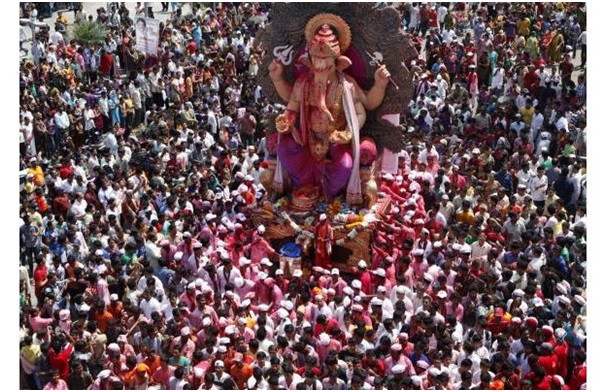
Ganpati is my most favourite festival of all – it is when Lord Ganesha comes into our humble abode and stays with us for 10 days. It is also celebrated in a big way on a common platform – localities have a common idol complete with a theme and decorations. Going from one mandal (locality) to another – mandal-hopping – is a common thing for families in Mumbai and it continues late into the night. However, this seems to be marred somehow with the increasing incidences of eve teasing and molestation against women. In fact, this year the Mumbai Commissioner of Police has asked all the Ganpati mandals to ensure that there is no case of sexual harassment. As the accompanying picture illustrates, there are hardly any women on the last day of the festival – when Lord Ganesha is given a teary farewell by the city and exhorted to come again sooner next year.

While the kind of harassment faced by women during Holi is unique to the festival, the one faced during the other festivals is more to do with the sheer number of people out on the streets. The perpetrators of different acts of harassment simply take advantage of the crowds knowing well that it is next to impossible for them to be caught by the authorities. Also, if a woman does raise her voice, say against inappropriate touching, they can always plead innocence under the guise of there being little space as hundreds of thousands of people have descended onto the streets.

What men, however, fail to realize is that women have as much of a right as them to enjoy each and every part of the festivals that is so intrinsic to our culture. Women should not fear stepping out of their own homes worrying about harassment or molestation. If such acts continue, we would soon have celebrations which would feature only men.

Men need to make these festivals and their celebrations safer for women. If each one of them took a pledge to ensure a harassment-free experience for women at each of these events, it would make a world of difference, and not just to the women!

Pallavi is a qualified Chartered Accountant and a Commerce Graduate from the University of Mumbai, India, with around 12 years of experience working in the corporate sector. Follow her on Twitter, @pallavisms.


Share

Filed Under: correspondents, Stories, street harassment Tagged With: Ganpati, Holi, India

USA: Catcalls as compliments?

September 3, 2013 By Correspondent

By: Taylor Kuether, Minnesota, USA, SSH Blog Correspondent

Glamour magazine is one of my favorite guilty pleasures. Not quite as insipid as Cosmopolitan, nor as unattainable as Vogue, the magazine is a happy medium. When I read things inside its pages I find incongruent with feminist ideals, I can shrug it off – it doesn’t claim to be a feminist magazine, like Bitch or Ms.

So when I gleefully tore into the September issue – the thickest, most important issue of the year – I was startled to find the following on the magazine’s recurring “Hey, It’s OK!” page, usually a collection of quirky things many women do and shouldn’t feel bad about: “If catcalls offend you one day and make you totally happy the next.”

Hey, that’s not ok. If we’re going to fight street harassment, we can’t be “ok” with being objectified as we go about our day. It got me thinking: do women really find catcalls flattering? Do they really take street harassment as a compliment? I posed the question to my female friends and it turns out that, yeah, they do.

One friend confessed that, before she took a women’s studies class in college, she used to feel flattered upon hearing a catcall directed at her. She’d think, “Hey, I guess I look good today.” She described walking to campus, about a six block walk, and hearing everything from wolf whistles to horns honked to words like “slut” tossed at her. As time passed, she said, she went from feeling confident, to feeling bad about “feeling good” about the harassment, to finally feeling downright disgusted.

I appreciate my friend for allowing me to share her story on the blog, because I know she’s not alone. She’s not the only woman in the world who feels good about herself after being catcalled at. The feeling good part isn’t what’s problematic; it’s the source of the validation. That’s what we need to change.

We live in a society that raised us to seek external validation. We were raised to make ourselves attractive to the opposite sex. When we hear that positive reinforcement, be it anything from a friend telling us we look nice to a lewd comment on the sidewalk, we believe we are attractive. In this paradigm, a catcall is praise. A catcall means we’re doing it right.

I say screw that. Make yourself look the way you want to look for YOURSELF. For as long as we feel complimented by catcalls, we are losing the battle. The bigger compliment should be our ability to walk down the street in peace, knowing we’re fabulous and not needing a honk from a passing car to prove it.

Taylor Kuether is a senior journalism student at University of Wisconsin-Eau Claire in northwestern Wisconsin. She has previously written for The Washington Post and Minneapolis’ Star Tribune, worked as a reporter at her city’s daily newspaper, The Leader-Telegram, and its arts and culture publication, VolumeOne, hosted a local-music centered radio show on Wisconsin Public Radio, and worked as Editor-in-Chief at her student newspaper, where she enjoyed writing biting, slightly rant-y columns about feminist issues.

Share

Filed Under: correspondents, Stories, street harassment

Canada: Re-imagining Ottawa

September 2, 2013 By Correspondent

By: Lisane Thirsk, Ottawa, Canada, SSH Correspondent

Credit: Flickr user longzijun

Following a sexual assault near a bus station in Ottawa, our transit company OC Transpo dragged its feet before commenting on the incident. This was exasperating, as repeated assurances by them that our transit system is safe have been ringing hollow to many of us, especially in light of other recent gender-based crimes, as well as these survey results from Hollaback! Ottawa.

The good news is that since the assault, OC Transpo announced a new transit safety plan. However, specific efforts to prevent harassment are still unclear, as is the extent of collaboration we can expect among city officials and the community organizations that have tirelessly advocated around this issue.

In the meantime, I’ve had plenty of time to reflect on what an effective public education campaign against street harassment might look like here in Ottawa.

For those unfamiliar with Canada’s capital, you may be surprised to learn it’s small and relatively tranquil – not the characteristic bustling, overpopulated capital city. It’s the kind of place where I often bump into people I know, even though I haven’t lived here very long.

Ottawa is home to Parliament Hill and civil servants with a reputation for being obedient, conservative government employees. The city is considered “a nice place to raise kids” with vast green areas, good museums, and a lovely tulip festival.

Ottawans are required to have permits to do just about anything. And we’re generally the types to wait for the pedestrian light and cross at crosswalks.

To put it bluntly, we aren’t known for challenging the status quo. (However I happen to know enough local shit-disturbers to assure you the stereotype is far from reality!)

These narratives about Ottawa are in the background when we try to have conversations about street harassment.

It shouldn’t be hard to believe that Ottawa has “big city problems.” After all, street harassment happens everywhere there are streets, including small towns.

Most discouraging is that we are failing each other by remaining passive witnesses of this blatant violence. Many transit riders have reported to Hollaback! Ottawa that when they were harassed on a packed bus, no one bothered to help them.

Sadly, transit riders have also indicated that when facing harassment, they either wouldn’t consider it worthy of pushing the bus’ emergency button or worry about receiving a fine for activating the alarm.

From meetings I’ve attended, I know OC Transpo views this as a problem, as do women’s organizations. That’s why a public education campaign is crucial. And there’s reason to believe that a well-designed one would be effective.

I’ve repeatedly heard about a series of ads on buses featured a number of years ago, known as “Busology,” that many Ottawa residents remember fondly and want to see on buses again. They targeted common transit “incivilities” with messaging like:

Double, double, toil and trouble / Music blares and tempers bubble

O what a tangled web we weave / When by the forward door we leave

Other ads encouraged riders to set their backpacks on the floor to prevent bumping people, and to avoid wearing strong perfumes.

It seems there was a receptive audience for those simple ads discouraging behaviour that imposes on other people’s space and their ability to enjoy a peaceful bus ride.

Stereotypes about polite Canadians aside, it seems that what Ottawans need, far more than Bus Manners 101, is a campaign to identify street harassment and empower bystanders to do something about it.

It’s certainly incredible that riders need to be reminded to practice common courtesies like moving big bags away from doors so people can exit, or respecting Priority Seating areas. But it’s no less important to build a culture where everyday street harassment is not only considered socially unacceptable, but acknowledged as gender violence.

How disgraceful that a bus full of people will watch a man follow a woman from seat to seat or grope her as she tries to escape – and then look away, return to their books, glad it’s not them in that humiliating situation.

In those situations, wouldn’t it be great to see people taking up more room, making more noise? If it’s safe to do so, for example, drop a bag to create a distraction. Move next to the target. Speak up! (Check out these Badass Bystander Moves: direct, distract, delegate).

It’s not that this is unheard of in Ottawa – here’s an example of bystander intervention on the bus a few months ago.

But there’s something about Ottawa’s image that has played a part in delaying action, be it our supposedly “mild-mannered” nature, or our city’s beloved “safe” image.

Could we change our reputation in favour of the anti-street harassment cause? Use that small town feel to hold perpetrators accountable in Ottawa.

We need to dismantle the idea that things don’t need to be shaken up in Ottawa. Because we are not living in a safe city when sexual assaults occur on buses and at transit stops.

We can be that place where people don’t hesitate to take up more room when they witness gender violence. Hopefully city officials will have our backs now in this endeavor.

Lisane works in the non-profit communications sector and supports local anti-street harassment advocacy through Hollaback! Ottawa. In 2012, she completed a Master’s in Socio-Legal Studies at York University in Toronto, where she wrote her Major Research Paper on gender-based street harassment. She holds a B.A. in Latin American Studies and Spanish from the University of British Columbia

Share

Filed Under: correspondents, Stories, street harassment

South Africa: Rape Culture, Victim Blaming and Harassment

August 31, 2013 By Correspondent

By: Gcobani Qambela, South Africa, SSH Correspondent

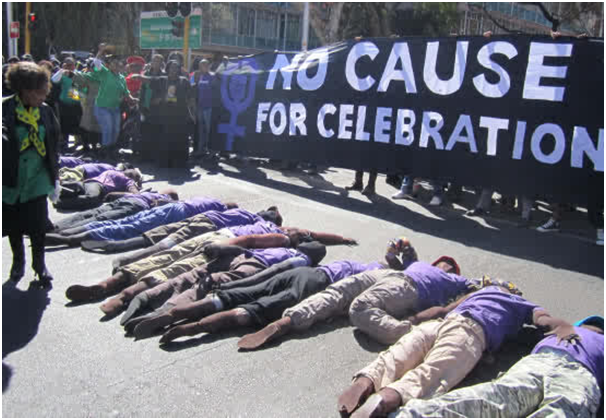
No Cause for Celebration by the 1 in 9 Campaign.

August 2013 was declared “Women’s Month” by the South African government. This is in effort to commemorate the historic march organised by the Federation of South African Women on August 9, 1956, that was attended by over 20,000 women who marched to the Union Buildings in the then apartheid South Africa. The women who came from diverse backgrounds were protesting the extension of “Pass Laws” to women. As they marched, they sang:

Wathint’ abafazi,
Wathint’ imbokodo,
Uza kufa!

[When] you strike the women,
You strike a rock,
You will be crushed [You will die]!

The post-apartheid South African government has since declared the 9th of August “Women’s Day”, an annual public holiday celebrating the courage of these women. Yet, as many have noted, despite the contribution of South African women to the anti-apartheid struggle, many women still have to battle many other oppressions in post-apartheid South Africa. Kamaria Munti for instance notes that “… rape, relationship terrorism and general cultural disparities remain critical issues for South Africa’s women.”

This was no more evident than this month of August ironically dedicated to celebrating women. The secretary-general of the largest trade union in South Africa, the Congress of South African Trade Unions (Cosatu), Zwelinzima Vavi, was accused of rape by a junior employer (who later withdrew the accusations). But what was worrying about this case, is not whether it was true or not, but as TO Molefe shows us, it demonstrated to us the various ways in which rape culture is still woven into the fabric of South African society. Molefe notes for instance that “From the moment the story hit the pages of the weekend newspapers, her claim was treated with doubt and judgement. Pronouncements were made about how and why her actions discredited her claims of sexual harassment and rape, yet no scrutiny was directed at the actions of Vavi and how and why they discredit his claim that he did not sexually harass or rape her.”

What was more disturbing to me is how this showed an element that is still ignored in the South African legal framework. The woman in question was harassed on Twitter with many people tagging and mentioning her in very vile messages which often centred on blaming her for being raped and sexually assaulted. An image that landed on my Twitter feed for instance showed an image of the women with an inscription saying how “who could resist?” raping her if she looked that attractive.

Victim blaming and harassment is not new in South Africa. When our own current President, Jacob Zuma was also accused of rape, there were many reports of victim blaming where the woman in question was called many violently misogynistic names. This, as the Sonke Gender Justice Project notes, happens in a country where the Bill of Rights enshrined in the Constitution proclaims in Section 12, subsection 2, that everyone regardless of gender, race or sexual orientation “has the right to bodily and psychological integrity, which includes the right to security in and control over their bodies”.

These cases the Sonke Gender Justice Project tells us that they teach and remind us that “sexual violence is endemic and that very little is done to stop it [and further that] men’s violence is still explained away by crude victim blaming.” The increasingly accessibility of social media platforms like Twitter, have increased access to victims (especially when they have been named publicly as the case with Vavi) and thus consequently opened a floodgate opportunity for sexism, rape culture, victim blaming and harassment that much easier.

This is made worse by the lack of channels to report (cyber) assaults. Last year I reported for instance on the Twitter misogynistic attack that was levelled again popular South African actress Bonnie Henna on Twitter. Some of my women and (gay) male friends have been harassed online, especially on twitter and told to “go eat a dick” or called “faggots” as a means to silence them online.

As we move into September, leaving behind “Women’s Month”, my hope is that we do not only remember the march of 1956, but that we start realising the vision they had for South Africa. The women marched not just to end systematic racialised oppression, but they marched [amongst others] for the right to own their bodies fully, to have complete freedom of movement free of harassment and full control over their humanity.

If this 2013’s Women’s Month taught us anything as South Africans however, it should be that the sacrifices of those women in 1956 are yet to be fully realised, and they deserve better. They deserve a country where women are not subjected to the harassment, sexism and oppression that they are currently subjected to in South Africa. They deserve much better than this.

Gcobani is completing his Masters in Medical Anthropology through Rhodes University, Grahamstown, South Africa. His research centres around issues of risk, responsibility and vulnerability amongst Xhosa men (and women) in a rural town in South Africa living in the context of HIV/AIDS. Follow him on Twitter, @GcobaniQambela.

Share

Filed Under: correspondents, Stories, street harassment

USA: “My ‘Brother’ Would Respect Me”

August 30, 2013 By Correspondent

By Lauren McEwen, Washington, D.C., USA, SSH Correspondent

I came here today to write about street harassment and race. How it affects me as a black woman, personally. How it distorts the way we speak about street harassment, as a whole. How I feel that my sexuality and freedom of gender expression are circumscribed by forces that I cannot control: history and bigotry and sexism.

The internal conversation that I have with myself each morning: Will this outfit draw too much attention? Can a black girl walk down the street in gym shorts without being harassed at every corner? I think all of these things and then I change into something that will leave less room for comment.

Regardless of how many anti-slut-shaming lectures I give myself, I know that my sexuality is not my own, but is tied to a history of excusing violence against black women and dehumanizing black women by portraying us as innately sexual beings with no feelings, virtue or value.

It’s a legacy that has been passed down since slavery and like many perverse tools of subjugation that were created back then, still affects our everyday.

For this reason, I get furious when I am harassed by black men on the street.

I understand that most street harassment is intra-racial, stemming from a blend of proprietary delusions and a sense of comfort while degrading women with a shared racial heritage. But, as I listened to the speakers in front of the Lincoln Memorial on the 50th anniversary of the March on Washington, as I feel these feelings of camaraderie and hope with people who share “my struggle,” it  reinforces old feelings of disappointment and anger that I feel each time I am harassed by a black man.

I expect better from them, and I cannot shake it. As potential victims of racial profiling and police harassment, I expect black men to be cognizant of what it feels like to be unable to walk down the street without fear, or worrying about the way your appearance or body language may be perceived.

That was why this tweet from @brokeymcpoverty, during the height of the #BlackPowerisforBlackMen hashtag’s popularity rang so true that I must print it here: “#BlackPowerIsForBlackMen because when i explain not wanting to be bothered on the street, im accused of misandry/conceit/rudeness.”

That entire trending topic spoke to the myriad of ways that women have been silenced by black men in the Black Power Movement. From women standing on stage with Dr. King 50 years ago in silence, to far too many black men refusing to acknowledge black women’s problems, while expecting us to stand behind them when called.

And yet, when Stop and Frisk was finally ruled unconstitutional, I cheered along with many others. I had spent months retweeting articles about the NYPD’s discriminatory program, tapping my touchscreen violently in outrage. I shed tears watching YouTube documentaries about the effect Stop and Frisk had on black and brown men, and how police officers were forced to harass these young men in order to stay in good standing at work.

But I have literally had a black man tell me that I “don’t love” myself because I am bothered by street harassment. A strong black woman isn’t easily bothered by constant threats and leers and groping from strangers, apparently.

That hashtag, no matter how firmly rooted in truth, was called “divisive” by some loud voices. I started seeing women friends of mine, tweeting how they love black men and disagree with everything that is being said. Others began to argue that the conversation “took away” from what we are trying to accomplish as a race. That we should continue to ignore sexism in the black community just like we should ignore racism in the feminist movement.

It directly parallels the guilt trip that I have had harassers try to employ when I refuse their advances. I am sometimes accused of “being afraid of brothers,” not being attracted to black men out of some fault of my own – usually, because I am a light-skinned snob. It’s frustrating because the black community became insular out of necessity, and in my mind, using that background to justify harassing black women perverts that history. Pet names like, brother, sister, queen and king were meant to build a sort of fellowship, and now that is distorted to place the blame on me when I am turned off by street harassment.

I expect more from black men because their sexuality has had limitations placed on it by racism, as well. The oversexed man of color is the boogeyman in too many articles that I have read about street harassment. I cannot tell you how many times I have come across comment section standoffs where women of all races swear up and down that they are harassed by men of color at disproportionate rates, unaware of how strongly their comments echo assumptions made about black male sexuality from the Nadir of American Race Relations.

Studies and my own personal experiences (I tend to be harassed by black men more frequently, but not exclusively.) tell me that that is not true, but perception and reality are two separate animals.

Some feminists who have studied street harassment argue that mistreating women is one of the only spoils of patriarchy in which black men can engage. That may be true. But it does not stop me from shaking my head in disappointment every time I’m accosted by a black, male harasser.

Am I being unrealistic? Maybe. But I have also been told that it’s foolish to dream of a day where gendered harassment in public is no longer the norm. And yet, here we all are.

Lauren is a recent graduate of Howard University where she majored in print journalism with a minor in photography. You can check out more of her work at laurenmcewen.weebly.com and follow her on Twitter at @angrywritergirl.

Share

Filed Under: correspondents, Stories, street harassment

« Previous Page
Next Page »

Share Your Story

Share your street harassment story for the blog. Donate Now

From the Blog

  • #MeToo 2024 Study Released Today
  • Join International Anti-Street Harassment Week 2022
  • Giving Tuesday – Fund the Hotline
  • Thank You – International Anti-Street Harassment Week 2021
  • Share Your Story – Safecity and Catcalls Collaboration

Buy the Book

  • Contact
  • Events
  • Join Us
  • Donate
  • Facebook
  • Instagram
  • Pinterest
  • Tumblr
  • Twitter
  • YouTube

Copyright © 2026 Stop Street Harassment · Website Design by Sarah Marie Lacy