• About Us
    • What Is Street Harassment?
    • Why Stopping Street Harassment Matters
    • Meet the Team
      • Board of Directors
      • Past Board Members
    • In The Media
  • Our Work
    • National Street Harassment Hotline
    • International Anti-Street Harassment Week
    • Blog Correspondents
      • Past SSH Correspondents
    • Safe Public Spaces Mentoring Program
    • Publications
    • National Studies
    • Campaigns against Companies
    • Washington, D.C. Activism
  • Our Books
  • Donate
  • Store

Stop Street Harassment

Making Public Spaces Safe and Welcoming

  • Facebook
  • Instagram
  • Pinterest
  • Tumblr
  • Twitter
  • YouTube
  • Home
  • Blog
    • Harassment Stories
    • Blog Correspondents
    • Street Respect Stories
  • Help & Advice
    • National Street Harassment Hotline
    • Dealing With Harassers
      • Assertive Responses
      • Reporting Harassers
      • Bystander Responses
      • Creative Responses
    • What to Do Before or After Harassment
    • Street Harassment and the Law
  • Resources
    • Definitions
    • Statistics
    • Articles & Books
    • Anti-Harassment Groups & Campaigns
    • Male Allies
      • Educating Boys & Men
      • How to Talk to Women
      • Bystander Tips
    • Video Clips
    • Images & Flyers
  • Take Community Action
  • Contact

“That Stuff Actually Happens?”

January 25, 2014 By SSHIntern

Earlier this week, I explained my internship with Stop Street Harassment to a male friend. He immediately asked me, “What is street harassment?” I explained that it can include, but is not limited to, honks, whistles, crude comments, uncomfortable leering, or even unwanted physical contact. I expected some sort of heartfelt response. Instead, he surprised me by asking, “So that stuff actually happens?”At first I was mildly annoyed because I assumed that he was being condescending. However, as the conversation continued, I came to a sudden realization: he had no idea what I was talking about.

This was not the first time that I’ve had to explain what street harassment is to a man. However, it took me until this conversation to realize why men do not understand it. Aside from individuals in the LGBQT community, women are experiencing the majority of street harassment. Harassment in public spaces is simply not an obstacle that the average man has to face in his daily life. For that reason alone, I cannot expect every man to fully understand how often this harassment occurs or the humiliation that accompanies it.

I still keep finding myself returning to that guy’s question, “So that stuff actually happens?” It makes me recall how I reacted to my own experiences with street harassment. After an incident, I would confide in either my sister, my mom, or my female friends. Never once did I approach my dad, boyfriend, brother-in-law, or male friends about what I had experienced. For some reason, I only found myself sharing these stories in hushed tones among other women. I did this partially because I knew that the women around me had similar experiences. It was cathartic to vent with them about the jerks that whistled and yelled. I also did this because I never wanted to make the men in my life worry about my safety. Perhaps this is another reason why some men remain blissfully unaware of street harassment. It’s possible that we’re keeping them out the loop.

For the benefit of everyone, we must break free from our inhibitions. We need to bring harassment out from hushed female circles, instead sharing with all loved ones, both women and men. Ladies, if you have a brush with street harassment, consider sharing your experience with a man. Let him know that it happens. Let him know that it is degrading, intolerable, and terrifying. You will be doing him a favor by letting him relate to the women in his life that much more. It doesn’t matter if he is your father, brother, son, boyfriend, husband, friend, or a kind stranger. Whoever he is, your encounter with harassment will enlighten him.

Yes, some men out there are jerks who contribute to the problem, but always remember that there are an even greater number of wonderful male allies that are part of the solution, as well. Unless you tell them, the men in your life will not know that someone they care about has experienced street harassment. Just give them a chance to help you fight back.

Kendra Corbin is senior at Shenandoah University. She is majoring in Mass Communications and minoring in Women’s Studies.

Share

Filed Under: male perspective, street harassment

Digest of Street Harassment News: January 20, 2014

January 20, 2014 By SSHIntern

** Sign up to receive a monthly news e-newsletter from Stop Street Harassment **

Street Harassment Stories:

Share your story! You can read street harassment stories on the Web at:

Stop Street Harassment Blog

Bijoya in Bangladesh

Collective Action for Safe Spaces

The Hollaback sites

Ramallah Street Watch in Palestine

Resist Harassment in Lebanon

Safe City India

Safe Streets in Yemen

Street Harassment in South Africa

Street Harassment In the News, on the Blogs:

* Hollaback, “Week In Our Shores: Getting the Word Out Edition!”

* Hindustan Times, “Street art takes on sexual harassment”

* Al-Monitor, “Sexual harassment in Egypt still widespread”

* Authint Mail, “In Kasmir, parents of victim girls seek punishment for “drunk” eve-teasers”

* The New Indian Express, “Were You Asking to be Eve-teased in That Dress?”

* EurasiaNet, “More Reflections on Azerbaijan: When Will the Catcalls Stop?”

* RH Reality Check, “PSA Raises Awareness of Street Harassment in Egypt”

* CBC News, “Sexual harassment on the rise on transit, say police”

* Greater Greater Washington, “Raising awareness can curb street harassment”

* Jezebel, “Philly Has a Street Harasser Who Drapes His Dick in Swiss Cheese”

* Huffington Post, “Here’s The Best Way To Holler At A Woman On The Street”

* Hollaback, “Street Harassment and Internet Harassment: One and the Same?“

Announcements:

* We’re collecting stories about the street harassment of LGBQTAI people for a new web section — please consider sharing yours, if relevant!

* Meet SSH’s newest board member, Patrick Ryne McNeil, who specializes in the street harassment of gay and bisexual men.

* Welcome SSH’s spring intern Kendra Corbin!

* SSH’s first Blog Correspondents cohort of 2014 launched this month. They will write monthly articles through April.

10 Tweets from the Week:

* @Dontharassmebro “Hey mama, why are you angry? You’re beautiful. How about a smile?” 1. Not your mom. 2. No one asked your opinion. 3. No. #streetharassment

* @itnlpolitical “Ohh, I really want to marry that guy that whistled to me from his car!” .. said no girl ever. #streetharassment

* @sadiasmusings #lifeofamuslimfeminist #streetharassment listening to drunk white men catcall me as Muslim men on the side do nothing

* @rrachaelrae @EverydaySexism walking with boyfriend wearing shorts and a t-shirt, guy driving past yells at me “SLUT!” #everydaysexism #streetharassment

* @Sharon_Haywood when I askd my harasser if he was talking to me he said no-after getting over the shock that I actually have a voice

* @hollabackmumbai I was walking with my dad & a guy casually walks past us & knocks his elbows on my breasts #stories #harassment #endSH

* @msbrandiebrown Wish I was paying attention and said/did something 🙁 #EndSH #MBTAcreeps

* @maria_delrio I’ve just been catcalled in Catalan. It is still not ok. No matter the language you use, its discomforting and intrusive #EndSH

* @RSwirling Obviously we’re all obliged to listen to #streetharassment too – it’s their free speech rights to call me a whore all day

* @manda4444 Catcalling and street harassment is just that–harassment. Telling someone to take it as a compliment is ignorant and degrading.

Share

Filed Under: News stories, Resources, street harassment

A Message to Street Harassers

January 20, 2014 By SSHIntern

By Kendra Corbin, SSH Intern

Via Hollaback!

As a young woman, I’ve experienced my fair share of street harassment. I’ve been dealing with it for most of my life. For a long time, I tried to blow off the whistles and “hey baby” comments as just part of being a woman. Now I know better. Despite the lackluster belief that “it’s not a big deal,” it IS a terrifyingly big deal.

My most frightening experience happened when I was only 13-years-old. My older sister was 16 at the time. She had offered to drive my friend and I home late at night. We accidentally locked ourselves out of the car in an empty parking lot. As we waited for my parents, a group of men in a truck began to drive around us in circles while they honked, whistled, and laughed. Frightened and alone, we huddled together while we waited for them to lose interest and leave.

In retrospect, it disgusts me that those men found amusement in harassing terrified children. I also find myself growing angry, but I become angrier because I recognize that my experience is not uncommon. Street harassment is a subject that most women can relate to because they’ve experienced it themselves. Whenever I bring the subject up with friends or acquaintances, the conversation seems to flood with stories that all begin with, “Well, this one time…” In honor of these stories that have been shared with me, I would like to acknowledge just a few of the harassers that either I or my loved ones have encountered.

The man that yelled, “I didn’t know they made tits that big” to me as I walked to class, then demanded that I show him that “cherry pie under there.”

The man that tried to yank up my friend’s skirt while she was visiting DC.

The man that leered at my sister, then commented on her “nice ass legs.”

The boy on my school bus who was dared to grope my breasts when I was 14 (who was not successful because I promptly shoved back into his seat).

The man that slapped my friend’s behind as she walked to the beach.

The group of men that thought it would be hilarious to pretend to masturbate as they drove by sister.

The young men that held a sign on the highway to my mother and other female drivers that read, “Show us your hooters.”

And finally, that very first man that honked and whistled at me when I was only 11-years-old.

To all of these harassers and the many others out there, we have a clear message: We are not required compliment your male ego. Your advances are not welcomed. Your words are not flattering. Your behavior is intolerable.

To every woman that has had her day interrupted by rude comments, uncomfortable gazes, unwanted touching, or any other form street harassment, you are not alone. Familiarize yourself with ways to respond to street harassers. You’ll thank yourself for it later when you’re prepared with a witty response for someone’s barbaric behavior.

Please share your story.

Kendra Corbin is senior at Shenandoah University. She is majoring in Mass Communications and minoring in Women’s Studies.

Share

Filed Under: SSH programs, Stories, street harassment

If Beyonce Isn’t Safe, Is Any Woman Safe?

January 18, 2014 By SSHIntern

In the midst of Beyonce’s album release, through all of the fanatic and media frenzy, one thing stuck out to me in her visual album: Harassment.

It ranged from being followed or harassed by fans when trying to take a walk and clear her mind, as seen in “Jealous” to the more abrasive, familiar form of harassment in “Blow”: being pulled forcefully by a male aggressor when walking.

This is the form of harassment that I’m most familiar with. Catcalls are definitely one form, but I’m often grabbed and pulled off my path, whether I’m walking down the street, through the transit center, or in a hallway.

This scene, less than five seconds of the video, was left unaddressed and hardly served as a major plot point. So I couldn’t help but wonder why she included it. Was it real and unprompted? Or was it so commonplace to her, the way it is to me, that there was nothing to say about it. That’s it’s just what happens?

I then remembered her having her butt slapped by a male audience member recently during her world tour. I wondered if that was related.

While she received both praise and criticism for how she responded in the moment, I wondered if and how this affected her relationship with her fans. She has been known to create intimate venues, or to get close enough to shake hands, touch shoulders or share the microphone. Did being groped while trying to create intimate entertainment impact her willingness to do this?

Yes, five seconds in a video left me with all of these questions: questions about authenticity, harassment, and traumatic experiences. But that five seconds also left me with arguably the biggest question of all:

If someone of her status and power gets groped and harassed, is anyone safe?

Rickelle Mason was the Stop Street Harassment intern in fall 2013. She is an undergraduate senior at the University of North Carolina at Charlotte. With a major in Psychology and a minor in Women’s and Gender Studies, she has a passion for feminist psychology, and using community-based participatory research to dismantle gender-based violence. She has worked for several years in the university’s Community Psychology Research Lab, which was recently the recipient of the “Outstanding Training in Community Psychology” International Award.

Share

Filed Under: street harassment

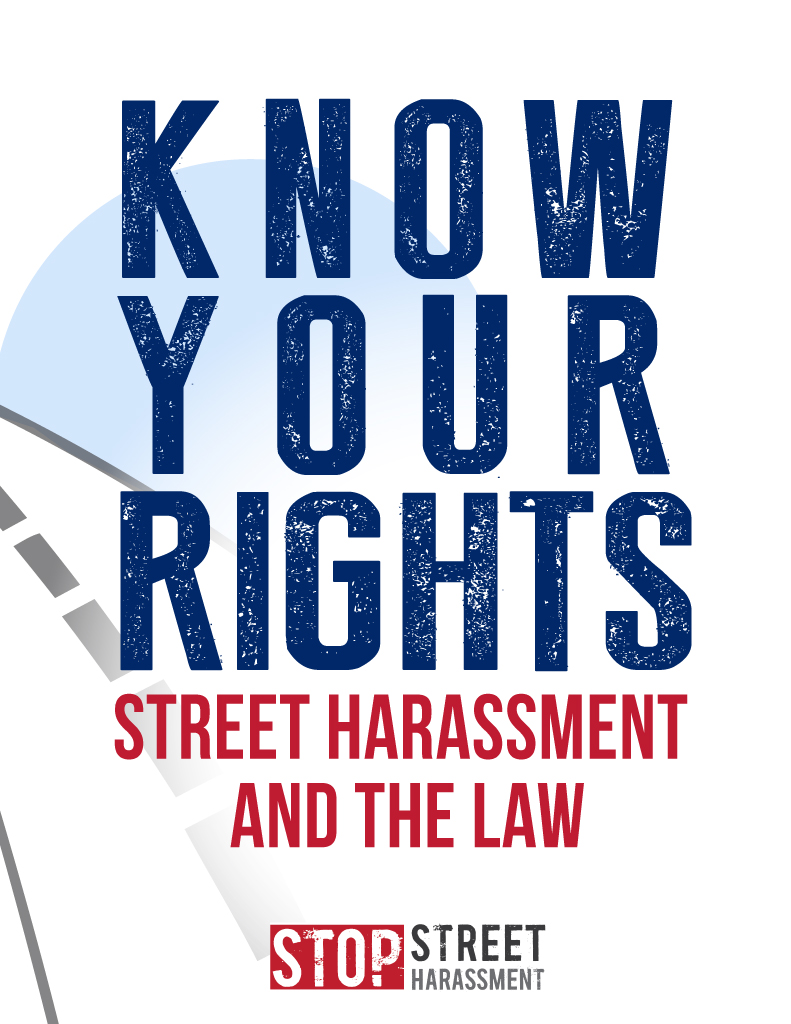
Know Your Rights: Street Harassment and the Law

December 10, 2013 By SSHIntern

Stop Street Harassment is pleased to announce the release of our newest publication and online resource Know Your Rights: Street Harassment and the Law.

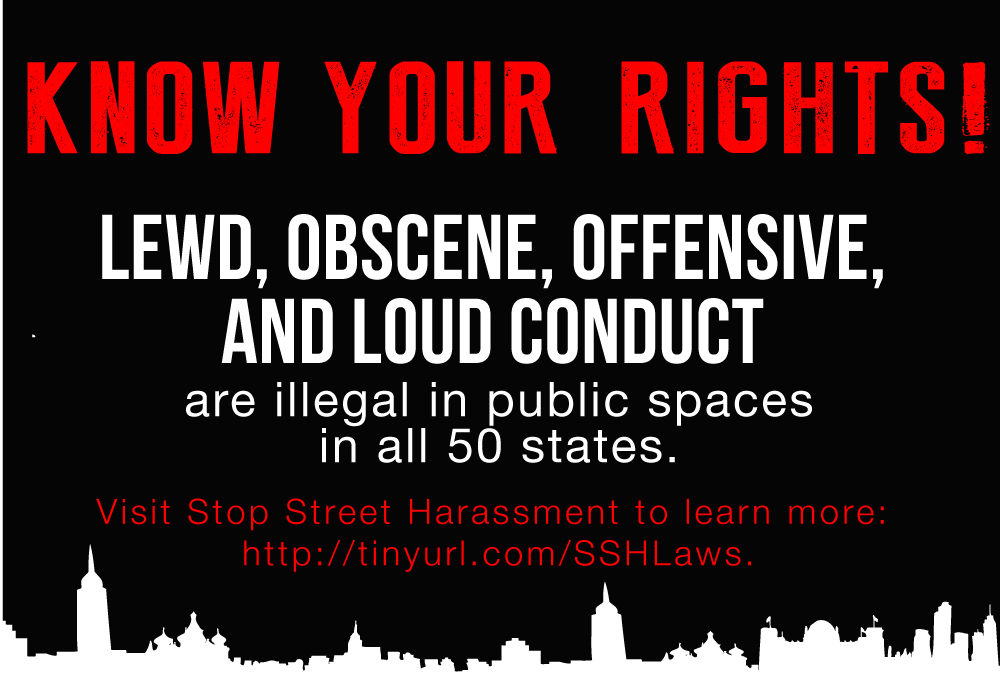
We’ve spent the summer and fall surveying the laws in all 50 U.S. states and D.C. and we have good news: many common street harassment behaviors (such as groping, indecent exposure, and up-skirt photos) are illegal across the U.S. That means you can report street harassment to the police and hold a street harasser legally accountable for his or her actions (when you feel that’s appropriate).

Street harassment is not specifically criminalized the way sexual harassment in the workplace and schools is. However, state laws like Disorderly Conduct, Invasion of Privacy, and Sexual Misconduct prohibit many common street harassment behaviors. Each state has their own set of rules about public behavior and sexual harassment, so we’ve laid out what the relevant crimes are called in each state’s code and let you know exactly what’s legal and what isn’t.

As of today – Human Rights Day – you can find all of this information online or you can download a PDF of the complete toolkit.

We think the Know Your Rights toolkit is a ground-breaking project in the fight against street harassment because, for the first time, all of the state-level criminal law that could be used to stop street harassment has been compiled, analyzed, and made accessible to anyone who needs them. In a society that says street harassment is a compliment, we want you to be able to say, “No, it’s disorderly conduct.”

We hope you will use this information to exercise your right to protection from the police when you experience illegal street harassment and to encourage your local lawmakers to further protect women, people of color, and members of the LGBTQ community in public spaces.

Of course, we know that reporting harassment to the police or criminalizing harassment are not the only ways to end street harassment. In some cases, these may not even be the best ways. Criminalizing behavior can be problematic when laws are disproportionately applied to low-income communities and communities of color. With that in mind, Stop Street Harassment encourages you to engage with your local law enforcement to ensure the law is always applied fairly and that your community handles street harassment in the most constructive way possible. We endeavor to provide you with information so that you can advocate for your rights to safe public spaces and to the other freedoms you are entitled to under the law, such as due process.

As we’ve said before, there is no best way to deal with street harassment – every person and situation differs. Ending street harassment for good will require a multi-pronged approach, including education, awareness campaigns, and engaging the legal system. If a street harasser does commit a crime against you, we want to equip you to make an informed decision. Armed with that knowledge, you can then decide whether or not to report harassers to law enforcement, especially for crimes like up-skirt photos, public masturbation, stalking, and groping.

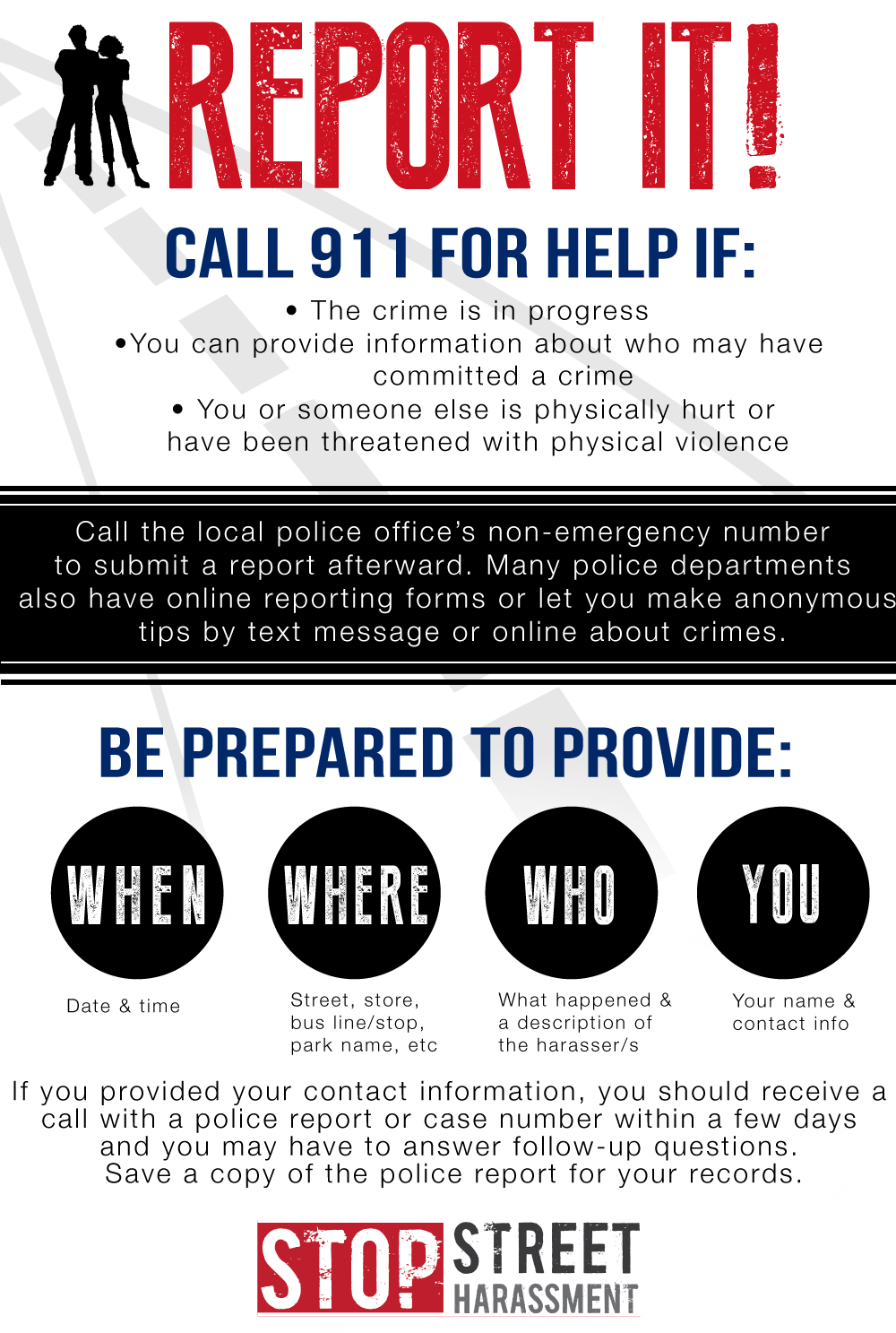
Take a look at your state’s section of the toolkit to get an idea of the kinds of street harassment that are illegal – or to report a crime that has already happened. You’ll also find useful information in the Introduction, including what to expect when you report street harassment and how to deal with harassment from police officers themselves.

Finally, we’d like to add one important takeaway from our work on the project: in speaking with several police officers around the country, we learned that you can engage a police officer or call 911 any time you feel threatened, even before a crime has been committed. This seems obvious in retrospect, but 75% of women report they have been followed and yet few report it to the police. If you think someone is following you, or you feel otherwise scared, intimidated, or threatened, you have the right to help from the police.

They say knowledge is power, friends, so here’s a nation’s worth.

Have you reported street harassment to the police? What happened? What did you learn about your local laws from our toolkit? How do you plan to use this knowledge? Share your story in the comments

Talia Hagerty has been an intern with Stop Street Harassment since June 2013. She is also a peace economics consultant working on a variety of projects that ensure the equitable economic participation of all. She holds a B.A. in Economics from Eckerd College and an M.S. in Global Affairs with a concentration in Peacebuilding from New York University. Talia blogs about peacebuilding, human rights, economic development, and witty responses to street harassment. Follow her on Twitter: @taliahagerty.

Share

Filed Under: Resources, SSH programs, street harassment

« Previous Page
Next Page »

Share Your Story

Share your street harassment story for the blog. Donate Now

From the Blog

  • #MeToo 2024 Study Released Today
  • Join International Anti-Street Harassment Week 2022
  • Giving Tuesday – Fund the Hotline
  • Thank You – International Anti-Street Harassment Week 2021
  • Share Your Story – Safecity and Catcalls Collaboration

Buy the Book

  • Contact
  • Events
  • Join Us
  • Donate
  • Facebook
  • Instagram
  • Pinterest
  • Tumblr
  • Twitter
  • YouTube

Copyright © 2026 Stop Street Harassment · Website Design by Sarah Marie Lacy